Food and Electrolytes
Electrolytes in Food: Where Sodium, Potassium and Magnesium Come From
Which everyday foods carry each electrolyte, how much you need, and a day of meals that adds them up.
 By the Glubbo Editorial Team · Updated Oct 19, 2026 · 11 min read
Short answer
Everyday food already carries all four main electrolytes.
- Potassium: lentils hold 731 mg a cup, a baked potato 610 mg, a banana 422 mg.
- Magnesium: pumpkin seeds 156 mg an ounce; calcium: plain yogurt 415 mg per 8 oz.
- Sodium is the one most people overdo: about 3,400 mg a day against a 2,300 mg limit.
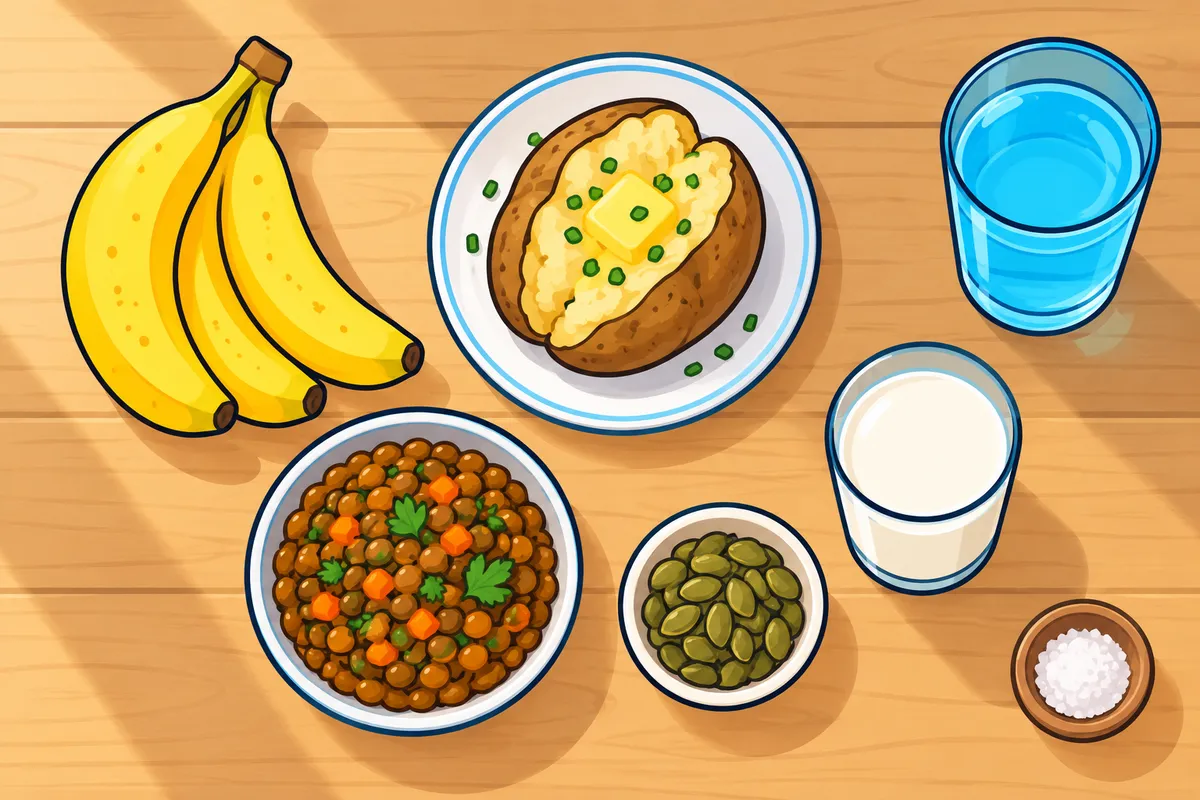
Sodium comes mostly from packaged food and salt, potassium from beans, potatoes, fruit and milk, magnesium from seeds, nuts and whole grains, and calcium from dairy, tofu and fortified drinks. One varied day of meals meets the potassium, magnesium and calcium targets, while most Americans already eat more sodium than the 2,300 mg limit.
Electrolytes sound like something you buy in a sachet, yet most reach you on a plate: the salt in your bread, the potassium in a baked potato, the calcium in a pot of yogurt.
What Are the Main Electrolytes?
Electrolytes are minerals in your blood and body fluids that carry an electric charge. MedlinePlus names six common ones: sodium, potassium, calcium, magnesium, chloride and phosphorus. They help set how much water your body holds, keep your blood at the right acidity and let your nerves and muscles work.
The six common electrolytes
6 items- Sodium, mostly from salt
- Potassium, in fruit, vegetables, beans and milk
- Calcium, in dairy and fortified foods
- Magnesium, in seeds, nuts, beans and whole grains
- Chloride, which travels with sodium in table salt
- Phosphorus
Chloride rides along with sodium, because table salt is sodium chloride. Phosphorus needs no chasing: the NIH says most Americans eat more than the 700 mg adult RDA, with dairy supplying about 20 % of it and bakery products 10 %, and phosphate additives in processed food add 300 to 1,000 mg more. So the rest of this page follows the four you can steer with your food choices: sodium, potassium, magnesium and calcium.
What Foods Are High in Electrolytes?
Beans, potatoes, dried fruit, seeds, nuts, dairy and leafy greens carry the most potassium, magnesium and calcium, while salt and packaged food carry the sodium. The NIH Office of Dietary Supplements lists the milligrams per serving for each mineral, and the four cards below sum up what those tables show.
Four electrolytes, where they come from
Sodium
Easy to overdo
- Under 2,300 mg a day
- Over 70 % from packaged food
- 1 teaspoon of salt is about 2,300 mg
Suits you if you cook at home and read labels on bread, soup and snacks.
Potassium
Most people fall short
- 2,600 mg women, 3,400 mg men
- Lentils, 1 cup: 731 mg
- Banana, 1 medium: 422 mg
Suits you if you can add a bean, potato or fruit dish to most meals.
Magnesium
Seeds and whole grains
- 310 to 420 mg, by age and sex
- Pumpkin seeds, 1 oz: 156 mg
- Spinach, ½ cup boiled: 78 mg
Suits you if you snack on nuts or seeds and choose brown over white rice.
Calcium
Dairy or fortified
- 1,000 to 1,200 mg, by age and sex
- Plain yogurt, 8 oz: 415 mg
- Fortified soymilk, 1 cup: 299 mg
Suits you if you eat dairy, or buy plant milks and tofu made with calcium.
Sodium
You rarely have to look for sodium. The FDA says more than 70 % of the sodium Americans eat comes from packaged and prepared foods, and its sodium page lists deli meat sandwiches, pizza, burritos and tacos, soups and savory snacks among the foods that bring about 40 % of it.
None of them tastes salty enough to warn you. In USDA data:
- A cup of canned chicken noodle soup holds 831 mg of sodium.
- An ounce of cheddar holds 185 mg.
- A slice of white bread holds 142 mg.
- A tablespoon of ketchup holds 154 mg.
The limit is less than 2,300 mg a day, about one teaspoon of table salt, for everyone 14 and older in the Dietary Guidelines for Americans, 2025–2030. Reading a label gets easier once you know that 1 g of salt carries about 400 mg of sodium.
Potassium
Potassium hides in plain foods, and the banana is not the richest of them: dried apricots, lentils and a baked potato all hold more than a banana's 422 mg. Eaten with the skin, a medium baked potato holds 926 mg.
The targets are 2,600 mg a day for women and 3,400 mg for men aged 19 and older, from the NIH potassium fact sheet. Milk, coffee, tea and potatoes are the top potassium sources for US adults, which makes your drinks part of the answer. The full ranking in milligrams also shows who should eat less of it: some people with kidney disease need less potassium, not more.
Magnesium
Seeds and nuts lead the magnesium list, then beans, leafy greens and whole grains. Refining grain strips much of it out, so brown rice carries four times the magnesium of white rice in the NIH table.
The magnesium targets are 310 to 320 mg for women and 400 to 420 mg for men, depending on age, in the NIH magnesium fact sheet. One ounce of pumpkin seeds covers about half of a woman's day, and food never counts toward the 350 mg cap that applies to magnesium pills.
Calcium
Dairy brings about 72 % of the calcium Americans eat, per the NIH calcium fact sheet. A cup of nonfat milk holds 299 mg and 8 oz of plain low-fat yogurt 415 mg. Without dairy, the best sources are fortified drinks, tofu made with calcium sulfate and canned fish eaten with the bones.
Spinach looks good on paper and does less in practice. The same fact sheet says your body takes up only 5 % of the calcium in spinach, against 27 % from milk, because spinach also holds oxalic acid.
Milk and yogurt
- Nonfat milk, 1 cup: 299 mg
- Plain low-fat yogurt, 8 oz: 415 mg
- About 27 % absorbed from milk
Boiled spinach
- ½ cup: 123 mg on the label
- Only about 5 % absorbed
- Oxalic acid holds the rest back
The targets are 1,000 mg a day for adults 19 to 50, rising to 1,200 mg for women over 50 and everyone over 70. Kale, broccoli and bok choy have no oxalic acid problem, so their smaller amounts count in full.
More is not better from pills: the NIH caps calcium at 2,500 mg a day up to age 50 and 2,000 mg after, and high blood calcium can make you lose fluid.
Can You Get Enough Electrolytes From Food?
Yes for sodium, often not for the other three. Most Americans eat more sodium than the limit, but large shares eat less potassium, magnesium and calcium than they need.
The gap comes from the food choices, because the foods that carry these minerals are ordinary groceries.
A daily electrolyte mix with 1,000 mg of sodium adds to that surplus, and whether electrolytes every day make sense depends on how much you sweat.
- 3,400 mg
- sodium on an average American day, against a 2,300 mg limit
- 48 %
- of Americans get less magnesium from food than they need
- 39 %
- of Americans aged 4 and over get less calcium than they need
Potassium shows the same pattern. US men aged 20 and older average 3,016 mg a day from food and women 2,320 mg, the NIH reports, so both sit a few hundred milligrams under their targets. One extra potato, bean or fruit serving a day closes most of that gap.
The magnesium figure counts people below the Estimated Average Requirement from food and drinks, in survey data from 2013 to 2016. The calcium figure counts food and supplements together, so the shortfall from food alone is larger still.
One Day of Meals, Added Up
Here is one ordinary day built from the NIH tables, so you can see how far plain food goes. The figures are the tables' own servings; a dash means that table does not list the food, so the totals run a little low.
| Meal | Food | Potassium | Magnesium | Calcium |
|---|---|---|---|---|
| Breakfast | Calcium-fortified orange juice, 1 cup | 496 mg | — | 349 mg |
| Breakfast | Banana, 1 medium | 422 mg | 32 mg | — |
| Lunch | Whole-wheat bread, 2 slices | 162 mg | 46 mg | 60 mg |
| Lunch | Canned kidney beans, 1 cup | 607 mg | 70 mg | — |
| Snack | Cashews, 1 oz | 187 mg | 74 mg | — |
| Snack | Plain low-fat yogurt, 8 oz | — | 42 mg | 415 mg |
| Dinner | Farmed Atlantic salmon, 3 oz | 326 mg | 26 mg | — |
| Dinner | Brown rice, 1 cup | 154 mg | 84 mg | — |
| Dinner | Calcium-fortified soymilk, 1 cup | 287 mg | 61 mg | 299 mg |
| Day total | 2,641 mg | 435 mg | 1,123 mg |

The sodium column is missing on purpose. Your sodium depends on how much salt you add and which bread, cheese and sauces you buy, so it comes from your own labels, not from a table.
What Drinks Have Natural Electrolytes?
Milk, orange juice, tomato juice and coconut water, and each leads with a different mineral:
- Milk brings calcium.
- Orange juice and coconut water bring potassium.
- Salted tomato juice brings a serious dose of sodium.
A sports drink holds more sodium than orange juice or coconut water, yet less potassium and calcium than all four.
| Drink, 1 cup (8 fl oz, USDA) | Sodium | Potassium | Magnesium | Calcium |
|---|---|---|---|---|
| Milk, 1 % | 107 mg | 366 mg | 27 mg | 305 mg |
| Orange juice | 2 mg | 496 mg | 27 mg | 27 mg |
| Coconut water, unsweetened | 64 mg | 404 mg | 15 mg | 17 mg |
| Tomato juice, no salt added | 24 mg | 527 mg | 27 mg | 24 mg |
| Tomato juice, with salt | 615 mg | 527 mg | 27 mg | 24 mg |
| Sports drink, lemon-lime | 102 mg | 44 mg | 0 mg | 2 mg |
The sports drink's one job is sodium and sugar during long sweaty exercise. For a normal day, a glass of milk or juice covers more of the minerals people fall short on.
Does Plain Water Have Electrolytes?
Not in useful amounts. MedlinePlus says that "water alone does not contain a significant amount of electrolytes", which is why the minerals have to come from food or from drinks that contain them.
Magnesium is the partial exception, because the NIH says tap, mineral and bottled waters range from 1 to over 120 mg of magnesium a liter, depending on the source and brand.
Food also counts toward your fluid, and a wedge of watermelon or a sliced cucumber adds to your day's water. That water also fills a plate for very few calories.
A whole cucumber alone holds about 287 g of water, roughly 1.2 cups.
Do You Need More Electrolytes When You Sweat?
Sometimes, and sodium is the one that matters. The Dietary Guidelines say that "highly active individuals may benefit from increased sodium intake to offset sweat losses", while the NIH notes that only a very small amount of potassium leaves in sweat. On a normal day, a normal salty meal after a workout replaces what a short session took.
For sessions over an hour, long hot days and what a sports drink should hold, whether your training calls for electrolytes at all depends on how long and how hard you sweat.

What you eat after training also refills your water. A meal brings its own salt and minerals, and with them your body keeps more of the water you drink afterwards. If you train for over an hour on hot days, plan a salty meal for the hour after you finish.
A dill pickle fits that plan: one large pickle adds about 1,092 mg of sodium, though very little water.
A cup of milk does double work here. It counts toward your fluid and brings 366 mg of potassium and close to 300 mg of calcium in the NIH tables, which a sports drink does not. A sports drink brings sugar instead: a cup of lemon-lime Powerade holds 14.9 g, more than the 10 g of added sugar the Dietary Guidelines allow in a whole meal.
Who Should Be Careful With Electrolyte-Rich Foods?
People whose kidneys or medicines change how they clear potassium. The NIH says the potassium targets "do not apply to individuals with impaired potassium excretion", and that people with chronic kidney disease, or who take ACE inhibitors or potassium-sparing diuretics, can get too much potassium even from food below the target.
If none of that applies, the foods on this page are everyday groceries. Your kidneys clear what you do not need.
Pick Your Electrolyte Foods by What You Need
The best food depends on which mineral your meals are short of. Use the pick that matches your week.
If this is you, start here
- You rarely eat beans or potatoesA cup of lentils or a baked potato, 600 to 730 mg of potassium
- You skip dairyFortified soymilk or tofu made with calcium sulfate
- You eat white rice and white breadBrown rice, whole-wheat bread and a handful of seeds
- Most of your lunches come in a packetCook one more meal at home to cut the sodium
- You train hard for over an hour in the heatA salty meal afterwards, plus the sports-drink check
A Plate Built Around Four Minerals
- Add one potassium food to each meal: a banana at breakfast, beans at lunch, a potato at dinner.
- Keep a small bag of pumpkin seeds or cashews for the afternoon snack.
- Have one dairy or calcium-fortified drink or pot of yogurt a day.
- Read the sodium line on your bread, soup and snacks, and aim to stay under 2,300 mg.
- Ask a doctor first if you have kidney disease or take a medicine that affects potassium.
General information for healthy adults, not medical advice. If a doctor has set your fluid amount, follow that.
All Guides in Food and Electrolytes
Every guide, A to ZWater in Food 5 guides
About a fifth of your water comes from food. These guides give the measured water content of the foods people ask about and what it means for your day.
Water in Food page High Water Foods for Weight Loss: More Food for Fewer Calories
 Do Pickles Help With Dehydration? The Water and Salt in One Pickle
 Cucumber Water Content: How Much Water One Cucumber Gives You
 Banana Water Content: Are Bananas Good for Dehydration?
 Is Watermelon Hydrating? Water, Potassium and Sugar per Slice
Electrolytes and Minerals 8 guides
Most of the salt and minerals you lose in sweat come back with your next meal. These guides give the daily amounts from the public bodies and the foods that supply them, milligram by milligram.
Electrolytes and Minerals page How Much Sodium Per Day: Limits, Teaspoons of Salt and Label Numbers
 Foods High in Potassium, Ranked by Milligrams per Serving
 How Much Magnesium Per Day, by Age, From Food and Supplements
 Does Pickle Juice Help Muscle Cramps? What the Lab Trials Found
 Potassium for Dehydration: When You Need It and When Water Is Enough
 Magnesium and Dehydration: Does Magnesium Help You Rehydrate?
 Can High Calcium Cause Dehydration? How Blood Calcium and Fluid Link
 How Much Electrolytes per Day Is Safe? The Limit for Each Mineral
Sugar and Calories in Drinks 5 guides
A sweet drink can use up most of a day's added sugar before lunch. These guides give the daily limits from the public bodies and the grams in the drinks and foods people ask about, read from the label data.
Sugar and Calories in Drinks page How Much Added Sugar Per Day, in Grams, Teaspoons and Label Terms
 How Much Sugar Is in a Can of Soda? Grams and Teaspoons by Flavor
 Foods High in Sugar: A List by Grams per Serving and per 100 g
 Coconut Water Sugar Content and Potassium by Cup, Carton and Label
 Does Sugar Dehydrate You? What Sugary Drinks Do to Your Water

Sources
- MedlinePlus, US National Library of Medicine. Electrolytes, 2025.
- NIH Office of Dietary Supplements. Potassium, Fact Sheet for Health Professionals, 2022.
- NIH Office of Dietary Supplements. Magnesium, Fact Sheet for Health Professionals, 2026.
- NIH Office of Dietary Supplements. Calcium, Fact Sheet for Health Professionals, 2026.
- NIH Office of Dietary Supplements. Phosphorus, Fact Sheet for Health Professionals, 2025.
- USDA and US Department of Health and Human Services. Food Sources of Potassium, Dietary Guidelines for Americans, 2024.
- USDA Agricultural Research Service, FoodData Central. SR Legacy entries for soup, cheddar, white bread, ketchup and the drinks in the table, 2019.
- US Food and Drug Administration. Sodium in Your Diet, 2024.
- US Department of Health and Human Services and US Department of Agriculture. Dietary Guidelines for Americans, 2025–2030, 2026.
Sources checked by the Glubbo Editorial Team on Oct 19, 2026. General information, not medical advice. How we write and check our guides.

