Water Intake
How Much Water Should You Drink a Day? Find Your Own Number
9 to 13 cups of drinks
2.2 to 3.0 L (74 to 101 oz) for healthy adults
The US National Academies found that healthy women drink about 2.2 L (74 oz) of fluids a day and men about 3.0 L (101 oz). Food brings the rest of your water.
 By the Glubbo team · Updated Oct 16, 2026 · 7 min read
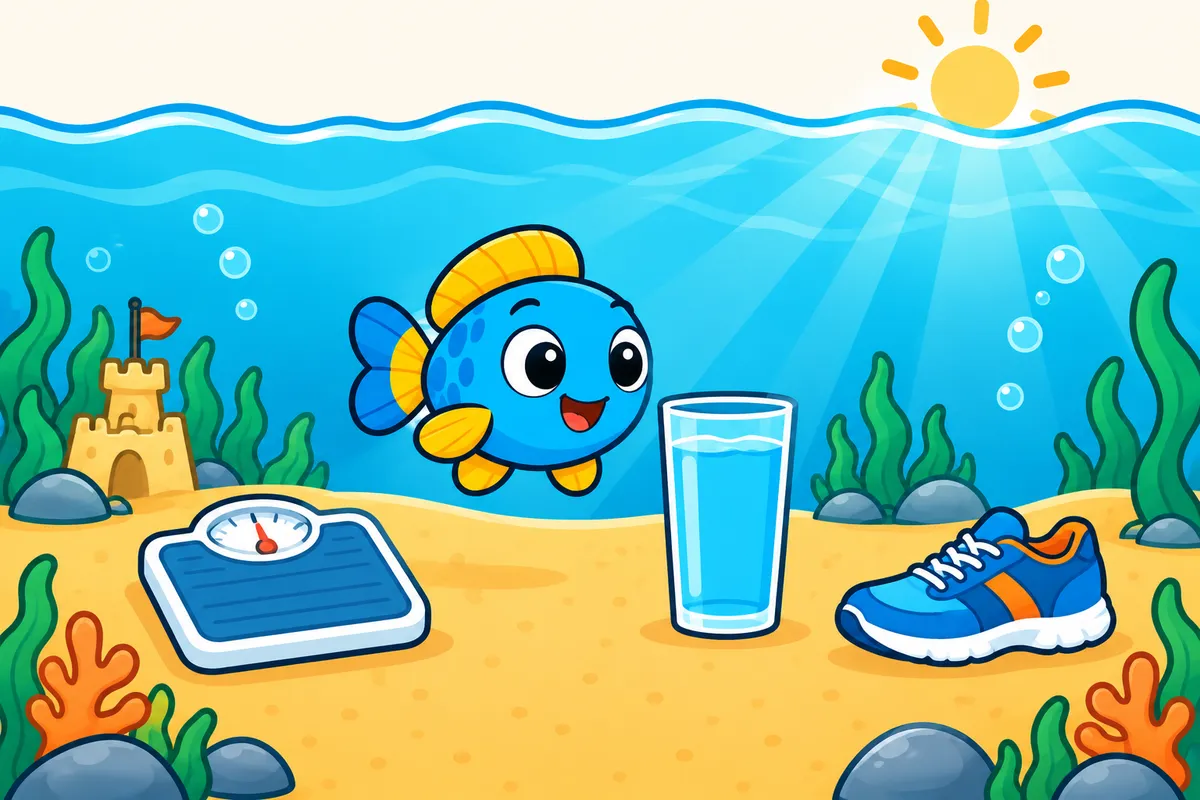
Most healthy adults do well on 9 to 13 cups of fluid a day, and their food covers the rest. Where you land in that range depends on your size, how much you move and how hot your days are.
Want one number for your own body? The water intake calculator works it out from your weight, activity and climate in a few seconds.
How Much Water Should You Drink a Day?
Healthy US women drink about 2.2 liters (74 oz) of fluids a day and men about 3.0 liters (101 oz), the US National Academies found. Food supplies about a fifth of the water you take in. Your own number moves up with heat, exercise and body size.
The US Numbers in Every Unit
The panel publishes two sets of figures, and the difference between them is your plate. The top row counts food; the rows under it count only what you drink.
| Per day | Women | Men |
|---|---|---|
| Total water, food included | 2.7 L (91 oz) | 3.7 L (125 oz) |
| From drinks | 2.2 L (74 oz) | 3.0 L (101 oz) |
| In 8 oz cups | about 9 | about 13 |
| In 16.9 oz (500 ml) bottles | about 4.5 | about 6 |
These values come from the median intake in a large US health survey, so they describe what healthy people actually drink. If you have read "3.7 liters a day", about 0.7 liters of it arrives in your food, as our guide to total water vs drinking water shows.
What the UK and the CDC Say
The NHS asks adults to aim for 6 to 8 cups or glasses of fluid a day, and it counts water, lower-fat milk, tea and coffee. The CDC gives no single number: it says your need varies with age, sex, pregnancy, breastfeeding and activity.
The US panel refused to count glasses at all. "We don't offer any rule of thumb based on how many glasses of water people should drink each day," it said in its 2004 report release. Our guide on whether 8 glasses a day is enough follows that famous rule back to 1945.
Your Own Number
Official values do not change with your weight, so Glubbo uses its own habit formula: 30 ml for each kilogram, plus or minus a little for activity, climate and sex. It is a practical target for drinks, never an official value.
The water intake by weight charts show the formula for every weight from 45 to 120 kg. If you think in ounces, how many ounces of water a day puts every figure in oz, cups and bottles.
How Much Plain Water Do You Need a Day?
Less than the totals above, if you also drink tea, coffee or milk and eat fruit and vegetables. Harvard Health says most people need about four to six cups of plain water a day, roughly 32 to 48 oz (1 to 1.4 liters). Other drinks and food make up the rest.
Coffee and tea count toward your total. The US panel found that caffeinated drinks add to your water as much as other drinks do, and our guide on whether coffee counts as water walks through the studies.
How Do You Know You Are Drinking Enough Water?
Check two things: your thirst and the color of your pee. The NHS says to aim for pee that is a clear, pale yellow. For most healthy people, the US panel found that drinking when thirsty and having drinks with meals is enough to stay hydrated, with no counting at all.
Counting helps on the days thirst gets ignored: a 12-hour shift, a heat wave, a day of back-to-back calls. If you reach 3 pm without a drink, you are behind, whatever color your pee is.
What Are the Signs of Dehydration?
Thirst, dark yellow pee and peeing less often than usual are the early signs most people notice. The NHS lists these symptoms in adults and children, and warns that babies, children and older adults are more at risk of dehydration.
- feeling thirsty
- a headache and feeling light-headed
- dark yellow, strong-smelling pee
- peeing less often than usual
- feeling dizzy or tired
- a dry mouth, lips and tongue
- sunken eyes
You dry out faster after vomiting or diarrhea, with a high temperature, after too much alcohol, and after long spells in the sun or heavy sweating. On those days, drink more before the signs show up.
When Should You Drink More Water?
Drink more whenever you lose more: on hot days, during long stretches of activity, and when you are ill with vomiting, diarrhea or a fever. The NHS says you may need more fluid in a hot environment or when you are physically active for long periods. Heat and work set the clearest numbers.
| Situation | What to drink | Source |
|---|---|---|
| A hot day, active or not | More than usual | CDC |
| Moderate work in the heat, under 2 hours | 1 cup (8 oz) every 15 to 20 minutes | NIOSH |
| Sweating for several hours | Sports drinks with balanced electrolytes | NIOSH |
| Any single hour | No more than 6 cups (48 oz, about 1.4 L) | NIOSH |
Very active people who work in hot weather every day often need six liters or more of total water, the US panel notes. For anyone else that is far too much, and our guide on whether a gallon of water a day is too much explains where the risk starts.
Who Needs a Different Amount?
The adult numbers above fit healthy adults. Children, pregnancy, older age and some health conditions change the answer, and two of these need a doctor's word more than a chart.
How Much Water Should a Child Drink?
Children ages 1 to 3 need about 4 cups of fluids a day, counting water and milk, says the American Academy of Pediatrics. Ages 4 to 8 need about 5 cups, and older children 7 to 8 cups. Babies 6 to 12 months old need only 4 to 8 oz of water a day.
The US panel's figures for children run the same way, by age and never by weight:
| Age | Total water a day | From drinks |
|---|---|---|
| 1 to 3 years | 1.3 L | 0.9 L (30 oz) |
| 4 to 8 years | 1.7 L | 1.2 L (41 oz) |
| Girls 9 to 13 | 2.1 L | 1.6 L (54 oz) |
| Boys 9 to 13 | 2.4 L | 1.8 L (61 oz) |
| Girls 14 to 18 | 2.3 L | 1.8 L (61 oz) |
| Boys 14 to 18 | 3.3 L | 2.6 L (88 oz) |
Glubbo's formula and calculator work for adults only. Do not use them for a child.
How Much Water Should You Drink When Pregnant or Breastfeeding?
The US reference is about 3.0 liters of total water a day in pregnancy, of which about 2.3 liters (78 oz, about 10 cups) comes from drinks. While breastfeeding it rises to 3.8 liters, about 3.1 liters (105 oz, 13 cups) of it from drinks, per the US panel's water chapter. Ask your midwife or doctor for your own amount.
Why Do Older Adults Get Dehydrated More Easily?
Thirst fades with age, so your body can run short before you feel it. Harvard Health notes that older people don't sense thirst as much as they did when younger, and the US panel found that "thirst and fluid intake are impaired in the elderly." Drink on a routine instead of waiting for thirst.
A 1984 study showed the gap clearly. After a day without water, healthy men aged 67 to 75 felt less thirsty and drank less than younger men did. In hot weather, the CDC tells adults over 65 to drink more than usual and not wait until they are thirsty.
Should Anyone Limit How Much Water They Drink?
Yes: Harvard Health warns that with some conditions, such as thyroid disease or kidney, liver or heart problems, you can take in too much water. If your doctor limits your fluids or prescribes water pills, the CDC says to ask that doctor how much to drink in hot weather. Your doctor's amount then replaces every number on this page.
Turn Your Number Into a Day of Drinks
A number helps only once you drink it. Four steps take you from a figure to a habit:
- Find your goal with the water intake calculator.
- Turn it into refills of the bottle you carry with Bottles per Day.
- Spread it from waking to an hour before bed with the water drinking schedule.
- Let reminders carry the afternoon, when most people stop drinking.
The Drinking Habits guides cover the routines that make this automatic, and What Counts sorts out which drinks and foods add to your number. Glubbo sets your goal with the same formula as the calculator, then sends Gentle, Smart or Strict reminders, and each glass you log fills your fish's tank.
General information for healthy adults, not medical advice. If a doctor has set your fluid amount, follow that.
Sources
- National Academies of Sciences. Dietary Reference Intakes for Water, Potassium, Sodium, Chloride, and Sulfate: Summary, 2005.
- National Academies of Sciences. Dietary Reference Intakes for Water, Potassium, Sodium, Chloride, and Sulfate: Chapter 4, Water, 2005.
- National Academies of Sciences. Report sets dietary intake levels for water, salt, and potassium (press release), 2004.
- NHS. Water, drinks and hydration, 2023.
- NHS. Dehydration, 2026.
- Harvard Health Publishing. How much water should you drink?, checked 2026.
- CDC. About Water and Healthier Drinks, 2026.
- CDC. About Heat and Your Health, 2026.
- CDC. Heat and Older Adults (Aged 65+), 2024.
- CDC NIOSH. Heat Stress, Workplace Recommendations, 2024.
- American Academy of Pediatrics (HealthyChildren.org). Choose Water for Healthy Hydration, 2024.
- New England Journal of Medicine (Phillips et al.). Reduced thirst after water deprivation in healthy elderly men, 1984.
Sources checked by the Glubbo team on Oct 16, 2026. General information, not medical advice.