Water Intake · Your Daily Number
How Much Water Should I Drink Based on My Weight? Charts in kg and lb
 By the Glubbo team · Updated Oct 16, 2026 · 7 min read
On This Page
- How Much Water Should I Drink Based on My Weight?
- Water by Weight Chart in Kilograms
- Water by Weight Chart in Pounds and Ounces
- Is Half Your Body Weight in Ounces a Good Rule?
- Worked Examples for Two Common Weights
- How Many ml of Water per kg of Body Weight?
- Do Bigger People Need More Water?
- What Else Moves Your Number
- When the Weight Rule Breaks Down
- Sources
Start near 30 ml per kg.
No health body sets water by weight. Glubbo's habit formula starts at 30 ml per kg (about 0.46 oz per lb): a 70 kg (154 lb) adult with a moderately active day gets 2,200 ml (74 oz) of drinks.
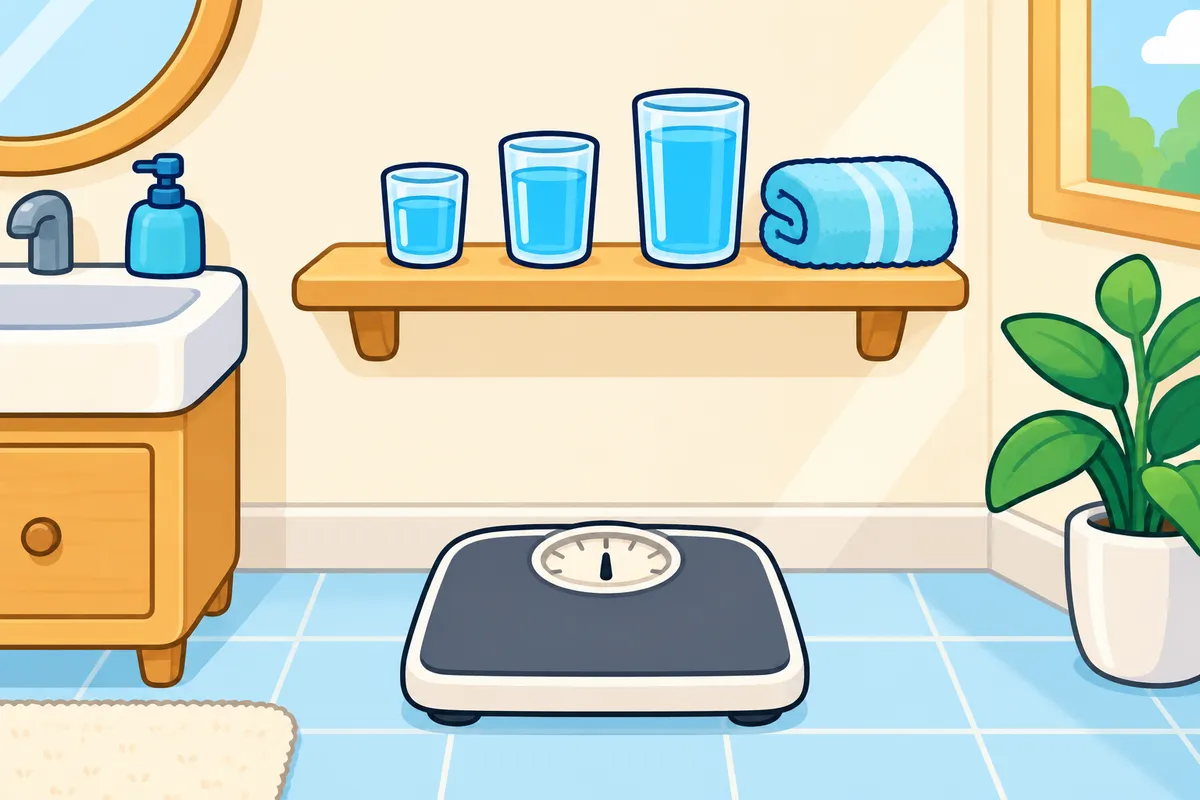
Your weight is a good place to start a daily water goal, because a bigger body burns more energy and loses more water. No health body turns that into an official per-pound number, though. Every weight chart you find, ours included, is a rule of thumb.
Our main guide on how much water you should drink a day gives the official figures. Below you get Glubbo's habit formula in kg and lb, worked examples, and a fair test of the half-your-weight rule.
How Much Water Should I Drink Based on My Weight?
No national health body sets water by body weight. The US National Academies based their values on the median intake of healthy people in a US survey, by age and sex. Weight rules are rough guides, and Glubbo's habit formula starts at 30 ml per kg, then adds or takes away a little for activity, climate and sex.
The Formula, Step by Step
Multiply your weight in kilograms by 30. Add 100 ml for a moderately active day or 300 ml for a very active one (take 100 ml away for a mostly seated day), add 250 ml in a hot climate (take 100 ml away in a cool one), and add 150 ml for men or take 150 ml away for women.
We round the result to the nearest 50 ml and never go below 1,600 ml. It is the same formula the Glubbo app and the water intake calculator use, so the chart, the calculator and your reminders agree.
Water by Weight Chart in Kilograms
Each figure is Glubbo's habit formula for a mild climate, with sex left out. Pick the column that matches your usual day.
| Weight | Low activity | Moderate activity | High activity |
|---|---|---|---|
| 45 kg | 1,600 ml | 1,600 ml | 1,650 ml |
| 50 kg | 1,600 ml | 1,600 ml | 1,800 ml |
| 55 kg | 1,600 ml | 1,750 ml | 1,950 ml |
| 60 kg | 1,700 ml | 1,900 ml | 2,100 ml |
| 65 kg | 1,850 ml | 2,050 ml | 2,250 ml |
| 70 kg | 2,000 ml | 2,200 ml | 2,400 ml |
| 75 kg | 2,150 ml | 2,350 ml | 2,550 ml |
| 80 kg | 2,300 ml | 2,500 ml | 2,700 ml |
| 85 kg | 2,450 ml | 2,650 ml | 2,850 ml |
| 90 kg | 2,600 ml | 2,800 ml | 3,000 ml |
| 95 kg | 2,750 ml | 2,950 ml | 3,150 ml |
| 100 kg | 2,900 ml | 3,100 ml | 3,300 ml |
| 110 kg | 3,200 ml | 3,400 ml | 3,600 ml |
| 120 kg | 3,500 ml | 3,700 ml | 3,900 ml |
The formula never goes below 1,600 ml (54 oz), so smaller adults on quiet days all land on that floor.
Water by Weight Chart in Pounds and Ounces
The same formula for a moderately active day in a mild climate, in the units on a US bottle label. We convert at 0.4536 kg per pound, as the calculator does.
| Weight | Daily drinks | In ounces | In 16.9 oz bottles |
|---|---|---|---|
| 100 lb | 1,600 ml | 54 oz | about 3 |
| 120 lb | 1,750 ml | 59 oz | about 3.5 |
| 140 lb | 2,000 ml | 68 oz | 4 |
| 160 lb | 2,300 ml | 78 oz | about 4.5 |
| 180 lb | 2,550 ml | 86 oz | about 5 |
| 200 lb | 2,800 ml | 95 oz | about 5.5 |
| 220 lb | 3,100 ml | 105 oz | about 6 |
| 240 lb | 3,350 ml | 113 oz | about 6.5 |
| 260 lb | 3,650 ml | 123 oz | about 7 |
Is Half Your Body Weight in Ounces a Good Rule?
It is a fair first guess for many people, but none of the health bodies we checked publish it, and we could not trace where it started. Half an ounce per pound works out to about 32.6 ml per kg, a little above Glubbo's 30 ml. For a heavy person it can overshoot what even the average man drinks.
| Weight | Half your weight in oz | Glubbo base (30 ml per kg) |
|---|---|---|
| 120 lb (54 kg) | 60 oz (1.8 L) | 1,650 ml (56 oz) |
| 150 lb (68 kg) | 75 oz (2.2 L) | 2,050 ml (69 oz) |
| 180 lb (82 kg) | 90 oz (2.7 L) | 2,450 ml (83 oz) |
| 200 lb (91 kg) | 100 oz (3.0 L) | 2,700 ml (91 oz) |
| 250 lb (113 kg) | 125 oz (3.7 L) | 3,400 ml (115 oz) |
| 300 lb (136 kg) | 150 oz (4.4 L) | 4,100 ml (139 oz) |
The base column leaves out activity, climate and sex. At 300 lb the half-weight rule asks for 150 oz a day, 49 oz more than the 101 oz the average US man drinks.
Use either rule as a starting point, then let your thirst and your pee adjust it. The main guide explains how to tell you are drinking enough without counting.
Worked Examples for Two Common Weights
Two weights come up again and again in searches. Here is each one under both rules, with the arithmetic shown.
How Much Water Should I Drink If I Weigh 150 Pounds?
By the half-your-weight rule, 75 oz (about 2.2 liters). Glubbo's habit formula starts 150 lb (68 kg) at 2,050 ml (69 oz), then adjusts: a moderately active woman in a mild climate lands on 2,000 ml (68 oz), a man on 2,300 ml (78 oz). All of these sit near the 74 oz the average US woman drinks.
How Much Water Should I Drink If I Weigh 200 Pounds?
By the half-your-weight rule, 100 oz (about 3.0 liters), the same as the average US man drinks. Glubbo's habit formula starts 200 lb (90.7 kg) at 2,700 ml (91 oz). A moderately active man in a mild climate lands on 2,950 ml (100 oz), a woman on 2,650 ml (90 oz).
How Many ml of Water per kg of Body Weight?
We found no official per-kilogram figure for healthy adults. Glubbo uses 30 ml per kg as the base of its habit formula, which equals about 0.46 oz per pound. The half-your-weight rule equals about 32.6 ml per kg, so the two land within about 9 % of each other.
Do Bigger People Need More Water?
Generally, yes. Water needs rise with the energy you burn, and a bigger body burns more. The US panel's water chapter uses this to explain lower needs in women: "Women are physically smaller, thus they probably have lower water requirements due to lower metabolic expenditures."
The same chapter offers "a convenient 'liberal standard'" of 1 ml of total water for each calorie you burn. That rule ties water to the energy you use, and so, loosely, to your size.
What Else Moves Your Number
Weight sets the base, and your day moves it. Here is how Glubbo's formula adjusts next to what the official sources say.
| What changes | Glubbo's adjustment | What the sources say |
|---|---|---|
| Activity | Low −100 ml, Moderate +100 ml, High +300 ml | For moderate work in the heat, NIOSH advises 1 cup (8 oz) every 15 to 20 minutes |
| Climate | Cool −100 ml, Mild 0, Hot +250 ml | Very active people in hot weather often need six liters or more of total water (US panel) |
| Sex | Female −150 ml, Male +150 ml, Skip 0 | Healthy women drink about 2.2 L of fluids a day, men about 3.0 L |
| Food | Not counted: the goal is for drinks | Food gives about 19 % of total water |
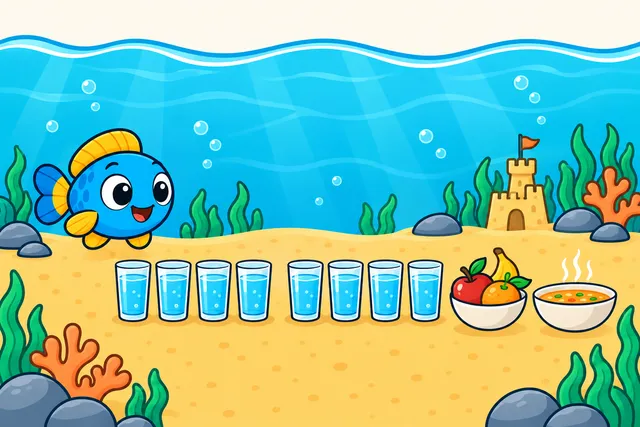
Food is the quiet one. Total water vs drinking water shows how a day of fruit and soup can bring a liter on its own, and how many ounces of water a day puts these numbers in cups and bottles.
When the Weight Rule Breaks Down
The rule fits healthy adults, and it stops there. For very large bodies the per-kilogram rule climbs fast; if your number feels out of reach, start from the US drinks figures (about 3.0 L for men, 2.2 L for women) and adjust by thirst.
Children follow age, never weight. The main guide lists how much water a child should drink by age, from the American Academy of Pediatrics.
General information for healthy adults, not medical advice. If a doctor has set your fluid amount, follow that.
More in Water Intake
Sources
- National Academies of Sciences. Dietary Reference Intakes for Water, Potassium, Sodium, Chloride, and Sulfate: Summary, 2005.
- National Academies of Sciences. Dietary Reference Intakes for Water, Potassium, Sodium, Chloride, and Sulfate: Chapter 4, Water, 2005.
- National Academies of Sciences. Report sets dietary intake levels for water, salt, and potassium (press release), 2004.
- NIST. Approximate Conversions from U.S. Customary Measures to Metric, checked 2026.
- CDC NIOSH. Heat Stress, Workplace Recommendations, 2024.
Sources checked by the Glubbo team on Oct 16, 2026. General information, not medical advice.