What Counts
What Counts Toward Your Water Intake? Drinks and Food Compared
Almost every drink counts
plus the water in your food
The US National Academies count water, juice, milk, coffee, tea and soda, plus the water in fruit and vegetables. Caffeinated drinks add as much as other drinks do.
 By the Glubbo team · Updated Oct 16, 2026 · 6 min read
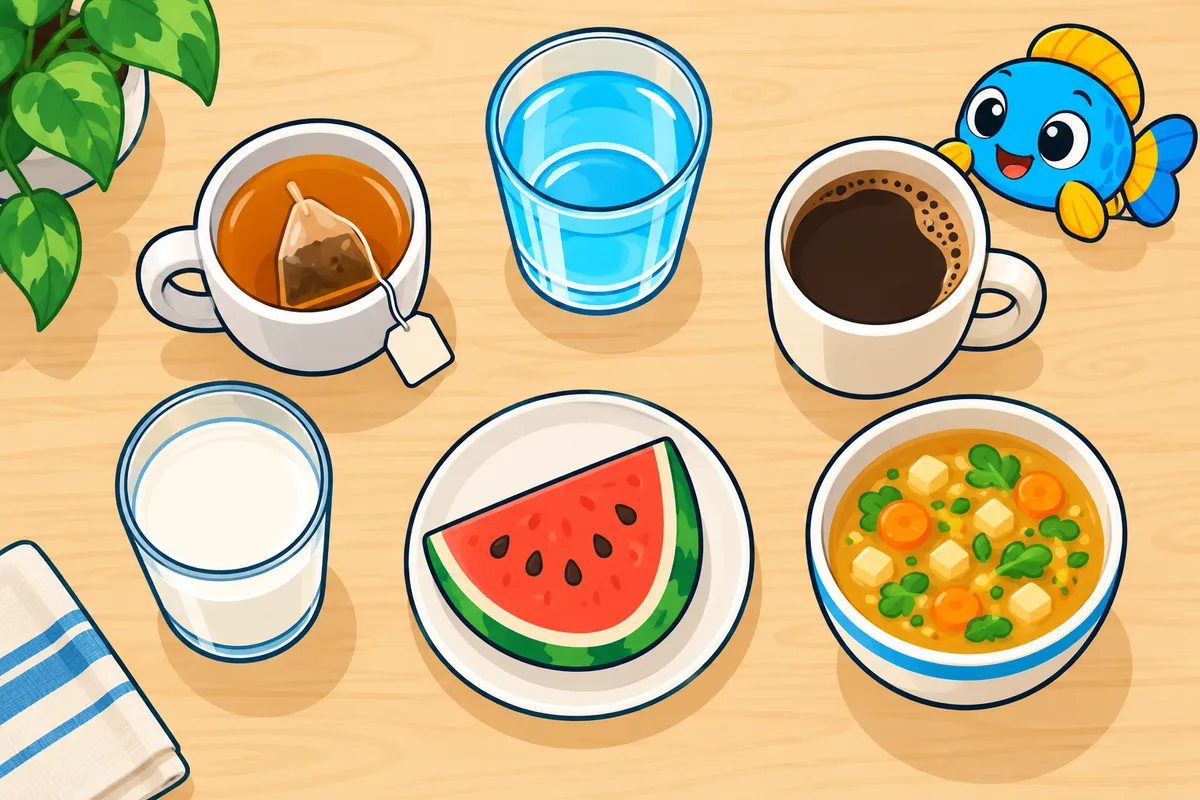
Almost every drink you have counts toward your water for the day. The US National Academies list juice, milk, coffee, tea and soda as sources of water, along with fruit, vegetables and other foods.
Below you get each drink compared with plain water, the one drink we leave out of your goal, and a real day counted line by line.
Which Drinks Count?
Water, sparkling water, coffee, tea, milk, juice, soda and sports drinks all count toward your daily water. Each of them is mostly water, and your body takes that water in. The one drink Glubbo leaves out of your goal is alcohol, for reasons you will find further down.
| Drink | Counts toward your goal | Compared with water in the 2016 trial | What to watch |
|---|---|---|---|
| Still water | Yes | The reference | Nothing |
| Sparkling water | Yes | Same as water | Nothing |
| Coffee | Yes | Same as water | Caffeine above 400 mg a day |
| Hot tea, iced tea | Yes | Same as water | Caffeine |
| Orange juice | Yes | Same as water | Sugar: 150 ml (5 oz) a day at most |
| Cola | Yes | Same as water | Sugar and caffeine |
| Diet cola | Yes | Same as water | Caffeine |
| Sports drink | Yes | Same as water | Sugar; meant for long sweaty hours |
| Full-fat milk | Yes | Held about 1.5 times as much | Nothing for most people |
| Skim milk | Yes | Held about 1.6 times as much | Nothing for most people |
| Oral rehydration solution | Yes | Held about 1.5 times as much | Made for illness, not daily drinking |
| Lager | We leave it out | Same as water | Alcohol |
"Same as water" means the drink left as much fluid in the body as plain water did, measured by how much the men peed over the next 4 hours. The next section explains the trial and its limits.
How Hydrating Is Each Drink Compared With Water?
Most drinks hydrate you about as well as water does. In a 2016 trial, 72 healthy men drank 1 L (34 oz) of one of 13 drinks within 30 minutes, and the researchers collected their urine for 4 hours.
Only milk and oral rehydration solution kept clearly more fluid in the body. Read that result with its limits in mind: the men started on an empty stomach, drank a large amount fast, and the test covered one morning, not a normal day. The European Hydration Institute funded the work.
Does Sparkling Water Count as Water Intake?
Yes. In the 2016 trial, sparkling water hydrated the men just like still water: their urine over the next 4 hours matched. So a 12 oz (355 ml) can or a 500 ml (16.9 oz) bottle goes into your log at its full size.
If plain water bores you, sparkling water is the easiest swap you can make.
Is Milk More Hydrating Than Water?
Over a few hours, yes. Two hours after drinking, the men's bodies held on to about 1.5 times as much fluid from milk as from water, for full-fat and skim milk alike. This is a short-term result from fasting men who drank 1 L in 30 minutes, so it says little about a glass of milk with dinner.
In your log, milk counts the same way as any drink: 250 ml of milk is 250 ml toward your goal. The NHS names lower-fat milk among the drinks that count.
Are Sports or Electrolyte Drinks More Hydrating Than Water?
For everyday drinking, no. The sports drink in the 2016 trial did no better than water, so on a normal day it only adds sugar. Oral rehydration solution did hold more fluid, but you take it for vomiting or diarrhea, not with lunch.
Sports drinks earn their place when you sweat for hours. NIOSH advises drinks with balanced electrolytes for workers whose sweating lasts several hours.
Do Juice and Soda Count?
Yes, both add water to your day. The US National Academies count juice and soda alongside water, and orange juice, cola and diet cola all matched water in the 2016 trial. The catch is sugar, so the NHS says to keep fruit juice and smoothies to one small 150 ml (5 oz) glass a day.
The NHS also advises swapping sugary drinks for diet, sugar-free or no-added-sugar ones. Here are swaps that keep the fluid and drop most of the sugar:
- One 150 ml glass of juice with breakfast, then water for the rest of the morning
- The sugar-free version of the soda you already like
- Sparkling water with a slice of lemon in place of a second can
- Juice topped up with sparkling water, so one 150 ml portion fills a tall glass
Does Alcohol Dehydrate You?
Alcohol makes you pee more, but only for a short time. The US National Academies found that the extra water loss after drinking alcohol appears to be transient. Lager even matched water in the 2016 trial, where each man drank a full liter of it within 30 minutes.
We still leave alcohol out of your Glubbo goal. Counting beer toward a water goal would reward drinking more of it, and the CDC advises limiting alcohol, along with sugary and caffeinated drinks, on hot days.
What About Coffee and Tea?
Both count. The National Academies found that caffeinated drinks add to your water as much as other drinks do, and our guide on whether coffee counts as water covers the trials and where caffeine sets the limit.
Where Food Fits In
Food adds water too: about 19 % of the total in US survey data, the National Academies report. Per USDA data, cucumber, iceberg lettuce and watermelon are more than 90 % water by weight, while saltine crackers and almonds hold about 5 % or less.
Our table of the foods with the most water ranks 26 foods by water content and counts what a day of meals adds. Food also explains why the official "total water" figures sit above the drinks figures; total water vs drinking water shows how to read each one.
Counting a Real Day
Here is how one ordinary day adds up. Sam weighs 80 kg (176 lb), walks a lot at work and lives somewhere mild, so the water intake calculator gives him a goal of 2,650 ml (90 oz).
| Time | Drink | Amount | In his log? |
|---|---|---|---|
| 7:30 am | Coffee | 355 ml (12 oz) | Yes |
| 10:00 am | Water | 500 ml (16.9 oz) | Yes |
| 12:30 pm | Sparkling water | 355 ml (12 oz) | Yes |
| 12:30 pm | Orange juice | 150 ml (5 oz) | Yes |
| 3:00 pm | Water | 500 ml (16.9 oz) | Yes |
| 7:00 pm | Skim milk | 240 ml (8 oz) | Yes |
| 8:30 pm | Beer | 355 ml (12 oz) | No |
| Total logged | 2,100 ml (71 oz) | 550 ml short |
The goal comes from Glubbo's habit formula: 30 ml per kg of body weight, plus small steps for activity, climate and sex. It is a habit target, not an official recommendation.
How to Log Mixed Drinks
A few rules keep your log honest without turning it into homework:
- Log every drink at its real size, coffee, tea, milk and juice included.
- Leave alcohol out, and pair it with a glass of water.
- Keep juice to one 150 ml glass and count the rest as water or sugar-free drinks.
- Treat food as a buffer on top of your goal, not as part of it.
Glubbo logs drinks in 50, 150, 250 and 500 ml steps, so a 12 oz can is close to one 250 ml glass plus two 50 ml sips. For the bigger picture behind your daily number, read how much water you should drink a day.
General information for healthy adults, not medical advice. If a doctor has set your fluid amount, follow that.
Sources
- National Academies of Sciences. Report sets dietary intake levels for water, salt, and potassium (press release), 2004.
- National Academies of Sciences. Dietary Reference Intakes for Water, Potassium, Sodium, Chloride, and Sulfate: Summary, 2005.
- National Academies of Sciences. Dietary Reference Intakes, Chapter 4: Water, 2005.
- American Journal of Clinical Nutrition (Maughan and colleagues). A randomized trial to assess the potential of different beverages to affect hydration status: development of a beverage hydration index, 2016.
- NHS. Water, drinks and hydration, 2023.
- CDC. About Heat and Your Health, 2024.
- CDC NIOSH. Heat Stress, Workplace Recommendations, 2024.
- USDA Agricultural Research Service. FoodData Central, SR Legacy (nutrient "Water", g per 100 g), 2018.
Sources checked by the Glubbo team on Oct 16, 2026. General information, not medical advice.