What Counts · Water in Food
Foods With the Most Water, Ranked From Lettuce to Almonds
 By the Glubbo team · Updated Oct 16, 2026 · 6 min read
On This Page
Lettuce, cucumber, melon.
Per USDA data, iceberg lettuce is 95.6 % water, cucumber 95.2 % and watermelon 91.5 %. White bread is 36 % water and almonds 4 %.
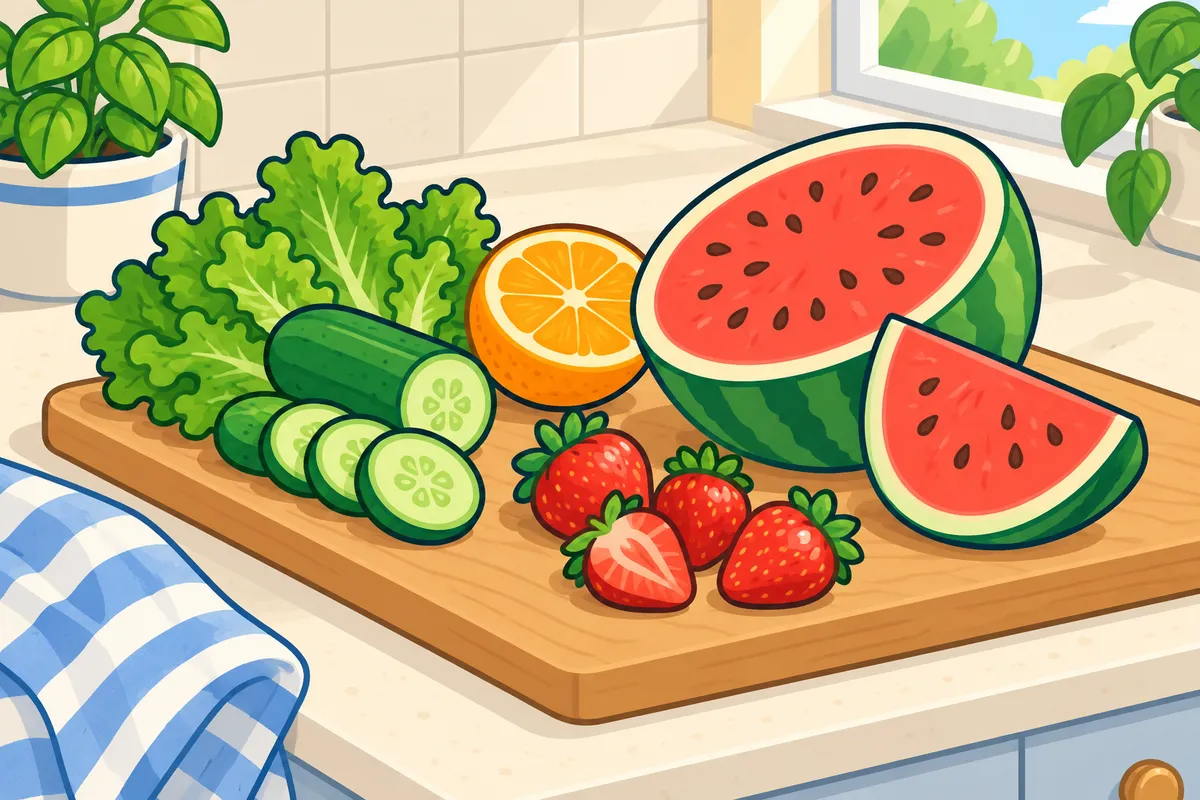
A cucumber is 95 % water by weight. Eat a whole one and you have taken in almost 290 ml (10 oz), close to a full glass.
Food counts toward your water, as our guide to what counts toward your water intake explains. This page shows which foods carry the most, using USDA's own measurements, and what a day of meals can add.
Which Foods Have the Most Water?
Raw vegetables and fruit lead the list. Per USDA FoodData Central, iceberg lettuce is 95.6 % water, celery 95.4 %, cucumber 95.2 % and zucchini 94.8 %. Watermelon (91.5 %), strawberries (91.0 %) and cantaloupe (90.2 %) top the fruit.
Soup made with water comes close at 94.2 %, and the cooked grains and dry foods sit far below.
The tables below give each food's water per 100 g (3.5 oz), then the water in one USDA portion. One gram of water is about 1 ml, so 95 g of water per 100 g means a 100 g serving holds about 95 ml. The FDC ID lets you look up any row on the USDA site.
Vegetables
| Food (raw) | Water per 100 g | USDA portion | Water in that portion | FDC ID |
|---|---|---|---|---|
| Iceberg lettuce | 95.6 g | 1 cup shredded, 72 g | 69 ml (2.3 oz) | 169248 |
| Celery | 95.4 g | 1 cup chopped, 101 g | 96 ml (3.3 oz) | 169988 |
| Cucumber, with peel | 95.2 g | 1 cucumber (8¼ in), 301 g | 287 ml (9.7 oz) | 168409 |
| Zucchini, with skin | 94.8 g | 1 medium, 196 g | 186 ml (6.3 oz) | 169291 |
| Tomato, red | 94.5 g | 1 medium, 123 g | 116 ml (3.9 oz) | 170457 |
| Green bell pepper | 93.9 g | 1 cup chopped, 149 g | 140 ml (4.7 oz) | 170427 |
| Cauliflower | 92.1 g | 1 cup chopped, 107 g | 99 ml (3.3 oz) | 169986 |
| Spinach | 91.4 g | 1 cup, 30 g | 27 ml (0.9 oz) | 168462 |
| Broccoli | 89.3 g | 1 cup chopped, 91 g | 81 ml (2.7 oz) | 170379 |
Spinach shows why the portion matters. It is 91 % water, but a cup of raw leaves weighs only 30 g, so it adds just 27 ml.
Fruit
| Food (raw) | Water per 100 g | USDA portion | Water in that portion | FDC ID |
|---|---|---|---|---|
| Watermelon | 91.5 g | 1 wedge (1/16 melon), 286 g | 262 ml (8.8 oz) | 167765 |
| Strawberries | 91.0 g | 1 cup halves, 152 g | 138 ml (4.7 oz) | 167762 |
| Cantaloupe | 90.2 g | 1 cup diced, 156 g | 141 ml (4.8 oz) | 169092 |
| Peach, yellow | 88.9 g | 1 medium, 150 g | 133 ml (4.5 oz) | 169928 |
| Orange | 86.8 g | 1 fruit (2⅝ in), 131 g | 114 ml (3.8 oz) | 169097 |
| Pineapple | 86.0 g | 1 cup chunks, 165 g | 142 ml (4.8 oz) | 169124 |
| Apple, with skin | 85.6 g | 1 medium, 182 g | 156 ml (5.3 oz) | 171688 |
| Grapes | 80.5 g | 1 cup, 151 g | 122 ml (4.1 oz) | 174683 |
| Banana | 74.9 g | 1 medium, 118 g | 88 ml (3.0 oz) | 173944 |
Soup, Milk and Yogurt
| Food | Water per 100 g | USDA portion | Water in that portion | FDC ID |
|---|---|---|---|---|
| Chicken noodle soup, canned, made with water | 94.2 g | 1 cup, 248 g | 234 ml (7.9 oz) | 172909 |
| Whole milk | 88.1 g | 1 cup, 244 g | 215 ml (7.3 oz) | 171265 |
| Plain whole-milk yogurt | 87.9 g | 1 container (6 oz), 170 g | 149 ml (5.1 oz) | 171284 |
Milk is a drink, so it already goes into your log as fluid. Soup sits on the line between food and drink; total water vs drinking water covers how to count it.
How Much Water Is in Watermelon?
Watermelon is 91.5 % water by weight. One USDA wedge, about a sixteenth of a melon at 286 g (10 oz), holds about 262 ml (8.8 oz) of water. That is about one 250 ml glass, which makes a wedge of watermelon one of the easiest ways to add water on a hot afternoon.
A cup of diced watermelon (152 g) gives you about 139 ml (4.7 oz), a little over half a glass.
Which Foods Add Almost No Water?
Dry foods add very little. Per USDA data, white bread is 36.4 % water, saltine crackers 5.1 % and almonds 4.4 %. A slice of bread brings about 11 ml, and a 1 oz handful of almonds (23 nuts) about 1 ml.
Cooked rice (68.4 %) and pasta (62.1 %) hold more, because they soak up water as they cook.
| Food | Water per 100 g | USDA portion | Water in that portion | FDC ID |
|---|---|---|---|---|
| White rice, cooked | 68.4 g | 1 cup, 158 g | 108 ml (3.7 oz) | 168878 |
| Pasta, cooked | 62.1 g | 1 cup spaghetti, 124 g | 77 ml (2.6 oz) | 169737 |
| White bread | 36.4 g | 1 slice, 29 g | 11 ml (0.4 oz) | 174924 |
| Saltine crackers | 5.1 g | 5 crackers, 15 g | about 1 ml | 172746 |
| Almonds | 4.4 g | 1 oz (23 almonds), 28 g | about 1 ml | 170567 |
On a day of toast, crackers and nuts, your glass has to do nearly all the work. That is the day to keep a bottle on your desk.
How Much Water Can Food Add to Your Day?
Anywhere from a few hundred ml to well over a liter, depending on what you eat. In US survey data, food gave people about 19 % of their total water, the National Academies report. For the women's total of 2.7 L, that comes to about 500 ml from food.
Your plate can sit far above or below that average. Here are two days built only from the foods in the tables above.
A Day of Fruit, Salad and Soup
| Meal | Food | Water |
|---|---|---|
| Breakfast | 6 oz plain yogurt, 1 cup strawberries | 288 ml |
| Lunch | 1 cup chicken noodle soup; salad of 2 cups lettuce, 1 tomato, ½ cup cucumber | 537 ml |
| Snack | 1 medium apple | 156 ml |
| Dinner | 1 cup rice, 1 cup broccoli | 189 ml |
| Dessert | 1 wedge of watermelon | 262 ml |
| Total | about 1,430 ml (48 oz) |
A Day of Bread, Crackers and Pasta
| Meal | Food | Water |
|---|---|---|
| Breakfast | 2 slices of toast, 1 medium banana | 110 ml |
| Lunch | Sandwich on 2 slices of bread | 21 ml |
| Snack | 10 saltines, 1 oz almonds | 3 ml |
| Dinner | 2 cups spaghetti | 154 ml |
| Total | about 290 ml (10 oz) |
Should Food Count Toward Your Water Goal?
Food counts toward your total water, but Glubbo's goal counts drinks only. The US National Academies include fruit, vegetables and other foods in total water, which is why their total figures sit above the drinks figures.
We keep food out of your log for a practical reason: nobody weighs their salad, so treat food as a buffer instead.
On a fruit-and-soup day you may feel fine a glass short of your goal, and on a dry day you may need a glass more. The water intake calculator gives you the drinks goal to start from.
Easy Ways to Eat More Water
Harvard Health points to salads, fruit and applesauce as foods that bring fluid with them. These swaps add water without changing what you drink:
- Swap a 15 g pack of crackers for a cup of strawberries: about 137 ml more water.
- Add a side salad of 2 cups lettuce and a tomato to lunch: about 254 ml.
- Start dinner with a cup of soup: about 234 ml.
- Keep cut watermelon or cantaloupe in the fridge for the 3 pm slump.
Drinks still do most of the work. For coffee, tea and the rest of your glass, see whether coffee counts as water.
General information for healthy adults, not medical advice. If a doctor has set your fluid amount, follow that.

More in What Counts

Sources
- USDA Agricultural Research Service. FoodData Central, SR Legacy (nutrient "Water", g per 100 g, and food portion weights), 2018.
- National Academies of Sciences. Dietary Reference Intakes for Water, Potassium, Sodium, Chloride, and Sulfate: Summary, 2005.
- National Academies of Sciences. Report sets dietary intake levels for water, salt, and potassium (press release), 2004.
- Harvard Health Publishing. How much water should you drink?, 2024.
Sources checked by the Glubbo team on Oct 16, 2026. General information, not medical advice.