Water Intake Calculator: Find Your Daily Water Goal
Your daily water goal from your weight, activity and climate.
2,350 ml a day
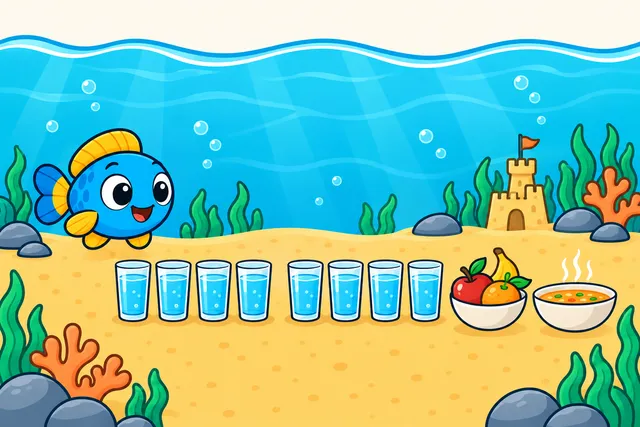
About 10 glasses of 250 ml
79 oz · 5 bottles of 500 ml


A general estimate for healthy adults. Not medical advice.
How This Compares
How Does a Water Intake Calculator Work?
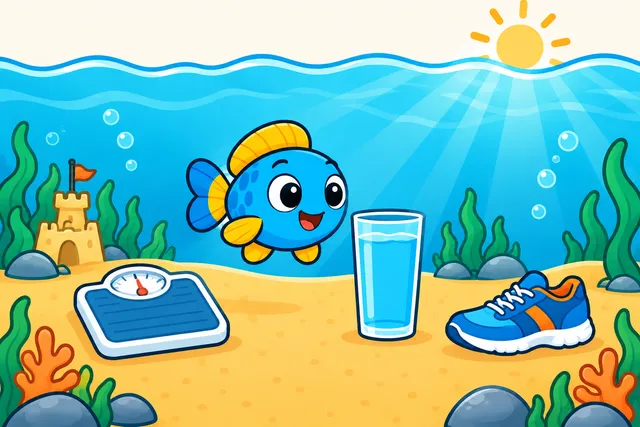
Most water calculators multiply your weight by a fixed amount and add a little for activity and heat. Glubbo starts with 30 ml of water for every kilogram you weigh, then adds or takes away a little for how you live. The result rounds to the nearest 50 ml, and it never drops below 1,600 ml.
It is the same formula the Glubbo app uses when you set your goal. So the number you see here is the number your reminders will aim for.
| What you choose | Change to your goal |
|---|---|
| Weight | 30 ml for each kg (about 0.5 oz for each pound) |
| Activity: Low | 100 ml less |
| Activity: Moderate | 100 ml more |
| Activity: High | 300 ml more |
| Climate: Cool | 100 ml less |
| Climate: Hot | 250 ml more |
| Sex: Male / Female | 150 ml more / 150 ml less |
Think of the result as a habit target for drinks. Food brings water too, which is why this number sits below the "total water" figures you may have read.
Once you have it, the water drinking schedule turns it into times to drink and Bottles per Day turns it into refills.
Three People, Three Goals
Your Number Next to the Official Ones
Most official advice falls between 2 and 3 litres of drinks a day for adults, and the bars above show where your goal sits in that range.
The US National Academies found that men drink about 3.0 L of fluids a day and women about 2.2 L. In Europe, EFSA sets 2.5 L of total water for men and 2.0 L for women, food included.
The NHS keeps it simple: 6 to 8 cups or glasses of fluid a day. Our guide on total water vs drinking water explains why these figures look so different, and the main guide covers how much water you should drink a day in full.
When You Need More Than This
Heat and hard work raise your need fast. On a hot day, outdoor workers who sweat for under two hours should drink about 1 cup (8 oz) every 15 to 20 minutes, says NIOSH.
Long, heavy sweating calls for drinks with salts as well. Fever, vomiting and diarrhoea raise your need too. So do pregnancy and breastfeeding.
There is a top end too. NIOSH advises no more than 6 cups (about 1.4 L) in one hour, and our guide on whether a gallon a day is too much explains why.
Common Questions
Does coffee count toward my goal?
Yes. The NHS counts tea and coffee as fluid, along with water and lower-fat milk. Our guide on whether coffee counts as water covers caffeine, tea and the studies behind the answer.
Why do water calculators give different answers?
They use different rules. Some take half your body weight in ounces, others a fixed amount per kilogram, and some mix up total water with drinks, which inflates the result by about a fifth.
None of these weight rules is an official guideline. The US reference values are "set based on the median total water intake from the U.S. NHANES III data," the US National Academies explain, which means they describe what healthy people actually drink.
Does the calculator count water from food?
No. It gives you a drinks goal, because drinks are the part you can count and control. Food adds roughly another fifth on top, which is why your goal sits below the 3.7 L and 2.7 L figures you may have read; see total water vs drinking water.
Should I drink my whole goal in one go?
No. Your kidneys clear about 0.7 to 1.0 litres an hour at most, so a whole goal at once can overwhelm them. Small drinks through the day work better, and they are easier to remember.
Can I use this for a child or during pregnancy?
No. The formula is built for adults and has a 1,600 ml floor. Ask your doctor or midwife for the right amount.
Why does the calculator ask about sex?
Men tend to be larger and carry more muscle, so official figures for men run higher. Pick Skip if you prefer, and the calculator leaves that step out.
General information for healthy adults, not medical advice. If a doctor has set your fluid amount, follow that.
Guides Behind the Numbers
Sources
- National Academies of Sciences. Dietary Reference Intakes for Water, Potassium, Sodium, Chloride, and Sulfate: Summary, 2005.
- EFSA. Scientific Opinion on Dietary Reference Values for Water, 2010.
- NHS. Water, drinks and hydration, 2023.
- CDC NIOSH. Heat Stress, Workplace Recommendations, 2024.
Formula and sources checked by the Glubbo team on Oct 16, 2026.