Food and Electrolytes · Sugar and Calories in Drinks
How Much Added Sugar Per Day, in Grams, Teaspoons and Label Terms
Four official limits side by side, turned into grams and teaspoons, with the label line that shows them.
 By the Glubbo Editorial Team · Updated Oct 19, 2026 · 9 min read
On This Page
- How Many Grams of Added Sugar Should You Have a Day?
- How Many Teaspoons of Added Sugar a Day?
- How Much Added Sugar Do Americans Eat?
- What Counts as Added Sugar?
- Does the Sugar in Fruit and Milk Count as Added Sugar?
- How Do You Read Added Sugars on a Food Label?
- How Much Added Sugar Can Children Have?
- Cut Your Added Sugar, Starting With Your Drinks
- Sources
Short answer
Less is better: aim under 25 g of added sugar a day.
- US 2025–2030 guidelines: no added sugar is recommended, and no meal over 10 g.
- WHO and AHA: about 25 g (6 teaspoons) for women; the label's Daily Value is 50 g.
- A 12 oz can of regular soda holds about 10 teaspoons, the CDC says.

Aim for 25 g of added sugar a day or less, which is about 6 teaspoons. Four health bodies give four different limits, and the newest US one is the strictest: no amount is recommended at all.
How Many Grams of Added Sugar Should You Have a Day?
About 25 g or less keeps you inside every daily limit except the strictest. The Dietary Guidelines for Americans, 2025–2030 recommend no added sugar and cap one meal at 10 g; the WHO and the American Heart Association land near 25 g for most women; the FDA's label value is 50 g.
Four limits, four bodies
US Dietary Guidelines 2025–2030
The strictest
- No amount is recommended
- No more than 10 g in one meal
- Avoid sugar-sweetened drinks
Suits you if you want the current US government line.
World Health Organization
Under 10 %, ideally 5 %
- Under 10 % of your energy
- Under 5 %: about 25 g, 6 teaspoons
- Applies to adults and children
Suits you if you want one number that works anywhere.
American Heart Association
Split by sex
- No more than 6 % of calories
- Women: 100 calories, about 6 tsp
- Men: 150 calories, about 9 tsp
Suits you if you want a daily allowance in teaspoons.
FDA label Daily Value
For reading labels
- 50 g a day on a 2,000-calorie diet
- 5 % DV or less is low
- 20 % DV or more is high
Suits you if you compare two products in the shop.
The FDA's 50 g comes from the older guideline of less than 10 % of calories: on a 2,000-calorie day, that is 200 calories or 50 g. The 2025–2030 guidelines dropped that allowance, so treat 50 g as a label yardstick, not a target.
Turning Calories Into Grams
The AHA gives its limit in calories and teaspoons, and one gram of sugar holds four calories. So its 100 calories for women is 25 g of added sugar. Its 150 calories for men works out to 37.5 g, which the AHA writes as about 9 teaspoons or 36 g.
The US guidelines have no daily gram number at all. Their only figure is 10 g per meal, so three meals at that cap would come to 30 g.
Your Limit at Your Calorie Level
The WHO and the older US rule are percentages, so your gram limit grows with how much you eat. To find your limit:
- Take your daily calories.
- Multiply by 0.10 or 0.05.
- Divide by 4 calories per gram.
| Daily calories | Under 10 % of energy | Under 5 % of energy |
|---|---|---|
| 1,600 | 40 g | 20 g |
| 2,000 | 50 g | 25 g |
| 2,400 | 60 g | 30 g |
| 2,800 | 70 g | 35 g |
How Many Teaspoons of Added Sugar a Day?
About 6 teaspoons for women and 9 for men, by the AHA's count. The WHO's stricter target is "roughly 25 grams (6 teaspoons)", so one teaspoon of sugar weighs about 4 g. At that rate, the FDA's 50 g label value is about 12 teaspoons.
| Limit | Grams | Teaspoons |
|---|---|---|
| One meal, US 2025–2030 | 10 g | about 2.5 |
| WHO under 5 %, AHA women | 25 g | about 6 |
| AHA men | 36 g | about 9 |
| FDA label Daily Value | 50 g | about 12 |
Picture the sugar bowl: six level teaspoons is the whole day for most women by the WHO and AHA measures. One can of regular soda can use it up on its own. Flavor changes the count only a little, from about 32 g in ginger ale to 49 g in cream soda.
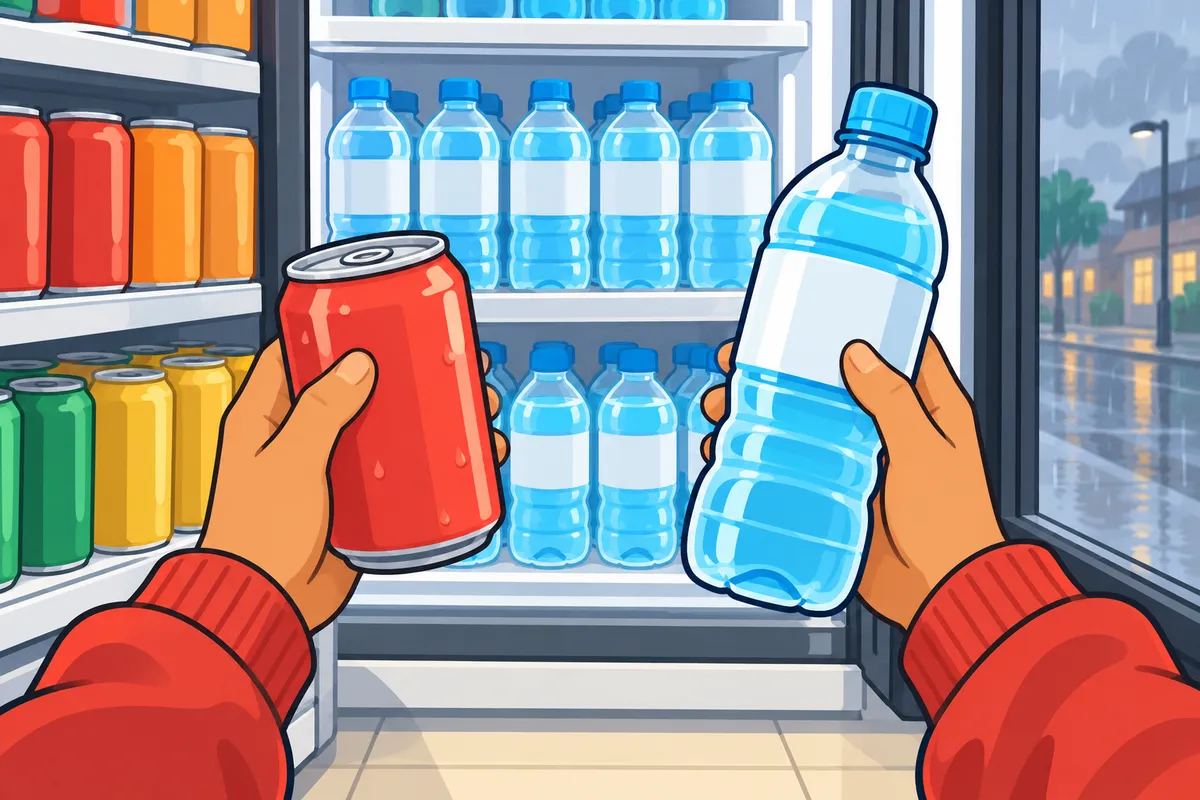
The CDC lists a 12-ounce can of regular soda at 10 teaspoons of added sugar and 155 calories, and the WHO says a can can hold up to 40 g. Water, plain sparkling water, coffee and tea without sugar count toward your fluid with none of it, and plain sparkling water is as hydrating as still.
How Much Added Sugar Is in Coffee and Tea?
Every level teaspoon you stir in is about 4 g. Two sugars in each of three cups a day is 6 teaspoons or 24 g, almost the entire 25 g allowance before you eat anything. Unsweetened coffee and tea carry none, so cutting from two sugars to one takes 12 g off a three-cup day.
Cutting by half a teaspoon every few days is easier on the taste buds than quitting at once, and the CDC's tips for cutting back include skipping the flavored syrups at coffee shops.
How Much Added Sugar Do Americans Eat?
About 17 teaspoons a day, close to three times the WHO and AHA target for women. The CDC reports that adults aged 20 and older averaged 17 teaspoons in 2017 to 2018, men 19 and women 15, and children and young adults aged 2 to 19 averaged 17 as well.
- 19 tsp
- average for US men a day
- 15 tsp
- average for US women a day
- 17 tsp
- average for ages 2 to 19 a day
By the WHO's ratio of 25 g to 6 teaspoons, 17 teaspoons is about 70 g, more than the FDA's 50 g label value. The leading sources are sugar-sweetened drinks, desserts and sweet snacks, and too much added sugar can contribute to weight gain and obesity, type 2 diabetes and heart disease.
Drinks lead that list, so a drink swap is the fastest cut you can make. One 12 oz soda a day is about 10 of those 17 teaspoons.
What Counts as Added Sugar?
Any sugar or syrup put into a food or drink, plus honey and concentrated juice. The FDA counts sugars added during processing, table sugar, syrups, honey and sugars from concentrated fruit or vegetable juices. The Dietary Guidelines' tip for spotting them: look for words with "sugar" or "syrup", or ending in "-ose".
Names for added sugar on an ingredient list
5 items- Cane sugar, beet sugar, turbinado sugar
- High-fructose corn syrup, corn syrup, rice syrup, agave syrup
- Fructose, glucose, dextrose, sucrose, maltose, lactose
- Fruit juice concentrate
- Honey and molasses
Honey and agave sound natural, and they still count. The guidelines list them beside table sugar.
Sweeteners Are Not a Free Pass
The 2025–2030 guidelines treat low-calorie sweeteners the same way. They say "no amount of added sugars or non-nutritive sweeteners is recommended or considered part of a healthy or nutritious diet", and name aspartame, sucralose, saccharin, xylitol and acesulfame K as examples.
Does the Sugar in Fruit and Milk Count as Added Sugar?
No. The guidelines say the sugars found naturally in fruit and plain milk "are not considered added sugars", and the FDA leaves the sugar naturally in milk, fruit and vegetables out of the added-sugars line. A whole apple or a glass of plain milk adds zero grams of added sugar to your count.
Not added sugar
- Whole fruit
- Plain milk and plain yogurt
- Sugar that grows in vegetables
Added sugar
- Sugar, honey and syrups stirred in
- Fruit juice concentrate
- Sweetened yogurt, cereal and drinks
Flavored yogurt shows the difference on one pot. The FDA's own label example is a yogurt with 8 g of sugar from milk and 7 g added, 15 g in total, and the label splits the two for you.
Sauces, cereals and sweetened dried fruit carry it too, as USDA's sugar figures for 28 everyday foods show.
Is Fruit Juice Added Sugar?
It depends on who is counting. The FDA's added-sugars line includes sugar from concentrated fruit or vegetable juice, and the Dietary Guidelines list fruit juice concentrate among the names for added sugar. The WHO goes further: its "free sugars" include the sugars naturally present in honey, syrups, fruit juices and fruit juice concentrates.
The WHO limit leaves out the sugar in fresh fruit, vegetables and milk. So a whole orange does not count toward the WHO's 25 g, while a glass of orange juice does.
How Do You Read Added Sugars on a Food Label?
Find the Added Sugars line under Total Sugars, then look at its % Daily Value. The FDA's rule of thumb is 5 % DV or less is low and 20 % DV or more is high, the same cut-offs as the sodium line. Total Sugars has no Daily Value, because no limit has been set for sugar in general.
Read the Sugar Lines in Ten Seconds
- Find Total Sugars, then the Added Sugars line under it
- FDA example: 15 g total sugars, of which 7 g added
- 7 g added is 14 % of the 50 g Daily Value
- Under 5 % DV is low; 20 % DV or more is high
Check the serving size before you add it up. A bottle that lists two servings doubles every number on the label once you drink the whole thing.
How Much Added Sugar Can Children Have?
None, in the US guidelines. They say to avoid added sugars through infancy and early childhood, up to age 4, and that for children aged 5 to 10 "no amount of added sugars is recommended". The WHO's under-10 % and under-5 % advice covers children as well as adults.
The American Heart Association is the one body that gives children a gram number: in a 2017 scientific statement it called it reasonable to keep children to 25 g (about 6 teaspoons) or less a day, and to avoid added sugars for children under 2. It found links between added sugars and heart disease risk factors in children at levels far below what US children eat now.

Drinks are the easiest place to start with a child. The guidelines tell everyone to avoid sugar-sweetened drinks such as sodas, fruit drinks and energy drinks, and to choose water, still or sparkling, or unsweetened drinks with meals.
A child raised on juice or soda at dinner may push back on plain water. A slice of lime or orange in sparkling water keeps the fizz and adds no sugar.
Cut Your Added Sugar, Starting With Your Drinks
Most of the change sits in your glass. One ordinary lunch and afternoon, before and after the swap:
Today
- Lunch: a 12 oz soda, about 10 teaspoons
- Coffee with two sugars in the afternoon
- Flavored yogurt for dessert
Tomorrow
- Lunch: sparkling water with lime, no sugar
- Coffee with one sugar, then none next week
- Plain yogurt with fresh fruit on top
- Read the Added Sugars line on the three sweet foods you buy most.
- Pick the version with 5 % DV or less where one exists.
- Replace one sweet drink a day with water or plain sparkling water.
- Aim for 25 g a day or less, about 6 teaspoons, and fewer still if you can.
General information for healthy adults, not medical advice. If a doctor has set your fluid amount, follow that.

More in Food and Electrolytes


Sources
- US Department of Health and Human Services and US Department of Agriculture. Dietary Guidelines for Americans, 2025–2030, 2026.
- US Food and Drug Administration. Added Sugars on the Nutrition Facts Label, 2024.
- World Health Organization. WHO calls on countries to reduce sugars intake among adults and children (news release), 2015.
- American Heart Association. Added Sugars, 2024.
- Centers for Disease Control and Prevention. Rethink Your Drink, 2024.
- Circulation (Vos and colleagues, American Heart Association). Added Sugars and Cardiovascular Disease Risk in Children: A Scientific Statement From the American Heart Association, 2017.
- Centers for Disease Control and Prevention. Added Sugars, data and research, 2026.
Sources checked by the Glubbo Editorial Team on Oct 19, 2026. General information, not medical advice. How we write and check our guides.

