Sweat Rate Calculator: How Much to Drink Per Hour of Exercise
Two weigh-ins give you your sweat rate, a drink range for next time and the refill after.
1.3 L sweat an hour
You lost 1.1 % of your weight
- Next time, drinkup to 1,300 ml an hourto stay under 2 %, never more than you sweat
- After this session800–1,200 mlover the next hours, 100–150 % of what you lost
For healthy adults. Not medical advice.
The calculator takes the numbers from one real session and gives you four answers: how much you sweat in an hour, how close you came to the 2 % line, what to drink next time, and how much to refill afterwards. Its arithmetic follows the 2017 fluid replacement position statement of the National Athletic Trainers' Association (NATA).
This page is about reading those answers and using them. If you want the method itself, a run in kilograms and a soccer game in pounds are worked line by line.
What Does My Sweat Rate Mean?
It is the fluid your body lost in each hour of that session, shown in liters or ounces. Nearly all of it left as sweat, so it tells you how fast you dry out at that effort and in that weather. NATA puts adult sweat rates during exercise anywhere from 0.5 to 4.0 L an hour, so a wide spread of numbers is normal.
The result card shows four lines, and each one maps to a decision about what you drink next time.
| Line on the card | What it tells you | What you do with it |
|---|---|---|
| Sweat an hour | Weight lost, plus what you drank, minus pee, divided by the hours | Compare it with what you can carry and drink in an hour |
| You lost X % of your weight | Your weight drop as a share of your starting weight, with a gauge marked at 2 % | Under 2 %, your drinking kept up; over 2 %, drink more next time |
| Next time, drink | A range per hour for a session of the same length | Aim inside it: the low end keeps you under 2 %, the high end equals your sweat |
| After this session | 100 to 150 % of the weight you lost, as fluid | Spread it over the next two hours |
The 2 % line comes from NATA. Its goal for active people is to lose no more than 2 % of body mass during activity, and it adds that you should never gain weight while you exercise.
The Korey Stringer Institute at the University of Connecticut explains why the line sits there. Once you lose about 2 % of your body mass as fluid, it says, the drop in performance becomes noticeable.
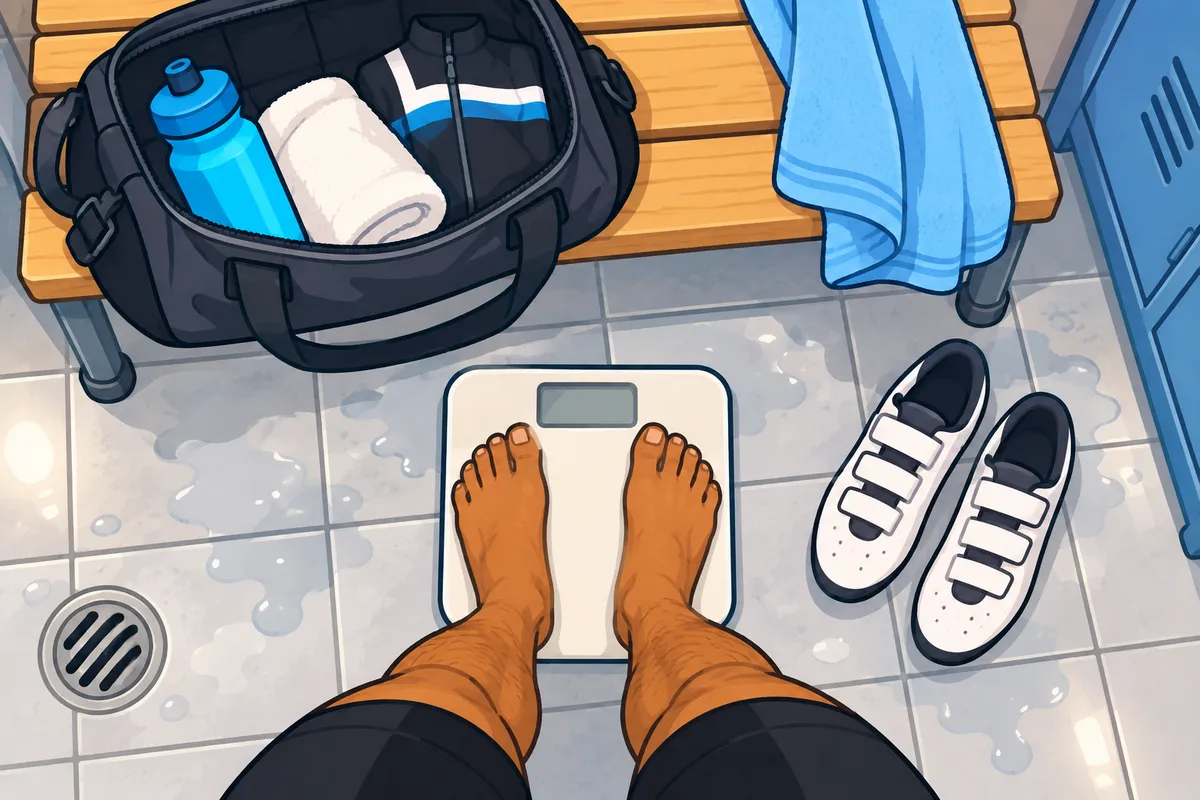
Three Sessions, Three Readings
Lena's range starts at zero, because one hour at her rate cannot take her past 2 % even with no bottle at all. Dana's starts at 400 ml, because two hours at her rate would.
Jordan's result shows why you treat the top of the range as a ceiling. The next section explains it.
Plan Your Drinks for the Next Session
Pick an amount inside the range and turn it into sips you can take on the move. The low end is the least that keeps you under 2 % over a session of the same length. The high end matches your sweat, and drinking past it makes you heavier.
The Low End Keeps You Under 2 %
The calculator works out how much weight you can lose before you hit 2 %, takes that off your total sweat loss, and spreads the rest over the hours. When the answer is zero, the session is short enough to drink to thirst.
For Dana, 400 ml an hour is 100 ml every 15 minutes, a few mouthfuls from a bike bottle. NATA's general starting point of about 200 ml every 15 to 20 minutes works out at 600 to 800 ml an hour, so it covers her with room to spare.
The High End Stops You Gaining Weight
Your sweat rate is the most you should drink in an hour of that session. NATA warns against drinking more than you lose, because too much plain water or sports drink is what causes exercise-associated hyponatremia, a dangerous fall in blood sodium.
That ceiling has a lid of its own. The Korey Stringer Institute puts what the stomach can absorb at about 1.2 L an hour, and NIOSH tells workers in the heat to keep fluid under 6 cups an hour, about 1.4 L (48 oz).
Jordan's 62 oz is above both limits, so drinking his whole sweat back on the run is off the table. He drinks what his stomach handles, plans a loop past a water fountain on hot days, and makes up the rest after. If you ever finish heavier than you started, you drank more than you lost, and low blood sodium has early warning signs worth knowing.
After the Session, Drink Back the Loss
Drink 100 to 150 % of the weight you lost, spread over the next two hours. NATA gives that range for replacing what you lost after exercise, and the Korey Stringer Institute advises finishing your rehydration within 2 hours.
Food is part of the refill. NATA asks you to eat and drink within 2 hours of activity, with enough sodium to replace your losses but not a large excess, so plain water is not always the best refill.
To count the refill in bottles, enter it with your bottle size; Lena's 800 to 1,200 ml is about 1.5 to 2.5 standard 500 ml bottles.
How Accurate Is a Sweat Rate Calculator?
It is as accurate as your weigh-ins. The arithmetic is exact, but a scale that rounds to half a kilo, a soaked shirt or a forgotten pee can shift the answer by a few hundred milliliters. Weigh with care and log every drink, and the result is close enough to plan a session around.
Small losses are the hardest case. After a short, easy session you may drop 0.3 kg, less than the step of a scale that reads to the nearest 0.5 kg, while a long, hot session gives a bigger loss and a steadier number.
These habits make the most difference:
- Use one scale for both weigh-ins. NATA asks for a calibrated scale accurate to 0.1 kg (0.2 lb) when it checks body mass.
- Weigh nude if you can, as the Korey Stringer Institute does in its test. Otherwise wear the same dry kit both times.
- Pee before the first weigh-in, and dry your skin and hair before the second.
- Measure your bottle once with a kitchen jug, and enter half a bottle as half.
- Enter the whole session length, warm-up included, since you sweated through all of it.
- Take both weights on the same day. NATA counts a change in body mass as a hydration measure only when you watch the loss happen.
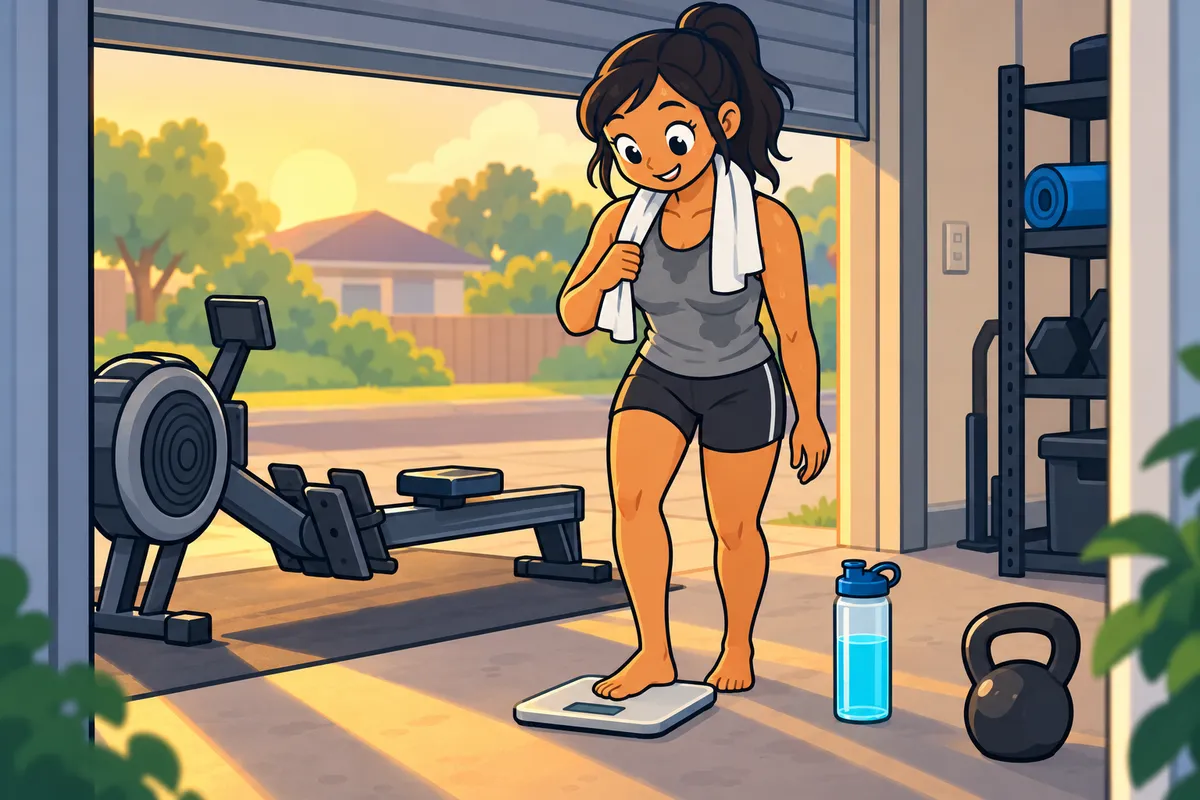
Test It More Than Once
One session gives you one number. NATA advises repeating the test in realistic weather, at different efforts, in the clothes and gear of your sport, so run it on an easy day and a hard one, in spring and again in summer.
Keep each result next to the date, the temperature and the session. After three or four tests you know your low, typical and high rate, and you can plan from the one that matches the day.
Is a High Sweat Rate Bad?
No, a high rate is a fact about you, the same as your height. NATA's adult range runs from 0.5 to 4.0 L an hour, and it lists body size, weather, effort and heat adaptation as things that move your number. A high rate needs a better plan, because you lose fluid faster than you can drink it.
The Korey Stringer Institute notes that people who sweat over 2 L an hour will find it hard to replace all of it during exercise. If your card shows that, plan around it:
- Start hydrated. The institute's own test begins once your urine is a light color.
- Use breaks to drink, since you cannot keep pace on the move.
- Refill at the top of the after-session range, with food or a salty drink.
- Shorten long hot sessions until you know how far your weight drops.
Salt matters too. NATA reports sweat sodium from 10 to 100 mEq/L, so two people with the same sweat rate can lose very different amounts of salt.
Notes by Sport and by Weather
Your rate belongs to one sport, one effort and one kind of day. Keep a separate number for each session you do often, and plan from the one that matches.
Running
You carry little on a run, so the plan is mostly about where you can drink. From a 5K to a half marathon, the answer changes with distance, and a full marathon needs race drinks planned hour by hour.
Cycling
A bike carries bottles, so you can drink close to your planned rate as you ride. Multiply the hourly amount by the hours of the ride to count bottles; a 3-hour and a 5-hour ride are worked out bottle by bottle.
Team Sports and Heavy Kit
Pads, helmets and long sleeves change how much you sweat. That is why NATA asks for tests in the standard clothing and equipment of your sport, so run yours in a real practice, then take the pads off for both weigh-ins so the sweat they soak up does not count.
Hot Days
Heat raises your rate, and so does getting used to the heat. NATA notes that sweat losses go up as you acclimatize, and NIOSH builds workers up to full shifts in the heat over 7 to 14 days.
Test again after your first two weeks of summer training. The rest of a hot day counts too, because the hours you spend off the track still call for more water than usual.
Bring Four Numbers Home From Your Next Workout
Weigh yourself before your next usual session, note what you drink, weigh again, and fill in the calculator. Save the four lines with the date and the weather.
Your sweat loss comes on top of an ordinary day, so set that everyday baseline from your weight too. A sheet on the fridge keeps count on the days between sessions.
Common Questions
Should I weigh myself with clothes on?
Weigh nude if you can, as the Korey Stringer Institute does in its sweat test. If not, wear the same dry kit for both weigh-ins.
Can I use pounds and ounces?
Yes. Switch the units to lb and oz and the calculator converts your weights and drinks, then shows every result in ounces.
How long should the test session be?
An hour of your usual training works well. Shorter or longer sessions work too, because the calculator divides the loss by the time you enter.
Can a teenager or child use this calculator?
No. It uses adult sweat ranges and adult limits. For school and club sports, young athletes need a plan built for their age.
General information for healthy adults, not medical advice. If a doctor has set your fluid amount, follow that.

Guides Behind the Numbers
Sources
- National Athletic Trainers' Association (Journal of Athletic Training). National Athletic Trainers' Association Position Statement: Fluid Replacement for the Physically Active, 2017.
- Korey Stringer Institute, University of Connecticut. Hydration, 2026.
- CDC NIOSH. Heat Stress Workplace Recommendations, 2026.
Formula and sources checked by the Glubbo Editorial Team on Oct 16, 2026.

Glubbo
Log a drink in 1 tap. Every glass fills a fish tank
Free · No account needed
912 people installed Glubbo in the last 30 days912 installed in 30 days
Free · No account needed

