Exercise and Heat · Workouts
How to Calculate Sweat Rate, With Worked Examples in kg and lb
 By the Glubbo team · Updated Oct 16, 2026 · 7 min read
On This Page
Weigh in, weigh out, add what you drank.
then divide by the hours you trained
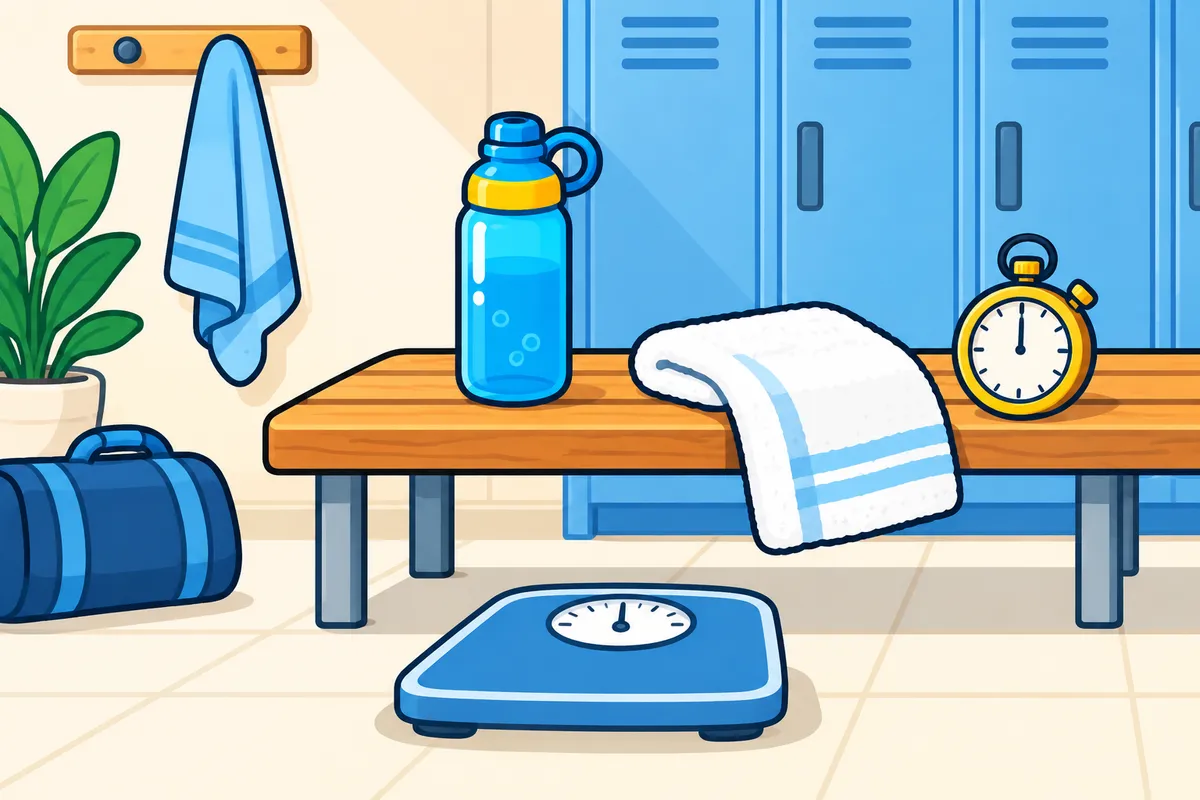
Your sweat rate turns general advice into your own plan. Two people on the same run can lose half a litre or two litres an hour, so the 200 ml every 15 to 20 minutes from our guide on how much water to drink before, during and after a workout fits one of them and misses the other.
You need a scale, a bottle you know the size of, and a watch. The formula below comes from the 2017 position statement of the National Athletic Trainers' Association (NATA).
How Do I Calculate My Sweat Rate?
Weigh yourself right before and right after exercise. Your sweat loss in litres is the weight you lost in kilograms, plus the fluid you drank, minus any urine you passed. Divide that by the hours you exercised, and you have your sweat rate in litres per hour.
Find Your Sweat Rate
- Weigh in
- Train for an hour
- Weigh out
- Add what you drank
- Divide by the hours
- Sweat loss (L) = weight before (kg) − weight after (kg) + fluid drunk (L) − urine (L)
- Sweat rate (L per hour) = sweat loss (L) ÷ exercise time (hours)
The formula works because a litre of water weighs about a kilo, so each kilo you lose stands for about a litre of sweat. In pounds, the Korey Stringer Institute puts it as "every 2.2 pounds a person loses equates to 1 liter of fluid loss". One pound lost is about 0.45 L, or 15 oz.
Step by Step
- Pee before you start, then weigh yourself in light, dry clothes. Write the number down.
- Note the start time and the size of your bottle.
- Train as usual and track every drink: a full 500 ml bottle finished is 0.5 L.
- If you pee during the session, note roughly how much.
- Towel off and weigh yourself again in the same clothes, before you eat or drink anything.
- Put the numbers into the formula.
Worked Example in Kilograms
Her bottle replaced about a third of what she sweated. That is fine: during exercise the target is to stay under 2 %, and NATA warns against drinking more than you lose.
Worked Example in Pounds
Working only in ounces? Count about 15 oz of sweat for each pound you lost. Marcus's 2.6 lb is about 40 oz, plus 20 oz drunk, minus 8 oz of pee: 52 oz.
What Is a Normal Sweat Rate?
There is no single normal. NATA puts adult sweat rates during exercise anywhere from 0.5 to 4.0 L an hour, and the Korey Stringer Institute cites a range of about 1 to 3 L an hour. Heat, effort, body size and fitness all move your number, so measure it instead of guessing.
What your number means depends on how it compares with what you can drink. NATA's "about 200 mL of fluid every 15 to 20 minutes" comes to 600 to 800 ml an hour, and the table shows how far that goes at four sweat rates.
| Your sweat rate | What 600 to 800 ml an hour covers | What to watch |
|---|---|---|
| 0.5 L (17 oz) an hour | More than you lose | Drinking on a timer can make you gain weight; drink to thirst |
| 1.0 L (34 oz) an hour | Most of it | The standard plan works for sessions of a few hours |
| 1.5 L (51 oz) an hour | About half | A 70 kg person can pass 2 % in under two hours; drink a little more and weigh in |
| 2.5 L (85 oz) an hour | A quarter to a third | You cannot keep up; plan breaks and a bigger refill after |
At the top of that range, more drinking is no fix. The Korey Stringer Institute notes that "the stomach only absorbs ~1.2 Liters per hour", and for workers in the heat NIOSH says intake "should not exceed 6 cups per hour", about 1.4 L.
Why Your Number Changes
Test more than once. NATA advises measuring sweat rate "several times under realistic environmental conditions and at varying exercise intensities", because an easy jog in March and a hard session in July are different tests.
Heat adaptation moves it too. NATA notes that "sweat losses increase and sweat-electrolyte concentrations decrease with heat acclimatization", so your summer rate can sit above your spring one; our page on how much water to drink in hot weather covers that season. In cold weather NATA reports that "the drive for thirst is blunted", as our page on dehydration in cold weather explains.
How Much Weight Loss During Exercise Is Too Much?
More than 2 % of your body weight. NATA and the American College of Sports Medicine both set the goal of losing no more than 2 % during exercise, and NATA adds that you should never gain weight. For a 70 kg (154 lb) person, 2 % is 1.4 kg (3.1 lb), and the table gives other weights.
| Body weight | Your 2 % line |
|---|---|
| 50 kg (110 lb) | 1.0 kg (2.2 lb) |
| 60 kg (132 lb) | 1.2 kg (2.6 lb) |
| 70 kg (154 lb) | 1.4 kg (3.1 lb) |
| 80 kg (176 lb) | 1.6 kg (3.5 lb) |
| 90 kg (198 lb) | 1.8 kg (4.0 lb) |
| 100 kg (220 lb) | 2.0 kg (4.4 lb) |
The line sits at 2 % for a reason. NATA reports that thirst typically rises "at about 2% hypohydration", and the ACSM position stand calls a bigger drop "excessive".
A gain is the other warning sign. If you finish heavier than you started, you drank more than you sweated, the pattern behind low blood sodium; our page on drinking too much water covers its symptoms.
Past 2 %, watch for the usual signs of dehydration, such as dark pee or dizziness when you stand up.
How to Use Your Sweat Rate
Use it to set how much you drink during long sessions and how much you drink back after. During, drink enough to stay under 2 %, never more than you lose.
- During: Priya sweats 1.04 L an hour, and her 2 % line is 1.28 kg. On a 2-hour run she loses about 2.1 L, so she drinks at least 0.8 L, about 400 ml an hour, to stay under it.
- After: NATA advises drinking back 100 to 150 % of the loss. Marcus lost 1.18 kg, so he drinks 1.2 to 1.8 L (40 to 60 oz) over the next two hours.
- Long or salty sessions: past an hour, a drink with carbohydrate and sodium can help; see electrolytes and sports drinks.
- Running: carrying the right amount is its own problem, covered in water for runners.
To turn a refill into bottles, type the amount into bottles per day and pick your bottle size.
Mistakes That Skew the Number
Most bad results come from the weigh-ins, not the maths. Check these before you trust your number:
- Weighing in a sweat-soaked shirt. The sweat in the fabric counts as body weight and shrinks your result.
- Eating or drinking between the end of the session and the second weigh-in.
- Leaving out urine. The formula subtracts it; skip that step and your rate comes out too high.
- A scale that reads only to the nearest 0.5 kg or 1 lb. On a 0.4 kg loss, that error is as big as the answer.
- Comparing weigh-ins from different days. Creatine loading or a salty dinner can shift your morning weight, so both numbers must come from the same session; see water with creatine for the loading shift.
- Testing once in spring and using the number all summer.
What to Do Today
Pick your most common session, the one you do every week, and run the test next time. Write down the date, the temperature, the session and the result, then repeat it on a hot day.
Your sweat loss sits on top of your everyday goal. Find that goal with the water intake calculator, which uses Glubbo's habit formula, and see how much water you need on an ordinary day for where the official numbers come from.
General information for healthy adults, not medical advice. If a doctor has set your fluid amount, follow that.

More in Exercise and Heat
Sources
- National Athletic Trainers' Association (Journal of Athletic Training). National Athletic Trainers' Association Position Statement: Fluid Replacement for the Physically Active, 2017.
- Korey Stringer Institute, University of Connecticut. Hydration, 2026.
- American College of Sports Medicine (Medicine and Science in Sports and Exercise). American College of Sports Medicine position stand. Exercise and fluid replacement (abstract), 2007.
- CDC NIOSH. Heat Stress Workplace Recommendations, 2026.
Sources checked by the Glubbo team on Oct 16, 2026. General information, not medical advice.