Exercise and Heat · Running, Cycling and Other Sports
How Much Water to Drink During a Marathon, Hour by Hour
Build your own race plan from one training run, with three runners from 3 h 30 to 6 hours worked out.
 By the Glubbo Editorial Team · Updated Oct 19, 2026 · 12 min read
On This Page
- How Much Water Should You Drink per Hour During a Marathon?
- Build Your Race Plan Hour by Hour
- Arriving at the Start Line Ready
- Should You Drink at Every Aid Station?
- Why Small Sips Work Better Than Big Gulps
- Can You Drink Too Much Water During a Marathon?
- Do Salt Tablets Help in a Marathon?
- Water or a Sports Drink at the Aid Stations?
- What About Gels and Other Food on the Course?
- Race Days in Heat and Cold
- After the Finish Line
- Your Everyday Goal in Marathon Training
- Rehearse the Drink Plan on Your Long Runs
- Sources
Short answer
Drink so you lose under 2 % of your weight, never gain.
- NATA's pace: about 200 ml (7 oz) every 15 to 20 minutes, 600 to 800 ml an hour.
- Set your own amount from a 90-minute run at race pace, weighed before and after.
- Drink by your plan, not at every station; slower runners risk drinking too much.
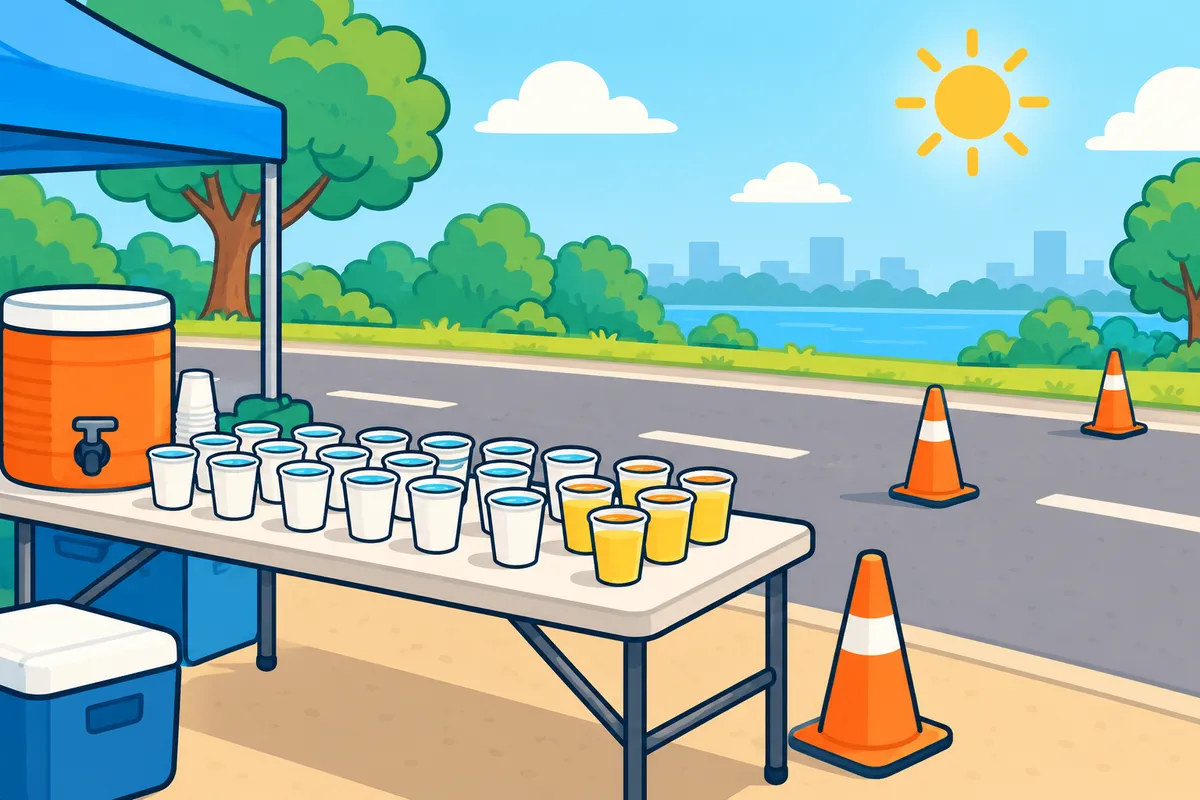
Drink enough during a marathon to finish less than 2 % lighter than you started, and never heavier. For a fast runner who sweats hard that can mean 800 ml (27 oz) an hour; for a six-hour finisher who sweats little, less than half of that. Your own sweat rate, measured on a long training run, sets the number.
How Much Water Should You Drink per Hour During a Marathon?
Enough that you finish less than 2 % lighter and never heavier. The National Athletic Trainers' Association (NATA) says about 200 ml (7 oz) every 15 to 20 minutes "may be ideal", which is 600 to 800 ml (20 to 27 oz) an hour. Smaller and slower runners who sweat less need less than that, and NATA warns against drinking more than you lose.
The two limits come straight from NATA. During exercise the goal is to "not allow more than a 2% body mass loss", and you "should not gain body mass" between the start and the finish.
Why Two Marathoners Need Different Plans
NATA makes the point with an example from the same race:
First Marathon, 6 Hours
- A 50-year-old woman in her first marathon
- Sweats about 0.4 L an hour
- About 2.4 L of sweat over the race
Elite Runner, 2 Hours 15
- A 28-year-old elite male runner
- Sweats more than 2 L an hour
- Over 4.5 L of sweat in a much shorter race
NATA says the two "should not receive the same hydration plan". Adult sweat rates during exercise run from 0.5 to 4.0 L an hour, so a cup count copied from a faster friend can be far too much for you.
Build Your Race Plan Hour by Hour
Start from your sweat rate, set the two limits, then spread the drinks over your race time. You need one long training run with a scale before and after it, plus the short sum that turns two weigh-ins into liters an hour.
Five Steps to a Race-Day Plan
- Weigh yourself before and after a 90-minute run at race pace
- Work out your sweat per hour from the weight lost plus what you drank
- Multiply by your goal time to get the race's total sweat
- Drink at least the sweat minus 2 % of your weight, and at most the full sweat
- Split it into drinks every 15 to 20 minutes and practice it on long runs
The American College of Sports Medicine gives the same method in its 2007 position stand: sweat rates vary so much that it recommends "customized fluid replacement programs", built from weighing yourself before and after exercise.
A 4-Hour-30 Finish
Take a 60 kg (132 lb) runner who sweats about 0.6 L an hour on a mild morning. Over 4 hours 30 minutes that is about 2.7 L, and the 2 % line is 1.2 kg. So the drinks must total at least 1.5 L and no more than 2.7 L.

At 150 ml (5 oz) every 20 minutes, three drinks an hour, from a gun at 8 am, the race looks like this:
| Hour | Drinks that hour | Drunk so far | Sweat so far | Weight change so far |
|---|---|---|---|---|
| 8–9 am | 3 × 150 ml | 0.45 L | 0.6 L | −0.15 kg |
| 9–10 am | 3 × 150 ml | 0.9 L | 1.2 L | −0.3 kg |
| 10–11 am | 3 × 150 ml | 1.35 L | 1.8 L | −0.45 kg |
| 11 am–12 pm | 3 × 150 ml | 1.8 L | 2.4 L | −0.6 kg |
| 12–12:30 pm | 1 × 150 ml | 1.95 L (66 oz) | 2.7 L | −0.75 kg (1.25 %) |
The runner crosses the line 0.75 kg lighter, inside the 2 % line, and lighter than at the start. Both of NATA's limits hold.
A 3-Hour-30 Finish
A 75 kg (165 lb) runner who sweats about 1.2 L an hour loses 4.2 L over 3 hours 30 minutes, and the 2 % line is 1.5 kg, so the drinks must total at least 2.7 L.
At NATA's upper pace, 200 ml every 15 minutes, that is 800 ml an hour and 2.8 L (95 oz) in all. The runner finishes 1.4 kg (1.9 %) lighter: just inside the line, which is why a heavy sweater needs the full pace from the first hour.
A 6-Hour Finish
A 65 kg (143 lb) runner who sweats about 0.4 L an hour, like the first-timer in NATA's example, loses about 2.4 L over 6 hours and needs only 1.1 L to stay inside the 1.3 kg line.
At 100 ml (3.4 oz) every 20 minutes that is 1.8 L, and the runner finishes 0.6 kg (0.9 %) lighter. Copying the heavy sweater's 200 ml every 15 minutes would mean 4.8 L, twice the sweat, and a finish about 2.4 kg heavier, the pattern the Boston study linked to low blood sodium.
Arriving at the Start Line Ready
Arrive with normal body water, not a surplus. The race-morning top-up, sized to your weight, ends about 4 hours before the gun, so your pee is pale yellow and your bladder empty when you line up.
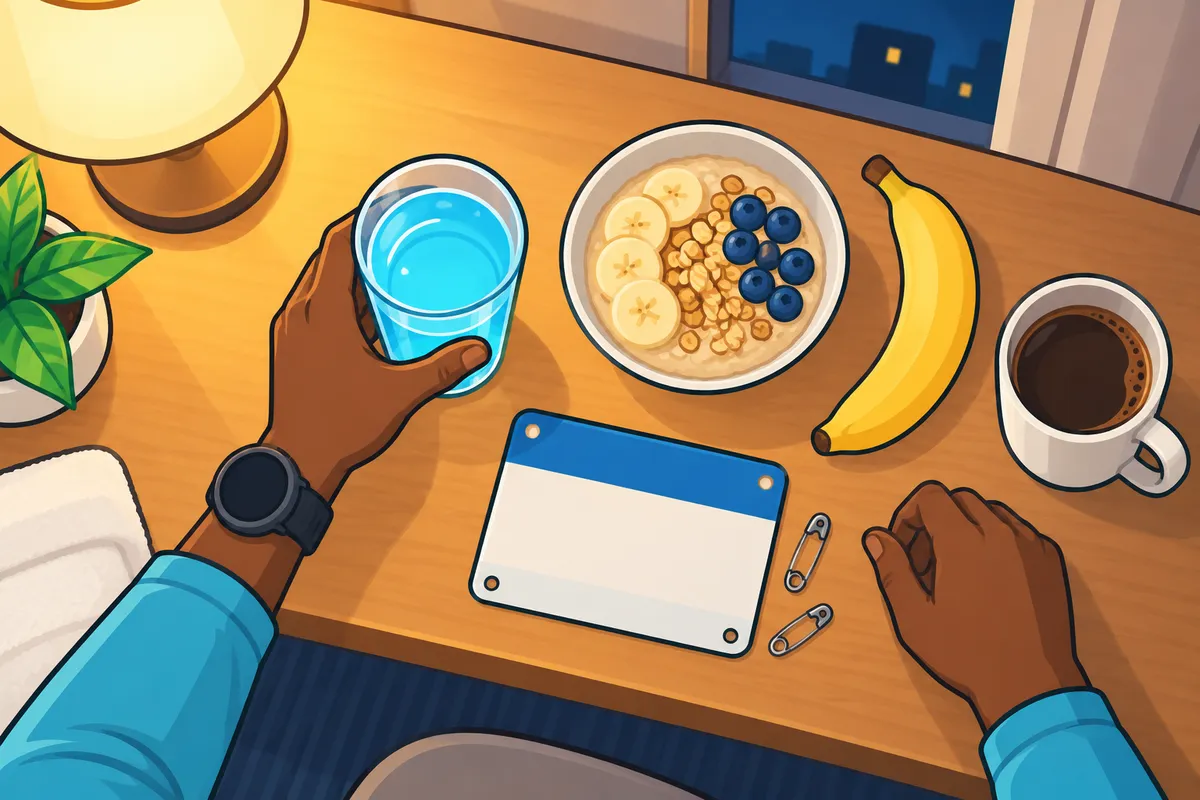
A big bottle in the starting pen only sends you to the toilet queue.
NATA also notes that competitive athletes can benefit from a drink with carbohydrate and electrolytes before activity, so a sports drink with breakfast is fine if your stomach knows it. Never try it for the first time on race morning.
Should You Drink at Every Aid Station?
No, drink by your plan. In the Boston Marathon study, drinking fluids at every mile was one of the habits linked to low blood sodium in the first, simpler analysis, along with drinking more than 3 L during the race. Count the drinks your plan needs, find those stations on the course map, and walk past the rest.
If your race spaces its stations differently from your training, adjust the size of each drink and keep the hourly total. Taking a cup and drinking half of it is a plan too.
Thirst still has a vote. NATA says that "most individuals can avoid fluid-balance problems by drinking when thirsty", and that competitive athletes may benefit from a plan that replaces their sweat losses; on race day, let thirst decide between a sip and a full cup. For recreational runners the CDC travel guide goes further: drink only enough to relieve thirst, because forcing fluids on someone who is not thirsty increases the risk of low blood sodium.
Why Small Sips Work Better Than Big Gulps
Your stomach empties fastest when it holds a moderate amount. NATA says keeping 400 to 600 ml (14 to 20 oz) of fluid in the stomach optimizes gastric emptying, and that about 200 ml every 15 to 20 minutes may be ideal. A cup gulped at a station and nothing for the next two miles misses that target.
Pace and dehydration both slow it down. At more than 80 % of your VO2max, a very hard effort, the stomach empties more slowly, and so does a fluid deficit above 4 %, which can bring on stomach symptoms. A runner racing near the limit does better with smaller, more frequent sips than with one big cup.
Can You Drink Too Much Water During a Marathon?
Yes, and slower runners face the higher risk. Drinking more than you sweat lowers the sodium in your blood, a condition called exercise-associated hyponatremia. NATA says it occurs in 10 % to 20 % of sampled marathon finishers, though cases that cause symptoms are less common.
What the Boston Study Found
The study took blood from 488 of 766 enrolled runners at the finish of the 2002 Boston Marathon.
- 488
- runners with a blood test at the finish
- 13 %
- had low blood sodium
- 0.6 %
- had the critical form
In the final analysis, three things went with it:
- Gaining weight during the race.
- Finishing in more than 4 hours compared with under 3 hours 30.
- A body-mass index at either extreme.
Being a woman, the type of drink and the use of anti-inflammatory painkillers made no difference in that analysis. Gaining weight during the race raised the odds of low sodium 4.2 times, and finishing in more than 4 hours instead of under 3 hours 30 raised them 7.4 times.
Why the Back of the Pack Is at Risk
A six-hour runner passes the same drink stations as a three-hour runner but sweats less and has twice as long to overdrink. The US National Academies note that symptomatic hyponatremia from exercise is usually linked to "greater than 6 hours of prolonged stressful exercise", and that healthy kidneys clear at most 0.7 to 1.0 L of water an hour.
The scale is your protection. If you weigh more at the finish than at the start, you drank more than you sweated, whatever your time.
Do Salt Tablets Help in a Marathon?
Probably not, and they can upset your stomach. NATA says "little evidence supports" salt tablets for holding on to fluid during activity, and that their side effects during exercise are unknown. If you want extra sodium, NATA advises fitting it to your own losses and practicing it in training.
Salt Tablets
- Little evidence they hold fluid (NATA)
- Often cause nausea and vomiting (CDC)
- Side effects during exercise are unknown (NATA)
Salty Food
- The most efficient way to replace salt for recreational athletes (CDC)
- A salty snack or meal after the finish
- Extra sodium is advised past 6 hours of exercise or in heat (CDC)
The CDC's travel health guide adds that most sports drinks do not hold enough sodium to prevent low blood sodium, which is why food, not a stronger drink, is the usual answer.
Water or a Sports Drink at the Aid Stations?
Either can work when the hourly total matches your plan.
| Water | Sports drink (3–8 % carbs) | |
|---|---|---|
| Replaces fluid | Yes | Yes |
| Replaces sodium | No | Some, but not enough to prevent low sodium alone (CDC) |
| Adds carbohydrate | No | Yes; aids performance in long events (NATA) |
| Recommended concentration | — | About 6 %, nothing above 8 % (Korey Stringer Institute) |
| Course availability | Every station | Check which brand your race serves |
NATA says endurance athletes "may be aided by fluids containing carbohydrates and electrolytes" in long events, and that a drink of 3 % to 8 % carbohydrate is best absorbed. Course drinks differ from race to race, so check which one yours serves and rehearse with it. A sports drink at every station also brings some sodium, but not enough to excuse extra volume.
What About Gels and Other Food on the Course?
Gels, chews and banana pieces add water and carbohydrate, and the water in them counts toward your hourly total. A typical gel sachet holds about 30 to 40 ml of fluid, so four gels over a race add roughly 120 to 160 ml. Count them, because they stack on top of your cup plan.
NATA says carbohydrate "can improve exercise performance during prolonged events" when the drink or food sits at 3 to 8 % carbohydrate concentration. A gel washed down with too much water can push the concentration below that and upset the stomach, so take each gel with a measured sip, not a full cup.
Should You Stop Drinking in the Last Miles?
No, but slow down if you feel bloated or hear sloshing. Stomach emptying slows above about 80 % of VO2max, the pace of a hard kick to the finish, so a cup at mile 25 may sit longer than one at mile 15. The Korey Stringer Institute advises adjusting the drink plan to how you feel as well as the clock, and never gaining weight over the race.
Race Days in Heat and Cold
Heat raises your sweat rate, so your training number undercounts on a hot morning. Weigh in on a warm long run if race day may be warm, and stay under the hourly limit for drinking in the heat.
Adjust Your Race-Day Drink Plan For
4 items- A hot morning: re-test your sweat rate on a warm long run and raise the hourly total
- A cold race: thirst fades, so drink to your plan even when you do not feel like it
- High altitude (above 2,500 m): you pee more for the first few days, so arrive early
- A slower finish than planned: cut each drink, not the schedule, so you do not overdrink
A runner who becomes confused, stops sweating normally or collapses in the heat needs help at once, because confusion is what sets heat stroke apart from heat exhaustion.
In the cold, thirst fades but sweat still leaves, so drink to your plan even when you do not feel like it. Above 2,500 m, you lose extra fluid through faster breathing and more urine for the first few days, which is why altitude races call for an early arrival. A slower finish than planned calls for smaller drinks at each station rather than skipping stations, because a shorter gap between cups keeps your stomach emptying steadily.
After the Finish Line
Weigh yourself if you can, then drink back 100 to 150 % of what you lost over the next few hours, not in the first ten minutes. NATA defines exercise-associated hyponatremia as low blood sodium "during or within 24 hours" of activity, so the finish-line chug can still cause trouble.
A runner 0.75 kg lighter at the line drinks 0.75 to 1.1 L (25 to 38 oz) through the afternoon, with a salty meal.
Your Everyday Goal in Marathon Training
Race-day drinks sit on top of your normal day. Glubbo's habit formula sets that everyday goal from weight, activity, climate and sex; in a marathon block you are on High activity, which adds 300 ml. Keep the two numbers apart: your everyday goal is for ordinary days, and your race number comes from the long-run sweat test.
Rehearse the Drink Plan on Your Long Runs
- Weigh yourself before and after your next 90-minute run at race pace.
- Turn the result into liters of sweat an hour, and mark your 2 % line in kilos.
- Write your drink plan by the hour and mark the stations you will use.
- Practice the plan, drinks and gels included, on your last three long runs.
- On race morning, finish your drinks a few hours before the start.
General information for healthy adults, not medical advice. If a doctor has set your fluid amount, follow that.
More in Exercise and Heat



Sources
- Journal of Athletic Training (National Athletic Trainers' Association). National Athletic Trainers' Association Position Statement: Fluid Replacement for the Physically Active, 2017.
- New England Journal of Medicine (Almond and colleagues). Hyponatremia among runners in the Boston Marathon, 2005.
- Medicine and Science in Sports and Exercise (American College of Sports Medicine). American College of Sports Medicine position stand. Exercise and fluid replacement (abstract), 2007.
- Korey Stringer Institute, University of Connecticut. Hydration, 2026.
- National Academies of Sciences. Dietary Reference Intakes, Chapter 4: Water, 2005.
- CDC Yellow Book. Heat and Cold Illness in Travelers, 2025.
Sources checked by the Glubbo Editorial Team on Oct 19, 2026. General information, not medical advice. How we write and check our guides.

