Sleep and Recovery · Sleeping Better
How to Beat Jet Lag: Shift Your Clock an Hour a Day, East or West
How many days your body needs, the light plan for east and west, and the pre-trip shift the CDC suggests.
 By the Glubbo Editorial Team · Updated Oct 19, 2026 · 8 min read
On This Page
- How Long Does Jet Lag Last?
- Which Light Helps After Flying East or West?
- How Do You Beat Jet Lag?
- Which Flight Is Best for Jet Lag?
- How Do You Get Over Jet Lag Fast?
- Does Melatonin Help With Jet Lag?
- Should You Nap When You Have Jet Lag?
- Water, Caffeine and Alcohol on the Flight
- Pick a Plan for Your Trip
- Packing for the Time Change
- Sources
Short answer
Move your clock before you fly, then use daylight.
- Your clock adjusts about 1 hour a day after flying east, 1.5 hours flying west (CDC).
- Shift bedtime 1 hour a day for 2 to 3 days before you leave.
- On arrival, live on local time: meals, light, sleep; naps of about 20 minutes.

Move your sleep about an hour a day toward your destination for the 2 to 3 days before you fly, then live on local time the moment you land: daylight, meals and bedtime on the new clock. The CDC says your body clock adjusts about 1 hour a day after flying east and 1.5 hours a day after flying west.
Jet lag is your body clock still running on home time. Your watch says 7 AM in Rome; your body says 1 AM in New York and wants to sleep.
How Long Does Jet Lag Last?
About one day for each time zone you cross going east, and a little less going west. The CDC's average adaptation rate is 1 hour a day after eastward flights and 1.5 hours a day after westward ones. The NHS says jet lag usually improves within a few days.
These are averages worked from the CDC's rates, not a promise. The CDC counts jet lag as a disorder only after crossing at least two time zones, and only when symptoms start within 1 to 2 days of the trip; one zone is a normal Monday after a late weekend.
What Jet Lag Feels Like
The main symptoms are below. Less often jet lag also causes indigestion, nausea, constipation, changes in appetite and mild anxiety.
Symptoms of jet lag
5 items- difficulty sleeping at bedtime and waking up in the morning
- tiredness and exhaustion
- difficulty staying awake during the day
- poor sleep quality
- concentration and memory problems
Which Light Helps After Flying East or West?
Morning light after flying east, and no bright light early in the morning after flying west. Going east, you want light to pull your clock earlier; going west, you let it slide later.
The east leg is the slower one: six zones east takes about six days to adjust, against about four for six zones west, at the CDC's rates of 1 and 1.5 hours a day.
Flying east
- Get bright light in the early morning
- Avoid light in the evening
- Shift bedtime 1 hour earlier a day before you go
Flying west
- Avoid bright light in the early morning
- Go outside in daylight at local time
- Shift bedtime 1 hour later a day before you go
Does the Light Rule Hold on Long Trips?
Not always. The CDC says the best timing for light "is based on the direction of travel and the number of time zones crossed", so the simple rule above fits a trip of a few zones best. For a long eastward flight, the CDC points to a jet lag calculator for personal timing instead of a fixed rule.
How Do You Beat Jet Lag?
Start before you leave, keep going on the plane, and live on local time from the first morning. The CDC suggests moving your sleep 1 hour a day for the 2 to 3 days before the trip, earlier for an eastward flight and later for a westward one. Every hour you move at home is one fewer day of jet lag at the other end.
Beat jet lag in four moves
- 2 to 3 days before: move bed and wake times 1 hour a day toward the destination
- On board: set your watch to local time and sleep if it is night there
- On arrival: daylight at the right time of day for your direction
- From day one: meals, light and sleep on local time
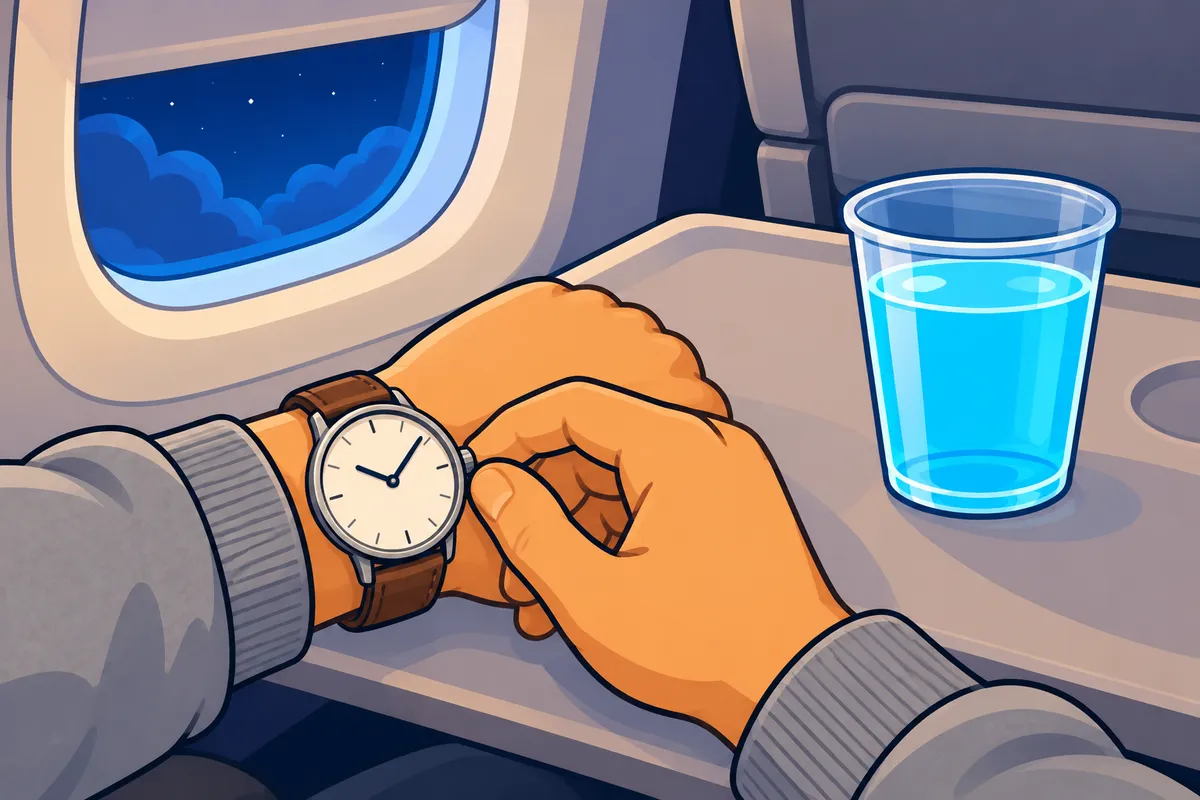
New York to London in Two Days Instead of Five
London is 5 hours ahead of New York, a trip of 5 zones east. At the CDC's rate of 1 hour a day, that is about 5 days of jet lag if you change nothing.
Move your sleep 1 hour earlier on each of the 3 nights before the flight, and you land only 2 zones behind. That leaves about 2 days to adjust instead of 5, and you have spent the shift in your own bed.
Short Trips Are Different
For a trip under 2 days, the CDC suggests keeping your home schedule instead of adapting. Another line is drawn at 2 to 3 days, where you could keep your eating and sleeping times on home time.
The smallest shift of all happens without a flight, when the clocks move an hour twice a year, and the same small nightly steps carry you through it.
Which Flight Is Best for Jet Lag?
The one that lands when daylight can do its work. The CDC says to choose a flight that arrives at a time that gives you the best timed light exposure for your direction.
Where you can, pick the arrival time before the price.
| Direction | Best arrival (light rule) | Why |
|---|---|---|
| East | Morning, after an overnight flight | The CDC asks for bright light in the early morning |
| West | Afternoon or early evening, after a daytime flight | You can stay up in daylight until local bedtime |
How Do You Get Over Jet Lag Fast?
Live on local time from the first hour. The CDC's advice is to time meals, sleep and light exposure to the destination time zone. Set an alarm so you do not oversleep, and spend time outdoors in daylight.
A first day in London on London time
- 7 AM
- 1 PM
- 4 PM
- 10 PM

Daylight is the strongest clock-setter you have, and it costs nothing. A morning walk on your first day does more for the shift than a second coffee.
Does Melatonin Help With Jet Lag?
The two health bodies disagree. The CDC says timing decides everything:
- Taken when your body clock thinks it is early evening, melatonin moves your clock earlier, which helps after an eastward flight.
- Taken in the morning, it moves your clock later, which helps after a westward flight.
Melatonin tablets are not recommended on the NHS for jet lag because there is not enough evidence they work. Daylight needs no prescription, and melatonin's long-term safety has not been studied. Ask your doctor or pharmacist before you take any sleep aid or melatonin for a trip, since the right choice depends on you and your direction.
Should You Nap When You Have Jet Lag?
A short one, yes; a long one, no. The two sources set the line in different places:
- The CDC says daytime naps of 20 to 30 minutes can help you stay alert through the local day, while longer ones can interfere with your night.
- The NHS goes further and suggests avoiding daytime naps.
The hard moment is the first afternoon after an overnight flight east. Set an alarm for 20 minutes, and see why 10 to 20 minutes beats a long nap if you are tempted to lie down for longer.
Water, Caffeine and Alcohol on the Flight
Drink as you would on any long day. The CDC says to stay hydrated because volume depletion can worsen physical symptoms of jet lag, and the NHS tells you to drink plenty of water on the plane. Carry an empty bottle through security and refill it at the gate for the flight.
Caffeine helps you through the first afternoon, but the CDC says to stop it 6 hours before bedtime; its example day plan stops after 4 PM. Go easy on alcohol too: the CDC asks you to avoid excess, and too much of either can make jet lag worse.
Once you land, enter your new local wake time and bedtime in the drink-time planner, and your drinks follow the new clock along with your meals.
Pick a Plan for Your Trip
The right plan depends on how far and how long you go.
Your jet lag plan by trip
- A 1- or 2-day tripStay on home time, as the CDC and NHS suggest for short trips
- Flying east for a week or moreBedtime 1 hour earlier a day for 3 days; morning light on arrival
- Flying west for a week or moreBedtime 1 hour later a day; no bright light early in the morning
- Landing in the morning after a night flightA short nap of 20 to 30 minutes, outdoors after it, bed at local bedtime
Packing for the Time Change
Pack for the time change
4 items- An eye mask and earplugs, to sleep on board if it is night at your destination
- Dark sunglasses, to block light at the wrong time of day (CDC)
- A bottle to refill after security: drink plenty of water on the flight
- An alarm set for local time, so you do not oversleep the first morning
General information for healthy adults, not medical advice. If a doctor has set your fluid amount, follow that.

More in Sleep and Recovery


Sources
- CDC Yellow Book 2026 (Riedy and Williams). Jet Lag Disorder, 2025.
- NHS. Jet lag, 2023.
- Centers for Disease Control and Prevention. About Sleep, 2024.
Sources checked by the Glubbo Editorial Team on Oct 19, 2026. General information, not medical advice. How we write and check our guides.

