Drinking Habits · Building the Habit
How to Stay Hydrated While Traveling, From Airport to Hotel
The bottle rules at security, the pace on a plane and the first days away.
 By the Glubbo Editorial Team · Updated Nov 2, 2026 · 10 min read
On This Page
- Does Flying Dehydrate You?
- How Much Water Should You Drink on a Plane?
- Can You Bring an Empty Water Bottle Through Airport Security?
- Does Drinking Water Prevent Blood Clots on a Flight?
- Road Trips, Trains and Long Bus Rides
- What to Drink Where the Tap Water Is Not Safe
- Hot Destinations, Jet Lag and the First Days
- Pack Tonight
- Common Questions
- Sources
Short answer
Carry a bottle and sip every waking hour you fly.
- Take the bottle through security empty and fill it at the gate.
- On long flights, sip about 100 to 300 ml (3 to 10 oz) an hour.
- Go easy on caffeine and alcohol, which the NHS says can make jet lag worse.
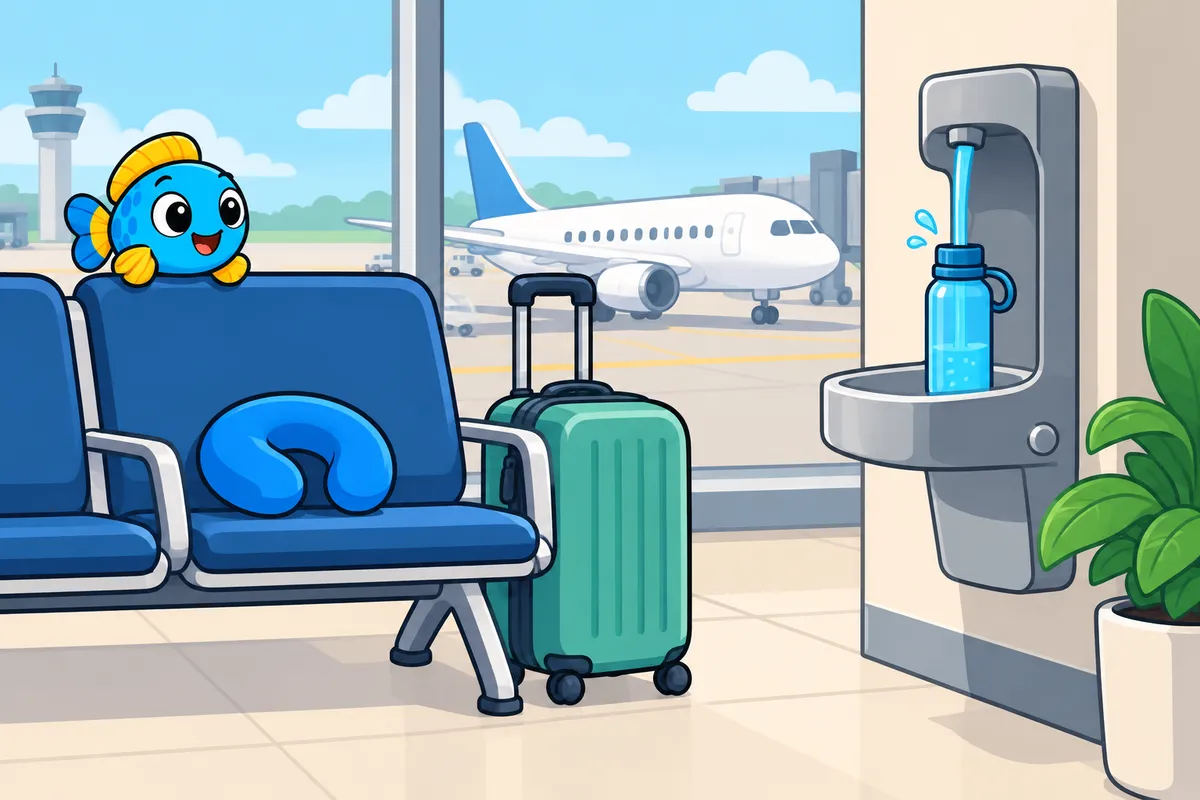
Carry an empty bottle through security, fill it airside and sip about 100 to 300 ml (3 to 10 oz) an hour on a long flight. Cabin air is dry, but how much water an ordinary flight costs you has been measured in very few studies.
Travel breaks every drinking cue you have at home. No kettle, no desk, no fridge, and a security line that takes your water away just as the day starts. So you rebuild the cues on the road: an empty bottle in your bag, a refill after every checkpoint and a sip every waking hour in the air.
Does Flying Dehydrate You?
A little, mostly through your breath and skin, and the evidence is thinner than most travel tips suggest. The CDC puts cabin air at 10 to 20 % humidity, dry enough to irritate your nose, throat and eyes. Few studies have measured how much water a normal passenger loses on a normal flight.
- 10–20 %
- humidity of cabin air in flight
- 160 → 360 ml
- breathing losses an hour at rest, 60 % to 12 % humidity (a calculation)
- 2,440 m
- the altitude the maximum cabin pressure matches (8,000 ft)
What the Dry Air Does to Your Water
Dry air pulls more water out with every breath. A 2020 review in Nutrients calculates that resting breathing losses rise from about 160 ml to 360 ml an hour when humidity drops from 60 % to 12 %.
That figure is a calculation for a person at rest in a room at about 21 °C, not a measurement on passengers. The same review found only a handful of flight studies, most of them small:
- 71 volunteers on an 8-hour flight;
- 40 men on a 9-hour flight;
- 12 volunteers on a 7-hour one.
Its three authors describe it as a narrative review, and they say the effect of an ordinary flight on hydration is still poorly measured.
The Cabin Pressure
The CDC says cabins are pressurized to the equivalent of at most 2,440 m (about 8,000 ft) above sea level, and the review gives the minimum in-flight pressure as 75 kPa. The air is thinner than at the ground.
Most people feel the dryness long before they feel thirsty. A dry throat on a plane tells you about the air, and your pee tells you about your water: pale yellow means you are fine.
How Much Water Should You Drink on a Plane?
On a long flight, about 100 to 300 ml (3 to 10 oz) an hour, counting the water in your meal. That is the range the 2020 review gives for long-haul flights. Its authors call older advice to add 15 to 20 ml an hour "likely insufficient".
The review is not fully consistent: one of its tables suggests a minimum of 200 to 250 ml an hour. Read both as a sensible pace, not a measured requirement.
For a flight of 3 to 12 hours, awake the whole way, the range works out like this:
| Flight | At 100 ml an hour | At 300 ml an hour |
|---|---|---|
| 3 hours | 300 ml (10 oz) | 900 ml (30 oz) |
| 6 hours | 600 ml (20 oz) | 1.8 L (61 oz) |
| 9 hours | 900 ml (30 oz) | 2.7 L (91 oz) |
| 12 hours | 1.2 L (41 oz) | 3.6 L (122 oz) |
You sleep on most overnight flights, and that is fine. The review advises timing your drinks so they do not break up your sleep, so drink well before you settle down and again when you wake.
A 6 AM Departure With a 500 ml Bottle
- 5:30 AM
- 6:30 AM
- 8 AM
- 9:30 AM
- 11 AM
- 12:30 PM
- 3 PM
- 6 PM
- 8 PM
Do You Need Electrolytes on a Long Flight?
Water first; electrolytes are an extra, not a replacement. In one research letter the review describes, 40 healthy men drank either water or an electrolyte and carbohydrate drink on a 9-hour flight, and the electrolyte group kept more plasma volume and passed less urine.
The review concludes that electrolyte and carbohydrate drinks "may be beneficial, in addition to pure water". The evidence is one small study, so a salty snack with your water is a reasonable low-cost version.
Coffee, Alcohol and Juice in the Air
Water is the easy choice, and it is not the only one.
- The NHS advice on jet lag is to "drink plenty of water" during the flight and to avoid "too much caffeine or alcohol", because both can make jet lag worse.
- Alcohol has a second cost on a plane. The CDC chapter on travel blood clots notes that it "may induce diuresis, as well as promote immobility", so you pee more and move less. That is also why a glass of wine never goes in your water total.
- Your usual coffee still counts. The review cites a meta-analysis in which about 300 mg of caffeine had only a minor diuretic effect, and it advises travelers who drink coffee daily to stay at or below 300 mg in total; anyone who is not used to caffeine should skip it on the plane.
Fine on Board
- Water, plenty of it (NHS)
- Your usual coffee, up to 300 mg caffeine in total
- Sealed bottled water from the drinks cart
Go Easy
- Alcohol: you pee more and move less (CDC)
- Too much caffeine: worse jet lag (NHS)
- Wine never goes in your water total
Can You Bring an Empty Water Bottle Through Airport Security?
Yes. The TSA allows an empty water bottle in both carry-on and checked bags, and the officer at the checkpoint has the final say. A full bottle is a liquid, and liquids in your carry-on must be 3.4 oz (100 ml) or less each.
That rule comes from the TSA liquids page: travel-size containers in one quart-sized bag, and anything larger goes in the hold. So drink your bottle before the line, carry it through empty and fill it at the gate.
The same page lists medications and infant and child nourishments as exempt from the 3.4 oz limit, so those can travel in larger amounts; tell the officer at the start of screening.
Your Water Plan, Airport to Arrival
5 items- Pack an empty bottle in your carry-on
- Drink what is left before the security line
- Fill it at a fountain or café once you are airside
- Sip 100 to 300 ml an hour on long flights
- Drink before you sleep on board, and again when you wake
A 500 ml (17 oz) bottle covers about 2 to 5 hours of flying at that pace. On a long-haul flight you will need two or three refills from sealed bottles the crew hands out, and the refills for a whole travel day depend on your bottle size.
Does Drinking Water Prevent Blood Clots on a Flight?
No study shows that it does. The CDC states that "there is no evidence for an association between dehydration and travel-associated VTE", the clots that form in the legs. It adds that staying hydrated is "reasonable and unlikely to cause harm", though it cannot be recommended specifically to prevent them.
What the CDC does back is movement:
- For flights under 4 hours the risk of a symptomatic clot is negligible.
- On longer trips, walking the aisle and doing calf exercises is "reasonable".
So the two habits go together. Every sealed bottle you ask for is a walk to the galley, and every walk is a chance to ask for one.
Road Trips, Trains and Long Bus Rides
The same pace works on the ground, with a bottle per person and a refill at every stop, and a car is easier than a plane because nothing stops you from carrying a full 1 L (34 oz) bottle.
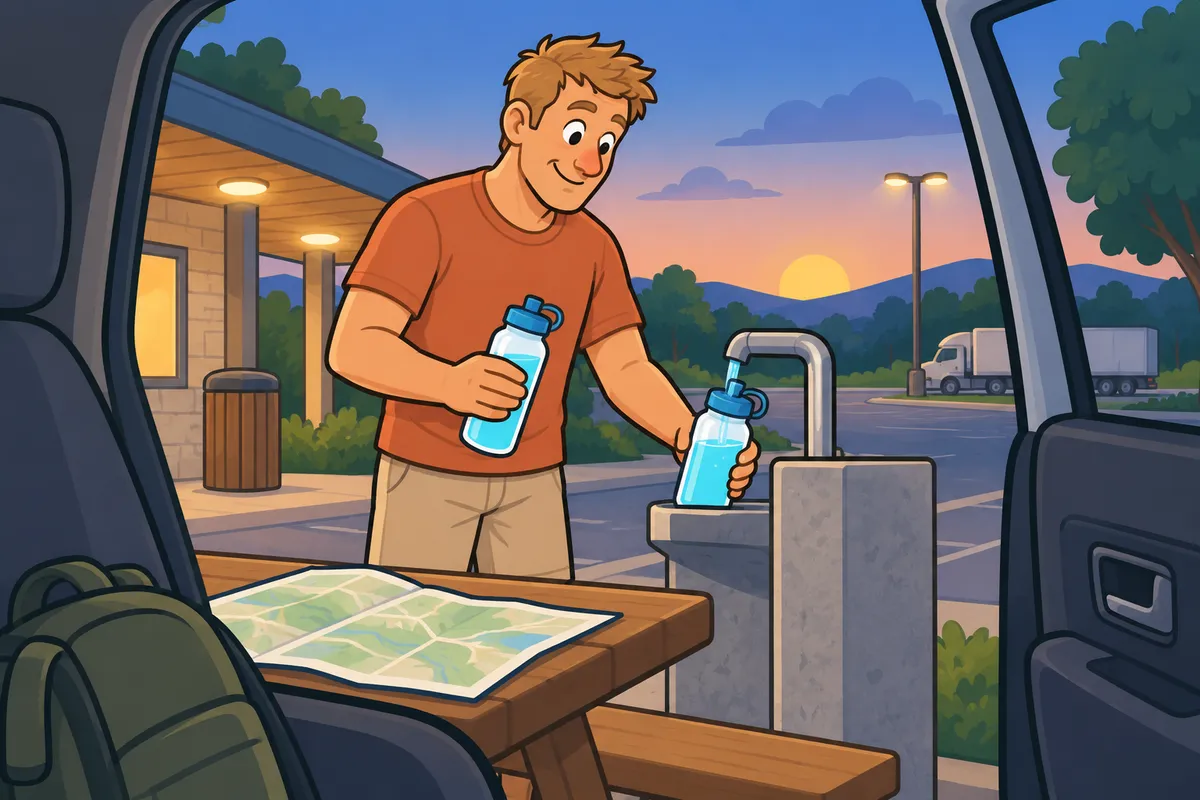
The trap on a road trip is drinking less to stop less. If you skip water to save a bathroom stop, you also skip the walk your legs need on a drive longer than 4 hours.
Set a repeating reminder on your phone for the long stretches when the road gives you no cue; every two hours is enough on a day of sitting.
What to Drink Where the Tap Water Is Not Safe
Bottled water from a sealed container, hot drinks made with boiled water and sealed canned drinks. Where tap water may be unsafe, the CDC advises "commercially bottled water from an unopened, factory-sealed container", and it says tea and coffee made with water that has just boiled "generally are safe to drink".
Ice is the drink people forget: the CDC tells travelers to avoid ice unless they are "reasonably certain" the ice came from safe water, and to ask for drinks without it.
Sealed cans and bottles are generally safe, though the CDC suggests you wipe the outside clean and dry before you drink from them.
Generally Safe
- Bottled water from a factory-sealed container
- Tea and coffee made with just-boiled water
- Sealed cans and bottles, wiped clean and dry
Skip It
- Ice, unless you know it came from safe water
- Tap water where it may be unsafe
- Drinks with ice: ask for them without
What to Drink If Travelers' Diarrhea Strikes
Keep drinking. The CDC says that in mild cases "any preferred liquid (including sports drinks)" keeps you rehydrated, while overly sweet drinks such as sodas can cause osmotic diarrhea in quantity. For severe fluid loss, oral rehydration solution from a packet, mixed into boiled or treated water, is the best replacement.
Hot Destinations, Jet Lag and the First Days
Your daily goal moves with the weather at your destination. Glubbo's habit formula adds 250 ml for a hot climate, so the same person needs one more glass a day in Bangkok than in Boston, and the water intake calculator shows the number for your own trip.
Long walks in the heat add more on top, and a day outside in the heat has its own hourly pace.
Jet Lag and Your Drinking Times
Jet lag moves your waking hours, and your drinks should move with them. Drink on the new local clock from the first morning, and let the evening taper off as you would at home, so the 3 am bathroom trip does not cut your first night short.
Cold Water on a Hot Trip
People drink about half as much again when the water is cool, which helps on a hot trip, as long as your ice comes from safe water.
If your trip falls on a fasting day, water rules depend on the fast:
- On an intermittent fasting plan, water stays allowed in the fasting hours.
- During Ramadan, your water fits between iftar and suhoor.
Pack Tonight
Before you leave:
- Put an empty bottle in your carry-on tonight, so you do not have to remember it at the door.
- Find out where the fountains sit after security at your airport.
On the plane:
- Drink a cup each waking hour.
- Take a sealed bottle at every drinks round instead of tap water or tea and coffee made from the plane's tank.
- Walk to the galley to ask for one on flights longer than 4 hours.
Common Questions
Can you take frozen water through airport security?
Yes, if it is frozen solid when you reach the checkpoint, TSA says. A bottle that has started to melt, turned slushy or has any liquid at the bottom falls under the 3-1-1 liquids rule.
Can you take electrolyte powder through airport security?
Yes, in small amounts. TSA says a powder container over 12 oz (350 ml) in a carry-on may need extra screening, and officers throw it away if they cannot clear it, so pack a large tub in the checked bag.
General information for healthy adults, not medical advice. If a doctor has set your fluid amount, follow that.
More in Drinking Habits

Sources
- US EPA. EPA Announces Results of Second Round of Aircraft Drinking Water Testing (news release), 2005.
- CDC Yellow Book. Air Travel, 2025.
- CDC Yellow Book. Deep Vein Thrombosis and Pulmonary Embolism, 2025.
- CDC Yellow Book. Food and Water Precautions for Travelers, 2025.
- CDC Yellow Book. Travelers' Diarrhea, 2025.
- Nutrients (Zubac, Buoite Stella, Morrison). Up in the Air: Evidence of Dehydration Risk and Long-Haul Flight on Athletic Performance, 2020.
- NHS. Jet lag, 2023.
- Transportation Security Administration. Empty Water Bottle, 2026.
- Transportation Security Administration. Liquids, Aerosols and Gels Rule, 2026.
- Transportation Security Administration. Ice, 2026.
- Transportation Security Administration. What is the policy on powders? Are they allowed?, 2026.
Sources checked by the Glubbo Editorial Team on Nov 2, 2026. General information, not medical advice. How we write and check our guides.

