What Counts · Coffee, Tea and Other Drinks
Does Alcohol Dehydrate You? What Happens and How Much Water Helps
 By the Glubbo team · Updated Oct 16, 2026 · 8 min read
On This Page
A little, for a few hours.
the extra peeing passes within hours
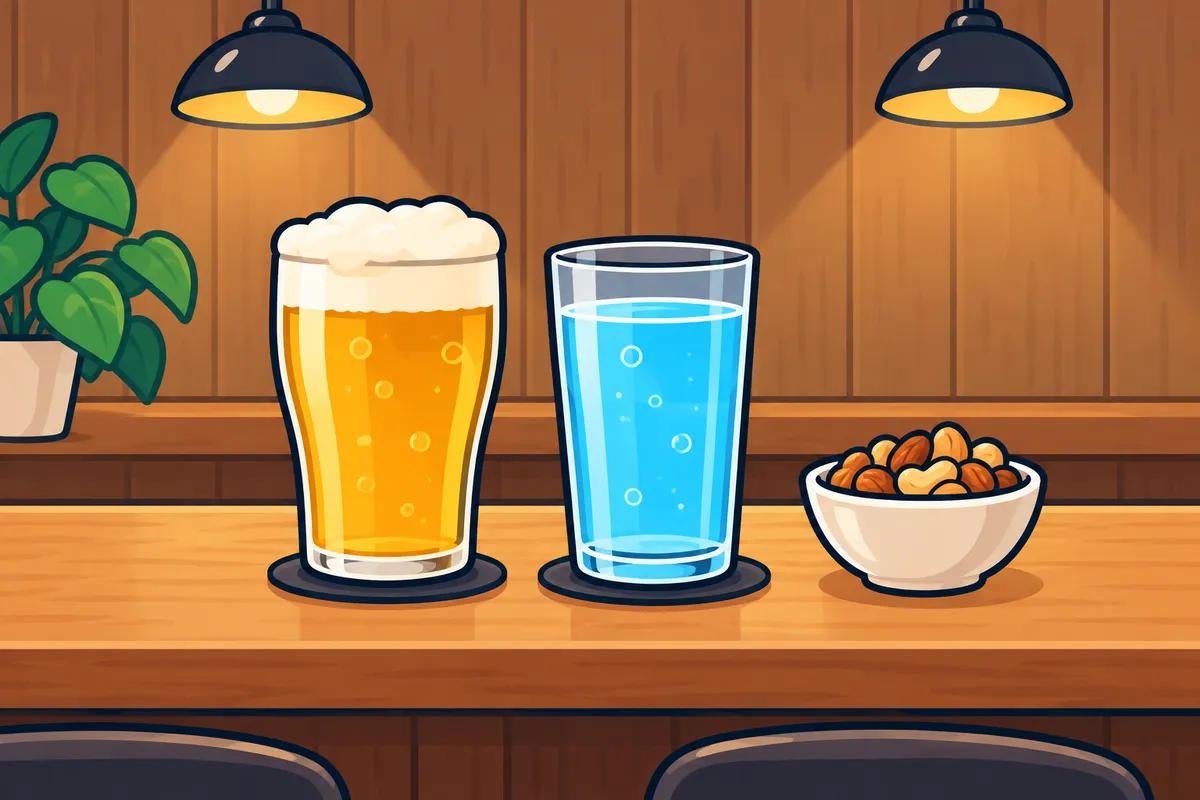
Alcohol does make you pee more, for a few hours. Over a whole day the extra loss is small, and a normal glass of beer barely shows it at all.
Glubbo still leaves alcohol out of your water goal, for reasons our guide to what counts toward your water intake sets beside every other drink. Here you get what the trials measured, how much water to drink next to a drink, and what water can and cannot do for a hangover.
Does Alcohol Dehydrate You?
Yes, but only for a short time. Alcohol holds back a hormone that tells your kidneys to keep water, so you pee more in the hours after drinking. The US National Academies judged the effect transient and found it "would not result in appreciable fluid losses over a 24-hour period."
The hormone is vasopressin. The NIAAA explains that when alcohol suppresses it, you lose extra fluid, and that "the mild dehydration that results likely contributes to hangover symptoms such as thirst, fatigue, and a headache."
What Happens Over the Next 12 Hours
The National Academies describe one study where healthy men drank 1.2 g of alcohol per kg of body weight, mixed into fruit juice. For an 80 kg (176 lb) man that is 96 g of alcohol, close to seven US standard drinks of 14 g each.
| Time after drinking | What the kidneys did | What it means for you |
|---|---|---|
| First 3 hours | Made more urine than usual | You lose a little more fluid than the drink gave you |
| From about 6 hours | Held water back (the report calls it an antidiuretic phase) | Your body starts to keep water again |
| Up to 12 hours | The holding-back phase could last this long | The early loss is partly made up overnight |
The panel adds that the effect of alcohol "appears to change during the course of the day" and may depend on how much water you drank at earlier meals. It also calls these data limited, so read the table as a rough shape, not a timetable.
Does Beer Dehydrate You?
Not at normal amounts. In a 2017 trial, 750 ml (25 oz) of 5 % beer made men pee no more than the same amount of alcohol-free beer. Wine and spirits with the same 30 g of alcohol raised urine a little in the first 4 hours, and by 24 hours none of the three differed from its alcohol-free version.
Each man drank his drink in three portions over lunch, and the researchers collected urine for a full day. The numbers below are the average urine in the first 4 hours.
| Drink, 30 g of alcohol | How much he drank | Urine in 4 hours | Alcohol-free version | After 24 hours |
|---|---|---|---|---|
| Beer, 5 % | 750 ml (25 oz) | 829 ml | 836 ml | No difference |
| Wine, 13.5 % | 279 ml (9.4 oz) | 536 ml | 504 ml | No difference |
| Spirits, 35 % | 108 ml (3.7 oz) | 471 ml | 450 ml (water) | No difference |
The authors concluded that only stronger drinks such as wine and spirits gave "a short and small diuretic effect." Beer carries so much water that it covers its own alcohol.
A 2016 trial of 72 fasting men found the same for lager. The men who drank 1 L (34 oz) of it within 30 minutes passed no more urine over the next 4 hours than after a liter of still water.
Does Alcohol Count as Water Intake?
Not in Glubbo. Beer does leave water in your body, but counting it toward a water goal would reward you for drinking more of it.
Strong drinks bring very little water anyway. The three shots of spirits in the 2017 trial added up to 108 ml (3.7 oz), less than half a glass. Log the water you drink beside your drink, and leave the drink itself out.
How Much Water Should You Drink With Alcohol?
No official body sets an amount. The NHS advises you to "alternate your drinks with water or non-alcoholic drinks", drink more slowly and drink with food. A simple way to follow that is one 250 ml (8.5 oz) glass of water for every drink.
A drink here means a US standard drink, which the CDC sets at 14 g of pure alcohol. Each of these holds that much, and each gets the same 250 ml (8.5 oz) glass of water beside it:
Sparkling water or soda water works as the glass in between, and counts just as well; our page on whether sparkling water is good for you covers the bubbles. Skip energy drinks as a mixer: the NCCIH warns that people who mix caffeine with alcohol "may not be able to tell how intoxicated they are", and our coffee guide explains how much caffeine one can holds.
A Night Out, Counted
Tom weighs 90 kg (198 lb), walks a lot at work and lives somewhere mild. Glubbo's habit formula gives him a goal of 2,950 ml (100 oz). On Friday he has four 12 oz beers between 7 pm and 11 pm.
| Time | Drink | In his log? |
|---|---|---|
| 6:30 pm | Dinner with a 250 ml glass of water | 250 ml |
| 7:00 pm | Beer, 355 ml | No |
| 7:45 pm | Water, 250 ml | 250 ml |
| 8:30 pm | Beer, 355 ml | No |
| 9:00 pm | Sparkling water, 250 ml | 250 ml |
| 9:45 pm | Beer, 355 ml | No |
| 10:15 pm | Water, 250 ml | 250 ml |
| 11:00 pm | Beer, 355 ml | No |
| 11:30 pm | Water before bed, 250 ml | 250 ml |
| Evening total | 1,250 ml (42 oz) logged |
Your own number will differ. The water intake calculator uses the same formula, and the water drinking schedule spreads your goal so the evening is not where you catch up.
Does Water Help a Hangover?
It helps your thirst, but it does little for the hangover itself. A 2024 review found that the amount of water people drank while hung over "was not related to changes of hangover severity and thirst." The authors concluded that water "was not effective to alleviate the alcohol hangover."
The same review explains why. Hangovers lasted a long time, while the dehydration "effects were usually mild and short-lasting." So by the next morning, most of the fluid gap has closed, and the headache and tiredness come from other effects of alcohol.
Does Drinking Water Prevent a Hangover?
Only a little. In the survey data the 2024 review pulled together, water drunk during or right after drinking "had only a modest effect in preventing next-day hangover." The authors call hangover and dehydration "two co-occurring but independent consequences of alcohol consumption."
Read it as a summary, not a new experiment. The review comes from researchers led from Utrecht University, one of whom also works at Danone's research centre. Its abstract does not say how many people the underlying studies covered.
What Ends a Hangover?
Time. The NIAAA states that "there is no cure for a hangover other than time", and that symptoms "can last 24 hours or longer."
Coffee, a shower and a morning drink of alcohol do not cure it, the NIAAA adds. Sports and rehydration drinks have no proven edge either: "Research has not found a correlation between the extent of electrolyte disruptions and the severity of hangovers." When salts do matter, after hours of sweat, our page on electrolytes and sports drinks explains it.
So drink water the morning after because you are thirsty, at your normal pace. Keep a 500 ml (17 oz) bottle by the bed and sip it as you wake; forcing down a liter will not shorten the hangover.
When It Is More Than a Hangover
Alcohol poisoning is an emergency, not a bad hangover. The NHS lists these symptoms:
Signs of Alcohol Poisoning
- confusion
- slurring words or being unable to speak
- being unable to coordinate movement – for example, being unable to stand, walk, or pick things up
- being sick
- peeing or pooing yourself
- pale or blue-tinged skin
- slow or irregular breathing
- having a seizure or fit
- loss of consciousness
What to Do on a Night You Drink
Most of the work happens before and during the evening, not the next day:
- Drink your normal water during the day, so you do not start the evening behind.
- Eat a real meal first. Soup and salad bring water with them, as our table of foods with the most water shows.
- Put a glass of water beside each drink, and log the water in Glubbo.
- Drink more slowly, the way the NHS advises.
- On a hot evening, start earlier with water; our guide to water in hot weather covers how much.
For the everyday number behind all of this, read how much water you should drink a day. If you carry a bottle, bottles per day turns your goal into refills.
General information for healthy adults, not medical advice. If a doctor has set your fluid amount, follow that.