How Much Caffeine Is in a Cup of Coffee? Every Brew and Size
The milligrams in a cup of coffee by brew method and cup size, and a quick way to estimate your own mug.
 By the Glubbo Editorial Team · Updated Oct 23, 2026 · 8 min read
On This Page
- How Much Caffeine Is in 8 oz of Coffee?
- How Much Caffeine Is in a Mug of Coffee?
- How Much Caffeine Is in a Coffee Shop Cup?
- Which Type of Coffee Has the Most Caffeine?
- Does Dark Roast Have Less Caffeine Than Light Roast?
- Why Does the Caffeine in Coffee Vary So Much?
- How Many Cups of Coffee Is 400 mg?
- How Much Caffeine Is in a Coffee Pod or K-Cup?
- Count the Caffeine in Your Own Mug
- Sources
Short answer
About 135 mg in an 8 oz cup of brewed coffee.
- Health Canada: 135 mg brewed, 179 mg filter drip, 76 to 106 mg instant per 8 oz.
- The FDA finds 113 to 247 mg in a 12 oz brewed coffee.
- A 16 oz mug of brewed coffee holds about 270 mg, two-thirds of a 400 mg day.
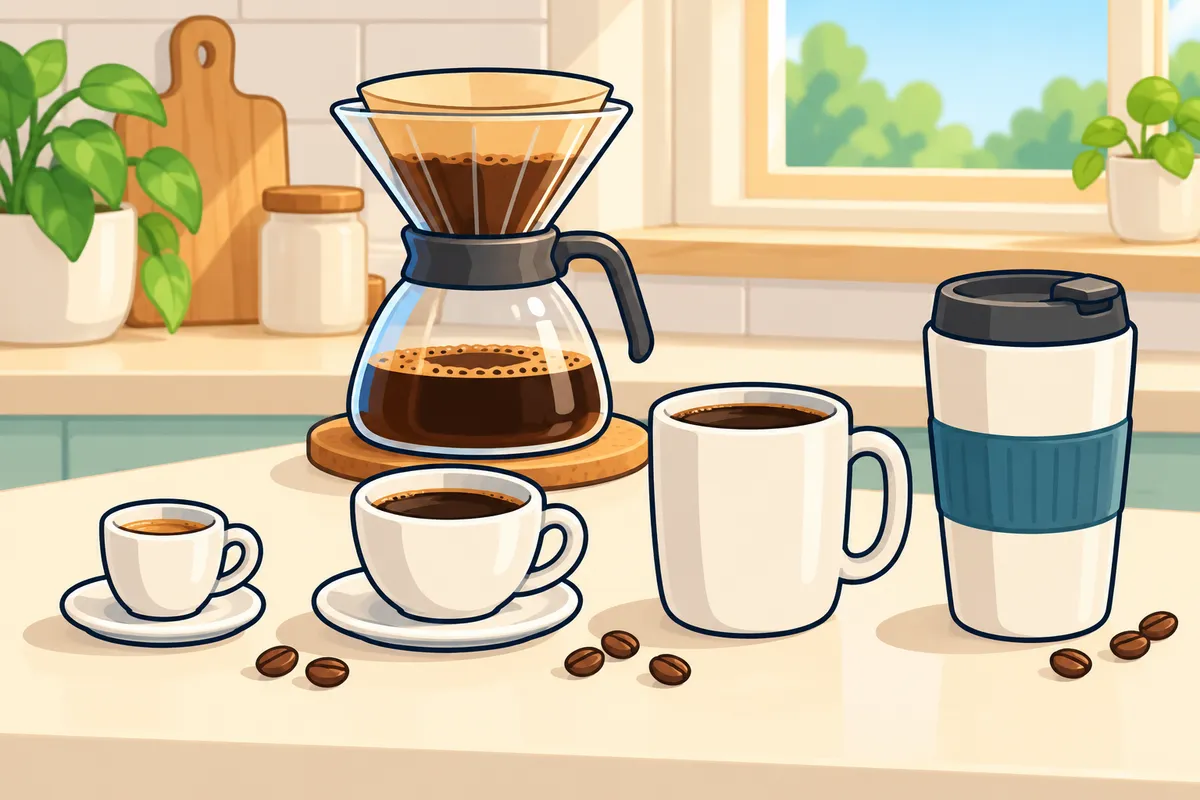
A cup of coffee is not one amount of caffeine. The same 8 oz pour can hold 76 mg or 179 mg depending on how someone made it, and most mugs today hold far more than 8 oz.
So you need two facts about your coffee: the brew method and the size of the cup. With those, you can put a fair number on any cup.
How Much Caffeine Is in 8 oz of Coffee?
About 135 mg for an 8 oz (237 ml) cup of brewed coffee, by Health Canada's average. Filter drip runs higher at 179 mg, percolated a little lower at 118 mg, and instant lower again at 76 to 106 mg.
The US figure is wider. The FDA gives 113 to 247 mg for a 12 oz brewed coffee, which scales to about 75 to 165 mg per 8 oz, with 135 mg near the middle.
Europe's typical cup is smaller. EFSA counts a 200 ml filter coffee at 90 mg, and the NHS puts a cup of instant at 100 mg, adding that filter and coffee-shop coffee "can contain more".
How Much Caffeine Is in a Mug of Coffee?
A 12 oz (355 ml) mug of brewed coffee holds about 200 mg, and a 16 oz (473 ml) mug about 270 mg, scaling the 135 mg per 8 oz. A big mug is two or three of the cups the charts talk about, so read the size before you read the number.
Every milliliter figure here uses NIST's 29.57 ml per US fluid ounce. The middle column scales the 135 mg average; the right column scales the FDA's 12 oz range.
| Cup or mug | Holds | Brewed coffee, average | Brewed coffee, FDA range |
|---|---|---|---|
| Small cup, 8 oz | 237 ml | about 135 mg | about 75 to 165 mg |
| Standard mug, 12 oz | 355 ml | about 200 mg | 113 to 247 mg |
| Large mug, 16 oz | 473 ml | about 270 mg | about 150 to 330 mg |
| Travel mug, 20 oz | 591 ml | about 335 mg | about 190 to 410 mg |
The bottom row is the one to watch. At the top of the FDA's range, one 20 oz travel mug passes the 400 mg a day that the FDA names for most healthy adults, and that 400 mg line comes with lower limits for pregnancy and children. EFSA's line for a single sitting is 200 mg, which one 12 oz mug at the average already reaches.

Mugs at home rarely say how much they hold. To find out, fill yours with water and pour it into a measuring jug.
How Much Caffeine Is in a Coffee Shop Cup?
About 200 mg on average in Hong Kong's test of 20 regular coffees bought from local shops, with single cups ranging from 110 to 380 mg. That spread is wider than any difference between brew methods, and a chain's large cup is not the same drink as a home-brewed mug.
The same Centre for Food Safety test measured 90 mg in a caffe latte (54 to 140 mg across four cups) and 110 mg in a cappuccino, which is why a milky shop drink often carries less than a plain coffee of the same size. When a shop or brand prints a caffeine figure for its own cup, use it: it measures the exact beans, grind and size you are holding.
Which Type of Coffee Has the Most Caffeine?
Filter drip, of the types in the Canadian table: 179 mg per 8 oz cup. Espresso is stronger per ounce but comes in a small shot, so a single espresso holds less caffeine than a full cup of drip. Instant has the least of the regular coffees.
| Coffee | Typical serving | Caffeine per serving | Caffeine per fluid ounce |
|---|---|---|---|
| Espresso shot | 2 oz (60 ml) | 80 mg (EFSA) | about 39 mg |
| Filter drip | 8 oz (237 ml) | 179 mg | about 22 mg |
| Brewed | 8 oz (237 ml) | 135 mg | about 17 mg |
| Percolated | 8 oz (237 ml) | 118 mg | about 15 mg |
| Instant | 8 oz (237 ml) | 76 to 106 mg | about 10 to 13 mg |
| Decaf | 8 oz (237 ml) | 3 mg; FDA 2 to 15 mg | under 2 mg |
Why Espresso Looks Stronger Than It Is
Per milliliter, espresso wins by far. EFSA's 80 mg in a 60 ml shot is about 1.3 mg per ml, against 0.45 mg per ml for its 200 ml filter coffee.
Per drink, the order flips. One shot holds 80 mg and one filter cup 90 mg, so a single-shot latte or cappuccino carries about the caffeine of the shot inside it, however big the cup of milk around it. Shop shots spread wider than that average: Hong Kong tests found 62 to 170 mg in a single espresso.
Percolated and Camp Coffee
The Canadian table lists percolated coffee below drip and brewed, at 118 mg per 8 oz. The figure is an average, so treat a pot you brewed extra strong as closer to the brewed or drip number.

Instant and Decaf in Two Lines
Instant coffee averages 76 to 106 mg per 8 oz, the lowest of the caffeinated coffees. Decaf is not zero: the table above lists 3 mg per cup and the FDA 2 to 15 mg per 8 oz, enough to matter only if you drink many cups.
Does Dark Roast Have Less Caffeine Than Light Roast?
Slightly less in the cup, if you brew them the same way, but the difference is small. A 2024 study in Scientific Reports found that caffeine concentrations in brewed samples were generally lower for dark roasts than for light and medium roasts. At the same extraction yield the pattern reversed, so the brew matters more than the roast.
The authors say two effects compete: roasting breaks down or boils off some soluble compounds, and darker beans become more porous. The study tested only two green coffees and one brewing method, so use it as a hint and not as a rule for your bag.
Why Does the Caffeine in Coffee Vary So Much?
Three things move the number:
- How the coffee was brewed. The brew method alone spans 76 to 179 mg per 8 oz in the Canadian table.
- How big the cup is. Cup size can double or triple that.
- Who made it, which the FDA range below shows.
Brewer labels add another trap: a coffee-maker “cup” may mean 5 oz, a pod button may select 4 to 12 oz and a mug may hold 8 to 16 oz. Use the beverage ounces in front of you when scaling a caffeine figure.
The third factor is the hardest to see. The FDA's own range for a 12 oz brewed coffee runs from 113 to 247 mg, more than double from one cup to another of the same size. EFSA notes that caffeine content and portion sizes vary within and between countries.
Cold brew stretches the range further still, since a 12 oz glass of undiluted 1:10 brew can pass 400 mg.
How Many Cups of Coffee Is 400 mg?
About three 8 oz cups of brewed coffee at the 135 mg average, or two to three 12 oz cups as the FDA counts it. In large 16 oz mugs, one and a half mugs reach the same 400 mg.
- 3 cups
- of 8 oz brewed coffee come to about 405 mg
- 2 mugs
- of 16 oz brewed coffee come to about 540 mg, over the line before lunch
- 2 to 3
- 12 oz cups make 400 mg by the FDA's count
Coffee also counts toward your fluids, and a 12 oz mug adds its full 355 ml to the water you drink in a day.
How Much Caffeine Is in a Coffee Pod or K-Cup?
Most single-serve pods hold about 75 to 150 mg of caffeine, depending on the roast, the brand and whether the pod is regular or extra-strong. The FDA does not break pods out separately, but its 113 to 247 mg range for a 12 oz brewed coffee covers the same ground: a standard pod brews 8 to 10 oz, so the caffeine per cup is lower than a 12 oz pour-over at the same strength.
Check the box. Many pod makers now print a caffeine estimate per capsule, and that number is more useful than any chart, because the grind, the dose and the water volume are fixed by the machine. A "bold" or "extra" pod typically sits at the top of the range, around 130 to 150 mg, while a breakfast blend sits near 75 to 100 mg.
If your machine makes a 6 oz cup from the same pod, the caffeine stays the same; only the concentration changes, stronger in a smaller cup, weaker in a larger one. That matters for taste but not for your 400 mg count.
Count the Caffeine in Your Own Mug
Put a number on your usual coffee once, and you can count every day after that in seconds.
Your Mug in Four Steps
- Fill your mug with water and measure it in a jug: say 14 oz (414 ml)
- Pick your brew's figure per 8 oz: brewed 135 mg, drip 179 mg, instant up to 106 mg
- Divide your ounces by 8 and multiply: 14 ÷ 8 × 135 = about 236 mg
- Check it against your daily limit before the second mug
Write the mug's size on the bottom with a marker, and if your second coffee would take you past 400 mg, make it a small cup or a decaf.
General information for healthy adults, not medical advice. If a doctor has set your fluid amount, follow that.

More in Coffee and Tea

Sources
- Health Canada. Caffeine in foods, 2025.
- US Food and Drug Administration. Spilling the Beans: How Much Caffeine is Too Much?, 2024.
- European Food Safety Authority. Caffeine (topic page on the 2015 scientific opinion), 2015.
- NHS. Foods to avoid in pregnancy, 2026.
- Centre for Food Safety, Hong Kong. Caffeine Content in Coffee and Milk Tea Prepared in Local Food Premises, 2013.
- Scientific Reports (Lindsey, Williams, Burgess, Moore and Splichal), via Europe PMC. Caffeine content in filter coffee brews as a function of degree of roast and extraction yield, 2024.
- NIST. Approximate Conversions from U.S. Customary Measures to Metric, 2026.
Sources checked by the Glubbo Editorial Team on Oct 23, 2026. General information, not medical advice. How we write and check our guides.

