How Much Caffeine Can You Have When Pregnant? Each Limit in mg
Each public body's pregnancy caffeine limit, why they differ, and how a day of drinks adds up.
 By the Glubbo Editorial Team · Updated Oct 19, 2026 · 8 min read
On This Page
- How Much Caffeine Can You Have When Pregnant?
- Why Do Pregnancy Caffeine Limits Differ?
- Can I Drink Coffee While Pregnant?
- What Does 200 mg of Caffeine Look Like?
- Does Chocolate Count Toward the Pregnancy Caffeine Limit?
- Should You Cut Caffeine When Planning a Pregnancy?
- Cut Down Without Giving Up the Cup
- Sources
Short answer
200 mg a day (NHS, EFSA) or 300 mg (Health Canada).
- NHS: "you should not have more than 200mg of caffeine a day".
- WHO: lower your intake if it is above 300 mg a day.
- US obstetricians (ACOG): "less than 200 mg per day" counts as moderate.

Most pregnant women do not have to give up coffee. They do have to count it, because the public bodies that set limits put the line at 200 or 300 mg a day, and a single large shop coffee can pass the lower one.
Two cups of instant coffee reach 200 mg. Every source counts toward the total, from tea and cola to chocolate and cold remedies.
How Much Caffeine Can You Have When Pregnant?
No more than 200 mg a day by the NHS and EFSA, or 300 mg by Health Canada. The NHS says "you should not have more than 200mg of caffeine a day", and every source of caffeine counts toward it: coffee, tea, cola, energy drinks and chocolate.
Pregnancy Caffeine Limits, Body by Body
NHS (UK)
200 mg a day
- "not more than 200mg" a day
- Linked to miscarriage and stillbirth
Suits you if you live in the UK or want the plainest rule
EFSA (EU)
200 mg a day
- Up to 200 mg a day, all sources
- Spread through the day
Suits you if you live in the EU or want the lower line
Health Canada
300 mg a day
- 300 mg a day in pregnancy
- Also 300 mg when planning one
Suits you if you live in Canada and follow its advice
WHO
Cut back above 300 mg
- Lower intake if over 300 mg a day
- For pregnancy loss, low birth weight
Suits you if you drink a lot of caffeine now and want a first target
ACOG (US)
Under 200 mg a day
- "less than 200 mg per day" is moderate
- Not a major factor in miscarriage
Suits you if you live in the US and see a midwife or doctor
Three of the five draw the line at 200 mg, and none sets a figure above 300 mg. If you want one number that satisfies all of them, 200 mg a day keeps you inside every limit on this page.
EFSA's wording adds a condition: intakes "up to 200mg per day consumed throughout the day" do not raise safety concerns for the foetus. Spreading the cups matters, as well as the total.
Why Do Pregnancy Caffeine Limits Differ?
Because the bodies weigh the same studies in different ways, and some set a ceiling while others set a warning line. The WHO's 300 mg marks the point where it recommends cutting back; the 200 mg of the UK and EU bodies is a ceiling for everyone.
The WHO recommends that pregnant women who take more than 300 mg a day lower their intake, to reduce the risk of pregnancy loss and low birth weight. Its remarks add that some observational studies link high caffeine to growth restriction, reduced birth weight, preterm birth or stillbirth.
Three other bodies speak differently:
- Health Canada uses 300 mg as its limit.
- Hong Kong's Consumer Council gave a band of "not more than 200-300 mg" a day, a range rather than one number.
- The FDA gives no number.
US obstetricians do give one. The American College of Obstetricians and Gynecologists concluded that "moderate caffeine consumption (less than 200 mg per day) does not appear to be a major contributing factor in miscarriage or preterm birth", and that the link to growth restriction "remains undetermined".
Can Caffeine Cause Miscarriage?
The evidence is observational and not settled. The UK health service links too much caffeine to a higher chance of miscarriage and stillbirth, while ACOG finds that under 200 mg a day does not appear to be a major factor and cannot reach a final conclusion on high intake.
| Source | What it says about harm |
|---|---|
| NHS | Links high caffeine to a higher chance of miscarriage and stillbirth |
| ACOG | Finds under 200 mg a day no major factor in miscarriage or preterm birth, and growth restriction undetermined |
| WHO | Observational studies link excess intake to growth restriction, low birth weight, preterm birth and stillbirth |
| Cochrane review | Insufficient evidence on whether avoiding caffeine changes outcomes |
Randomized trials are scarce. A Cochrane review found only one trial that contributed data, 1,197 women who drank caffeinated or decaffeinated instant coffee, and cutting caffeine in the second and third trimesters did not change birth weight, preterm birth or small-for-gestational-age babies. It judged the evidence low quality and "insufficient" to confirm or refute the benefit of avoiding caffeine.
Does Caffeine Stay Longer in Your Body When Pregnant?
Yes. The WHO says that "during pregnancy, caffeine clearance from the mother's blood slows down significantly", so each cup lingers longer than the 3 to 7 hours a cup usually takes to halve.
Can I Drink Coffee While Pregnant?
Yes, within the limit. On its list, a cup of instant coffee holds 100 mg, so two cups reach 200 mg. It warns that filter coffee and coffee from shops "can contain more", and the FDA finds 113 to 247 mg in a 12 oz brewed coffee.
That top figure is the trap. One 12 oz shop coffee at the strong end, 247 mg, is over the 200 mg limit on its own, before any tea or chocolate.
The tea figure is on the high side. Other bodies count a cup of black tea lower, so counting each cup as 75 mg keeps you on the safe side.
Decaf helps when you want the taste without the count, because what decaffeination leaves behind adds very little to your 200 mg.
What Does 200 mg of Caffeine Look Like?
Two cups of instant coffee, or a coffee and a cup and a half of tea, on that list. Two worked days show how the numbers stack.
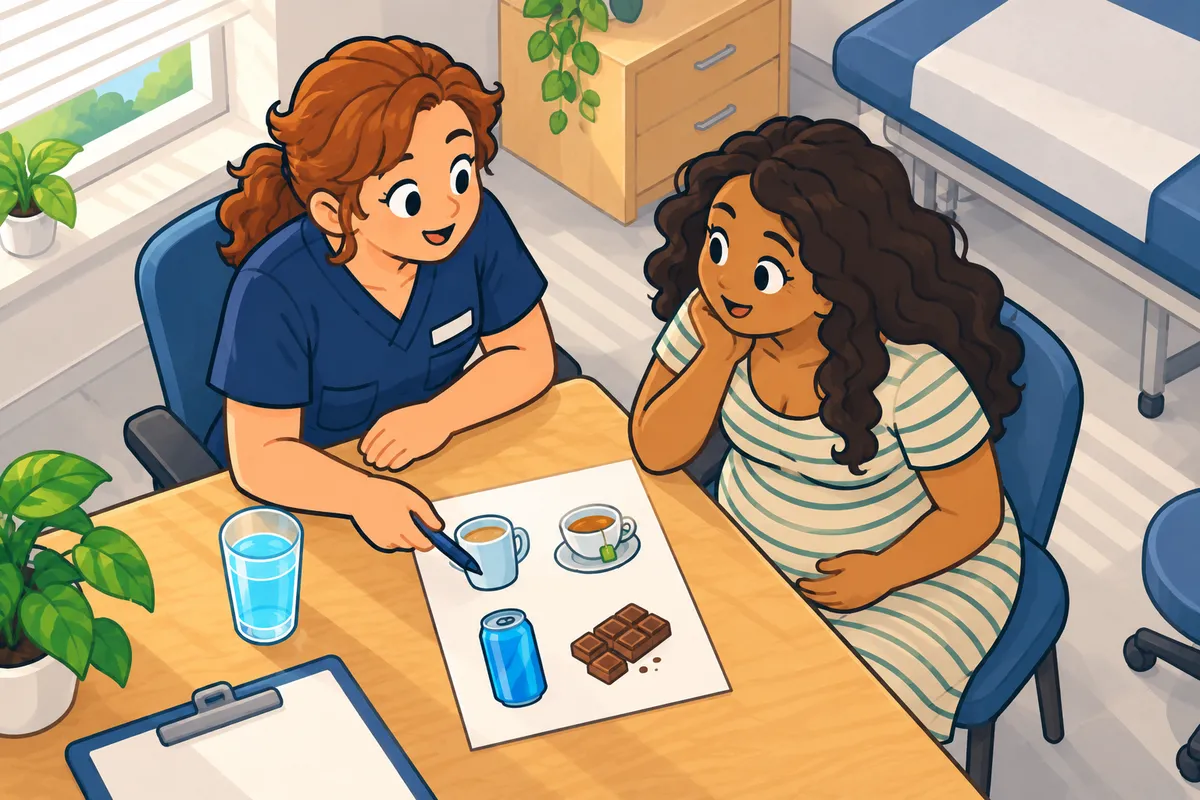
Does Chocolate Count Toward the Pregnancy Caffeine Limit?
Yes, though it adds little. The NHS counts less than 25 mg in a 50 g bar of plain dark chocolate and less than 10 mg in milk chocolate, so a bar matters only on a day you are already close to 200 mg.
Other sources hide better. The WHO lists tea, coffee, soft drinks, chocolate, kola nuts, energy drinks and some over-the-counter medicines. Read the box of any cold or headache remedy before you take it, or ask a pharmacist, because a caffeinated remedy counts toward your 200 mg like a cup of tea.
Herbal teas carry their own advice. The NHS asks you to avoid more than 4 cups of herbal tea a day in pregnancy and to avoid teas containing liquorice root, and many herbal teas have no caffeine at all.
Should You Cut Caffeine When Planning a Pregnancy?
Health Canada thinks so. It sets the same 300 mg a day for people planning to become pregnant as for those who are pregnant, so the habit is in place before the first test.
Does Decaf Count Toward the 200 mg Limit?
Barely. The FDA puts decaf at 2 to 15 mg per 8 oz cup, so even four cups of decaf add at most 60 mg, well under the 200 mg line. That makes decaf the simplest swap for your second or third cup of the day: the taste stays, the count barely moves, and the ritual of a warm mug carries on.
A decaf bottle that lists its caffeine per serving is more useful than any general chart.
After the birth the question changes, and the limits for coffee while breastfeeding come from the same public bodies.
Cut Down Without Giving Up the Cup
Your swap, by your habit
- I buy a large shop coffee every morningOrder a small size, or half decaf, and ask the shop for its caffeine figure
- I drink tea all dayMake every other cup herbal, up to 4 cups of herbal tea a day, and skip liquorice root
- I reach for a can in the afternoonCola is 40 mg and an energy drink 80 mg on that list; water or decaf costs nothing
- I take cold or headache tabletsRead the label for caffeine and ask a pharmacist before you count the day
- I am trying to conceiveStart at Health Canada's 300 mg or the 200 mg most bodies use in pregnancy
Once the day's cups reach your limit, a glass of water or a caffeine-free tea is the easiest swap.
General information for healthy adults, not medical advice. If a doctor has set your fluid amount, follow that.

More in Coffee and Tea

Sources
- NHS. Foods to avoid in pregnancy, 2026.
- European Food Safety Authority. Caffeine (topic page on the 2015 scientific opinion), 2015.
- Health Canada. Caffeine in foods, 2025.
- World Health Organization. Restricting caffeine intake during pregnancy (e-Library of Evidence for Nutrition Actions), 2023.
- US Food and Drug Administration. Spilling the Beans: How Much Caffeine is Too Much?, 2024.
- Consumer Council, Hong Kong. Caffeine in coffee and milk tea (press release, 15 October 2013), 2013.
- American College of Obstetricians and Gynecologists, Obstetrics & Gynecology (PubMed record). ACOG Committee Opinion No. 462: Moderate caffeine consumption during pregnancy, 2010.
- Cochrane Database of Systematic Reviews (Jahanfar and Jaafar), via Europe PMC. Effects of restricted caffeine intake by mother on fetal, neonatal and pregnancy outcomes, 2015.
Sources checked by the Glubbo Editorial Team on Oct 19, 2026. General information, not medical advice. How we write and check our guides.

