Espresso vs Coffee Caffeine: Which Has More, Shot or Cup?
Espresso against a cup of coffee, per ounce and per serving, with double shots and how many shots make a cup.
 By the Glubbo Editorial Team · Updated Oct 19, 2026 · 7 min read
On This Page
- Does Coffee or Espresso Have More Caffeine?
- How Much Caffeine Is in a Shot of Espresso?
- Is Espresso Stronger Than Coffee per Ounce?
- How Much Caffeine Is in a Double Shot of Espresso?
- Does an Americano Have More Caffeine Than Drip Coffee?
- How Many Shots of Espresso Equal a Cup of Coffee?
- Do Milk Drinks Have Less Caffeine Than Espresso?
- How Many Shots of Espresso Is Too Many?
- Which Espresso or Coffee to Order
- Sources
Short answer
A cup of coffee has more; espresso is stronger per ounce.
- Hong Kong shop tests: 97 mg per espresso, 200 mg per regular coffee.
- Per ml, espresso held about four times the caffeine of the coffee.
- A double shot, about 194 mg, roughly matches one regular coffee.
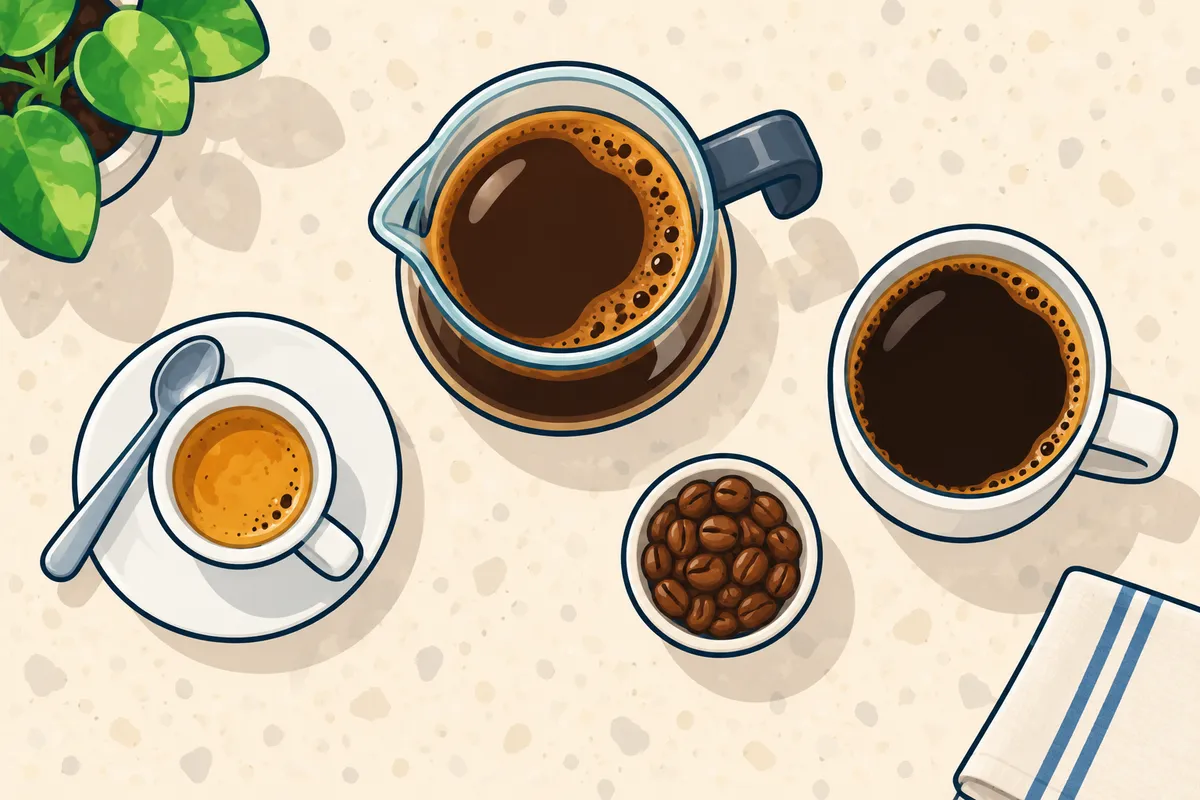
A mug of drip coffee usually holds more caffeine than a single espresso, because a shot is a few tablespoons and a mug is a whole cup. Sip for sip, espresso is the stronger drink by far.
Which one gives you more caffeine depends on whether you compare an ounce with an ounce or a drink with a drink.
Does Coffee or Espresso Have More Caffeine?
A regular cup of coffee, per serving. Hong Kong's Centre for Food Safety tested drinks from local cafes and chains and found 97 mg in an average espresso against 200 mg in an average regular coffee. Per liter, the espresso was about four times stronger.
The European figures point the same way. EFSA's opinion, as EUFIC lists it, counts 80 mg in a 60 ml (2 oz) espresso and 90 mg in a 200 ml (6.8 oz) cup of filter coffee, so even a large espresso falls just short of a small filter cup.
How Much Caffeine Is in a Shot of Espresso?
About 80 to 100 mg in a typical shot. Two sources set that range:
- The Hong Kong study averaged 97 mg across 12 shop espressos.
- EFSA's figures give 80 mg for a typical 60 ml espresso.
- The Hong Kong range ran from 62 to 170 mg, so a strong shop can nearly triple a mild one.
EFSA's 200 mg single-dose line works out to roughly 2½ espressos of that size.
| Drink | Per liter | Per serving | Samples |
|---|---|---|---|
| Espresso | 3,700 mg (2,000 to 7,200) | 97 mg (62 to 170) | 12 |
| Regular coffee | 880 mg (320 to 1,600) | 200 mg (110 to 380) | 20 |
| Cappuccino | 390 mg (230 to 520) | 110 mg (55 to 160) | 4 |
| Caffe latte | 300 mg (180 to 500) | 90 mg (54 to 140) | 4 |
Source: Centre for Food Safety, Hong Kong, drinks bought from local food premises in 2013. Each figure is the mean, with the range in brackets.
Why Shot Sizes Differ So Much
The Hong Kong shots worked out to about 26 ml each: 97 mg divided by 3.7 mg per ml. EFSA's typical espresso is 60 ml, more than twice that volume, yet it holds less caffeine per ml.
A shot is not a fixed measure. Three things the barista controls change it, and a 60 ml pour sits closer to what many cafes call a double or a long shot.
What Sets the Caffeine in One Shot
3 items- The dose of ground coffee packed into the basket
- How fine the coffee is ground
- How much water the machine pushes through
You cannot see any of these from the counter. The 62 to 170 mg spread in Hong Kong came from shops that all called their drink an espresso, so treat 97 mg as a middle guess. A ristretto (shorter) or a lungo (longer) changes the water, and no regulator has published tested figures for them, so the shot's name tells you less than the shop's own number does.
Is Espresso Stronger Than Coffee per Ounce?
Yes, by about 4 to 12 times, depending on the coffee you set it against. A US fluid ounce is 29.57 ml, so the Hong Kong espresso's 3.7 mg per ml comes to about 109 mg per ounce, against 26 mg in the Hong Kong regular coffee and about 9 to 21 mg in a cup of brewed coffee.
Each bar divides the source's milligrams by its volume. Health Canada's brewed coffee is 135 mg per 237 ml (8 oz), its filter drip 179 mg and its instant 76 to 106 mg; the FDA's 12 oz brewed coffee runs 113 to 247 mg, about 9 to 21 mg per ounce.
Strength per ounce tells you how fast caffeine goes down, not how much. A shot finished in three sips can still carry less than the mug you drink over an hour.
How Much Caffeine Is in a Double Shot of Espresso?
About 190 mg at the Hong Kong average, two shots of 97 mg each. Here is where that sits:
- With the study's range, a double can hold anywhere from about 124 mg to 340 mg, which spans a mild cup of coffee to more than a strong mug.
- EFSA's 200 mg single-dose line for a healthy adult sits right at the average double.
- A third shot in the same sitting (about 291 mg) passes that line.
Does an Americano Have More Caffeine Than Drip Coffee?
It does when it is a double. An americano is espresso topped up with hot water, and the water adds no caffeine, so the drink carries only the shots in it: about 97 mg for one and 194 mg for two at the Hong Kong average. A 12 oz drip runs 113 to 247 mg by the FDA's range, so a double americano lands inside it and a single one falls below it.
Shops differ in what "double" means. Some pull a double as standard in every drink, so a single espresso on the menu may already be two shots' worth; ask, or read the chain's caffeine figure when it publishes one.
How Many Shots of Espresso Equal a Cup of Coffee?
About one and a half to two single shots, depending on the cup and the shop.
- 1.4
- shots of 97 mg to match an 8 oz brewed coffee (135 mg)
- 2.1
- shots to match a Hong Kong regular coffee (200 mg)
- 1.2–2.5
- shots to match a 12 oz FDA brewed coffee (113 to 247 mg)
The size of your mug decides most of this. A 16 oz brewed coffee at Health Canada's strength holds about 270 mg, nearly three shots, which is why a big mug of drip coffee often beats a shop's double espresso.
Cold brew is the outlier. Steeped at a strong ratio and drunk straight, a 12 oz glass of cold brew can hold over 400 mg, four average shots.
Do Milk Drinks Have Less Caffeine Than Espresso?
Not less than the shots inside them. Milk adds no caffeine, so a latte or cappuccino carries the espresso the barista made it with: the Hong Kong lattes averaged 90 mg and the cappuccinos 110 mg, both close to the 97 mg shot.
A larger latte usually means more shots, not more caffeine from the milk. Decaf shots sit at the other end: decaf espresso is low in caffeine, though not free of it.
How Many Shots of Espresso Is Too Many?
Four average shots in a day, and two in one sitting. The two limits work out this way:
- For the day, at the Hong Kong average of 97 mg a shot, 400 mg is 4.1 shots, so four shots sit just under the daily line the FDA and EFSA both name.
- For one sitting, EFSA's 200 mg line is 2.1 Hong Kong shots, or about 2½ of the 60 ml espressos EUFIC lists at 80 mg each.
Count by the shop's shot, not the word "single": a shop whose shots run toward the top of the 62 to 170 mg range reaches the daily line at about two and a half shots.
Which Espresso or Coffee to Order
Pick by the number you need, not by the name on the menu.
Choose by the Caffeine You Want
- A lift under 100 mgA single shot or a latte, about 90 to 110 mg at the Hong Kong averages
- Stay at EFSA's 200 mg for one sittingA double, or one 12 oz drip at the milder end of 113 mg
- Two drinks in one dayAdd them on one tally: a double plus a 12 oz drip can reach 194 + 247 = 441 mg
- An afternoon drinkA decaf shot, or an espresso only if you have 6 hours before bed
General information for healthy adults, not medical advice. If a doctor has set your fluid amount, follow that.

More in Coffee and Tea
Sources
- Centre for Food Safety, Hong Kong. Caffeine Content in Coffee and Milk Tea Prepared in Local Food Premises, 2013.
- European Food Safety Authority. Caffeine (topic page on the 2015 scientific opinion), 2015.
- EUFIC (European Food Information Council). EFSA opinion on the safety of caffeine, 2015.
- Health Canada. Caffeine in foods, 2025.
- US Food and Drug Administration. Spilling the Beans: How Much Caffeine is Too Much?, 2024.
Sources checked by the Glubbo Editorial Team on Oct 19, 2026. General information, not medical advice. How we write and check our guides.

