How Much Caffeine Is in Cold Brew? Glass, Concentrate and Iced
The milligrams in a glass of cold brew, why ratio and dilution set them, and how it compares with iced coffee.
 By the Glubbo Editorial Team · Updated Oct 19, 2026 · 7 min read
On This Page
Short answer
About 350 to 440 mg in 12 oz of undiluted 1:10 brew.
- A lab study measured 990 to 1,230 mg per liter in cold brew steeped at 1:10.
- Cut 1:1 with water or milk, a 12 oz glass drops to about 210 mg.
- One 16 oz glass of undiluted brew can pass the FDA's 400 mg a day.
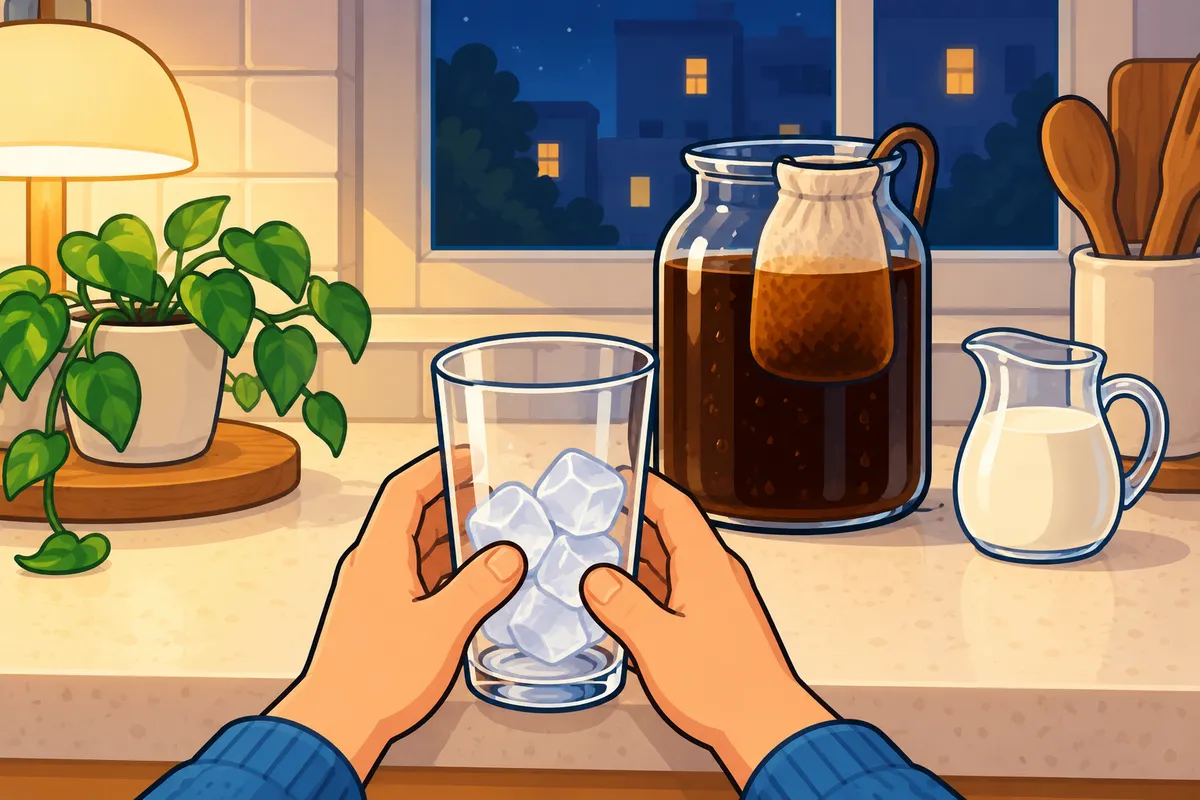
Cold brew tastes gentle, so people expect it to be weak. In a lab, cold brew made at a common home ratio came out as strong as hot coffee made the same way, and stronger than most cups you buy.
The number on your glass comes down to two things you control: how much coffee went into the jar, and how much water, milk or ice went in after.
How Much Caffeine Is in Cold Brew?
About 350 to 440 mg in a 12 oz (355 ml) glass of undiluted cold brew made at 1:10, coffee to water. A 2017 Scientific Reports study measured 990 to 1,230 mg of caffeine per liter in cold brew steeped for 24 hours at room temperature.
- 990–1,230 mg
- caffeine per liter of 1:10 cold brew after 24 hours
- 419 mg
- in an undiluted 12 oz glass of the medium roast, medium grind brew
- 400 mg
- a day for most healthy adults, per the FDA
Most glasses hold less than that, because few people drink the brew straight. Shops and home brewers usually cut it with water, milk or ice, and each half of the glass that is not brew halves the caffeine.
The FDA gives no figure for cold brew. Its range for an ordinary 12 oz brewed coffee is 113 to 247 mg, so an undiluted 1:10 glass sits well above a typical hot cup.
What the Lab Measured
Megan Fuller and Niny Rao tested two brews:
- For the cold version, they steeped 35 g of ground coffee in 350 ml of water, a 1:10 ratio, at 21 to 25 °C for up to 24 hours.
- For the hot version, they used the same coffee and ratio in a French press with 98 °C water for 6 minutes.
The table shows their results, with each concentration turned into a 12 oz glass of undiluted brew.
| Coffee | Cold brew, per liter | Cold brew, 12 oz glass | Hot brew, per liter | Hot brew, 12 oz cup |
|---|---|---|---|---|
| Medium roast, medium grind | 1,180 mg | about 419 mg | 1,040 mg | about 369 mg |
| Medium roast, coarse grind | 1,230 mg | about 437 mg | 970 mg | about 344 mg |
| Dark roast, medium grind | 1,080 mg | about 383 mg | 1,060 mg | about 376 mg |
| Dark roast, coarse grind | 990 mg | about 351 mg | 840 mg | about 298 mg |
Source: Fuller and Rao 2017, Table 3. The 12 oz columns multiply each liter figure by 0.355 liters.
A 1:10 ratio is strong. Health Canada's average brewed coffee holds 135 mg per 8 oz (237 ml), which works out to about 570 mg per liter, roughly half the lab's cold brew. So the lab brew behaves like a concentrate, and that is how most people use it.
Does Steeping Cold Brew Longer Make It Stronger?
Not after the first 6 to 7 hours. Time mattered only at the start.
Caffeine rose fast for the first 3 hours, then slowed, and reached its plateau between 6 and 7 hours. Steeping past that added very little, and a longer steep changes the taste more than the caffeine: if you want more, add more coffee to the jar.
Grind size made no significant difference to the final caffeine in most of the comparisons. Medium roast generally gave more caffeine than dark roast, though the gap in the medium-grind pair was too small to count. The authors note that grind size was not tightly controlled, because they used commercial coffee without sieving it.
Does Cold Brew Have More Caffeine Than Regular Coffee?
Only when you brew it stronger or serve it larger. Brewed at the same 1:10 ratio, cold brew held about the same caffeine as hot coffee in the medium-grind pairs, and somewhat more in the coarse-grind pairs, where cold brew beat hot by 260 and 150 mg per liter.
A smooth taste does not mean a weak cup. The same study found chlorogenic acid and pH comparable between hot and cold brews, and its authors concluded that cold brew's mild acidity is probably not down to the caffeine or acid levels, so the mildness tells you nothing about the milligrams.
The bigger difference sits in the recipe. Cold brew recipes use far more coffee per cup of water than a drip machine does, then rely on dilution to bring the strength down. If you skip the dilution, you drink a concentrate.
Size works the same way it does for any hot cup by brew and size. A 24 oz cup of the same brew holds twice the caffeine of a 12 oz one.

Does Cold Brew Have More Caffeine Than Iced Coffee?
Usually yes, but the reason is the recipe, not the temperature. Iced coffee is hot coffee poured over ice, so its caffeine comes from a normal-strength brew that the ice then waters down. Cold brew starts from a stronger ratio.
In the lab, the hot brew at 1:10 held 840 to 1,060 mg per liter, close to the cold brew. Brew hot coffee that strong and chill it, and you would match cold brew almost mg for mg.
Two habits pull iced coffee lower:
- A shop brews it at an ordinary strength.
- The ice takes up part of the cup, so a 16 oz iced coffee holds less coffee than 16 oz.
Take a 16 oz cup in which ice fills a third. Two thirds of it is hot coffee at Health Canada's 135 mg per 8 oz, about 180 mg, against 558 mg for the same cup filled with straight 1:10 cold brew. The ice fraction is our assumption, but the gap stays large for any fraction.
How Much Caffeine Is in Cold Brew Concentrate?
As much as the lab brew above, about 1,000 to 1,230 mg per liter at a 1:10 ratio, and more if the maker uses more coffee. You cut concentrate before drinking it, and the dilution you choose sets the caffeine in the glass.
| Glass | Straight 1:10 brew | Cut 1:1 with water or milk | Cut 1:2 | Hot brewed coffee, average |
|---|---|---|---|---|
| 12 oz (355 ml) | about 419 mg | about 209 mg | about 140 mg | about 202 mg |
| 16 oz (473 ml) | about 558 mg | about 279 mg | about 186 mg | about 270 mg |
| 24 oz (710 ml) | about 837 mg | about 419 mg | about 279 mg | about 405 mg |
Worked from the medium-roast, medium-grind result in Fuller and Rao 2017, 1,180 mg per liter. The last column scales Health Canada's 135 mg per 8 oz.
A 1:1 mix comes out about the same as a normal mug of hot coffee, and a straight pour is two to three times that.
Bottled concentrates differ from brand to brand. When the label gives caffeine per serving, use that figure, and read the serving size next to it, since a concentrate serving is often a small pour meant for a full glass of water.
Why a Big Glass of Cold Brew Can Pass 400 mg
Because a glass that tastes smooth can hold a day's caffeine. The FDA names 400 mg a day for most healthy adults, with lower ceilings in pregnancy and childhood, and EFSA counts up to 200 mg in one sitting as no concern; a large undiluted glass passes both.
The afternoon cup matters for sleep as well. In a 2013 trial of 12 normal sleepers, 400 mg taken six hours before bed cut measured sleep by more than an hour, so the time of your last coffee counts as much as the size.
Cold brew still counts as a drink, too: a glass of coffee adds its water to your day the same way a mug of hot coffee does.
Setting the Strength Before You Pour
Decide the strength before you pour, not after the first glass.
Make the Glass Fit Your Day
- I want a normal coffee's worthCut 1:10 brew 1:1 with water or milk: about 210 mg per 12 oz
- I drink two or three a dayCut 1:2, about 140 mg per 12 oz glass
- I want it ready fasterSteep 6 to 7 hours; longer adds little caffeine
- I drink it after lunchKeep it six hours clear of bedtime, or brew it from decaf
Write your jar's ratio on the lid. With the ratio and your dilution, you can count every glass in seconds: 1,180 mg per liter at 1:10, halved for each equal part of water or milk.
General information for healthy adults, not medical advice. If a doctor has set your fluid amount, follow that.

More in Coffee and Tea
Sources
- Scientific Reports (Fuller and Rao). The Effect of Time, Roasting Temperature, and Grind Size on Caffeine and Chlorogenic Acid Concentrations in Cold Brew Coffee, 2017.
- US Food and Drug Administration. Spilling the Beans: How Much Caffeine is Too Much?, 2024.
- Health Canada. Caffeine in foods, 2025.
- European Food Safety Authority. Caffeine (topic page on the 2015 scientific opinion), 2015.
- Journal of Clinical Sleep Medicine (Drake, Roehrs, Shambroom and Roth). Caffeine Effects on Sleep Taken 0, 3, or 6 Hours before Going to Bed, 2013.
- CDC, National Institute for Occupational Safety and Health. NIOSH Training for Nurses on Shift Work and Long Work Hours, Module 6: Caffeine, 2015.
Sources checked by the Glubbo Editorial Team on Oct 19, 2026. General information, not medical advice. How we write and check our guides.

