Cold Brew Benefits: Is It Really Easier on Your Stomach?
What a lab found when it brewed six coffees hot and cold, what it means for your stomach, and how to keep a jar safe.
 By the Glubbo Editorial Team · Updated Oct 22, 2026 · 8 min read
On This Page
- What Are the Benefits of Cold Brew Coffee?
- Is Cold Brew Less Acidic Than Hot Coffee?
- Does Cold Brew Have Fewer Antioxidants?
- Is Cold Brew Easier on Your Stomach?
- What Changes in Your Cup With Cold Brew vs Hot Brew
- Is Homemade Cold Brew Safe to Keep in the Fridge?
- Is Cold Brew Good for You Every Day?
- Getting the Most From Your Next Jar
- Sources
Short answer
Less acid by one measure, fewer antioxidants.
- Six coffees brewed cold had 10 to 30 % less titratable acid than hot, at the same pH.
- The same cold brews had 12 to 36 % less antioxidant activity than hot.
- As of 2018, no published research had tested cold brew's health effects.
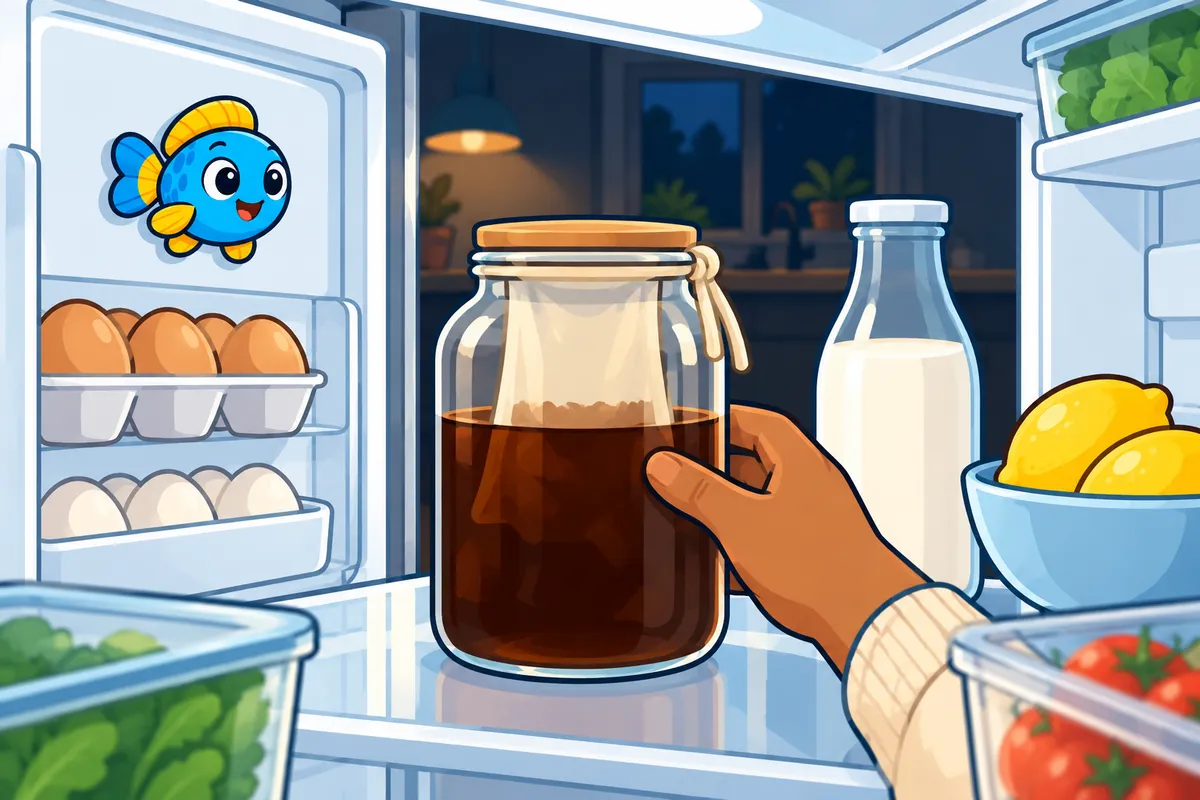
Cold brew has one benefit a lab has measured: less titratable acid than hot coffee. In a 2018 Scientific Reports study, six coffees steeped cold had 10 to 30 % less of it than the same coffees brewed hot, while the pH of every brew sat in the same band, 4.85 to 5.13.
The same cold brews carried 12 to 36 % less antioxidant activity, so the trade runs both ways. And the claim people care about most, an easier stomach, had not been tested on cold brew itself when the authors wrote in 2018 that there was "no published research on the health effects of cold brew coffee."
What Are the Benefits of Cold Brew Coffee?
Cold brew's measured benefit is a lower load of acid that a base can neutralise, at the same pH as hot coffee; its measured cost is fewer antioxidants. Those two results come from Niny Rao and Megan Fuller, researchers at Thomas Jefferson University, in a lab study their university funded.
- 4.85–5.13
- pH of all twelve brews, hot and cold alike
- 24 % less
- titratable acid in the cold brews, on average
- 24 % less
- antioxidant activity in the cold brews, on average
They brewed six light-roast coffees from Brazil, Colombia, Mexico, Myanmar and two regions of Ethiopia both ways. Each cold brew was 35 g of coffee in 350 ml of water, a 1:10 ratio, steeped 7 hours at 21 to 25 °C; each hot brew used the same ratio with boiling water in a French press for 6 minutes.
Is Cold Brew Less Acidic Than Hot Coffee?
By pH, no; by titratable acidity, yes. Every hot and cold brew landed between pH 4.85 and 5.13, but every cold brew needed less base to neutralise, which means it held less acid in total.
| Coffee | pH, hot / cold | Titratable acid, hot → cold | Total CQA, hot → cold (mg/L) |
|---|---|---|---|
| Brazil | 5.10 / 5.04 | 6.53 → 5.88 (10 % less) | 2,503 → 2,201 (12 % less) |
| Ethiopia, Ardi | 4.85 / 5.01 | 7.08 → 5.25 (26 % less) | 3,270 → 2,149 (34 % less) |
| Ethiopia, Yirgz | 4.96 / 4.96 | 7.45 → 5.18 (30 % less) | 2,530 → 1,895 (25 % less) |
| Myanmar | 4.92 / 5.13 | 6.40 → 5.32 (17 % less) | 2,517 → 1,697 (33 % less) |
| Colombia | 4.99 / 5.00 | 7.85 → 5.52 (30 % less) | 2,669 → 1,912 (28 % less) |
| Mexico | 4.95 / 5.08 | 6.68 → 4.75 (29 % less) | 2,808 → 1,616 (42 % less) |
Source: Rao and Fuller 2018, the paper's tables. Titratable acid is the ml of 0.1 N sodium hydroxide that 40 ml of coffee took to reach pH 8; CQA are the caffeoylquinic acids, the main coffee antioxidants. The percentages are our arithmetic.
Why pH and Titratable Acid Give Different Answers
pH reads only the acid that is already active in the cup, while titration counts all the acid a base can neutralise, including acid still held in reserve. The authors concluded that hot brewing "tends to extract additional non-deprotonated acids", the reserve kind, and that pH "is a poor measurement" of coffee's acid chemistry.
So a cold brew label that says "less acidic" is right about the total and wrong about the pH. The study did not test taste, so the lower total acid is a possible reason for the smoother cup people describe, not a proven one.
Does the Roast Change the Answer?
Yes, a little: with darker beans, cold brew can even come out slightly lower in pH than hot. The same two researchers had earlier brewed a medium and a dark roast both ways at 1:10, the cold brews for 24 hours, and found the pH of hot and cold brews "comparable".
| Roast and grind | pH, cold brew | pH, hot brew | 3-CGA, cold | 3-CGA, hot |
|---|---|---|---|---|
| Medium roast, medium grind | 5.54 | 5.41 | 510 mg/L | 510 mg/L |
| Medium roast, coarse grind | 5.40 | 5.35 | 520 mg/L | 460 mg/L |
| Dark roast, medium grind | 5.53 | 5.61 | 390 mg/L | 430 mg/L |
| Dark roast, coarse grind | 5.41 | 5.48 | 360 mg/L | 340 mg/L |
Source: Fuller and Rao 2017, Table 3, after 24 hours. 3-CGA is one chlorogenic acid, so these columns are not comparable with the 2018 total CQA figures.
They found no significant difference in that chlorogenic acid between cold and hot, and medium roast gave more of it than dark roast in cold brew. Across both studies, hot and cold pH never differed by more than 0.21.
Is Cold Brew a Low-Acid Food?
Yes, and so is hot coffee. The FDA's canning rule calls a food low-acid when its pH is above 4.6 and its water activity above 0.85, and every brew in the study sat above that pH line. For a home jar, that number matters for storage more than for your stomach.
Does Cold Brew Have Fewer Antioxidants?
Yes: in the 2018 test every cold brew showed less antioxidant activity than the same coffee brewed hot, about a quarter less on average. Cold brew also held 12 to 42 % less CQA in every one of the six coffees. In the cold brews, more CQA went with more antioxidant activity (r = 0.82), while in the hot brews the link was weak (r = 0.22).
The authors wrote that this lower antioxidant capacity "may decrease the chemoprotective benefits" linked to hot coffee. That is their inference from a lab measure, not a result in people, and they added that more research is needed to understand any difference in health effects.
Is Cold Brew Easier on Your Stomach?
Not on the evidence so far: the 2018 study measured the drink, not the people drinking it, and the older work its authors cite points away from acidity as the cause of coffee heartburn.
They describe a study in which coffee lowered the pressure of the valve at the top of the stomach at both an acidic and a neutral pH, so acidity "may not be the inciting factor". They also cite a population study that "found no association" between how often or how badly people had reflux and how much coffee they drank.
The swap that has a trial behind it is decaf. In a double-blind trial in 17 people with reflux disease, acid sat in the gullet for a median 17.9 % of three hours after regular coffee and 3.1 % after decaf, and the decaf page sets out that trial and the solvent question.
What Changes in Your Cup With Cold Brew vs Hot Brew
Cold brew trades some antioxidants for less total acid and the same pH, and the rest depends on your recipe.
Cold brew, 7 hours at room temperature
- pH 4.96 to 5.13 in the six coffees
- 10 to 30 % less titratable acid
- 12 to 36 % less antioxidant activity
- No heat step, so it relies on the fridge
Hot brew, 6 minutes in a French press
- pH 4.85 to 5.10 in the same coffees
- More total acid in every coffee
- More antioxidants in every coffee
- Made fresh with boiling water
Caffeine does not follow the temperature. A 1:10 cold brew is strong because of how much coffee goes into the jar, and the milligrams in a glass of cold brew depend on that ratio and on how much water or milk you add.

Is Homemade Cold Brew Safe to Keep in the Fridge?
Cold brew is safe to keep cold, and the fridge is its only safety step, because it never meets boiling water. The Canadian Food Inspection Agency calls cold brew a higher-risk drink for that reason, and because it may sit in the fridge for long periods.
When the agency tested 59 pre-packaged cold brews from stores in 11 Canadian cities, none carried Salmonella or E. coli O157. Fifteen of them, 25.4 %, had raised aerobic colony counts, a measure of general bacteria, and the agency recommends safe handling for makers, sellers and consumers alike.
A Simple Routine for a Home Jar
- Wash the jar, lid and filter in hot soapy water first
- Steep about 7 hours, then strain out the grounds
- Move the brew to the fridge straight away
- Write the brew date on the lid
- Pour it out if it smells sour or looks cloudy
Each step is our practical routine, not a rule from the agency. Canned cold brew is a different product: at a pH above 4.6 it falls under the FDA's rules for low-acid canned foods, which is why shelf cans come from a processor and a home batch belongs in the fridge.

Is Cold Brew Good for You Every Day?
A daily glass of cold brew fits a healthy adult's day if the caffeine does. The FDA cites 400 mg a day for most adults as an amount not generally linked to negative effects, and a large glass of undiluted cold brew can carry a big share of that.
The large coffee studies do not settle cold brew either way. The 2022 UK Biobank study split its 449,563 adults into ground, instant and decaf coffee drinkers, so its lower death and heart disease rates say nothing about cold brew in particular.
The FDA advises asking your health care provider whether you need to limit caffeine if you:
- Are pregnant or breastfeeding
- Have a heart rhythm problem
- Take medicines
Cold brew counts like any other coffee in that total.
Getting the Most From Your Next Jar
Pick the brew for what you want from it.
Which Brew Suits What You Want
- A smoother tasteCold brew: less total acid at the same pH
- The most antioxidants per cupHot brew, which beat cold in all six coffees
- Fewer heartburn morningsDecaf, the swap with a reflux trial
- A batch for the whole weekCold brew in a clean jar, kept in the fridge
- An afternoon glass without a late nightCold brew made from decaf beans
General information for healthy adults, not medical advice. If a doctor has set your fluid amount, follow that.

More in Coffee and Tea


Sources
- Scientific Reports (Rao and Fuller). Acidity and Antioxidant Activity of Cold Brew Coffee, 2018.
- Scientific Reports (Fuller and Rao). The Effect of Time, Roasting Temperature, and Grind Size on Caffeine and Chlorogenic Acid Concentrations in Cold Brew Coffee, 2017.
- US Code of Federal Regulations (eCFR). 21 CFR 113.3 Definitions (thermally processed low-acid foods packaged in hermetically sealed containers), 2026.
- Canadian Food Inspection Agency. Bacterial Pathogens in Cold Brewed Coffee, April 1, 2018 to March 31, 2019, 2020.
- Alimentary Pharmacology & Therapeutics (Pehl, Pfeiffer, Wendl and Kaess). The effect of decaffeination of coffee on gastro-oesophageal reflux in patients with reflux disease, 1997.
- European Journal of Preventive Cardiology (Chieng, Canovas, Segan and others). The impact of coffee subtypes on incident cardiovascular disease, arrhythmias, and mortality: long-term outcomes from the UK Biobank, 2022.
- US Food and Drug Administration. Spilling the Beans: How Much Caffeine is Too Much?, 2024.
Sources checked by the Glubbo Editorial Team on Oct 22, 2026. General information, not medical advice. How we write and check our guides.

