Outdoors and Travel · Trips and Destinations
Is Airplane Water Safe to Drink? What to Sip and What to Skip
What the tank on a plane holds, how often airlines test it, and the drinks to ask for on your next flight.
 By the Glubbo Editorial Team · Updated Nov 2, 2026 · 10 min read
On This Page
- Is Airplane Water Safe to Drink?
- Where Does the Water on a Plane Come From?
- What Is Safe to Drink on a Plane?
- Is Airplane Coffee or Tea Safe to Drink?
- Is the Water in Airplane Bathrooms Safe?
- How Often Do Airlines Test Their Water?
- Which Airlines Have the Safest Water?
- Your Sealed-Bottle Plan for the Next Flight
- Sources
Short answer
Drink sealed bottles and cans; skip the tank water.
- EPA found coliform bacteria in about 15 % of 327 planes it tested in 2004.
- Skip water, coffee and tea made from the plane's tank; ask for a sealed bottle.
- Keep lavatory water out of your mouth and carry a 60 % alcohol hand sanitizer.
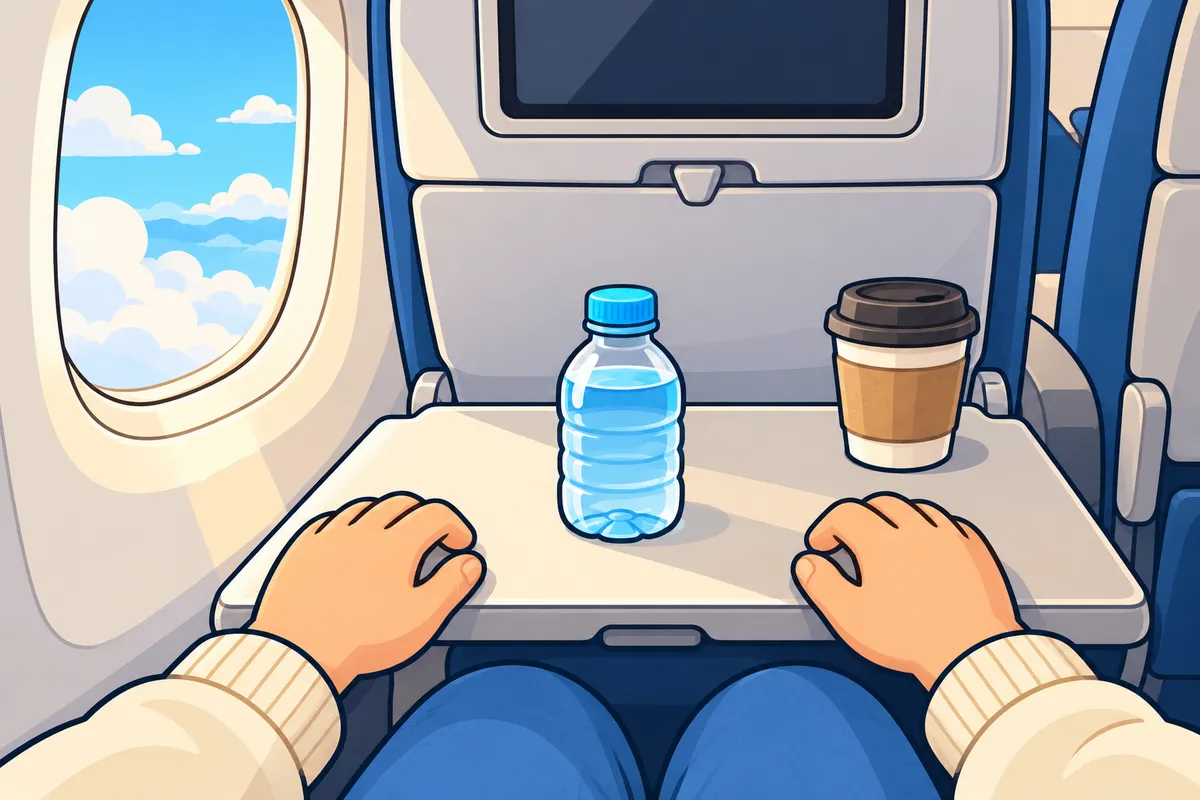
Water from a plane's own tank is often fine, and you have no way to tell when it is not. Drink only sealed bottled or canned drinks on board, skip water, coffee and tea made from the tank, and keep the lavatory tap out of your mouth.
That advice comes from the people who test the tanks. When the US EPA sampled 327 passenger planes in 2004, about 15 % carried total coliform bacteria, and it told worried passengers to ask for canned or bottled drinks.
Is Airplane Water Safe to Drink?
Sometimes, and you cannot check which flight you are on. In the United States, the federal Aircraft Drinking Water Rule makes airlines disinfect, flush and test each plane's tank, yet each plane gets tested only between once a month and once a year; the testing schedule and the airline scores below describe aircraft under that US rule. In the latest three-year count, 2.66 % of tested sample locations showed coliform bacteria.
EPA ran two rounds of tests in 2004:
- In the first, 20 of 158 planes tested positive for total coliform and two of them also carried E. coli.
- In the second, 29 of 169 were positive and none carried E. coli.
EPA's rule took effect in 2011. The 2026 Airline Water Study from the Center for Food as Medicine and Longevity (CFML) read EPA's records for October 2022 through September 2025: 949 of 35,674 sample locations were total coliform positive, and the airlines logged 32 E. coli violations. That study counts sample locations and EPA's 2004 tests counted planes, so the two percentages do not measure the same thing.
Coliform bacteria work as a warning light. EPA calls them indicators that disease-causing germs may be in the water, so a positive test means the tank needs cleaning, and it does not prove that a cup from it would make you sick.
Who Should Be Most Careful
EPA's 2004 advice named people with weakened immune systems first. The CFML study adds young children, older passengers and pregnant women to the list of travelers who may face higher risks from germs in the water.
Where Does the Water on a Plane Come From?
From the airports it flies through. A plane boards water through a temporary connection to an airport watering point, using cabinets, trucks, carts and hoses, and may fill up at several airports in one day. The tank then feeds both the galley and the lavatory sinks.
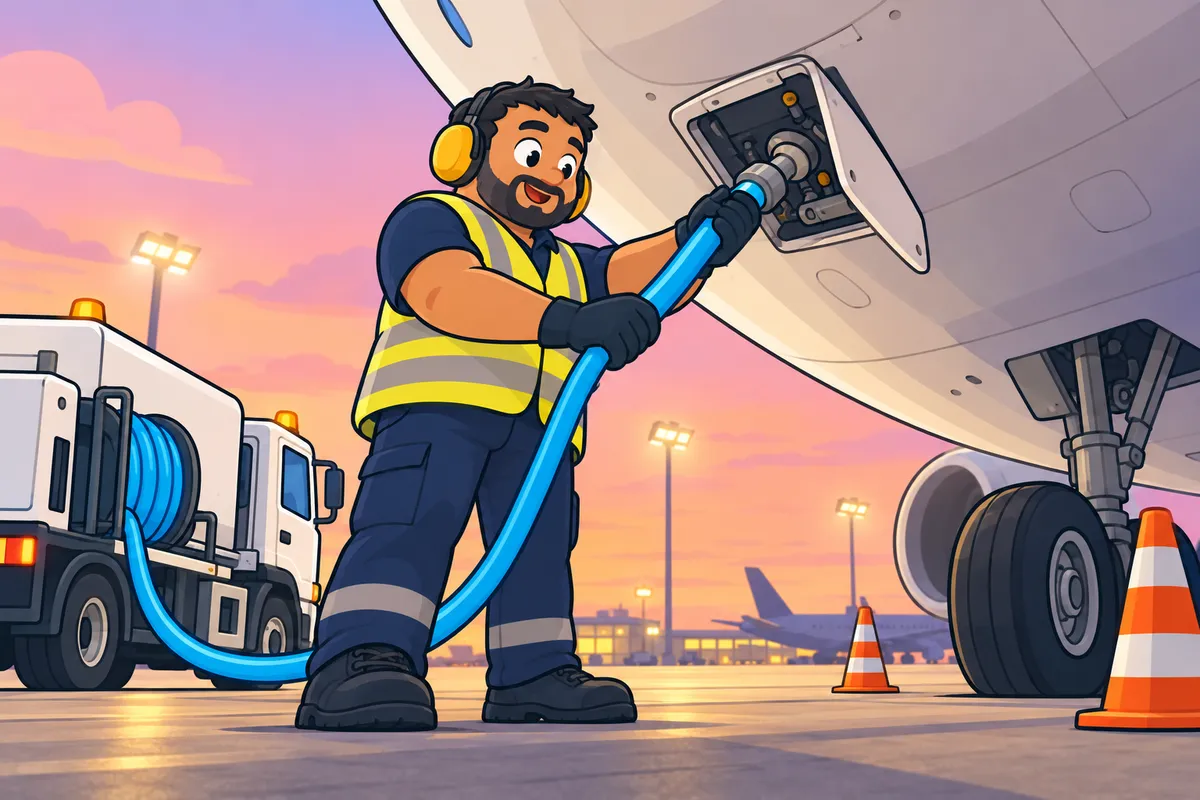
The EPA rule page lists what decides the quality:
- The water at each source.
- The care taken while boarding it.
- How well the airline maintains the onboard system and the transfer equipment.
Any one of those links can add germs that a later test catches only weeks or months on.
The CFML study names a second reason. Water sits still in the tank between flights and warms and cools with each climb and descent, conditions it says can let a film of bacteria grow on the inside of tanks and pipes.
What Is Safe to Drink on a Plane?
Anything that comes to you sealed is safe: a factory-sealed bottle of water, a can of soda or juice, a sealed carton.
Skip anything poured or brewed from the plane's tank, which means galley tap water, coffee and tea, and every drop from the lavatory sink.
Should you drink it on board?
1Does it reach you in an unopened bottle, can or carton?
YesDrink it. A factory seal keeps the plane's tank out of it.
No2Was it poured or brewed in the galley, such as tap water, coffee, tea or hot water for your own tea bag?
YesSkip it or ask for a sealed one. Galley drinks use water from the onboard tank.
No3Does it come from a lavatory tap?
YesNever drink it. Keep it out of your mouth; the studies advise hand sanitizer instead.
NoOtherwiseAsk the crew. If you cannot tell where a drink came from, ask for the unopened bottle.
The CDC Yellow Book asks travelers to treat the food and water served on flights with the same caution they use for restaurants. On the ground you would order a sealed bottle where the tap is doubtful, and the same habit works at 35,000 feet.
Is Bottled Water on a Plane Safe?
Yes, when the seal is intact. A factory-sealed bottle carries water filled and closed on the ground, so the plane's tank never touches it, and the CFML study's first advice is to drink no water on board that is not in a sealed bottle. Check that the cap is still locked to its ring before you drink.
A cup poured in the galley may come from a large bottle or from the tank, and you cannot see which. Ask for the small bottle or a can when the cart comes round, and pack an empty bottle to fill at an airport fountain before boarding.
Is Airplane Coffee or Tea Safe to Drink?
It is the drink most worth skipping. The galley makes coffee and tea with water from the onboard tank, and EPA's 2005 advice was to refrain from tea or coffee unless made with bottled water. Both the 2019 and 2026 airline water studies tell passengers not to drink coffee or tea on board.
The rule itself shows where coffee water comes from. When an airline has to shut a plane's water system after a bad test, the Aircraft Drinking Water Rule tells it to supply bottled water "for drinking and coffee or tea preparation", along with hand gels or wipes for the galleys and lavatories.
Hot does not settle it. The Yellow Book counts tea and coffee as generally safe when made with water that has just come to a boil, the 1-minute rolling boil that kills germs in a kettle, and EPA still did not rely on that for drinks brewed in a plane's galley.
Is the Water in Airplane Bathrooms Safe?
Not for drinking or brushing your teeth. Lavatory sinks run on the same tank as the galley, and the federal rule takes one of each plane's two routine samples from a lavatory tap. When a test fails, the notice posted in each lavatory says the water is not safe for drinking, teeth brushing or hand washing.
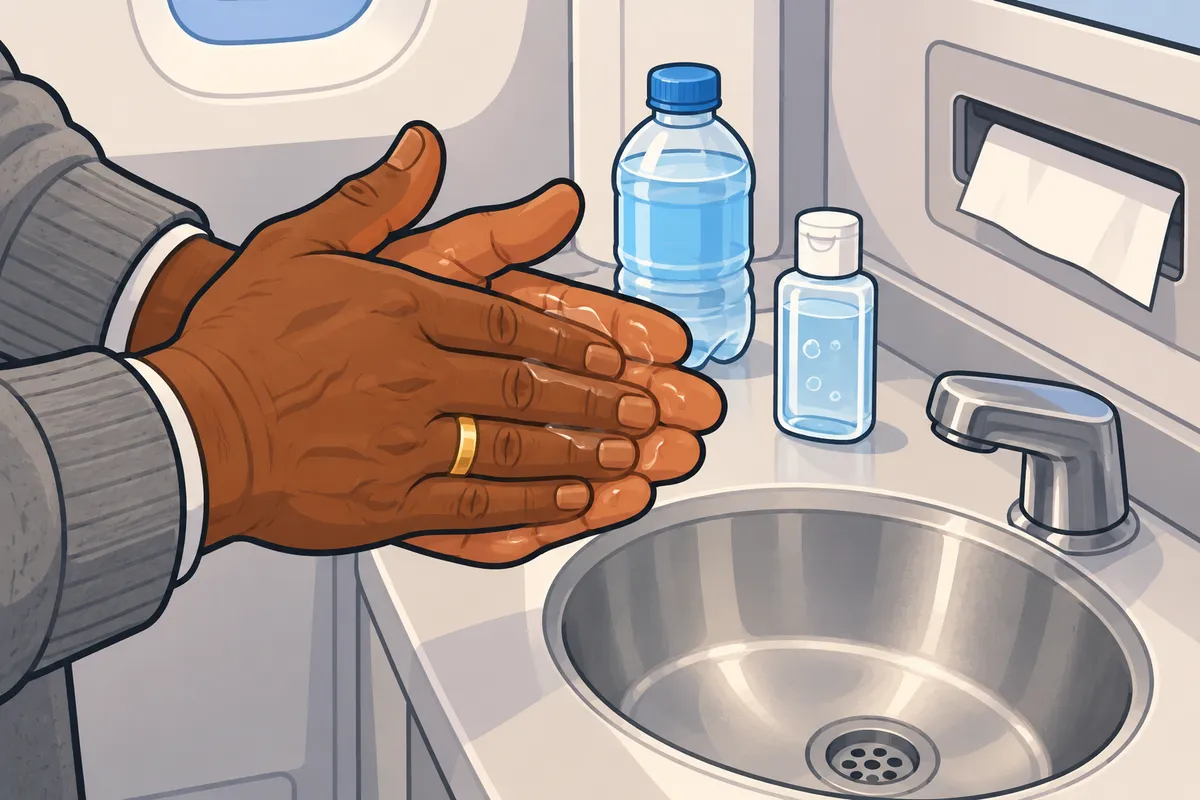
The rule also tells you what a working system is for. Its definition of human consumption covers drinking, hand washing, teeth brushing and food preparation, so a plane that passes its tests should give water safe for all of them.
Is It Safe to Wash Your Hands on a Plane?
The rule counts hand washing as an intended use of the water, yet the study authors advise against it as a precaution: the 2019 release says "Do not wash your hands in the bathroom; bring hand-sanitizer with you instead." They did not measure a handwashing risk. Use an alcohol-based sanitizer with at least 60 % alcohol.
Neither study says what to do about visibly dirty hands, so ask the crew, and never wash at the tap when a non-potable notice is posted.
Keep the tap water away from your mouth while you do it, and rinse your toothbrush with water from a sealed bottle.
How Often Do Airlines Test Their Water?
Between once a month and once a year for each plane, set by how often the airline disinfects and flushes it. The Aircraft Drinking Water Rule follows the system maker's cleaning schedule, and a plane cleaned less often must be tested more often. Each test is two 100 ml samples, one from a lavatory and one from the galley.
| Disinfect and flush at least | Coliform test at least | Samples a year |
|---|---|---|
| 4 times a year (every 3 months) | once a year | 2 |
| 3 times a year (every 4 months) | twice a year (every 6 months) | 4 |
| 2 times a year (every 6 months) | 4 times a year (every 3 months) | 8 |
| once a year or less | 12 times a year (every month) | 24 |
Source: 40 CFR 141.803, Table B-1. The samples-a-year column is our arithmetic, two samples per test.
A plane cleaned 4 times a year may give only 2 water samples in 12 months, while it boards water at airport after airport. Neither end of the table checks the water before your flight.
The rule also keeps the test simple. Airlines must wait at least 72 hours after a cleaning before they sample, and the lab must start within 30 hours. It records only whether coliforms or E. coli are present and never counts them.
The 2019 Hunter College study adds that the rule skips the other microorganisms the national rules for ground systems test for.
What Happens After a Positive Test
The rule sets a clock for every result:
- A total coliform hit without E. coli gives the airline 72 hours to disinfect and flush or to close the system.
- An E. coli hit gives it 24 hours to close the taps.
Airlines keep test and cleaning records for 5 years and report results to EPA, which enforces the rule for aircraft. FDA oversees the water used for food and drinks and the supply lines, and the FAA oversees the airline's maintenance program.
Who Checks the Airlines
Mostly the airlines check themselves, as every US public water system does, and report to EPA. Before it published the rule, which took effect on October 19, 2011, EPA placed 45 air carriers under consent orders. Both airline water studies say EPA rarely fines airlines that break the rule.
Which Airlines Have the Safest Water?
In the 2026 CFML study:
- Delta Air Lines scored 5.00 and Frontier 4.80 out of 5, both grade A, followed by Alaska at 3.85.
- American Airlines scored lowest among major airlines at 1.75.
- Among regional carriers GoJet scored best at 3.85 and Mesa lowest at 1.35.
The study counts 3.5 or better as relatively safe, clean water. It weighs five things from EPA's records: violations per aircraft, E. coli violations, the share of positive tests, public notices, and how often the airline disinfects and flushes.
The 2019 and 2026 scores cannot be compared directly, because the studies score different things: the 2019 Hunter College study used 10 criteria, and the 2026 study uses the five weighted criteria above. In 2019 Delta scored 1.6 and Frontier 2.6 while Alaska and Allegiant led at 3.3; in 2026 Delta and Frontier top the list.
So read the ranking as a record of the past three years, which says nothing about the plane at your gate today. Both studies give every passenger the same advice whatever the score. The sealed bottle is the one drink you can check yourself.
Your Sealed-Bottle Plan for the Next Flight
Pack for the water you can control. The hydration side of the flight, how much to sip each hour in dry cabin air, belongs to your drink plan from gate to arrival; the list here keeps the tank water out of it.
From Security to Landing
- Fill an empty bottle at a fountain after security
- Buy your coffee at a café after security
- Ask for a sealed bottle or can at each drinks round
- Sanitize hands with 60 % alcohol gel; never use the tap if a notice is posted
- Keep a small sealed bottle by your seat to brush your teeth
If you land somewhere the tap is doubtful, the same habit carries on: the water at your hotel gets its own check before you drink it. At home, your city's water comes with a yearly report you can read; ask your utility for it if you want the same answer for your own kitchen tap.
General information for healthy adults, not medical advice. If a doctor has set your fluid amount, follow that.

More in Outdoors and Travel


Sources
- US EPA (eCFR). 40 CFR Part 141 Subpart X, Aircraft Drinking Water Rule, 2026.
- US EPA. Aircraft Drinking Water Rule, 2026.
- US EPA. EPA Makes Passenger Aircraft Water Testing Information Available, 2004.
- US EPA. EPA Announces New Aircraft Drinking Water Quality Data, 2005.
- Center for Food as Medicine and Longevity. 2026 Center for Food as Medicine & Longevity Airline Water Study, 2025.
- Hunter College NYC Food Policy Center and DietDetective.com. Airline Water: Which Airline's Water Is Safest? (2019 Airline Water Study), 2019.
- CDC Yellow Book. Food and Water Precautions for Travelers, 2025.
Sources checked by the Glubbo Editorial Team on Nov 2, 2026. General information, not medical advice. How we write and check our guides.

