Outdoors and Travel · Emergency Water
How Much Bleach to Purify Water, in Drops per Quart and Gallon
The drops for each bleach strength and jug size, the 30-minute wait, and the bleach you must not use.
 By the Glubbo Editorial Team · Updated Oct 19, 2026 · 9 min read
On This Page
- How Much Bleach Do You Put in a Gallon of Water to Purify It?
- How Many Drops of Bleach per Gallon of Water?
- How Much Bleach for a 5-Gallon Jug or a 55-Gallon Drum?
- Can You Use Bleach to Purify Drinking Water?
- How to Disinfect Water With Bleach
- How Long After Adding Bleach Can You Drink the Water?
- What Kind of Bleach Can You Use to Purify Water?
- When the Treated Water Tastes Too Strong
- Is Bleach-Treated Water Safe to Drink Every Day?
- No Bleach in the House?
- Dose Plans for Three Real Jugs
- Mistakes That Leave the Water Unsafe
- Put a Bleach Kit Together Before the Next Storm
- Sources
Short answer
8 drops per gallon, 6 if your bleach is 8.25 %.
- EPA: 8 drops per gallon of 6 % bleach, 6 drops of 8.25 %; 2 drops per quart.
- Stir, wait 30 minutes and sniff for a faint chlorine smell.
- Double the dose for cloudy, colored or very cold water.
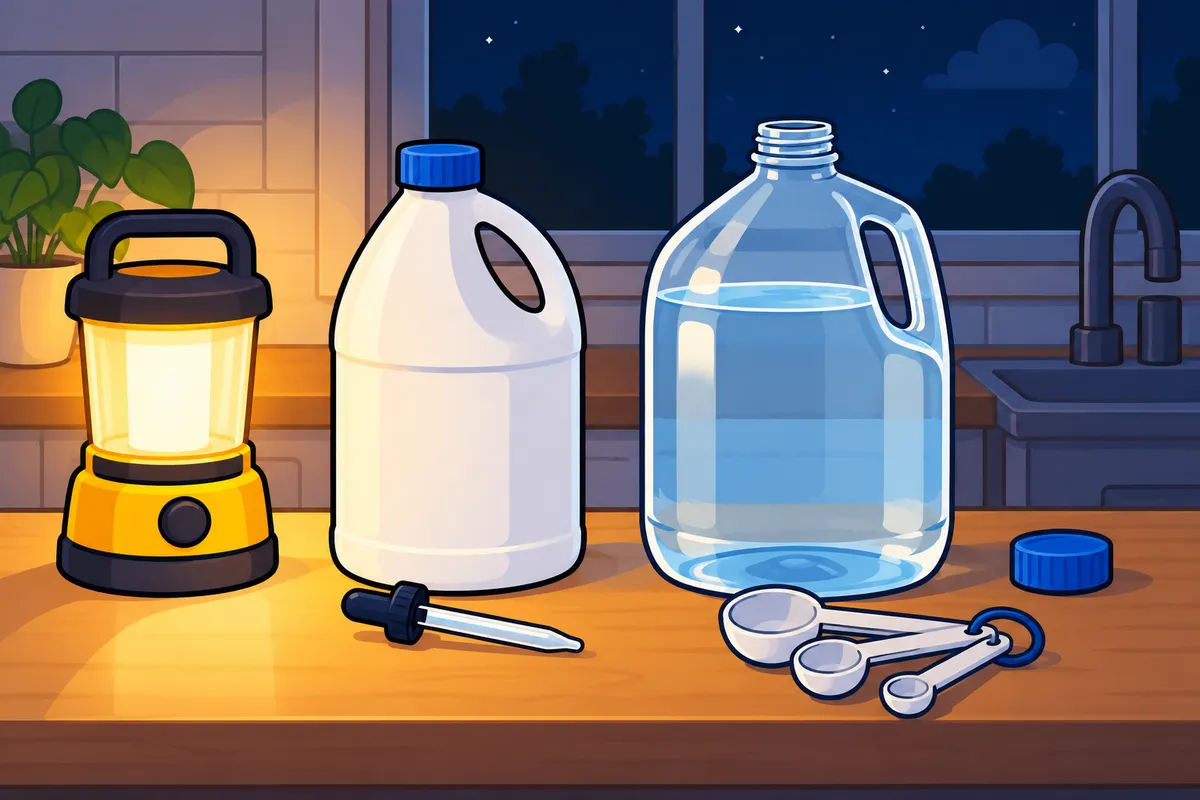
Add 8 drops of regular unscented 6 % bleach to each gallon of clear water, stir, and wait 30 minutes. A bottle that says 8.25 % needs only 6 drops. Cloudy, colored or very cold water needs twice the dose.
A boil notice on a night when the stove is electric is the usual reason people reach for the bottle under the sink. A dropper and half an hour of waiting make water safe against bacteria and viruses, but the strength printed on the label decides how many drops that takes.
How Much Bleach Do You Put in a Gallon of Water to Purify It?
Eight drops of regular unscented bleach per gallon, then 30 minutes of waiting. That is the EPA's figure for 6 % bleach; for the stronger 8.25 % bottles now common in stores, the EPA lowers it to 6 drops. The CDC simply says 8 drops for any bleach from 5 to 9 %.
Read the label before anything else. The CDC asks you to follow the bottle's own disinfecting directions when it has them, and to go by its sodium hypochlorite percentage when it does not.
How Many Drops of Bleach per Gallon of Water?
Eight drops for 5 to 9 % bleach, per the CDC, or 6 drops when the bottle says 8.25 %, per the EPA. Count them with a clean dropper; for larger amounts, the EPA switches to teaspoons.
An empty cell means that agency gives no figure for that volume.
| Water | CDC, 5 to 9 % bleach | EPA, 6 % bleach | EPA, 8.25 % bleach | CDC, 1 % bleach |
|---|---|---|---|---|
| 1 quart or liter | 2 drops | 2 drops | 2 drops | 10 drops |
| 1 gallon | 8 drops | 8 drops | 6 drops | 40 drops |
| 2 gallons | — | 16 drops (1/4 tsp) | 12 drops (1/8 tsp) | — |
| 4 gallons | — | 1/3 tsp | 1/4 tsp | — |
| 5 gallons | 40 drops | — | — | 200 drops |
| 8 gallons | — | 2/3 tsp | 1/2 tsp | — |
Sources: CDC, How to Make Water Safe in an Emergency; EPA, Emergency Disinfection of Drinking Water.
Why Do the CDC, EPA and Ready.gov Give Different Bleach Amounts?
They round for different bottles:
- The EPA writes one column for 6 % and one for 8.25 %.
- The CDC uses one figure across 5 to 9 % to keep it simple.
- Ready.gov still gives 1/8 teaspoon per gallon for 5.25 to 6 % bleach, the older standard strength.
By the EPA's own table, 16 drops equal 1/4 teaspoon, so Ready.gov's 1/8 teaspoon works out to about 8 drops. All three agree at 6 %; they part only at 8.25 %, where the EPA's 6 drops match the stronger bottle.
Teaspoons or Drops?
Drops for a quart to two gallons, teaspoons from four gallons up. A five-gallon jug takes 40 drops by the CDC's figure, which is easy to miscount, so measure a level fraction of a teaspoon for anything that big.
How Much Bleach for a 5-Gallon Jug or a 55-Gallon Drum?
Scale the CDC's rate of ½ milliliter of 5 to 9 % bleach per gallon of clear water. A 55-gallon drum takes about 27½ mL, a little under 2 tablespoons, and double that when the water is cloudy or cold.
The CDC's own table stops at 5 gallons (2½ mL, or ½ teaspoon). The larger rows are that same rate multiplied, so measure with a clean spoon or an oral syringe, not drops. The EPA's teaspoon column for 4 and 8 gallons runs a little lower per gallon than 8 drops each, so it is the smaller of the two figures for a big container.
| Container | Clear water, 5 to 9 % bleach | Cloudy or very cold water |
|---|---|---|
| 5-gallon jug | 2½ mL (½ tsp) | 5 mL (1 tsp) |
| 15-gallon tank | 7½ mL (1½ tsp) | 15 mL (1 tbsp) |
| 30-gallon rain barrel | 15 mL (1 tbsp) | 30 mL (2 tbsp) |
| 55-gallon drum | 27½ mL (just under 2 tbsp) | 55 mL (almost 4 tbsp) |
Fill the container, add the bleach, stir to the bottom with a clean stick or paddle, and let it stand 30 minutes before you sniff.
Can You Use Bleach to Purify Drinking Water?
Yes, against bacteria and viruses. The CDC says chlorine bleach kills both but does not work well against parasites, and its emergency page adds that chlorine does not kill Cryptosporidium.
That gap matters more for a stream than for a city tap during a power cut. For water from a lake or river, filter it first with a filter of 1 micron or less, as the CDC suggests, or boil it instead, since each treatment leaves a different germ standing.
Bleach cannot fix chemicals either. Water with fuel or toxic chemicals in it stays unsafe however much bleach you add. Use bottled water, call your health department and remember that in a disaster bleach comes third, after sealed water and a pot on the stove.
How to Disinfect Water With Bleach
Strain, dose, stir, wait, then smell. The whole job takes about 35 minutes, most of it waiting.
One Gallon, Start to Finish
- Cloudy? Let it settle, then pour it through a cloth or coffee filter
- Add 8 drops of 6 % bleach, or 6 of 8.25 %
- Stir or shake, then cap the jug
- Wait 30 minutes
- Sniff: a faint chlorine smell means it is ready
Keep the treated water in clean, sanitized containers with tight lids, the CDC says, so nothing new gets in after the chlorine has done its work.
How Long After Adding Bleach Can You Drink the Water?
After 30 minutes, if it smells faintly of chlorine. The smell is your only check without test strips, and the rule for a missing smell is stricter than most people expect.
- 30 min
- standing time after the first dose
- +15 min
- after a second dose, if you smell no chlorine
- ×2
- the dose for cloudy, colored or very cold water
If the second dose still gives no smell, Ready.gov says to throw that water out and find another source.
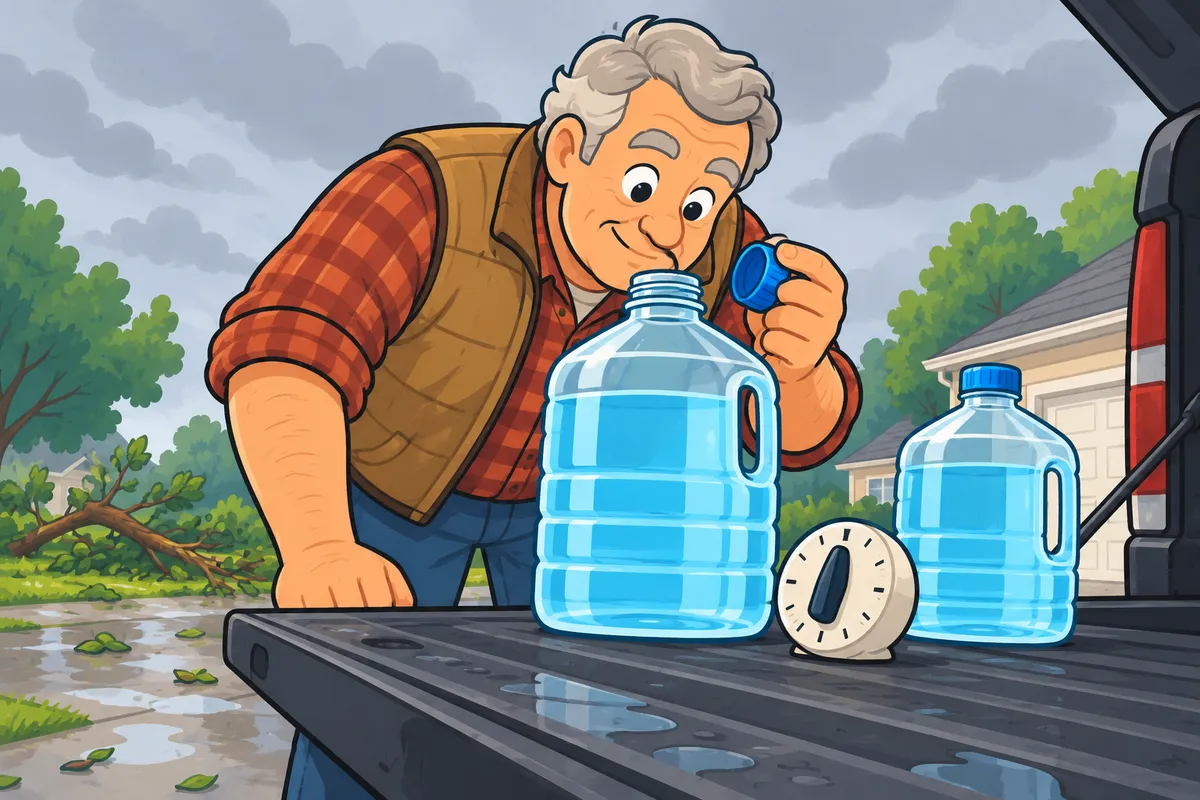
A cloudy jug uses up chlorine on the dirt before it reaches the germs. That is why both the CDC and the EPA double the dose for murky water and ask you to strain it first.
How Cold Water Changes the Wait
Cold water slows chlorine down. At 41°F (5°C) and a dose of 2 mg/L, the WMS guideline allows 240 minutes of contact to deal with Giardia, and 60 minutes at 8 mg/L. At 59°F (15°C) the same doses need 180, 60 and 30 minutes.
In winter, double the dose and give the water as long as you can before drinking it. A jug that sat in an unheated garage is cold water, even if the kitchen is warm.
What Kind of Bleach Can You Use to Purify Water?
Plain, unscented liquid chlorine bleach, and nothing else. The EPA asks for fresh bleach or a bottle stored at room temperature for less than a year; scented, color-safe and bleach with added cleaners are out.
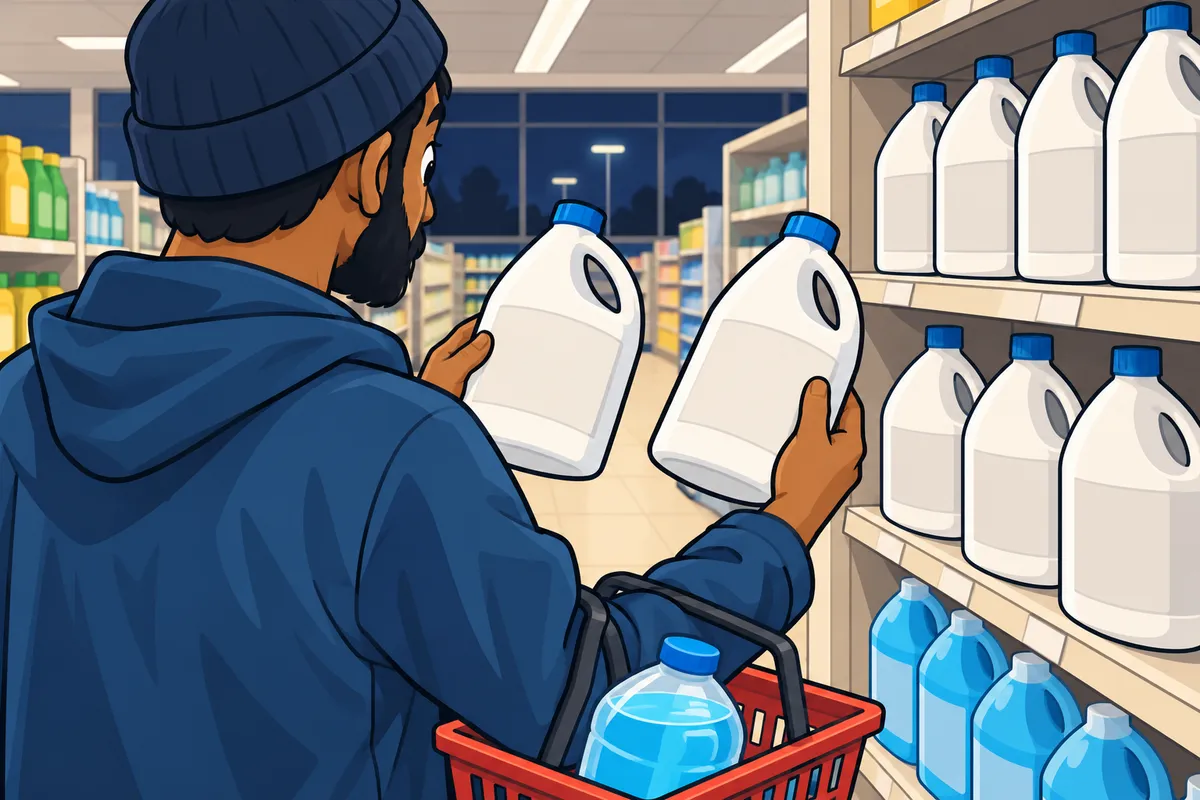
What the Label Tells You to Do
- The label says plain or regular chlorine bleach, 5 to 9 %Use the 5 to 9 % column
- The label says 8.25 % or concentratedUse the EPA's 8.25 % column
- Your bottle is a weak 1 % hypochloriteUse the CDC's 1 % column
- The label gives its own directions for treating waterFollow the bottle, as the CDC asks
- The bottle is more than a year oldBuy a fresh one
- Scented, color-safe or with cleaners addedKeep it for laundry and treat the water another way
When the Treated Water Tastes Too Strong
Two fixes work:
- Pour it back and forth between two clean containers and let it stand for a few hours, the EPA suggests. The chlorine taste fades as the water takes in air.
- The WMS describes one more trick for water you drink right away: a small pinch of vitamin C (ascorbic acid) in a liter, stirred in after the contact time, neutralizes the leftover chlorine.
Never do this to water you plan to store, because that leftover chlorine is what keeps it safe in the jug.
Is Bleach-Treated Water Safe to Drink Every Day?
For a few days or weeks in an emergency, yes. The WMS guideline says chlorine has no known toxicity at the concentrations used to disinfect water, and it judges the risk of untreated infectious disease far greater than the risk from chlorination by-products.
Emergency doses are higher than a city tap. The same guideline notes that the CDC recommends less than 2 mg/L for household use and that many emergency doses exceed that, which is one more reason to stop at the dose in the table instead of adding "extra to be safe". When the boil notice lifts, go back to the tap.
No Bleach in the House?
Boil the water, or use another chemical by its own label. The EPA gives 5 drops of 2 % tincture of iodine per quart, or 10 if the water is cloudy, then 30 minutes of standing time.
Water tablets work too, but chlorine, iodine and chlorine dioxide each need their own wait, and strengths vary, so follow the package for the volume it names.
With a working stove, boiling is simpler: a minute at a rolling boil kills Cryptosporidium as well, which bleach cannot.
Dose Plans for Three Real Jugs
Mistakes That Leave the Water Unsafe
Most failures come from the setup, not the chlorine:
- Reading the wrong strength. A bottle that says 8.25 % dosed at the 6 % rate is slightly over, but a 1 % solution dosed as if it were 6 % gets one fifth of the chlorine it needs.
- Skipping the strain on cloudy water. Dirt takes the chlorine first, so the germs get what is left.
- Pouring the treated water into a jug that was never washed. The CDC asks for clean, sanitized containers with tight lids.
- Treating a chemical problem with bleach. It does not remove fuel, pesticides or metals, so a flood that washed a garage into your well needs bottled water, not more drops.
Put a Bleach Kit Together Before the Next Storm
The Bleach Kit
5 items- One bottle of plain, unscented bleach, with the percentage and purchase date on masking tape
- A dropper or oral syringe taped to the bottle, so one tool measures every time
- Coffee filters or a clean cotton cloth to strain cloudy water
- Two clean, lidded jugs, one for treating and one for storing
- A marker to write the treatment time on the jug, so nobody drinks it early
Tape the dose table for your bottle's percentage to the lid of the kit. In a power cut you will not want to look it up.
General information for healthy adults, not medical advice. If a doctor has set your fluid amount, follow that.

More in Outdoors and Travel
Sources
- US Environmental Protection Agency. Emergency Disinfection of Drinking Water, 2026.
- US Centers for Disease Control and Prevention. How to Make Water Safe in an Emergency, 2024.
- Ready.gov (FEMA). Water, 2021.
- US Centers for Disease Control and Prevention. About Water Treatment Options When Hiking, Camping, or Traveling, 2025.
- Wilderness & Environmental Medicine (Backer, Derlet and Hill). Wilderness Medical Society Clinical Practice Guidelines on Water Treatment for Wilderness, International Travel, and Austere Situations, 2023.
Sources checked by the Glubbo Editorial Team on Oct 19, 2026. General information, not medical advice. How we write and check our guides.

