Outdoors and Travel · Water on the Trail
How Much Iodine to Purify Water, in Drops per Liter and Gallon
Drops of tincture or povidone-iodine per liter and gallon, the wait in cold water, and who should use another method.
 By the Glubbo Editorial Team · Updated Oct 19, 2026 · 8 min read
On This Page
- How Much Iodine to Purify Water?
- How Many Drops of Iodine per Liter of Water?
- How Many Drops of Iodine per Gallon of Water?
- How Long Do You Wait After Adding Iodine to Water?
- Can You Use Povidone-Iodine to Purify Water?
- What Does Iodine Not Kill in Water?
- Who Should Not Use Iodine to Treat Water?
- Can You Store Iodine-Treated Water?
- How to Purify Water With Iodine
- Iodine Mistakes That Leave Germs Alive
- A River Bag and a Storm-Hit Tap
- Write the Dose on the Bottle Before You Pack It
- Sources
Short answer
5 drops of 2 % tincture per quart or liter, 10 if cloudy.
- Let the water stand at least 30 minutes, the EPA's emergency rule.
- Cold water needs longer: the WMS gives up to 3 hours near freezing.
- Iodine does not kill Cryptosporidium; skip it in pregnancy or with thyroid disease.
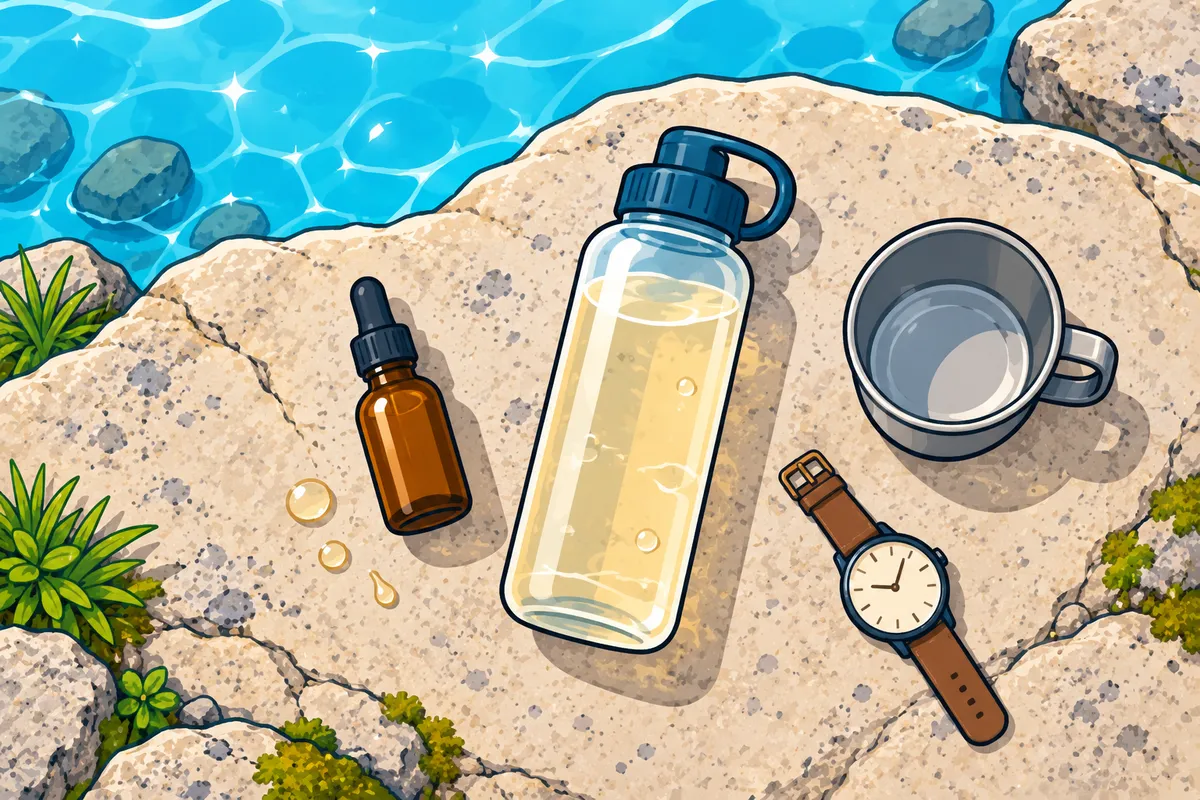
Put 5 drops of 2 % iodine tincture in each quart or liter of clear water, 10 if it is cloudy, and wait at least 30 minutes. Cold water needs a much longer wait, and iodine will not kill Cryptosporidium.
The answer is a short table, a watch and some patience. Cold water is where people get it wrong: too few drops or too short a wait leaves germs alive, and too many leaves the water tasting like a hospital.
How Much Iodine to Purify Water?
Use 5 drops of 2 % tincture per quart or liter, or 10 drops if the water is cloudy or colored, then let it stand at least 30 minutes. That is the dose and wait on the EPA's emergency disinfection page, and the Wilderness Medical Society says the same drops reach about 4 mg/L of iodine in clear water and 8 mg/L in cloudy water.
The WMS prefers the lower dose with a longer wait. Cloudy water uses up iodine, so the double dose makes up for it. The WMS also notes that 8 mg/L tastes poor, so clear the water first if you can, then use 5 drops.
How Many Drops of Iodine per Liter of Water?
Per liter of clear water, use one of these:
- Five drops of 2 % tincture.
- Eight drops of 10 % povidone-iodine.
- About 13 ml of a saturated iodine crystal solution.
Double each for cloudy water.
| Iodine product | Clear water, about 4 mg/L | Cloudy water, about 8 mg/L |
|---|---|---|
| 2 % iodine tincture | 0.25 ml (5 drops) per liter | 0.5 ml (10 drops) per liter |
| 10 % povidone-iodine | 0.4 ml (8 drops) per liter | 0.8 ml (16 drops) per liter |
| Saturated iodine crystal solution | 13 ml per liter | 26 ml per liter |
| Iodine tablets | half a tablet per liter (1 per 2 L) | 1 tablet per liter |
Source: WMS 2023, Table 7. For tablets, follow the package for the volume it names; the WMS says it is preferable to aim for 4 mg/L and wait longer, because the 8 mg/L dose for cloudy water gives poor taste.
Why Drops Vary From Bottle to Bottle
Droppers differ, so the drop count is an estimate. If your bottle comes with a measured dropper or a syringe, use the ml figure in the table instead of counting drops.
Check the label for color too. The WMS warns that colorless iodine contains only iodide and should not be used to treat water; the tincture you want is the brown kind.
How Many Drops of Iodine per Gallon of Water?
About 19 drops of 2 % tincture per US gallon of clear water, and 38 if it is cloudy. A US gallon is 3.785 liters on NIST's conversion table, so the WMS rate of 5 drops per liter comes to 18.9 drops. The EPA's 5 drops per quart gives 20 for the 4 quarts in a gallon, close enough to make no difference.
For a cloudy source, double every number in the chart. A US quart is 0.946 L, so 5 drops per quart lands a touch above 4 mg/L and works fine.
Drops, Milliliters or Teaspoons
Nineteen drops is about 1 ml, using the 20 drops per ml the WMS assumes. A teaspoon is 4.93 ml on NIST's table, so a teaspoon of tincture in a gallon gives about 1.3 ml per liter, roughly five times the WMS clear-water dose and far past what tastes drinkable.
How Long Do You Wait After Adding Iodine to Water?
At least 30 minutes, the EPA says, and much longer in cold water. These are the WMS contact times for halogens against Giardia:
| Water temperature | At 4 mg/L (clear water) | At 8 mg/L (cloudy water) |
|---|---|---|
| 30 °C (86 °F) | 45 minutes | 15 minutes |
| 15 °C (59 °F) | 60 minutes | 30 minutes |
| 5 °C (41 °F) | 180 minutes | 60 minutes |

Cold is what catches people out: a stream at 5 °C needs four times the wait of a summer lake. Treat the EPA's 30 minutes as the floor, not the finish line, once the water is cold.
Shortening the Wait
Raise the dose or warm the water. Doubling to 10 drops per liter cuts the wait at 5 °C from 180 to 60 minutes on the WMS table, at the cost of taste.
Why the Field Wait Is Longer Than the Lab Time
The WMS also lists what iodine did in laboratory tests, and those times are shorter than the field table. At 4 mg/L and pH 5, Giardia cysts were more than 99.99 % inactivated in 15 minutes at 30 °C, 45 minutes at 15 °C and 120 minutes at 5 °C. Hepatitis A fell by 99.9 % in under half a minute at 8 mg/L in purified water at 25 °C.
The field table adds margin for real water, which has other chemistry and dirt that use up iodine, and for dosing by drops. Use the field times.
Can You Use Povidone-Iodine to Purify Water?
Yes. The WMS lists 10 % povidone-iodine, a brown antiseptic, at 8 drops per liter of clear water and 16 for cloudy water. It says these solutions release free iodine at levels adequate for disinfection, but that few data are available.
Check that your bottle says 10 % povidone-iodine, since that is the strength the table assumes.
What Does Iodine Not Kill in Water?
Cryptosporidium. The CDC says iodine and iodine tablets will not kill it, and the WMS rates field doses of iodine as ineffective against Cryptosporidium and Cyclospora. Iodine does kill bacteria, viruses and, given time, Giardia.
That leaves a gap below farms and pastures, where cattle carry Cryptosporidium. A filter that stops parasites, used before the iodine, closes it; so does boiling.
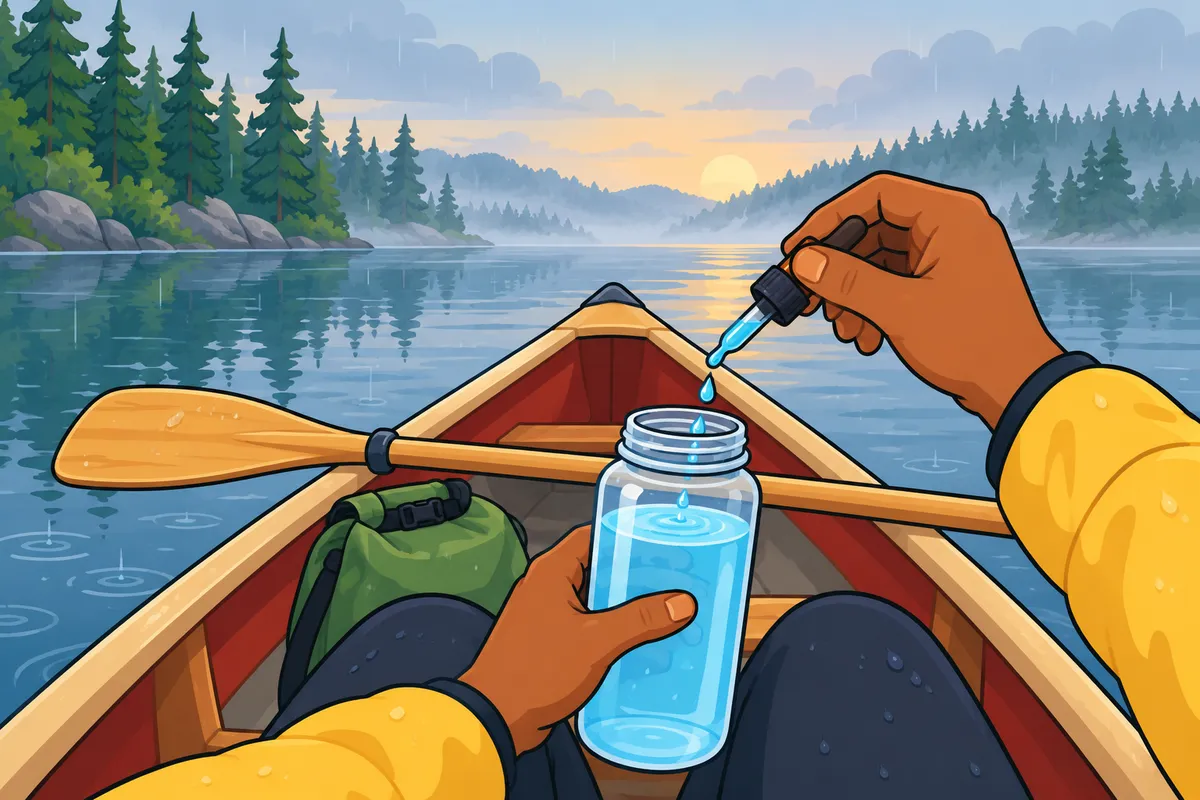
The Yellow Book adds that cloudy water holds substances that neutralize chemical disinfectants, which is why a murky source needs clearing or a double dose.
For a pasture creek, iodine plus a filter, or chlorine dioxide, the tablet the CDC calls somewhat effective against Cryptosporidium, is the safer kit.
Who Should Not Use Iodine to Treat Water?
The CDC says pregnant people, people with thyroid problems and anyone sensitive to iodine should avoid iodine-treated water, and that nobody should drink it for more than a few weeks at a time. The WMS adds people with a past or family history of thyroid disease, and people from countries with chronic iodine deficiency.
The same review found that neither the 2 mg a day ceiling nor the 3-week limit often quoted has a firm basis. That is a reason for the doctor's visit, not a license to stretch the limit on your own. The WMS itself limits iodine to short periods, which it puts at months, while the CDC says a few weeks.
Can You Store Iodine-Treated Water?
Only for a short time:
- The WMS says iodine works for short periods only, weeks at most, because it is a poor algaecide.
- For prolonged storage, it says the water should be chlorinated and kept in a tightly sealed container.
If you plan to keep a jug of water for an emergency, bleach is the better treatment for it.
How to Purify Water With Iodine
Clear the water, measure the drops, wait the full time, then fix the taste.
Iodine, Step by Step
- Let cloudy water settle, or pour it through a clean cloth
- Add 5 drops of 2 % tincture per liter (10 if still cloudy)
- Cap the bottle and shake it to mix
- Wait at least 30 min; 1 h at 15 °C, 3 h near freezing
- After the wait, a pinch of vitamin C removes the taste
Two rules for the vitamin C:
- Add it only after the full wait, and never to water you plan to store; that order comes from the WMS.
- The Yellow Book says only that a pinch of powdered vitamin C improves the taste.
Iodine Mistakes That Leave Germs Alive
Most failures come from a short wait or the wrong bottle, not from too few drops.
| Mistake | Why it fails | Do this instead |
|---|---|---|
| The same wait in snowmelt as in a warm lake | Cold slows iodine: 45 min at 30 °C, 3 h at 5 °C (WMS) | Take the EPA's 30 minutes as a minimum; in cold water wait longer or use 10 drops for 60 minutes |
| Using colorless iodine | It contains only iodide (WMS) | Buy brown 2 % tincture or 10 % povidone-iodine |
| A teaspoon per gallon | About 5 times the WMS clear dose | 19 drops per gallon, about 1 ml |
| Iodine alone below a cattle pasture | It does not kill Cryptosporidium (CDC) | Filter first, or boil |
| Vitamin C or drink mix added at once | It neutralizes the iodine | Add flavor after the wait |
| Iodine for a month-long trip | The CDC limit is a few weeks | Switch to chlorine dioxide or a filter |
A River Bag and a Storm-Hit Tap
Write the Dose on the Bottle Before You Pack It
Iodine is light and cheap, and it works if you respect the clock and its limits. Stick a strip of tape on the dropper bottle with three things, so the numbers are in front of you at the lake:
- The drops per liter
- The wait for the water temperature you expect
- The date you opened the bottle
If you would rather skip the chemistry, boiling for a minute kills everything iodine kills plus Cryptosporidium.
General information for healthy adults, not medical advice. If a doctor has set your fluid amount, follow that.

More in Outdoors and Travel

Sources
- US Environmental Protection Agency. Emergency Disinfection of Drinking Water, 2025.
- Wilderness & Environmental Medicine (Backer, Derlet and Hill). Wilderness Medical Society Clinical Practice Guidelines on Water Treatment for Wilderness, International Travel, and Austere Situations, 2023.
- US Centers for Disease Control and Prevention. How to Make Water Safe in an Emergency, 2025.
- CDC Yellow Book (Backer and Hill). Water Disinfection for Travelers, 2025.
- Environmental Health Perspectives (Backer and Hollowell). Use of iodine for water disinfection: iodine toxicity and maximum recommended dose, 2000.
- National Institute of Standards and Technology. NIST Guide to the SI, Appendix B.9: Factors for units listed by kind of quantity, 2026.
Sources checked by the Glubbo Editorial Team on Oct 19, 2026. General information, not medical advice. How we write and check our guides.

