Outdoors and Travel · Water on the Trail
How Do Water Purification Tablets Work? Kinds, Wait Times and Limits
What chlorine, iodine and chlorine dioxide tablets kill, how long each needs in cold water, and when to skip iodine.
 By the Glubbo Editorial Team · Updated Nov 3, 2026 · 11 min read
On This Page
- How Do Water Purification Tablets Work?
- How Long Do Water Purification Tablets Take to Work?
- Do Water Purification Tablets Kill Cryptosporidium?
- Is Chlorine Dioxide Better Than Iodine for Treating Water?
- Are Iodine Water Tablets Safe?
- Do Purification Tablets Work in Cloudy Water?
- How Do You Get Rid of the Taste of Purification Tablets?
- Can You Store Water Treated With Tablets?
- How to Use a Tablet So It Works
- How Long Each Method Takes Before You Can Drink
- What Tablets Cannot Remove
- A Snowmelt Creek and a Long Trek
- Do Purification Tablets Expire?
- Count the Tablets Before the Trip
- Sources
Short answer
They release a chemical that kills germs, given time.
- Chlorine, iodine and chlorine dioxide kill bacteria and viruses, the CDC says.
- Cold water slows them: 4 hours at 2 ppm in 5 °C water, per the WMS table.
- Only chlorine dioxide acts on Cryptosporidium, and it needs several hours.
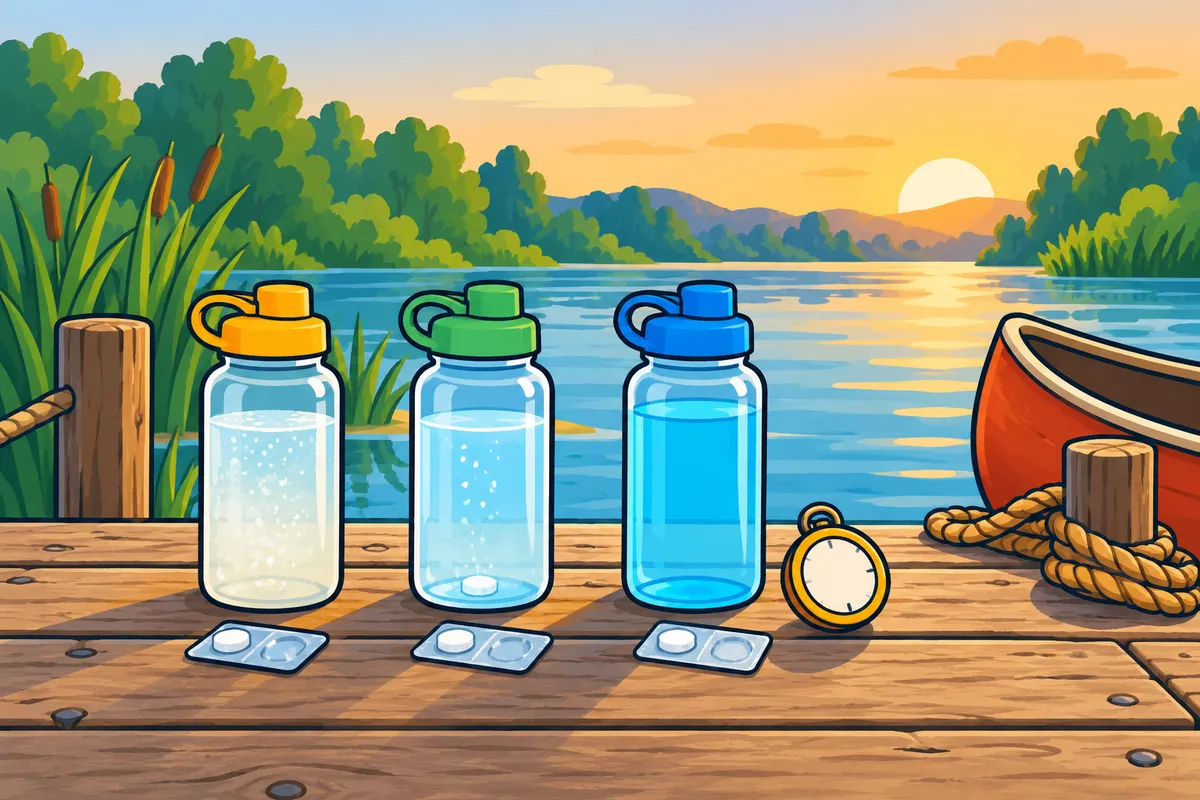
A tablet dissolves in the water and releases chlorine, iodine or chlorine dioxide, which kills bacteria and viruses once enough time has passed. The time is the part people get wrong: they drop one in, wait the half hour they remember from somewhere, and drink.
That half hour is right for some water and badly short for other water. What decides it is the chemical in the tablet, the temperature of the stream and the germ you are worried about.
How Do Water Purification Tablets Work?
A tablet dissolves and releases a disinfectant, usually chlorine, iodine or chlorine dioxide, that kills germs in the water. The CDC says all three kill viruses and bacteria but may not kill parasites. Strengths vary between brands, the EPA adds, so the label sets the dose and the volume it treats.
| Kind of tablet | Kills bacteria and viruses | Giardia | Cryptosporidium | The catch |
|---|---|---|---|---|
| Chlorine | Yes | Only with a long contact time | No | Cheap and common, weak against parasites |
| Iodine | Yes | Only with a long contact time | No | Not in pregnancy or thyroid disease; a few weeks at most |
| Chlorine dioxide | Yes | Yes | Yes, with several hours of contact | Slow, and the water must stay out of sunlight |
Sources: CDC, CDC Yellow Book, WMS 2023.
The chemical has to reach every germ and stay in contact long enough to kill it. The Yellow Book puts it as two numbers that work together: the concentration of the disinfectant and the contact time. Halve one and you need to raise the other.
Mud, leaves and silt use up part of the chemical before it reaches the germs. That is why every source on this page asks you to clear cloudy water first.
How Long Do Water Purification Tablets Take to Work?
Anywhere from 15 minutes to 4 hours, depending on the dose and the water temperature. The Wilderness Medical Society chart gives the contact times for chlorine or iodine against Giardia; follow your label when it asks for longer, and plan on several hours for chlorine dioxide, which the WMS puts at upwards of 2 to 4 hours for dependable disinfection.
| Disinfectant level | Water at 5 °C (41 °F) | At 15 °C (59 °F) | At 30 °C (86 °F) |
|---|---|---|---|
| 2 ppm (mg/L) | 240 min | 180 min | 60 min |
| 4 ppm | 180 min | 60 min | 45 min |
| 8 ppm | 60 min | 30 min | 15 min |
Source: WMS 2023, Table 6, contact times for halogens based on Giardia cysts, already lengthened for very cold water.
Why Cold Water Slows Them Down
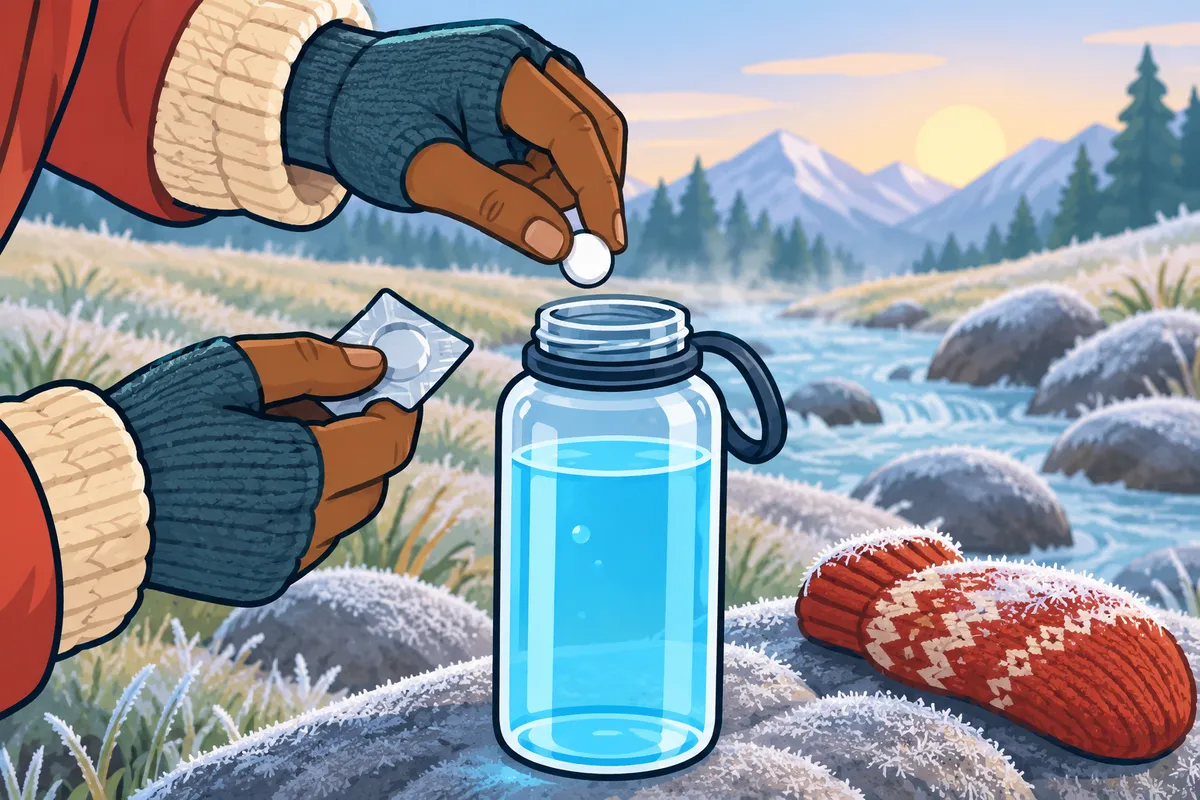
Chemistry runs slower in the cold. The WMS guideline says plainly that "cold water slows chemical disinfection reaction", and its fix is either a stronger dose or a longer wait.
Read the table down the 5 °C column: a snowmelt creek at 2 ppm needs four hours, while the same dose in a warm lake at 30 °C needs one.
For clear surface water, the guideline suggests aiming for 3 to 4 mg/L, because nobody can judge by eye how much chlorine a stream will use up. Lower levels, around 2 mg/L, suit a backup dose for doubtful tap water or a good well.
What the 30 Minutes on Many Labels Covers
Bacteria and viruses, in clear, mild water. The CDC's emergency page asks for at least 30 minutes after bleach, and that figure has become the habit for every tablet. Giardia in cold water and Cryptosporidium in any water need far longer, so the half-hour habit is where most tablet failures start.
Do Water Purification Tablets Kill Cryptosporidium?
Only chlorine dioxide tablets act on it. The CDC says iodine and chlorine tablets will not kill Cryptosporidium, while chlorine dioxide will "if you follow the instructions correctly". The Yellow Book says chlorine dioxide kills it at practical doses, with a wait of several hours.
The CDC hiking page is more cautious than its emergency page: it calls chlorine dioxide tablets "somewhat effective" at killing Cryptosporidium. And the WMS gives no Cryptosporidium-specific wait, only the general 2 to 4 hours for tablets, so read the label of the brand you carry.
Cryptosporidium matters most where cattle graze or people camp upstream. So the strongest tablet routine below a pasture is a filter of 1 micron or less, then chlorine dioxide for the viruses and bacteria the filter lets through. Each kind of trail water and its risk decides whether you need that second step.
Is Chlorine Dioxide Better Than Iodine for Treating Water?
For most hikers, yes. Chlorine dioxide acts on Cryptosporidium, which iodine does not, and it carries none of iodine's thyroid warnings. Iodine still works against bacteria, viruses and, with time, Giardia, so a few drops of tincture per liter remain a light backup for a short trip if none of its warnings apply to you.
Chlorine dioxide
- Kills Crypto, Giardia, bacteria and viruses
- No thyroid warning
- Needs several hours of contact (Yellow Book)
- No lasting residual; keep water out of sunlight (WMS)
- WMS gives tablets a weak recommendation: too little published dose data
Iodine
- Kills bacteria and viruses; Giardia only with long contact
- Not in pregnancy or thyroid disease; a few weeks at most (CDC)
- 30 minutes in warm water, up to 4 hours in cold (WMS table)
- Leaves a residual that guards the bottle afterward
- Cheap and light; a good backup for a short trip
The WMS rates chlorine dioxide itself highly, but it gives portable tablets and drops only a weak recommendation. Its reason: makers publish too little data on dose and contact time across real water conditions, so follow the label and add time when the water is cold.
Are Iodine Water Tablets Safe?
For a healthy adult over a short trip, yes; for some people, never. The CDC says to avoid iodine-treated water if you are pregnant, have thyroid problems or are sensitive to iodine, and that nobody should drink it for more than a few weeks at a time.
The numbers explain the limit. The WMS estimates that drinking 3 L a day treated at 2 to 4 mg/L gives 6 to 12 mg of iodine a day, and that recommended tablet doses would mean 16 to 32 mg a day. The guideline adds that the European Union banned the sale of iodine-based products for water disinfection in 2009.
Do Purification Tablets Work in Cloudy Water?
Poorly, unless you clear the water first or raise the dose. The Yellow Book says cloudy water needs higher concentrations or longer contact times, because the dirt uses up the chemical and shields germs.
Clear it in this order:
- Let a cloudy pot stand, then pour the clear top through a cloth or coffee filter before the tablet goes in.
- If settling is not enough, the Yellow Book offers coagulation with alum, 1.3 mL (one-fourth teaspoon) per quart, then a second treatment step, because alum does not remove all microbes.
- If you cannot clear it, the same logic applies as for bleach: double the dose for water that is cloudy, colored or very cold, as the CDC writes into its bleach drops for each jug size.
How Do You Get Rid of the Taste of Purification Tablets?
Wait until the contact time is over, then add a pinch of vitamin C or pour the water through activated charcoal. The Yellow Book lists both, plus 5 to 10 drops of 3 % hydrogen peroxide per quart, to take the chlorine or iodine taste away.
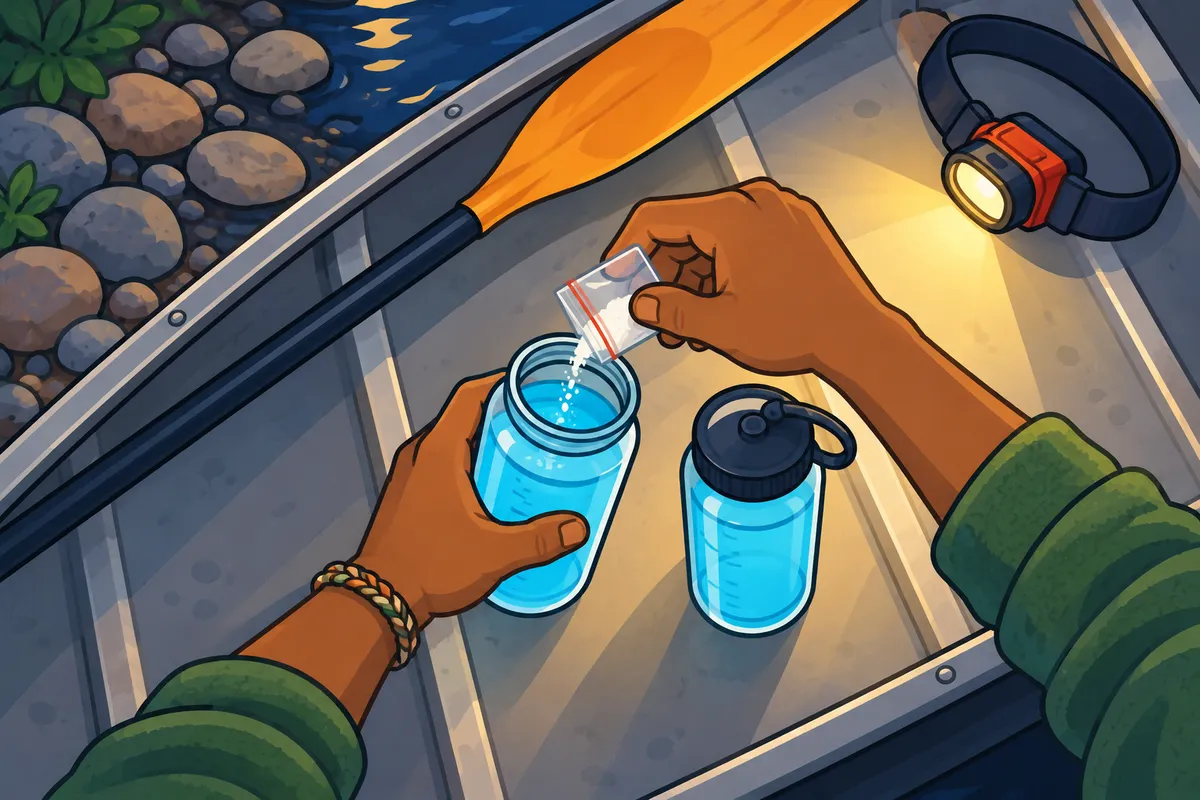
Timing is the whole trick. Vitamin C neutralizes the disinfectant, so a pinch added too early stops the treatment before it finishes.
The other fixes cost nothing. The CDC suggests pouring water back and forth between two containers and letting it stand a few hours, and a drink mix hides the taste once the water is safe.
Can You Store Water Treated With Tablets?
Chlorine and iodine tablets leave a residual that protects against new germs for a while; chlorine dioxide does not. The WMS says halogens provide a disinfectant residual against recontamination, while chlorine dioxide gives no lasting residual.
What that means for the bottle:
- Keep chlorine dioxide water out of sunlight, because the WMS says it needs protection from the sun. A dark or opaque bottle does it.
- Drink iodine water within the trip, because the WMS says iodine works for weeks at most when stored, being a poor algaecide.
- For prolonged storage, chlorinate the water and keep it in a tightly sealed container, the WMS advises.
How to Use a Tablet So It Works
Use clear water, the right dose for the volume and the full wait for the temperature. Most failures come from skipping one of those three.
One Bottle, Done Right
- Clear cloudy water: let it settle, pour it through a cloth
- Use the number of tablets the label gives for your bottle size
- Cap, shake, loosen the cap and wet the threads
- Wait the label time, longer in cold water (WMS table)
- Drink, or add vitamin C for taste once the wait is over
Wetting the threads matters because your lips touch them. Tip the bottle so treated water runs over the cap and rim before the wait begins.
Mistakes That Leave Germs Alive
Seven slips account for most tablet failures:
Mistakes that leave germs alive
7 items- A 1 L tablet in a 2 L bladder: half the dose for the volume
- 30 minutes in snowmelt: Giardia needs up to 4 hours at 5 °C
- Chlorine or iodine below a cattle pasture: neither kills Crypto
- A tablet into muddy water: dirt uses up the chemical
- Vitamin C before the wait ends: it neutralizes the disinfectant
- Iodine for a month-long trek: a few weeks at most, the CDC says
- Chlorine dioxide water left in the sun: no residual, needs shade
Each fix follows from the slip. Count tablets by liters, not by bottles, and wait the WMS table time for the temperature, not the half hour on the habit.
- Below a pasture, use chlorine dioxide or a filter plus a tablet.
- Settle and strain cloudy water before the tablet goes in.
- Add vitamin C only after the full contact time.
- Switch to chlorine dioxide or a filter for any trip past a few weeks.
- Store chlorine dioxide water shaded in a dark or opaque bottle.
How Long Each Method Takes Before You Can Drink
Tablets are the slowest of the field methods, and that is the price of their weight. The table sets the waits next to each other.
| Method | When you can drink | Source |
|---|---|---|
| Boiling | After 1 minute at a rolling boil, plus time to cool (3 minutes above 6,500 ft) | CDC |
| Filter | As soon as it is pumped, though it stops parasites and bacteria only | CDC |
| UV pen | After the pen's cycle on 1 to 2 L of clear water | Yellow Book |
| Bleach | After 30 minutes, and a second dose and 15 more minutes if there is no chlorine smell | EPA |
| Chlorine or iodine tablets | After the label wait, 15 to 240 minutes by dose and temperature | WMS table above |
| Chlorine dioxide tablets | After several hours, upwards of 2 to 4 | Yellow Book, WMS |
When time is short, a filter followed by a tablet or a boil is the combination the CDC calls the next best choice after boiling.
What Tablets Cannot Remove
Disinfectant tablets work on germs only. The CDC says you cannot make water that holds harmful chemicals, toxins or radioactive material safe by boiling or disinfecting it, and a tablet is a disinfectant.
They also do not clear a cloudy bottle, and they do not take salt out of seawater. Skip the tablet and find another source when the water:
- Smells of fuel or chemicals
- Shows an algal bloom, such as foam, scum or paint-like mats
- Runs below a mine or a spill
Whatever is in your first-aid kit, none of it fixes those.
A Snowmelt Creek and a Long Trek
Do Purification Tablets Expire?
Yes: tablets carry a shelf life, and one past its date may not release the dose the label promises. The WMS guideline gives no shelf life for tablets, so the only number here comes from a maker's spec. NRS, selling Katadyn Micropur MP1, writes: "As long as they’re sealed, the tablets have a four-year shelf life."
That is one brand; another brand can differ, so the date on your own pack decides.
Check two things before a trip:
- The expiration date printed on the box or the strip itself.
- The seal: if a foil blister is torn or a bottle cap is loose, count the tablets as suspect, because the four-year figure applies to sealed tablets only.
Our own rule of thumb, not a maker's or the WMS's: replace tablets that are near or past the printed date, and keep unused strips in a cool, dry place at home, not in the trunk of a car. A fresh strip costs far less than a stomach bug at altitude.
Count the Tablets Before the Trip
Multiply the liters you will treat in a day by the tablets the label gives per liter, add a day's spare, and write the wait for your coldest water on the strip. When the water runs out faster than you planned, the tablets are only half the answer: how much to carry between refills decides how many you need.
General information for healthy adults, not medical advice. If a doctor has set your fluid amount, follow that.

More in Outdoors and Travel


Sources
- US Centers for Disease Control and Prevention. About Water Treatment Options When Hiking, Camping, or Traveling, 2025.
- US Centers for Disease Control and Prevention. How to Make Water Safe in an Emergency, 2024.
- CDC Yellow Book (Backer and Hill). Water Disinfection for Travelers, 2025.
- Wilderness & Environmental Medicine (Backer, Derlet and Hill). Wilderness Medical Society Clinical Practice Guidelines on Water Treatment for Wilderness, International Travel, and Austere Situations, 2023.
- US Environmental Protection Agency. Emergency Disinfection of Drinking Water, 2026.
- NRS. Katadyn Micropur MP1 Water Purifier Tablets, 2026.
Sources checked by the Glubbo Editorial Team on Nov 3, 2026. General information, not medical advice. How we write and check our guides.

