Outdoors and Travel · Water on the Trail
How to Filter Muddy Water to Drink, From Silt to a Safe Bottle
Settle, strain and treat muddy water, with alum doses, boil times by altitude and the water no method can fix.
 By the Glubbo Editorial Team · Updated Nov 2, 2026 · 11 min read
On This Page
- How Do You Filter Muddy Water to Drink?
- Should You Let Muddy Water Settle or Filter It First?
- How Do You Use Alum to Clear Water?
- Can You Drink Cloudy Water If You Boil It?
- Which Treatments Struggle in Muddy Water?
- When Is Muddy Water Not Safe to Drink at All?
- Muddy-Water Plans for Three Camps
- Pack a Muddy-Water Kit for the Next Trip
- Sources
Short answer
Let it settle, strain it, then boil or disinfect it.
- Let it stand about 1 hour, then pour the top through a cloth or coffee filter.
- Boil 1 minute; 3 minutes above 6,500 ft (CDC) or 5,000 ft (EPA).
- Bleach instead? Double it for cloudy water: 16 drops of 6 % per gallon (EPA).
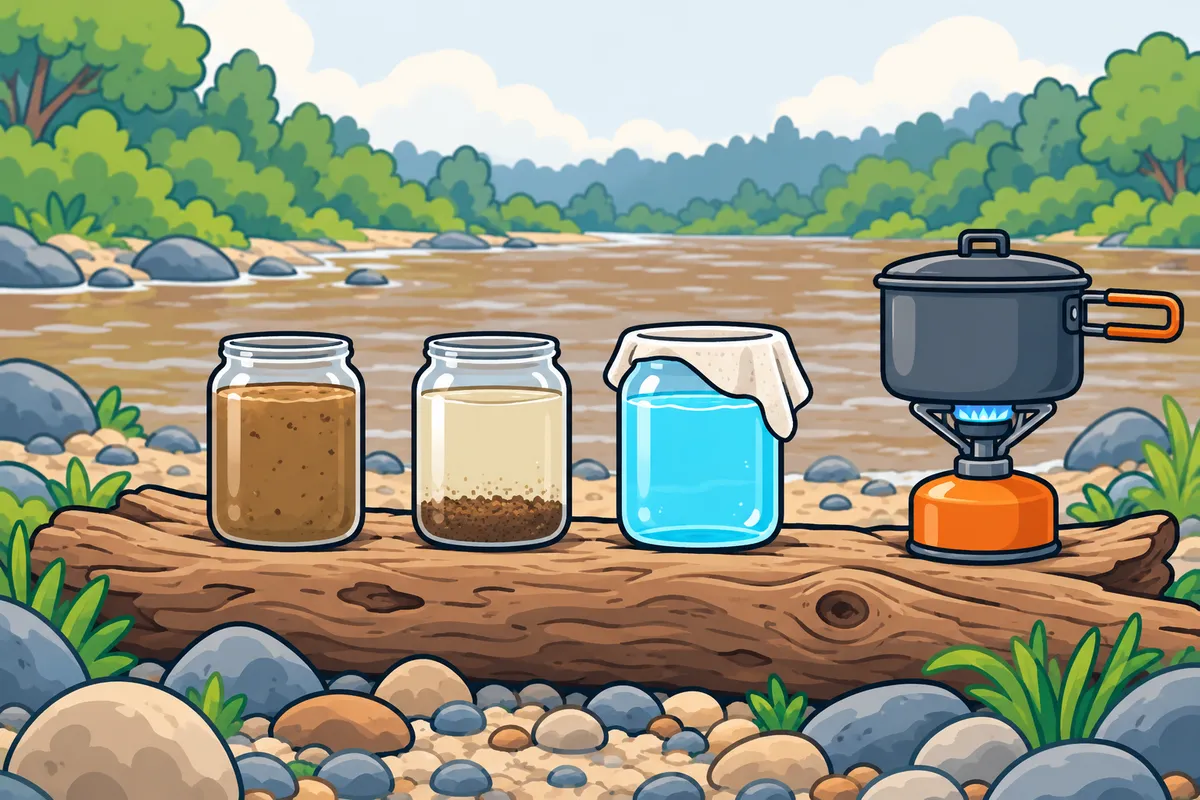
Let the muddy water stand for about an hour, pour the clear top through a clean cloth or coffee filter, and then boil it or disinfect it. The first two steps take out the dirt; only the third makes the water safe to drink.
Brown water from a river or pond can often be made drinkable, but only if nothing chemical got into it. You need a second pot or bucket, something to strain through, and the patience to wait before the stove goes on. If the water has a dark color, an odd smell or a fuel sheen, the EPA says to look for another source, because treating water does not remove chemicals.
How Do You Filter Muddy Water to Drink?
Settle it, strain it, then treat it. The Wilderness Medical Society says to let the water sit undisturbed for about 1 hour, or until sediment forms on the bottom, then pour the clear water off through a coffee filter or finely woven cloth. It adds that further treatment is still needed before you drink.
Brown River to Safe Bottle
- Fill a pot or bucket and leave it still for about 1 hour
- Pour the top slowly through a coffee filter or tight-weave cloth
- Still murky? Clump it with alum and let it settle again
- Boil it, or disinfect it (bleach doubled; tablets by their label)
- Store it in a clean bottle that never touched the raw water
Every later step works better on clear water. The WMS guideline explains that cloudy water can rapidly clog filters, needs more chemical treatment, and ends up tasting worse once dirt and disinfectant mix.
Clearing alone falls short. Simple strainers such as fabric, paper or crushed charcoal reduced bacteria and viruses by as much as 50 to 85 %, depending on the material, the same guideline says, so a jug can look clean and still make you sick.
Should You Let Muddy Water Settle or Filter It First?
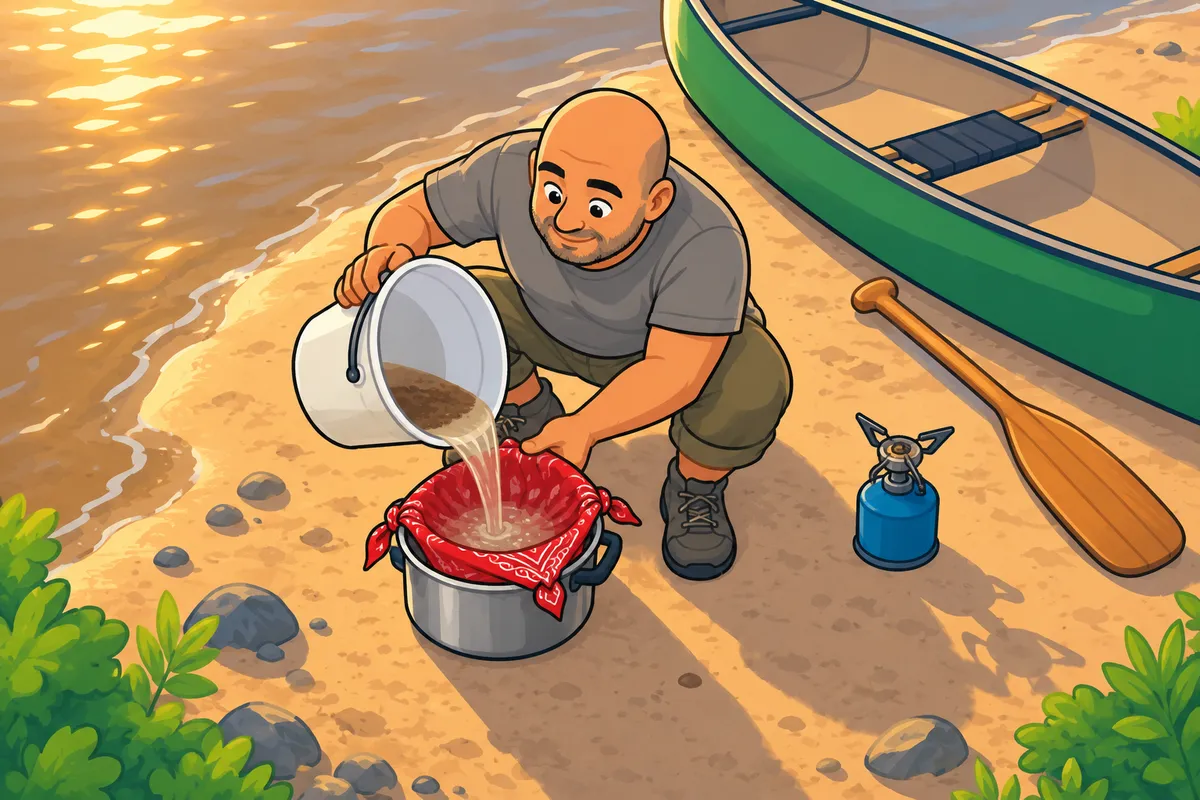
Settle first, then strain. The WMS and the Yellow Book both let the dirt sink before pouring the top through a cloth, and settling first spares the cloth on brown, silty water.
The CDC lists straining first and settling as "another option", so for lightly cloudy water a quick pour through a coffee filter meets its advice.
The agencies use slightly different words for the same job:
| Source | First step | What you strain through | Then |
|---|---|---|---|
| CDC | Filter through cloth, or let it settle and draw off the clear water | Clean cloth, paper towel or coffee filter | Boil or disinfect |
| EPA | Let it settle | Clean cloth, paper towel or coffee filter | Boil or disinfect |
| WMS 2023 | Sit about 1 hour, or until sediment forms | Coffee filter or finely woven cloth | Further treatment |
| Yellow Book | Settle, or clump with alum | Coffee filter or clean tight-weave cloth | A second treatment step |
The order matters for a practical reason. Sand and silt sink fast by gravity, while a cloth soaked in mud chokes after a cup or two, so pouring off the top of a settled bucket lets one coffee filter handle the whole batch.
How Long to Let It Settle
About an hour for sand and silt. The WMS says heavy particles settle rapidly, while most germs, especially parasite cysts, take much longer to sink, which is why settling counts as clearing and never as treatment.
Water that stays milky after an hour holds particles too fine to sink by themselves. That is the point to reach for alum instead of waiting longer.
How Do You Use Alum to Clear Water?
Stir a small amount of alum powder into the cloudy water until clumps form, let them sink for at least 30 minutes, and pour the water through a cloth or coffee filter. The clumps carry fine mud and most germs down with them, but the water still needs boiling or disinfecting afterward.
Alum works by coagulation and flocculation: it makes particles too small to settle on their own stick together into flakes heavy enough to sink. The two sources give quite different amounts.
| Source | Stated dose | Scaled to 1 gallon | Wait before pouring |
|---|---|---|---|
| CDC Yellow Book | 1.3 mL (one-fourth teaspoon) per quart (0.95 L) | About 5 mL, close to 1 teaspoon (our arithmetic) | Until the clumps settle or rise |
| WMS 2023 | About 1 mL (1/8 teaspoon, one large pinch) per 4 L | About 1 mL | At least 30 minutes |
The Yellow Book's gallon works out to roughly five times the WMS pinch. Both sources say to add more powder if the water stays cloudy, and the WMS says the amount "need not be precise", so start with the smaller dose and add until you see flakes.
- Stir or shake briskly for 1 minute to mix the powder in.
- Stir gently and often for at least 5 more minutes while the flakes grow.
- Still cloudy? Add a little more alum and repeat the mixing.
- Leave it at least 30 minutes so the flakes sink or float to the top.
- Pour the water through a coffee filter or tight-weave cloth into a clean pot.
Alum removes many germs but not all, so the Yellow Book requires a second treatment step afterward. The WMS also notes that some products combine a clumping powder with chlorine, which clears and disinfects in one step.
Can You Drink Cloudy Water If You Boil It?
Yes, as far as germs go. The EPA says boiling is enough to kill disease-causing bacteria, viruses and protozoa, and the WMS says they die within seconds at a boil. Boiling leaves the dirt in, though, so the CDC asks for clear water in the pot: settle and strain first, then boil.
Grit is a taste problem. The bigger limit is chemical: the EPA warns that boiling will not destroy heavy metals, salts and most other chemicals, so mud from a flooded road or a mine stays unsafe however long it boils.
Five minutes is not the rule either, despite what some camping blogs say. The CDC asks for a rolling boil of 1 minute, the WMS calls the old 10-minute advice obsolete, and no agency adds time because the water was cloudy. Height above sea level is the only thing that lengthens the boil, and the two agencies draw that line in different places.
Boil Time by Camp Elevation
- Your camp sits below 5,000 ft1 minute at a rolling boil (CDC and EPA)
- Your camp sits between 5,000 and 6,500 ft3 minutes, which meets the EPA line and the CDC's
- Your camp sits above 6,500 ft3 minutes, the figure both agencies give
The EPA moves to 3 minutes above 5,000 feet; the CDC waits until 6,500 feet. The WMS explains why the gap does little harm: water still boils at about 95 °C (203 °F) at 5,000 feet, hot enough to kill gut germs quickly. When fuel is short, the simmer-and-cover method for a low stove saves gas without giving up safety.
Which Treatments Struggle in Muddy Water?
Chemicals, UV light and filters all lose ground in cloudy water; boiling does not. Dirt uses up chlorine before it reaches the germs, shades germs from UV light, and plugs filter pores, so each method has its own fix.
| Method | What the mud does | The fix | Source |
|---|---|---|---|
| Boiling | Kills germs anyway; grit and taste stay | Settle and strain for taste, then boil | EPA |
| Household bleach | Substances in cloudy water neutralize the chlorine | Strain first, then use double the dose | CDC, EPA |
| Tablets and drops | They need a higher dose or a longer contact time | Clear the water, then follow the label for that volume | Yellow Book |
| UV pen | Small particles block germs from the light | Filter before you switch it on | CDC |
| Sun bottles (SODIS) | Particles block the sunlight the same way | Clear highly turbid water first | CDC, Yellow Book |
| Pump or squeeze filter | Cloudy water can rapidly clog it | Settle and pre-strain; carry a backup method | WMS |
| Activated carbon | Traps germs without killing them | Use it for taste only, after a real treatment | Yellow Book |
How Much Bleach Does Cloudy Water Need?
Twice the clear-water dose. Both the CDC and the EPA say to double the bleach when the water is cloudy, colored or very cold, then let it stand 30 minutes. Doubled by our arithmetic, a gallon of cloudy water takes 16 drops of regular 6 % bleach instead of the EPA's 8, and 16 drops of any 5 to 9 % bleach by the CDC's figure.
The EPA's smell test still applies: after 30 minutes the water should smell faintly of chlorine, and if it does not, repeat the dose and wait 15 more minutes. Every jug size and strength has its own row in the bleach table.
Why a Filter Still Needs Help
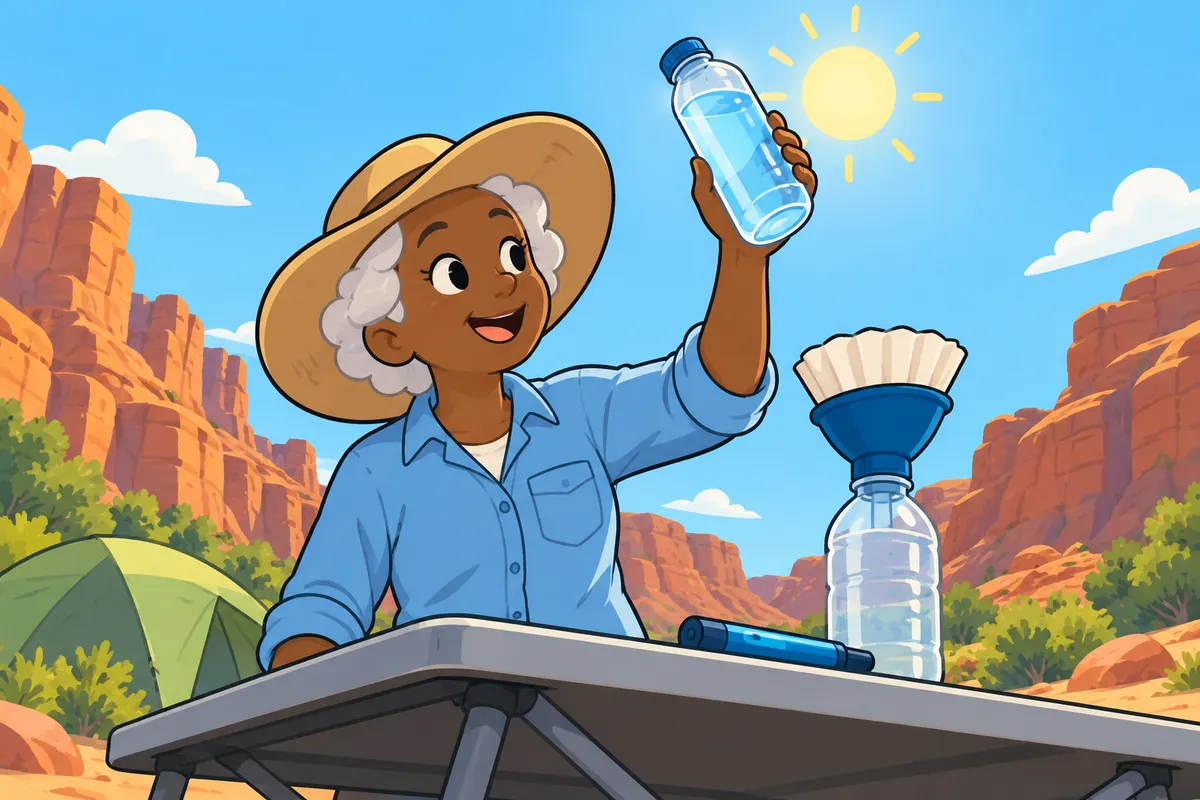
A pump or squeeze filter is the fastest way through a muddy source, and also the quickest to clog. The WMS warns that cloudy water rapidly plugs filters made to remove germs, so a settled, strained bucket protects the cartridge as much as your stomach.
Pore size sets the second limit. The CDC says a portable filter needs an absolute pore size of 0.3 micron or smaller to remove bacteria and 1 micron or smaller to remove parasites, and that no portable filter removes viruses on its own. The Yellow Book says portable microfilters do not reliably remove viruses such as norovirus, and only an ultrafilter or a purifier closes that gap.
Which Way to Treat Muddy Water?
1Does it have a fuel sheen, a chemical smell, or runoff from a road, farm or mine?
YesFind another source. Boiling, bleach and filters do not remove chemicals (CDC, EPA).
No2Do you have a stove and fuel?
YesSettle, strain, then boil. 1 minute, or 3 minutes above 6,500 ft (CDC) or 5,000 ft (EPA).
No3Do you carry a filter with an absolute pore size of 0.3 micron or smaller?
YesSettle and strain, filter, then disinfect. Portable filters do not remove viruses, so the CDC adds a disinfection step.
NoOtherwiseSettle, strain, then disinfect. Use bleach at double the dose, or tablets by their label.
When Is Muddy Water Not Safe to Drink at All?
When the mud carries chemicals. The CDC says you cannot make water containing fuel, toxic chemicals or radioactive material safe by boiling or disinfecting it, and the EPA adds heavy metals and salts to the list. Settling, straining and alum do not change that.
Clear-looking water does not get a pass either. The WMS says clearing may lower the number of germs, but not enough to make water safe, so a jar that settles to sparkling still goes on the stove. Milky tap water at home is a different case: when a glass of tap water clears from the bottom up, tiny air bubbles are the usual cause.
Muddy-Water Plans for Three Camps
The same three steps give different amounts and times at each camp.
Pack a Muddy-Water Kit for the Next Trip
Put these in one stuff sack before a trip to a river, a desert or anywhere a storm can turn the source brown:
The Muddy-Water Kit
6 items- A collapsible bucket or second pot for settling
- A stack of coffee filters and a clean, tight-weave bandana
- A small jar of alum powder and a 1/8 teaspoon measure
- Plain unscented bleach or tablets, with the dose written on the bottle
- Stove fuel for a 1- or 3-minute boil, depending on your camp's height
- A marker to write the treatment time on each jug
Keep the dirty bucket and the clean bottles apart all trip. Treated water picks up germs again from a dirty lid or a hand that touched the raw water, and boiled water has no chlorine left in it to protect it.
General information for healthy adults, not medical advice. If a doctor has set your fluid amount, follow that.

More in Outdoors and Travel

Sources
- US Centers for Disease Control and Prevention. How to Make Water Safe in an Emergency, 2024.
- US Environmental Protection Agency. Emergency Disinfection of Drinking Water, 2026.
- CDC Yellow Book (Backer and Hill). Water Disinfection for Travelers, 2025.
- Wilderness & Environmental Medicine (Backer, Derlet and Hill). Wilderness Medical Society Clinical Practice Guidelines on Water Treatment for Wilderness, International Travel, and Austere Situations, 2023.
Sources checked by the Glubbo Editorial Team on Nov 2, 2026. General information, not medical advice. How we write and check our guides.

