Outdoors and Travel · Water on the Trail
How Much Water for Camping? Gallons per Person for Each Trip
Gallons a camp needs for drinking, cooking and dishes, weekend totals by group, RV tank math, and dog water.
 By the Glubbo Editorial Team · Updated Oct 19, 2026 · 9 min read
On This Page
- How Much Water for Camping?
- How Much Water for Camping per Day?
- How Much Drinking Water for Camping?
- How Much Water for Cooking and Washing While Camping?
- How Much Water to Bring Camping for a Weekend?
- Do You Need to Bring Water if the Campground Has Water?
- How Much Water for Backpacking?
- How Much Water for an RV or Van?
- How Much Water for a Dog at Camp?
- Containers and Storage at Camp
- Pack Your Water by the Group and the Heat
- Sources
Short answer
2 gallons per person per day; 1 gallon is the floor.
- Camping guides plan 2 gallons (7.6 L) a person a day, all uses.
- Ready.gov's 1 gallon (3.8 L) is the emergency floor; Death Valley: drink 1 a day.
- A family of four on a 3-day weekend needs 24 gallons, or 12 at the floor.
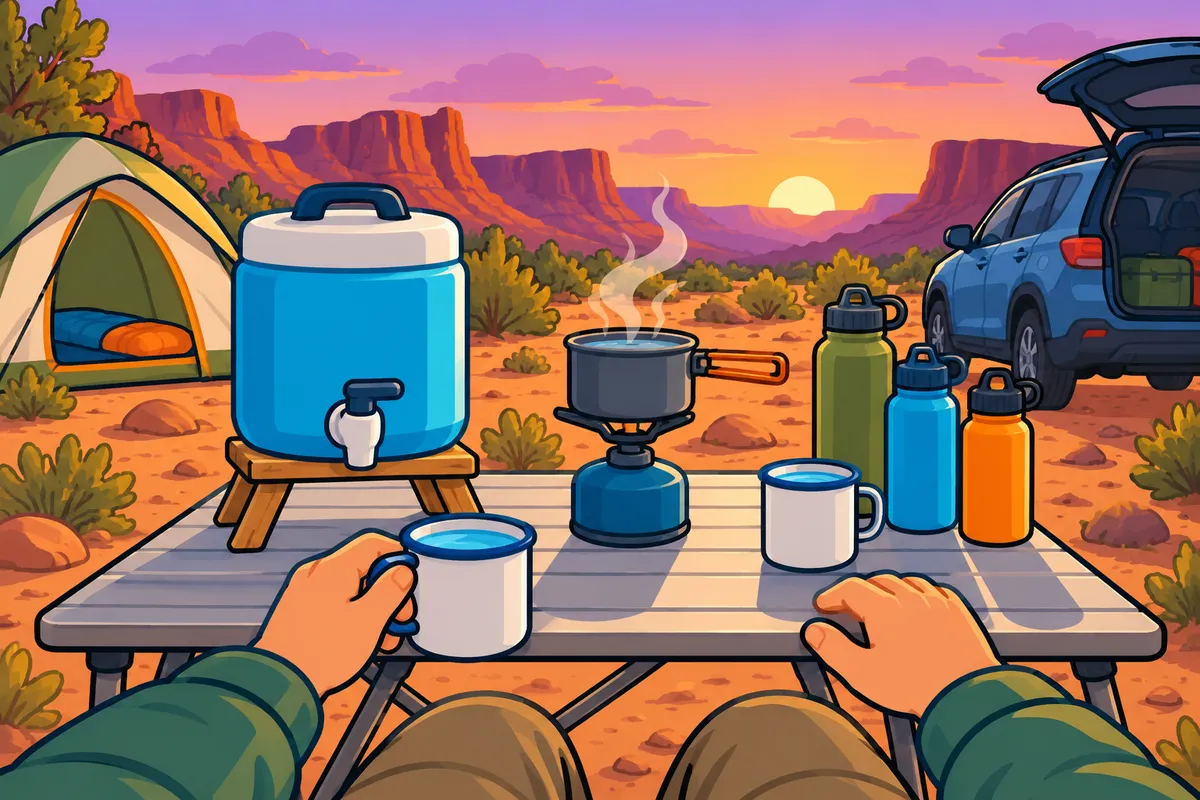
Bring 2 gallons of water per person per day when your campsite has no tap: about a gallon to drink and a gallon for cooking, dishes and washing. One gallon is the floor, and a hot week or a dog moves you up from there.
The car-camping math is simple, and the mistakes come from the two things that move it: the heat, and whether the campground has a tap you can trust. Too few jugs means a drive to town on Saturday afternoon; too many means a trunk full of water you carry home.
How Much Water for Camping?
Two gallons per person per day, about 7.6 liters, is the number camping guides land on for a camp without running water. Outforia calls it approximately 2 gallons or 7.5 liters, and the Boondockers Bible splits it the same way: one gallon to drink and another for cooking, cleaning up and brushing teeth.
The 1 gallon you see on emergency pages is a smaller number with a different job. Ready.gov tells households to store at least one gallon per person per day for drinking and sanitation, and adds that needs can double in very hot weather.
- 1 gal
- per person per day, the emergency floor for drinking and sanitation
- 2 gal
- per person per day, the car-camping plan with no tap
- 2 L
- of drinking water a day or more, the NPS rule of thumb
The gallon is a floor, not a target. Ready.gov adds that children, nursing mothers and sick people may need more, and the CDC tells people in hot climates and with pets to store more.
How Much Water for Camping per Day?
Two gallons per person with no tap, one when the campground has a tap you can trust, and more in the heat. A US gallon is 3.785 liters on NIST's table, so a person's day runs from about 3.8 to 7.6 liters and up.
| Conditions | Per person per day | Why |
|---|---|---|
| Tap at the campground, working | 1 gallon (3.8 L) in the car as a backup | Fill jugs on arrival, as the NPS advises |
| No tap, mild weather | 2 gallons (7.6 L) | A gallon to drink, a gallon for chores |
| Hot days, or long hikes from camp | 2 gallons or more | Ready.gov: needs can double in very hot weather |
| Desert heat in summer | 2 gallons or more, drinking first | Death Valley: drink at least 1 gallon a day |
| Children, nursing, sick | Add to the line above | Ready.gov names these groups |
Why Desert Camps Need the Top of the Range
In Death Valley, the National Park Service tells visitors to drink at least one gallon a day and notes summer highs as hot as 130 °F (54 °C), with nights up to 90 °F (32 °C). That gallon is drinking water only; cooking and dishes come on top, which is why a desert camp lands at 2 gallons a person or more.
How Much Drinking Water for Camping?
About 2 to 3 liters a person on a mild day, more in heat or on a hiking day. The NPS rule of thumb is to drink 2 liters a day or more, especially in very hot climates, and the National Academies report that drinks gave young men about 3.0 liters and young women about 2.2 liters a day in the US survey it used, before any extra sweat from hiking.
That is why a gallon a day works as the drinking half of the camp budget. Drinking takes 2 to 3 of its 3.8 liters, and other drinks count toward it.
If you hike from camp, the trail part is its own sum: hourly amounts for a day on the trail depend on heat, pace and climb, and the hiking water calculator works them out for your route.
How Much Water for Cooking and Washing While Camping?
The second gallon covers cooking, dishes, brushing teeth and a hand wash. Measure each recipe's water and use only what cleanup needs, as Outforia advises. If you boil pasta every night or heat water for washing, you are already at the top of the gallon.
Wash two ways to save water: one basin with soap, a second basin for rinsing, instead of rinsing under a running tap. Then care for the water around you. The National Park Service asks campers to:
- Carry water 200 feet away from streams or lakes to wash themselves or their dishes.
- Use small amounts of biodegradable soap.
- Scatter strained dishwater.
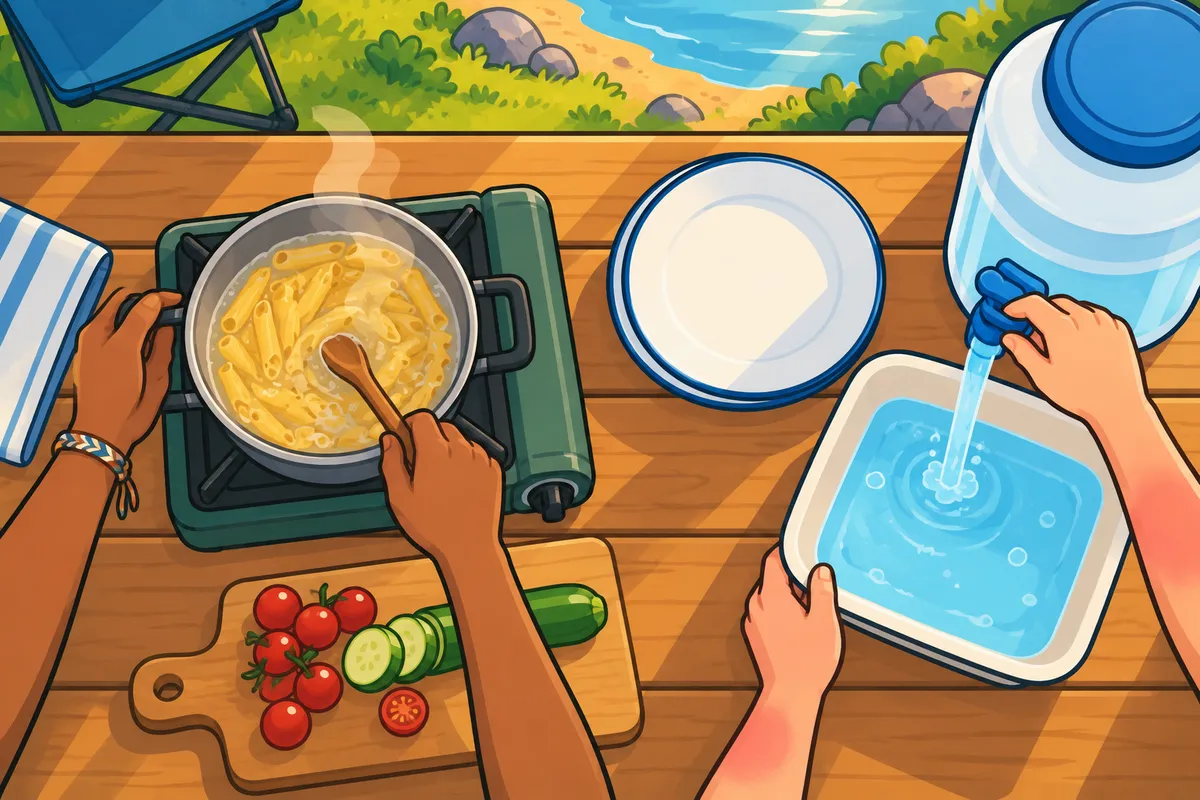
Water you take from a lake or stream for cooking or dishes still needs treating. The CDC asks campers to treat any water they are unsure about, and the steps for lake and stream water apply to your dish water too.
How Much Water for a Camp Shower?
No agency sets a number, and the camping guides give none. Count it yourself: the number of showers times the capacity of your shower bag or tank. A short "Navy-style" shower, wet, soap off, rinse, is how the Boondockers Bible stretches a tank.
How Much Water to Bring Camping for a Weekend?
Multiply people by days by gallons. A three-day weekend for two people with no tap needs 12 gallons (about 45 L) at the 2-gallon rule, or 6 at the 1-gallon floor.
| Group | 3 days at 1 gallon (floor) | 3 days at 2 gallons (plan) |
|---|---|---|
| Solo | 3 gal (11 L) | 6 gal (23 L) |
| Couple | 6 gal (23 L) | 12 gal (45 L) |
| Three friends | 9 gal (34 L) | 18 gal (68 L) |
| Family of four | 12 gal (45 L) | 24 gal (91 L) |
Add a reserve on top: a spare day's water stays in the car for a flat tire, a closed road or a tap that turns out to be broken.
Do You Need to Bring Water if the Campground Has Water?
Check before you trust it. At Joshua Tree National Park, the campground list lists these as of 19 October 2026:
- With water: Black Rock and Cottonwood
- No water: Indian Cove, Jumbo Rocks, Ryan, Sheep Pass, Belle, Hidden Valley and White Tank
A park with water at one campground can have none at the next, so check the listing for the exact site you booked. Even with a working tap on the map, bring one day's water per person in the car, in case the tap is off when you arrive.
At a frontcountry campground, the NPS says, filling up a water jug is one of the first things to do on arrival.
A tap under a boil notice is still usable: a minute at a rolling boil kills the germs, the CDC says, or 3 minutes above 6,500 feet.
How Much Water for Backpacking?
Drinking-water amounts are the same as at a car camp, but carrying is the difference. Guadalupe Mountains National Park tells backpackers that its backcountry has no water sources and to carry one gallon per person per day for drinking and cooking, noting that water weighs about 8 pounds a gallon.
| The route | What to carry |
|---|---|
| No water source on the trail | A gallon per person per day, filled at the trailhead or a ranger station |
| A stream or spring every day | Enough to reach it, and a way to treat what you collect |
The NPS says backcountry campers need to filter or purify the water they drink and cook with, and the choice between boiling, a filter and tablets decides how much you can leave at the trailhead. At 8 pounds a gallon, every gallon you filter on the way is a gallon you did not carry.
How Much Water for an RV or Van?
Divide the tank by people and days. At 2 gallons each, a 30-gallon tank for two people lasts 30 ÷ 4 = 7½ days, and every shower, flush or dog bowl shortens that.
Doubling the water per person halves the days:
The Boondockers Bible gives the other end of the range: a 100-gallon tank lasts two people about four weeks, perhaps five, when each takes one Navy-style shower a week and the tank also covers cooking, cleaning, flushing and brushing teeth. A 50-gallon tank lasts two to two and a half weeks. Work out your own use before the trip by filling the tank and keeping a log for a weekend.
How Much Water for a Dog at Camp?
Plan about 44 to 66 milliliters per kilogram of body weight per day, the range the Merck Veterinary Manual gives for most mammals in mild conditions. A 20 kg (44 lb) dog needs about 0.9 to 1.3 liters, or about 0.25 to 0.35 gallons, and more on hot or active days.
Bring extra, because dogs spill and slop. A dog's daily water needs climb with the heat just as yours do, and the dog drinks from the same supply as the people.
Containers and Storage at Camp
Use food-grade containers and keep them clean. The CDC recommends FDA-approved food-grade water containers, never ones that held chemicals, and gives a sanitizing mix of 1 teaspoon of unscented bleach in 1 quart of water for cleaning them before use.
A big jug with a tap for camp, plus a refillable bottle for each person, covers most trips.
- Keep the jugs in the shade.
- Fill the bottles from the jug's tap instead of dipping them in.
- Pour out and rinse a jug that has sat in a hot car before you refill it.
Water stored at home in your own containers should be replaced every six months, Ready.gov says, so refill the camp jugs the week of the trip.
Pack Your Water by the Group and the Heat
Your Camp, Your Water
- A mild weekend at a campground with a tapFill there, and bring 1 gallon per person as a backup
- A summer camp in the desert2 gallons per person per day, all carried in, plus a spare day
- A family with young children2 gallons each per day, and a little extra for the kids
- A dog in the groupAdd 0.25 to 0.35 gallon a day for a 44 lb dog
- Long hikes from campCamp gallons, plus trail water from the hiking calculator
Write the number of gallons on the jug lid before you load the car, so nobody has to do the math at the trailhead.
General information for healthy adults, not medical advice. If a doctor has set your fluid amount, follow that.
More in Outdoors and Travel
Sources
- Ready.gov (US Department of Homeland Security). Water, 2021.
- US Centers for Disease Control and Prevention. How to Create an Emergency Water Supply, 2025.
- National Park Service, Death Valley. Safety, 2024.
- National Park Service, Joshua Tree. Campgrounds, 2026.
- National Park Service. What to Bring, Camping, 2025.
- National Park Service, Guadalupe Mountains. Backpacking Preparation, 2025.
- National Park Service. Leave No Trace Seven Principles, 2024.
- National Academies of Sciences. Dietary Reference Intakes for Water, Potassium, Sodium, Chloride, and Sulfate: Chapter 4, Water, 2005.
- US Centers for Disease Control and Prevention. About Water Treatment Options When Hiking, Camping, or Traveling, 2025.
- Outforia. How Much Water Should I Bring Camping?, 2025.
- Boondockers Bible. How Much Water Do I Need for Boondocking?, 2025.
- Merck Veterinary Manual. Nutritional Requirements of Small Animals, 2024.
- National Institute of Standards and Technology. NIST Guide to the SI, Appendix B.9: Factors for units listed by kind of quantity, 2026.
Sources checked by the Glubbo Editorial Team on Oct 19, 2026. General information, not medical advice. How we write and check our guides.

