Hiking Water Calculator: What to Carry and Where to Refill
Enter your hours on the trail and get the water to carry, what it weighs and a pace for sipping.
3.3–4.3 L for the hike
113–145 oz · about 5 bottles of 1 L
- Carry from the start3.3–4.3 Labout 4.3 kg (9 lb) on your back
- On the trail1 cup (8 oz) every 15–20 minsip on a schedule; don't wait for thirst in the heat
For healthy adults on day hikes. Plan longer trips around water sources.
The calculator multiplies your hours on the trail by how much you drink in an hour, adds a reserve for delays, and tells you what to carry from the start and how heavy it will be. It also gives you a pace for sipping on the move. Each input below changes the carry weight, so set them from your last hike, not from a guess.
The Four Inputs
You fill in four things, and only the first two are required. Each one changes a different line on the result card.
| Input | What to enter | What it changes |
|---|---|---|
| Hours on the trail | Your whole time out, breaks and the walk back included, from 0.5 to 16 hours | The total for the hike |
| How much you drink an hour | Warm-day pace, or your own sweat rate in liters an hour | The total and the sipping pace |
| Extra for delays | None, + 0.5 L or + 1 L | Added once to the total and to what you carry |
| Longest stretch with no refill | Hours between two water points; leave it empty if there are none | What you carry from the start, and its weight |
Count the hours from the car park back to the car park. A 10 km loop that you walk in three hours of moving time often takes four with a lunch stop and photos.
Reading the Result Card
The big number is the water for the whole hike, in liters, with US ounces and 1 L bottles under it. Below it, two lines tell you what goes in the pack at the start and how often to drink once you walk.
The weight line counts about 1 kg for each liter. NIST notes that the kilogram was first defined as the mass of one cubic decimeter of water, which is one liter.
Should You Use the Warm-Day Pace or Your Own Sweat Rate?
Use the warm-day pace when you have never measured yourself, and switch to your own rate once you have. The warm-day pace is a general figure for moderate work in the heat; your sweat rate, measured on a real walk, fits your body, your speed and your usual weather far better.
The warm-day pace is the one NIOSH gives workers doing moderate activity in the heat for less than 2 hours: 1 cup (8 oz) of water every 15 to 20 minutes. That works out at about 0.71 to 0.95 L an hour, the two ends of the range the calculator shows.
When the Warm-Day Pace Falls Short
People sweat at very different rates, and the National Athletic Trainers' Association puts adult sweat rates during exercise anywhere from 0.5 to 4.0 L an hour.
On hot, steep trails, the high end matters. Grand Canyon rangers warn that hikers there can lose one or two quarts (liters) of water an hour, and the CDC's guide for travelers says sweat rates may reach 1 liter an hour.
If you choose My sweat rate, the field accepts 0.2 to 4 L an hour; two weigh-ins around one walk give you that number.
Keep Each Hour Within Reach
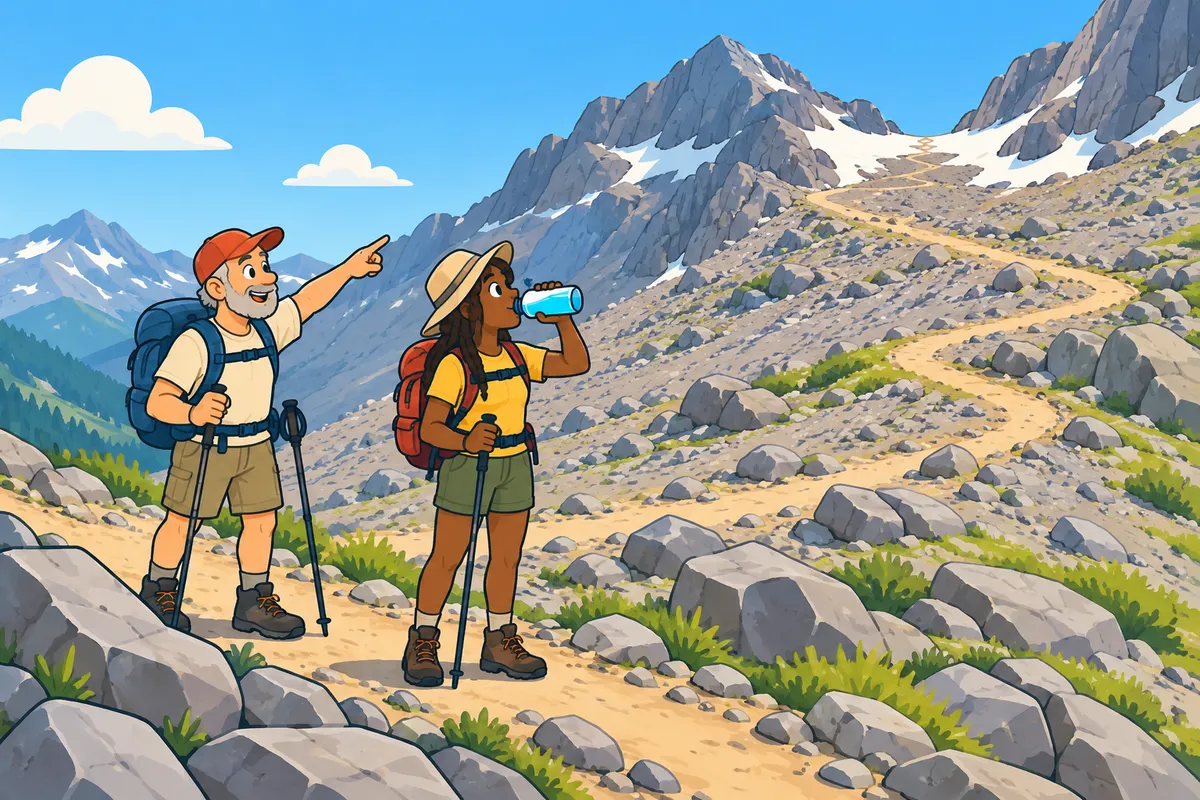
A high sweat rate does not mean you can drink it all back on the move. NIOSH advises that fluid generally should not go above 6 cups an hour, about 1.4 L, and suggests sports drinks when sweating lasts several hours.
If your rate is above that, carry what your stomach can take, plan shade breaks, and finish the refill at the car. On a long day, a sports drink can do more than plain water.
How Much Reserve Water Should You Add for Delays?
Add 0.5 L for a short, well-marked trail and 1 L for anything long, hot, remote or new to you. A reserve covers a wrong turn, a twisted ankle or a slow partner, and the calculator adds it once to both the total and the water you carry from the start.
The setting None suits a short loop with a tap at the trailhead. Even then, Death Valley National Park asks for at least 2 liters on a short winter day hike, and 1 gallon or more for longer warm-season hikes and overnight trips.
Treat the reserve as untouchable until the last hour.
How Do You Plan Water for a Hike With Refill Points?
Enter the hours of your longest stretch between two water points in the last box. The calculator then shows what you carry from the start for that stretch, plus the reserve, and adds "then refill" to the weight line; at each water point you fill back up to the same amount.
This is where the calculator saves your back. On the 6-hour ridge hike above, carrying the full 8.2 L would mean about 8 kg of water; with a spring at hour 3 you carry 4.6 L.
Check Every Refill Before You Count on It
A water point on a map is a promise only if it runs on the day you hike. Grand Canyon says only two of its trails have drinking-water taps, and these may be out of service due to time of year or maintenance.
Death Valley goes further: its springs are rare and should not be considered reliable. Call the ranger station or read the park's current trail notes the week you go.
Treat Water From Streams and Springs
Boil or treat any water you take from a spring or stream before you drink it, as Death Valley asks. A small filter or purifying tablets weigh far less than the liters they replace.
If a refill turns out dry, turn back while you still have the reserve. That decision is easier at hour 2 than at hour 4.
Pack and Drink So the Plan Works
A plan only helps if the water ends up inside you. Hikers often finish with full bottles buried in the pack and a headache on the drive home.
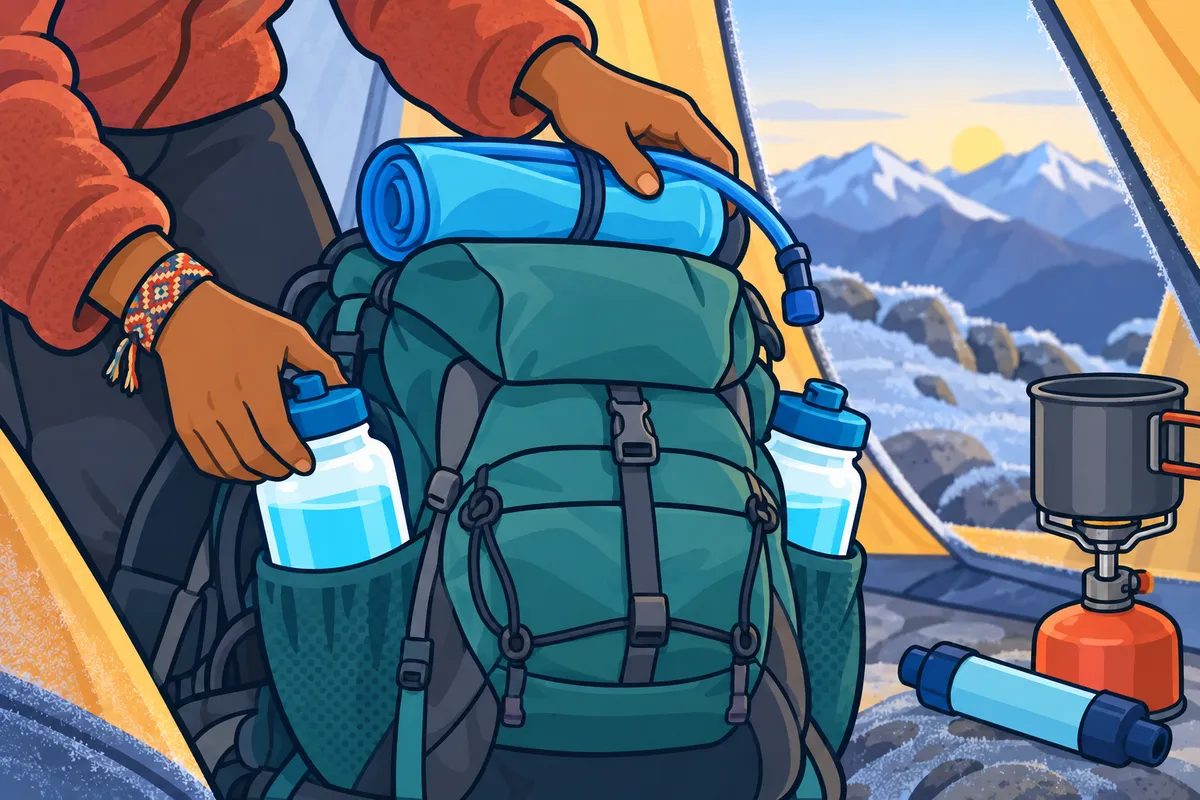
- Put one bottle where you can reach it without stopping, in a side pocket or on a shoulder strap.
- Set a timer for every 15 or 20 minutes, the pace on your card, and drink a few mouthfuls when it buzzes.
- Pack salty snacks; the CDC travel guide lists trail mix, crackers and pretzels.
- Start before the heat. Grand Canyon asks summer hikers to stay off the trail between 10 am and 4 pm.
- Weigh yourself before and after a few hikes and enter your real rate next time.
Drinking more than the card asks is not safer. The CDC travel guide says hyponatremia, a fall in blood sodium, occurs in both endurance athletes and recreational hikers, and advises drinking only enough to relieve thirst. Before a long hot day, learn what low blood sodium feels like.
Cold and height change the plan too. Thirst fades in the cold, so a winter hike needs the timer more, and the first days up high bring extra pee.
What to Do Before Your Next Hike
- Count your hours car to car and enter them.
- Pick the warm-day pace, or your sweat rate if you know it.
- Add a reserve and mark your longest dry stretch on the map.
- Fill the bottles the night before; a 16.9 oz bottle holds 500 ml, and any other size converts in a second.
- Drink back what the scale says you lost after the hike, and keep to your daily goal on the days in between.
Common Questions
How heavy is the water I carry?
About 1 kg for every liter, or 2.2 lb. The card shows the weight of the water you carry from the start, so 4.3 L means about 4.3 kg (9 lb) in your pack.
Does the calculator work for backpacking trips?
Use it one day at a time, with the longest dry stretch of that day. It does not count cooking water or the water you drink in camp, which a full backpacking day has to add.
Why does the result give a range?
The warm-day pace is 1 cup every 15 to 20 minutes. The low end is a cup every 20 minutes, the high end a cup every 15.
Can I enter my sweat rate in ounces?
The field takes liters an hour. Divide your ounces by 33.8 first, so 34 oz an hour becomes about 1.0 L.
General information for healthy adults, not medical advice. If a doctor has set your fluid amount, follow that.
Guides Behind the Numbers


Sources
- CDC, National Institute for Occupational Safety and Health. Heat Stress: Workplace Recommendations, 2026.
- CDC Yellow Book. Heat and Cold Illness in Travelers, 2025.
- National Park Service, Death Valley National Park. Hiking, 2026.
- National Park Service, Grand Canyon National Park. Summer Hiking: Hike Smart, 2026.
- Journal of Athletic Training (National Athletic Trainers' Association). National Athletic Trainers' Association Position Statement: Fluid Replacement for the Physically Active, 2017.
- NIST. SI Units: Mass, 2026.
Formula and sources checked by the Glubbo Editorial Team on Oct 16, 2026.

Glubbo
Log a drink in 1 tap. Every glass fills a fish tank
Free · No account needed
912 people installed Glubbo in the last 30 days912 installed in 30 days
Free · No account needed

