Water Unit Converter: ml, Ounces, Cups, Liters and Gallons
Type one amount and see it in milliliters, liters, US and UK ounces, cups, pints, quarts, gallons, glasses and bottles.
2 L = 2,000 ml
- Litres
- 2
- US fluid ounces
- 67.6
- US cups (8 fl oz)
- 8.45
- US pints
- 4.23
- US quarts
- 2.11
- US gallons
- 0.53
- UK fluid ounces
- 70.4
- Glasses of 250 ml
- 8
- Bottles of 500 ml
- 4
Type an amount, pick its unit, and the converter shows the same water in every other unit at once: liters and milliliters on top, then US fluid ounces, US cups, pints, quarts, gallons, UK fluid ounces, 250 ml glasses and 500 ml bottles. It uses the exact factors from NIST's guide to the SI, the US agency that keeps measurement standards.
It opens on 2,000 ml, which reads as 2 L, 67.6 US oz, 8.45 cups or 4 standard bottles. If what you really want to know is how many ounces to drink in a day, the official daily figures are already worked out in ounces.
The Units and Their Exact Sizes
Every unit in the list is a fixed number of milliliters. The converter turns your amount into milliliters first, then divides by each unit below.
| Unit in the list | Milliliters in one | Where the size comes from |
|---|---|---|
| Liter | 1,000 | Definition |
| US fluid ounce | 29.5735 | Exact factor |
| US cup (8 fl oz) | 236.588 | Exact factor |
| US pint (16 fl oz) | 473.176 | Exact factor |
| US quart (32 fl oz) | 946.353 | Exact factor |
| US gallon (128 fl oz) | 3,785.41 | Exact factor |
| UK fluid ounce | 28.4131 | Exact factor |
| Glass | 250 | Glubbo's everyday glass |
| Bottle | 500 | A standard disposable bottle |
NIST's shorter table of approximate conversions rounds the same units: 29.57 ml for a fluid ounce, 0.24 L for a cup, 0.47 L for a pint, 0.95 L for a quart and 3.79 L for a gallon. The rounded figures are fine for a kitchen; the converter keeps the long ones so big amounts stay exact.
Common Daily Goals in Every Unit
Most adult goals fall between 1.5 and 3 liters. Here they are in the units people mix up most, worked out with the converter's own factors and rounding.
| Daily goal | US fl oz | UK fl oz | US cups | 250 ml glasses | 500 ml bottles |
|---|---|---|---|---|---|
| 1.5 L | 50.7 | 52.8 | 6.34 | 6 | 3 |
| 2.0 L | 67.6 | 70.4 | 8.45 | 8 | 4 |
| 2.2 L | 74.4 | 77.4 | 9.3 | 8.8 | 4.4 |
| 2.5 L | 84.5 | 88 | 10.6 | 10 | 5 |
| 3.0 L | 101 | 106 | 12.7 | 12 | 6 |
The 2.2 L and 3.0 L rows are the fluids that healthy US women and men drink in a day, per the US National Academies. They count every drink, tea, coffee and milk included.
Glubbo's own goal is different for each person. The Water Intake Calculator gives you yours; bring it here to see it in any unit you like.
Bottle and Cup Sizes Side by Side
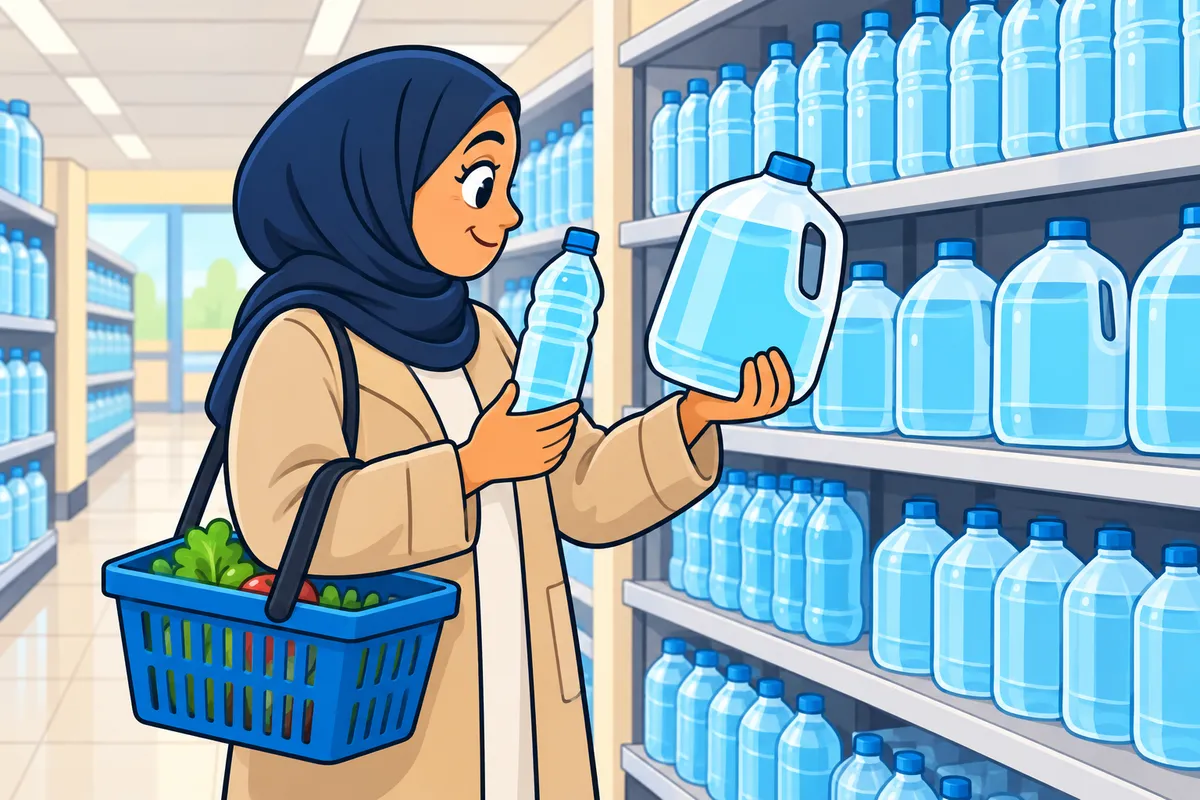
Labels print one unit and leave you to guess the rest. This table puts the common sizes in all four.
| Size on the label | ml | US fl oz | UK fl oz | US cups |
|---|---|---|---|---|
| 330 ml small bottle | 330 | 11.2 | 11.6 | 1.39 |
| 500 ml standard bottle | 500 | 16.9 | 17.6 | 2.11 |
| 20 oz bottle | 591 | 20 | 20.8 | 2.5 |
| 24 oz sports bottle | 710 | 24 | 25 | 3 |
| 32 oz bottle | 946 | 32 | 33.3 | 4 |
| 40 oz tumbler | 1,183 | 40 | 41.6 | 5 |
| 1 L bottle | 1,000 | 33.8 | 35.2 | 4.23 |
| US gallon jug | 3,785 | 128 | 133 | 16 |
To count your goal in any of these, pick the bottle and enter your goal; it also tells you how full the last bottle needs to be.
Why Are US and UK Fluid Ounces Different?
Each country split a different gallon into ounces. The US gallon of 3.785 L holds 128 US fluid ounces, while the imperial gallon of 4.546 L, still used in the UK and Canada, holds 160 smaller ones. So a US fluid ounce is 29.57 ml and a UK fluid ounce 28.41 ml, about 4 % less.
Both gallon sizes come from NIST's table, and you can check the split yourself: 3,785.41 divided by 29.5735 gives 128, and 4,546.09 divided by 28.4131 gives 160.
The gap stays small for one glass and grows with the amount. A 64 oz goal is 1,893 ml in US ounces but 1,818 ml in UK ounces, a difference of 75 ml, about a third of a glass.
Which Ounce Your Bottle Uses
Bottles sold in the US print US fluid ounces; a "16.9 fl oz" label is a 500 ml bottle. UK labels mostly print milliliters, and recipes or older advice from the UK, Ireland or Canada may use imperial ounces.
When the source is unclear, pick the unit by where the advice came from. If you still cannot tell, work in milliliters, which mean the same everywhere.
Is a Cup 236 ml or 240 ml?
Both, depending on who measures. A US cup of 8 fluid ounces is 236.588 ml by NIST, and the converter uses that. US nutrition labels round it: for labelling purposes, the FDA's rule says a cup means 240 ml and 1 fl oz means 30 ml.
The difference is about 1.4 %, too small to matter for one cup. Over a day it adds up a little: eight NIST cups make 1,893 ml, while eight label cups make 1,920 ml.
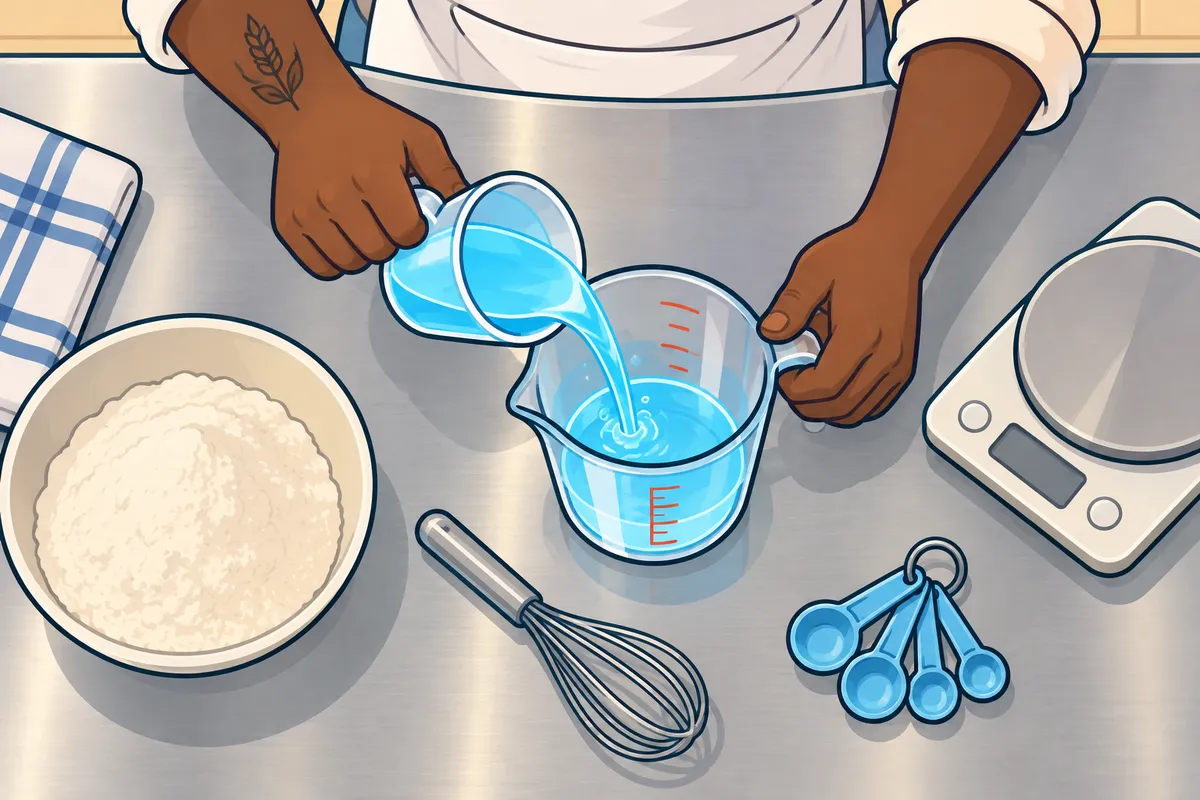
Kitchen measuring cups and drinking glasses vary far more than that. If you count your day in "glasses", measure yours once: the old eight-glass rule assumed 8 oz glasses, and yours may hold more or less.
How Do You Convert ml to oz in Your Head?
Divide the milliliters by 30 to get US fluid ounces, and multiply ounces by 30 to get milliliters. The answer comes out about 1 % off, which is fine for a bottle or a glass. For an exact number, divide by 29.57 or use the converter above.
These shortcuts cover most days:
- Milliliters to US ounces: divide by 30. 500 ml is about 16.7 oz; the exact answer is 16.9.
- US ounces to milliliters: multiply by 30. A 24 oz bottle is about 720 ml; the exact answer is 710.
- Liters to US cups: multiply by about 4.2. Two liters is about 8.4 cups; the exact answer is 8.45.
- US gallons to liters: multiply by 3.8. Half a gallon is about 1.9 L.
- UK ounces to milliliters: multiply by 28.4.
If your goal runs into gallons, it is likely more than you need, so check before you fill the jug.
Using the Result With the Other Tools
The converter answers "how much is this in my unit" while the other tools answer "how much do I need", so use them together, and keep one unit through the day so your count never mixes ounces and milliliters.
Children's amounts come in cups from the AAP, and the amount for your child's age also shows in milliliters and ounces. Trail plans come in liters, and a hiking plan turns them into the weight on your back.
The tables above count drinks only, and food adds about a fifth on top.
Common Questions
Does the converter work for other drinks?
Yes. It converts volume, so milk, tea, juice and soup convert the same way as water.
How big is a glass in the converter?
We count a glass as 250 ml and a bottle as 500 ml. If your glass holds more or less, measure it once and use milliliters instead.
How does the converter round?
It shows two decimals under 10, one decimal from 10 to 100, and whole numbers from 100 up.
Why does my bottle say 16.9 fl oz?
It holds 500 ml. 500 divided by 29.57 gives 16.9 US fluid ounces, so the label prints both.
General information for healthy adults, not medical advice. If a doctor has set your fluid amount, follow that.
Guides Behind the Numbers
Sources
- NIST. NIST Guide to the SI, Appendix B.9: Factors for Units Listed by Kind of Quantity or Field of Science, 2026.
- NIST. Approximate Conversions from U.S. Customary Measures to Metric, 2024.
- US Food and Drug Administration (Code of Federal Regulations). 21 CFR 101.9, Nutrition Labeling of Food, 2024.
- National Academies of Sciences. Dietary Reference Intakes for Water, Potassium, Sodium, Chloride, and Sulfate: Summary, 2005.
Formula and sources checked by the Glubbo Editorial Team on Oct 16, 2026.

Glubbo
Log a drink in 1 tap. Every glass fills a fish tank
Free · No account needed
912 people installed Glubbo in the last 30 days912 installed in 30 days
Free · No account needed

