Water Intake · Rules and Myths
Is a Gallon of Water a Day Too Much? Who Needs That Much
See who needs that much, how to pace it safely, and what 3 L or 100 oz a day means for you.
 By the Glubbo Editorial Team · Updated Oct 19, 2026 · 8 min read
On This Page
- Is It Okay to Drink a Gallon of Water a Day?
- How Many Glasses Is a Gallon?
- What About 3 Liters or 100 Ounces a Day?
- What Happens If You Drink a Gallon of Water a Day?
- Who Actually Needs a Gallon a Day?
- How Fast Can You Drink a Gallon Safely?
- Who Should Ask a Doctor Before Trying a Gallon?
- Will a Gallon a Day Clear Your Skin or Help You Lose Weight?
- A Smarter Target Than a Gallon
- Sources
Short answer
A gallon is more water than most people need.
- A US gallon is 128 oz (3.79 L); healthy adults drink about 74 to 101 oz a day.
- Spread it out: 128 oz over 16 waking hours is about 8 oz an hour.
- Never gulp it. Healthy kidneys clear at most about 0.7 to 1.0 liters an hour.
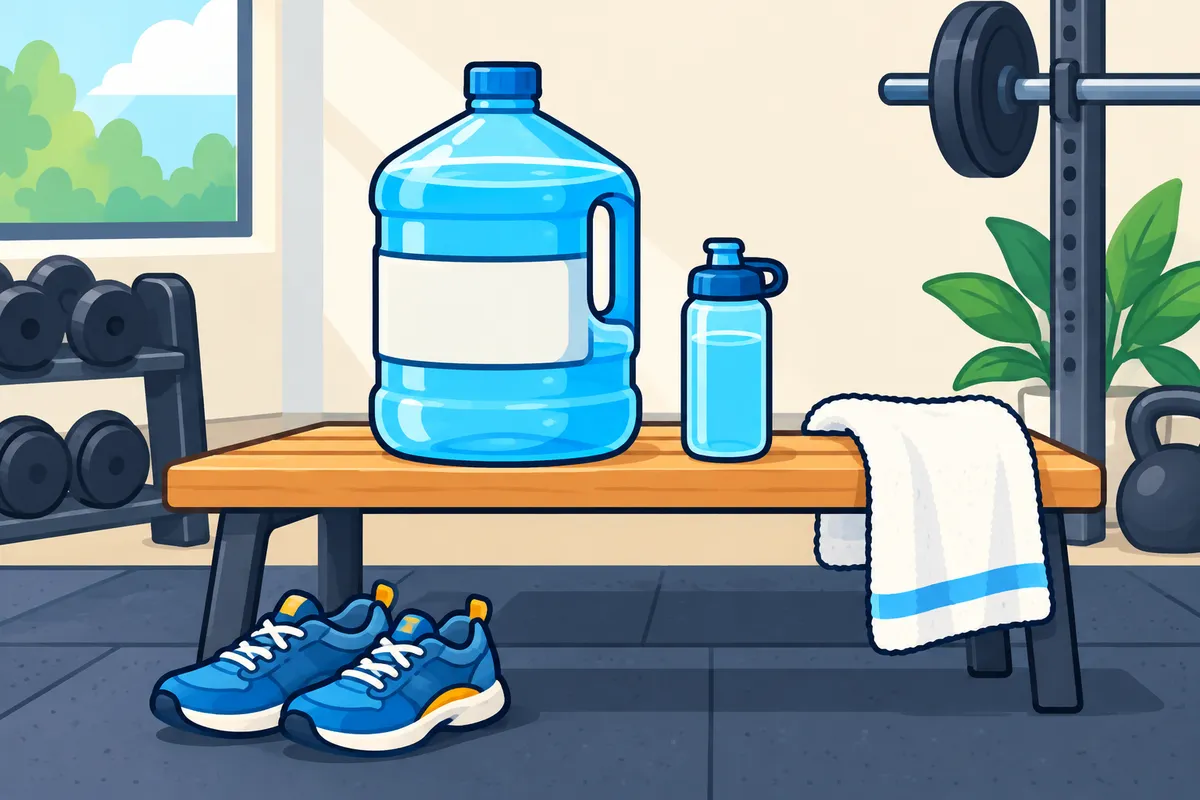
A gallon (128 oz, 3.79 L) is about a liter more than most adults need, but spread over the day it is safe for a healthy adult. The one thing that turns it risky is speed.
The gallon-a-day challenge comes back every summer: fill a big jug in the morning and drink it dry by bedtime. Pace it and the jug is fine; gulp it and your kidneys cannot keep up.
Is It Okay to Drink a Gallon of Water a Day?
For a healthy adult who spreads it over the day, yes, though most people gain nothing from it. A gallon is 3.79 liters, while healthy US adults drink about 2.2 liters (women) to 3.0 liters (men) of fluids a day. The US National Academies set no upper limit for water; the danger lies in drinking it too fast.
- 128 oz
- one US gallon (3.79 L)
- 101 oz
- average US man's drinks, 27 oz short of a gallon
- 74 oz
- average US woman's drinks, 54 oz short of a gallon
What about clearer skin or weight loss? The official reports promise neither. The US panel wrote that the vast majority of healthy people meet their daily needs "by letting thirst be their guide."

If the challenge helps you, it is usually because water replaces soda or juice. You get that win at a normal amount too.
How Many Glasses Is a Gallon?
Sixteen 8 oz glasses. A US gallon holds 128 fluid ounces, or 3.79 liters, by the NIST conversion, and how it splits into quarts, pints and cups is worked through on the kitchen-measures page. For a drinking day, the count depends on the glass or bottle in your hand:
| Your glass or bottle | Fills to a gallon |
|---|---|
| 8 oz glass | 16 |
| 12 oz glass | 10.7 |
| 16 oz pint glass | 8 |
| 16.9 oz (500 ml) bottle | 7.6 |
| 20 oz bottle | 6.4 |
| 32 oz bottle | 4 refills |
For any other size, divide 128 by its ounces. Three quarters of a gallon, 96 oz, is twelve 8 oz glasses, and most people find their own goal comes out well short of even that.
What About 3 Liters or 100 Ounces a Day?
Both sit between the average man's drinks and a full gallon. For a healthy adult who spreads them out, both are safe; whether you need them depends on your size and your day.
Is 3 Liters of Water a Day Too Much?
Not for a healthy adult. Three liters is about 101 oz, the amount of fluid the average US man drinks each day, per the US National Academies. A small woman at a desk needs less, and her kidneys pass the extra as urine, while a large man who trains may need every drop.
Glubbo's habit formula gives exactly 3,000 ml to an 85 kg (187 lb) man who trains hard in a mild climate. A 60 kg (132 lb) woman with a desk job gets 1,600 ml, the formula's floor, so 3 liters is almost twice her goal.
Is It Safe to Drink 100 Ounces of Water a Day?
For a healthy adult, yes. 100 oz is about 3.0 liters, close to what the average US man drinks. Spread it over the day: your kidneys clear at most about 0.7 to 1.0 liters an hour, the US panel found, and 100 oz over 16 waking hours is only about 6 oz (185 ml) an hour.
Here is one way 100 oz fits into a day from 7 am to 11 pm:
100 oz From 7 AM to 11 PM
- 7 AM
- 9 AM
- 11 AM
- 12:30 PM
- 3 PM
- 5 PM
- 7 PM
- 9 PM
The biggest pour on that plan, 16 oz, is under half a liter.
What Happens If You Drink a Gallon of Water a Day?
Mostly, you pee more. Urine output usually runs 1 to 2 liters a day and can reach 20 liters in people who drink very large amounts, the US panel's water chapter notes. Spread across your waking hours, a gallon brings more bathroom trips and, for most people, nothing else.
The trips are the reason most people quit the challenge in week one. They cluster in the evening if you leave half the jug for after dinner, and they wake you at night if you finish it late.
Pacing a Gallon Across the Day
Front-load it. This plan pours 128 oz between 7 am and 9 pm and never asks for more than 20 oz (about 590 ml) in one sitting:
| Time | Pour | Running total |
|---|---|---|
| 7 am | 16 oz | 16 oz |
| 9 am | 20 oz | 36 oz |
| 11 am | 20 oz | 56 oz |
| 1 pm | 20 oz | 76 oz |
| 3 pm | 20 oz | 96 oz |
| 5 pm | 16 oz | 112 oz |
| 7 pm | 12 oz | 124 oz |
| 9 pm | 4 oz | 128 oz |
By 3 pm you have three quarters of the jug behind you. Build the same kind of plan for your own goal, from your wake time to your bedtime.
If you want a month of daily water as a challenge, set the goal from your body instead of the jug.
Who Actually Needs a Gallon a Day?
People who work or train hard in the heat, day after day. The US panel notes that very active people who are continually exposed to hot weather often need six liters or more of total water a day. For them, a gallon of drinks can be right, and on the hottest shifts even short.
| Person and day | Habit-formula goal | Against a gallon |
|---|---|---|
| 60 kg (132 lb) woman, desk job, mild climate | 1,600 ml (54 oz) | A gallon is 2.4 times her goal |
| 85 kg (187 lb) man, hard training, mild climate | 3,000 ml (101 oz) | 27 oz short of a gallon |
| 95 kg (209 lb) bricklayer, hot summer | 3,550 ml (120 oz) | 8 oz short of a gallon |
Most people sit closer to the first row than to the last. With sex left out, the formula only reaches a gallon on a moderately active, mild day at about 123 kg (271 lb), and every weight on the way there has its own row.

How Fast Can You Drink a Gallon Safely?
Spread over your waking hours, a gallon stays well inside what your kidneys can clear. Drinking far faster can lower the salt in your blood, which is rare in healthy people but serious.
How Fast Is Too Fast?
Your kidneys clear at most about 0.7 to 1.0 liters an hour, the US panel's water chapter found. A gallon spread over 16 waking hours comes to about 240 ml (8 oz) an hour, about a third of that. Smaller goals sit lower still:
Hot, sweaty work has its own ceiling. NIOSH says fluid intake should not exceed 6 cups (48 oz, about 1.4 L) in any hour, even on the hottest job.
Who Is Most at Risk of Drinking Too Much Water?
Mostly people in very long, hard exercise, and some people with certain mental health conditions. The US panel ties exercise cases to "greater than 6 hours of prolonged stressful exercise," and names some athletes and some individuals with certain psychiatric disorders as the people at risk. A gallon spread over a normal day puts you in neither group.
Who Should Ask a Doctor Before Trying a Gallon?
People whose bodies hold on to water. Cleveland Clinic lists these among the causes of low blood sodium:
Ask first if you have
4 items- Heart failure
- Kidney failure
- Liver cirrhosis
- A diuretic (water pill) or an SSRI antidepressant
Will a Gallon a Day Clear Your Skin or Help You Lose Weight?
No trial shows either. The US National Academies set no upper limit for water and promise no benefit beyond meeting your need: the vast majority of healthy people "adequately meet their daily hydration needs by letting thirst be their guide."
The two claims stand on different ground:
- The skin claim rests on the idea that more water plumps the skin from inside. No controlled study has shown that drinking above your need changes skin moisture, elasticity or acne, and dermatology reviews typically trace breakouts to hormones, diet and sebum, not to the volume of water you drink.
- The weight claim is slightly better supported but still small. In one trial, people who drank 500 ml of water before each meal lost about 2 kg more over 12 weeks than the group that did not, but the gap was modest and the P-value for body weight did not reach significance.
Drinking a gallon adds nothing that a normal amount before meals does not already give.
A Smarter Target Than a Gallon
Start from your own number and add for heat and sweat. A daily goal worked out from your weight, activity and climate never asks for a gallon unless your day does.
Then spread it out
- Drink more in the morning and early afternoon, when the day's work happens
- Have one glass with each meal
- Taper off in the evening so the last glass is small
If you wake up at night to pee, stop the big glasses about two hours before bed.
Your goal also sits below the 3.7 liters you may have read, because food supplies part of that figure.
General information for healthy adults, not medical advice. If a doctor has set your fluid amount, follow that.

More in Water Intake
Sources
- National Academies of Sciences. Dietary Reference Intakes for Water, Potassium, Sodium, Chloride, and Sulfate: Summary, 2005.
- National Academies of Sciences. Dietary Reference Intakes for Water, Potassium, Sodium, Chloride, and Sulfate: Chapter 4, Water, 2005.
- National Academies of Sciences. Report sets dietary intake levels for water, salt, and potassium (press release), 2004.
- NIST. Approximate Conversions from U.S. Customary Measures to Metric, checked 2026.
- Cleveland Clinic. Hyponatremia, 2024.
- CDC NIOSH. Workplace Recommendations, 2024.
Sources checked by the Glubbo Editorial Team on Oct 19, 2026. General information, not medical advice. How we write and check our guides.

