Water Intake · Your Daily Number
Total Water vs Drinking Water: How Much Do You Need to Drink?
See why 3.7 liters is not 3.7 liters of drinks, and how much water your food adds on a normal day.
 By the Glubbo Editorial Team · Updated Oct 19, 2026 · 7 min read
On This Page
- How Much of Your Daily Water Comes From Food?
- Does 3.7 Liters a Day Mean I Should Drink 3.7 Liters?
- Do Fruits and Vegetables Count Toward Your Water Intake?
- Does Soup Count as Water Intake?
- Where Does Your Water Go Each Day?
- Do the European Totals Include Food Too?
- Has Food Always Supplied a Fifth?
- Which Number Should You Aim For?
- Sources
Short answer
About 80 % of your water comes from drinks, 20 % from food.
- A man's 3.7 L (125 oz) total means about 3.0 L (101 oz) to drink; a woman's 2.7 L, 2.2 L.
- A day of fruit, soup and salad can bring about 1,000 ml (34 oz) from food alone.
- Aim for the drinks number. It is the part you control and can count.
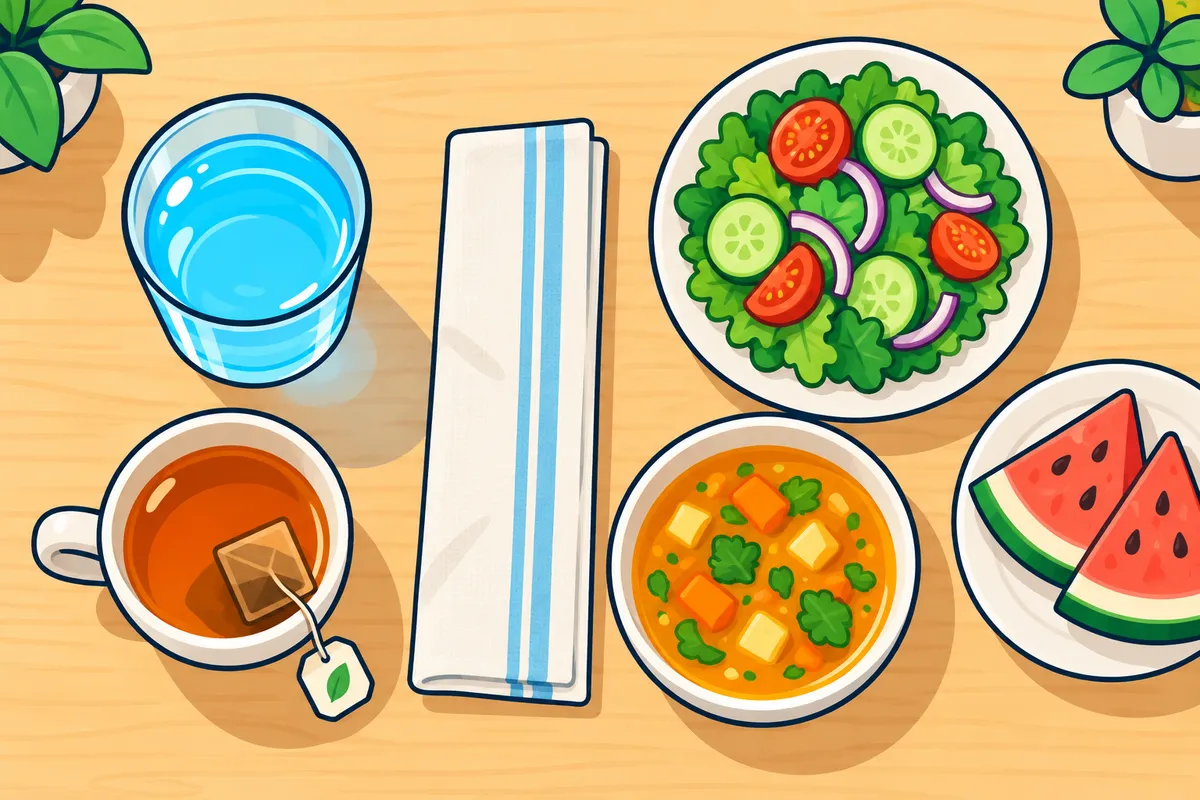
Look up a daily water amount and you will meet two numbers from the same US report: 3.7 liters of total water for men, and about 3.0 liters of that taken as drinks. Both are right. The bigger one counts the water in your food.
How Much of Your Daily Water Comes From Food?
About a fifth. In the US survey data behind the official values, food supplied about 19 % of the water healthy adults took in and drinks the other 81 %, the US National Academies report. For the average man that is roughly 0.7 liters (24 oz) a day.
Total Water and Drinking Water, Defined
Total water is every drop that enters your body in a day:
- plain water
- every other drink
- the moisture in your food
Drinking water, in these reports, means drinks only, from tap water to coffee.
The Split in Numbers
| Per day | Women | Men |
|---|---|---|
| Total water | 2.7 L (91 oz) | 3.7 L (125 oz) |
| From drinks | 2.2 L (74 oz) | 3.0 L (101 oz) |
| From food | about 0.5 L (17 oz) | about 0.7 L (24 oz) |
Those are averages across thousands of people. Your own split depends on what lands on your plate, and it can swing a lot from one day to the next.
A Day of Food, Measured
One summer day, built from USDA FoodData Central values, shows how far food can swing. A gram of water is about 1 ml, so grams of water per 100 g of food turn straight into milliliters.
| Food | Portion | Water per 100 g | Water in the portion |
|---|---|---|---|
| Plain whole-milk yogurt | 150 g | 87.9 g | 132 ml (4.5 oz) |
| Apple with skin | 180 g | 85.6 g | 154 ml (5.2 oz) |
| Chicken noodle soup, canned, made with water | 300 g | 94.2 g | 283 ml (9.6 oz) |
| White bread | 60 g | 36.4 g | 22 ml (0.7 oz) |
| Watermelon | 200 g | 91.5 g | 183 ml (6.2 oz) |
| Cooked white rice | 200 g | 68.4 g | 137 ml (4.6 oz) |
| Cucumber | 100 g | 95.2 g | 95 ml (3.2 oz) |
| Total | about 1,000 ml (34 oz) |
That day gives you about a liter from food, more than the US average. Keep the bread and rice, swap the rest for 30 g of saltine crackers and 30 g of almonds, and your food brings only about 160 ml (5.5 oz).
The US Panel's Own Sample Day
The report prints a sample day on a 2,200-calorie diet that lands on 3,740 ml, right at the 3.7-liter reference for men. Foods supply 891 ml of it and drinks 2,849 ml, per Table 4-14 of the panel's water chapter. Its biggest sources are below, the two foods in grey, and its iced tea is decaffeinated.
Food gives 24 % of that day, a little above the survey's 19 %. Look at the drinks, though. Coffee, decaf coffee and iced tea bring 1,534 ml, more than half of the drinks, and plain water only 712 ml.
Does 3.7 Liters a Day Mean I Should Drink 3.7 Liters?
No. The 3.7 liters for men and 2.7 liters for women count the water in your food too: the 2004 report "refers to total water, which includes the water contained in beverages and the moisture in foods." The drinks part is about 3.0 liters (101 oz) for men and 2.2 liters (74 oz) for women.
The mix-up is old: the 1945 advice behind eight glasses already noted that prepared foods hold most of that water.
Do Fruits and Vegetables Count Toward Your Water Intake?
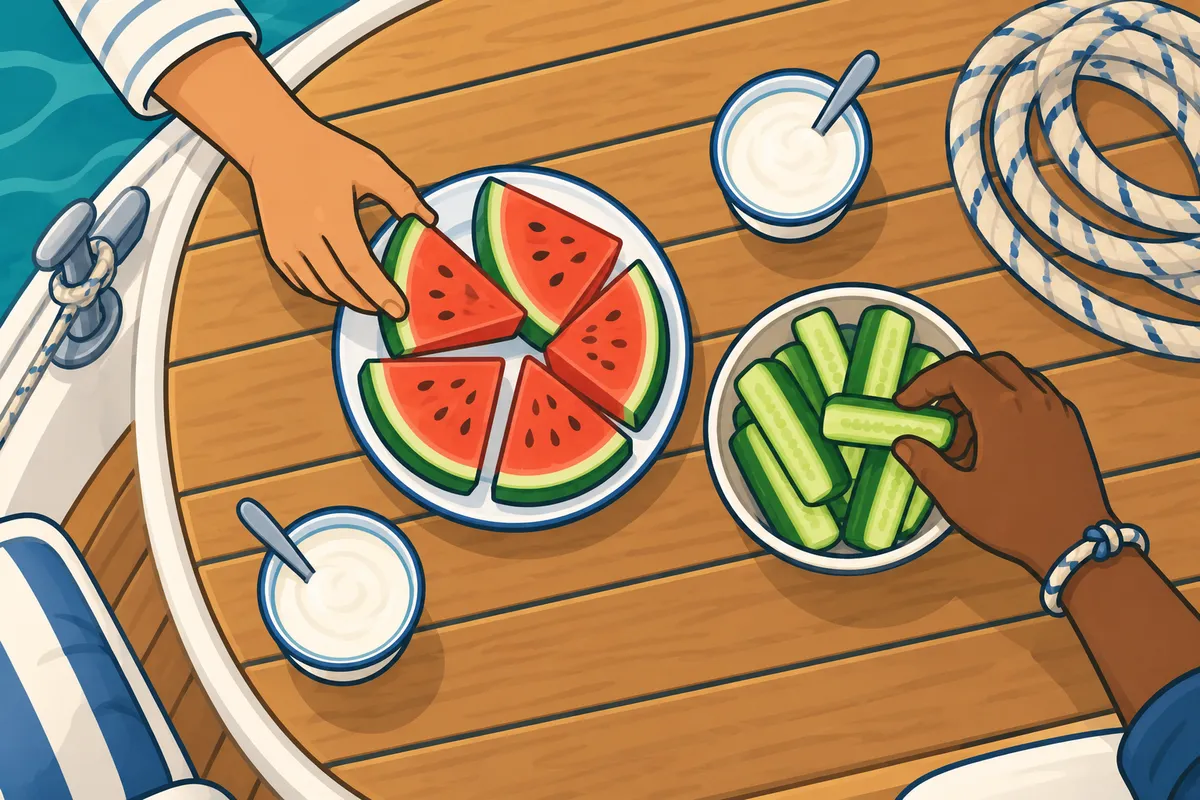
Yes. The US panel counts the water in fruit, vegetables and other foods as part of your total water, and it lists fruits and vegetables beside juice, milk, coffee and tea as everyday sources. Cucumber is about 95 % water by weight and watermelon about 92 %, so a big slice works much like a small drink.
Lettuce, cucumber and melon lead the foods that bring the most water, while crackers and nuts add almost nothing. Coffee and tea count as drinks, because caffeinated drinks add as much water as any other, the US panel found.
Does Soup Count as Water Intake?
Yes. Canned chicken noodle soup made with water is about 94 % water by weight, close to a drink, per USDA FoodData Central. A 300 g bowl brings about 280 ml (9.5 oz), more than a standard 8 oz cup of water.

On a cold day, when a glass of cold water appeals less, a bowl of soup at lunch does part of the work.
Where Does Your Water Go Each Day?
Out through your kidneys, skin, breath and gut. By the US panel's figures, a seated adult loses roughly 1.8 to 3.0 liters a day before any sweating, and your drinks and food put that back. The table adds up the four ways out.
| Way out | Per day, seated adult |
|---|---|
| Urine | 1 to 2 L |
| Skin, without sweating | about 450 ml |
| Breath | 250 to 350 ml |
| Stool | 100 to 200 ml |
| Total | about 1.8 to 3.0 L |
Your body also makes a little water as it burns food. At about 2,500 calories a day, that comes to roughly 250 ml, the water chapter estimates: one cup that never shows up on a label.
Sweat comes on top of all this. For active people in tropical or desert weather, daily sweat losses are often an additional 2 to 7 liters, the chapter notes, and that is when drinks have to do most of the work. Whatever comes in beyond those losses, healthy kidneys pass within hours, as the clock on a single glass of water shows.
Do the European Totals Include Food Too?
Yes. Europe's food safety agency sets adequate total water at 2.0 liters for women and 2.5 liters for men (68 and 85 oz), and its 2010 opinion says those values include drinking water, beverages of all kinds and food moisture. They apply at moderate temperatures and moderate activity.
| Total water a day | Women | Men |
|---|---|---|
| US National Academies | 2.7 L (91 oz) | 3.7 L (125 oz) |
| EFSA | 2.0 L (68 oz) | 2.5 L (85 oz) |
The two bodies drew on different surveys and set different totals, so a European site and a US site quote different numbers for the same person. Neither is a drinks number. Both rise when it is hot or you train, which is why the totals read as a starting point and not a target.
Has Food Always Supplied a Fifth?
No. A 1977 to 1978 US survey that the water chapter cites split adults' total water three ways:
- 28 %
- from food
- 28 %
- from drinking water
- 44 %
- from other drinks
The later survey behind today's values put food at 19 %.
Your own plate sets your share. Soup, salad and fruit at meals push it up.
Which Number Should You Aim For?
Aim for the drinks number. It is the part you control and can count, and food then works as a buffer on top.
Use the drinks figure (about 3.0 L for men, 2.2 L for women) or your own drinks goal from your weight and your day, which leaves food out for this reason. Then let your plate move it a little:
Match your drinks to your plate
- A day of fruit, soup and saladDrink your goal; if your pee stays pale, a glass short is a fair day
- A day of bread, crackers and nutsDrink your full goal and add a glass if your pee runs dark
- A hot day or a hard workoutLet drinks do the work; food cannot keep up with sweat
General information for healthy adults, not medical advice. If a doctor has set your fluid amount, follow that.

More in Water Intake
Sources
- EFSA Journal (EFSA Panel on Dietetic Products, Nutrition and Allergies). Scientific Opinion on Dietary Reference Values for water, 2010.
- National Academies of Sciences. Dietary Reference Intakes for Water, Potassium, Sodium, Chloride, and Sulfate: Summary, 2005.
- National Academies of Sciences. Dietary Reference Intakes for Water, Potassium, Sodium, Chloride, and Sulfate: Chapter 4, Water, 2005.
- National Academies of Sciences. Report sets dietary intake levels for water, salt, and potassium (press release), 2004.
- USDA FoodData Central (SR Legacy). Soup, chicken noodle, canned, prepared with equal volume water, 2018.
- USDA FoodData Central (SR Legacy). Watermelon, raw, 2018.
Sources checked by the Glubbo Editorial Team on Oct 19, 2026. General information, not medical advice. How we write and check our guides.

