Water Intake · Rules and Myths
How Long Does Water Stay in Your Body? From First Sip to Last Drop
How fast a glass is absorbed, how soon the extra comes back out, and how long the rest stays in you.
 By the Glubbo Editorial Team · Updated Oct 19, 2026 · 8 min read
On This Page
- How Long Does Water Stay in Your Body?
- How Fast Does Your Body Absorb Water?
- How Long Does It Take to Pee Out Water?
- How Long Does It Take to Replace All the Water in Your Body?
- Does Water Leave the Body More Slowly as You Get Older?
- Do Other Drinks Stay in the Body Longer Than Water?
- Spread Your Drinks So More of Each One Stays
- Sources
Short answer
Minutes to get in, hours to leave, 10 days on average.
- Water shows up in your blood within 5 minutes and is fully absorbed in 75 to 120.
- Healthy people pass about 90 % of a large water load within 4 hours.
- A typical sip of water stays about 10 days; the body renews half in about a week.
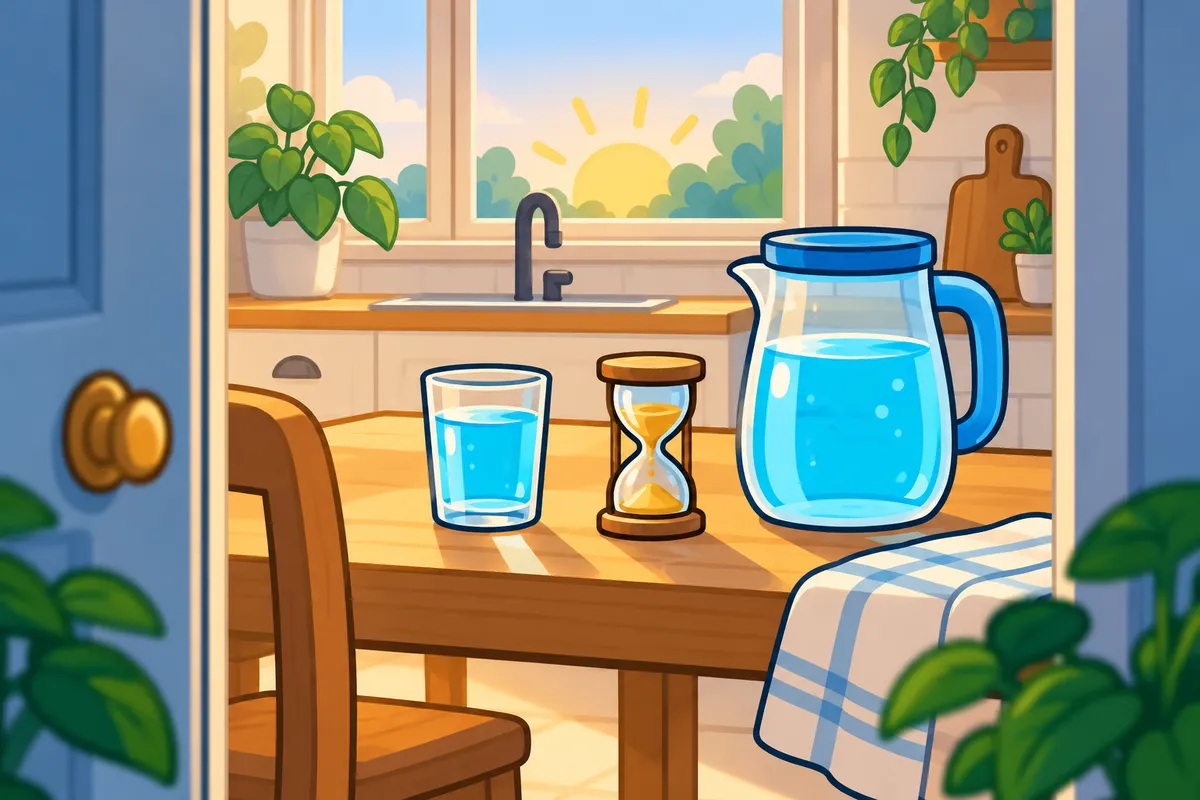
Three clocks run at once:
- Water reaches your blood in about 5 minutes.
- The part you did not need leaves as urine within about 4 hours.
- The part you kept mixes into your body water for about 10 days on average.
Which clock matters depends on your question. If you wonder why you need the toilet an hour after a big bottle, it is the second; if you wonder whether yesterday's water is still in you, it is the third.
How Long Does Water Stay in Your Body?
From minutes to weeks, depending on which water you mean. A glass reaches your blood within about 5 minutes, and your gut takes in all of it within 75 to 120 minutes. Extra water you did not need mostly leaves within 4 hours, while the average sip that stays mixes in for about 10 days.
One Glass of Water, Drunk at 8 AM
- 8 AM
- 8:05 AM
- 8:15 AM
- 9:30 AM
- 12 PM
Those times come from two different tests. The absorption numbers are from a study that traced 300 ml of labelled water, and the 4-hour mark from a clinic test where people drink a much larger load, so read the timeline as a rough guide.
How Fast Does Your Body Absorb Water?
Within minutes. In a 2012 study, 36 young men drank 300 ml of water labelled with a harmless heavy-water tracer after an overnight fast. The tracer appeared in their blood within 5 minutes, their guts took in half of it in about 11 to 13 minutes, and they had taken in all of it within about 75 to 120 minutes.
- 5 min
- until drunk water appears in the blood
- 11–13 min
- for the gut to take in half of a 300 ml glass
- 75–120 min
- until the gut has taken in the whole glass
Three limits to keep in mind:
- The men sat still for the first hour and drank on an empty stomach.
- With a meal or a large bottle, the water may take longer to clear the stomach, and the study did not test that.
- Danone Research, a bottled water maker, funded it, and three authors worked there.
How Long Does It Take to Pee Out Water?
For water your body does not need, a few hours. In the clinical water load test, healthy people drink 20 ml per kg of body weight within 15 to 30 minutes, and Labcorp states that healthy people typically pass 90 % of the load within four hours.
For a 70 kg (154 lb) adult, that load is 1,400 ml, almost three 500 ml bottles at once, so passing 90 % means about 1,260 ml leaves as urine by the fourth hour.
The 2016 drinks trial saw the same pattern from a different angle. In 72 healthy men aged 18 to 35, who had fasted and drank 1 L of still water within 30 minutes, urine over the next 4 hours averaged 1,337 g, more than the 1,000 g they drank, so they also passed water they already held. The trial is in the American Journal of Clinical Nutrition.
When You Are Short of Water, You Keep More
How much comes back out depends on whether your body needed it. A 1987 study gave the same 20 ml per kg load to young men who were well watered and to young men who had gone without water first.
The well-watered young men passed all of it, and a little more, within 2 hours. The men who started short kept about 30 % of the load, because their bodies were using it to refill.
So the water that leaves fast is the water you did not need; when you are behind, your kidneys hold on to more of each glass.
How Long Does It Take to Replace All the Water in Your Body?
About seven weeks for nearly all of it, and about one week for half. In the 2012 tracer study, the young men turned over about 4.6 liters a day. Half of a sip was gone in about 7 days, the average sip stayed about 10 days, and over 99 % had left after about 50 days.
| Measure, 2012 tracer study | Value |
|---|---|
| Body water | 60.7 % of body weight |
| Water turned over a day | 4.58 liters |
| Half of a sip gone | about 6.9 to 7.5 days |
| Average stay of a sip | 10.3 days |
| More than 99 % gone | about 50 days |
Source: Péronnet and colleagues, 2012, 36 young men averaging 77 kg (170 lb), asked not to exercise during the study.
The arithmetic is simple. Those men held about 47 liters of water each, and 4.6 liters a day is roughly a tenth of it, so each day replaces about 10 % of the water in your body, and that body water is about 60 % of an adult's weight.
Why Your Number Will Differ
Your turnover depends on how much you drink, sweat and eat. The US National Academies put turnover at about 3.2 liters a day in sedentary men and 4.5 liters in active men, with women about 0.5 to 1.0 liter lower.
Urine alone varies a lot. In 458 adults aged 40 to 79, Raman and colleagues measured an average of 2.2 liters a day for both men and women, with men ranging from 0.6 to 4.9 liters. A heavy sweater on a hot day turns water over far faster than someone sitting in a cool office.
Does Water Leave the Body More Slowly as You Get Older?
Yes, in healthy older men the kidneys clear extra water more slowly. In the 1987 study:
- six healthy older men passed only 41 % of a water load in 2 hours, against about 100 % in young men
- their peak urine flow came later and lower
- the authors tied this partly to the drop in kidney filtering that comes with age: once they adjusted for each man's lower filtering rate, the gap between old and young disappeared
That does not mean older adults should drink less. It means a large amount at once is handled more slowly, so spreading drinks through the day suits an older body better, and thirst fades with age too, which is why older adults often fall behind on fluids without noticing.
Do Other Drinks Stay in the Body Longer Than Water?
A few do, for a few hours. In the 2016 trial, each man drank 1 L of a drink within 30 minutes:
- full-fat milk, skimmed milk and an oral rehydration solution left about 300 to 360 g less urine over 4 hours than still water
- coffee, tea, cola, lager, sparkling water and a sports drink matched water at 4 hours, and orange juice matched it too once its water content was counted
| Drink, 1 L in 30 minutes | Urine over 4 hours | Less than still water |
|---|---|---|
| Oral rehydration solution | 1,038 g | 362 g |
| Skimmed milk | 1,049 g | 339 g |
| Full-fat milk | 1,052 g | 294 g |
| Still water | 1,337 g | none |
Source: Maughan and colleagues, 2016, 72 men; the last column is the average difference from water in that trial.
The authors point to what the drinks carry besides water. The rehydration solution holds 55 mmol/L of sodium, the milks about 40 mmol/L of potassium, and still water holds neither, so the body keeps more of them for a while. All 13 drinks, ranked, shows the rest.
Spread Your Drinks So More of Each One Stays
Because unneeded water leaves within hours, a big bottle drunk at once mostly passes through. If you are already behind on fluids, how long it takes to rehydrate is its own question. Drinks spread over the day keep you topped up instead, and how often to drink through a day turns that into a pace.
One Liter at Lunch
- Absorbed within about 2 hours
- Much of it passed by mid-afternoon
- Long gaps with nothing before and after
250 ml Every Two Hours
- Each glass absorbed in under 2 hours
- Smaller loads for your kidneys to pass
- Fluid arriving as you lose it
Match Your Drinking to What You Want
- Fewer toilet trips in the afternoonSmaller drinks spread out, not one big bottle
- A hot day or a long workoutDrink before, during and after, as you sweat
- An older parent who drinks littleSmall cups at set times, not one large glass
- A plan for your own hoursA drinking schedule built from your wake and bed times
General information for healthy adults, not medical advice. If a doctor has set your fluid amount, follow that.
More in Water Intake
Sources
- European Journal of Applied Physiology (Péronnet and colleagues). Pharmacokinetic analysis of absorption, distribution and disappearance of ingested water labeled with D2O in humans, 2012.
- Labcorp. Water Loading Test, 2024.
- Age and Ageing (Crowe and colleagues). Altered water excretion in healthy elderly men, 1987.
- American Journal of Clinical Nutrition (Maughan and colleagues). A randomized trial to assess the potential of different beverages to affect hydration status: development of a beverage hydration index, 2016.
- National Academies of Sciences. Dietary Reference Intakes for Water, Potassium, Sodium, Chloride, and Sulfate: Chapter 4, Water, 2005.
- American Journal of Physiology, Renal Physiology (Raman and colleagues). Water turnover in 458 American adults 40-79 yr of age, 2004.
Sources checked by the Glubbo Editorial Team on Oct 19, 2026. General information, not medical advice. How we write and check our guides.

