Drinking Habits · When to Drink
How Often Should You Drink Water? A Pace That Fits Your Day
 By the Glubbo team · Updated Oct 16, 2026 · 5 min read
On This Page
When thirsty, and with meals.
No health body sets an interval. On busy or hot days, a drink every hour or two keeps you on track and stays far below the 0.7 to 1.0 L an hour that healthy kidneys can clear.
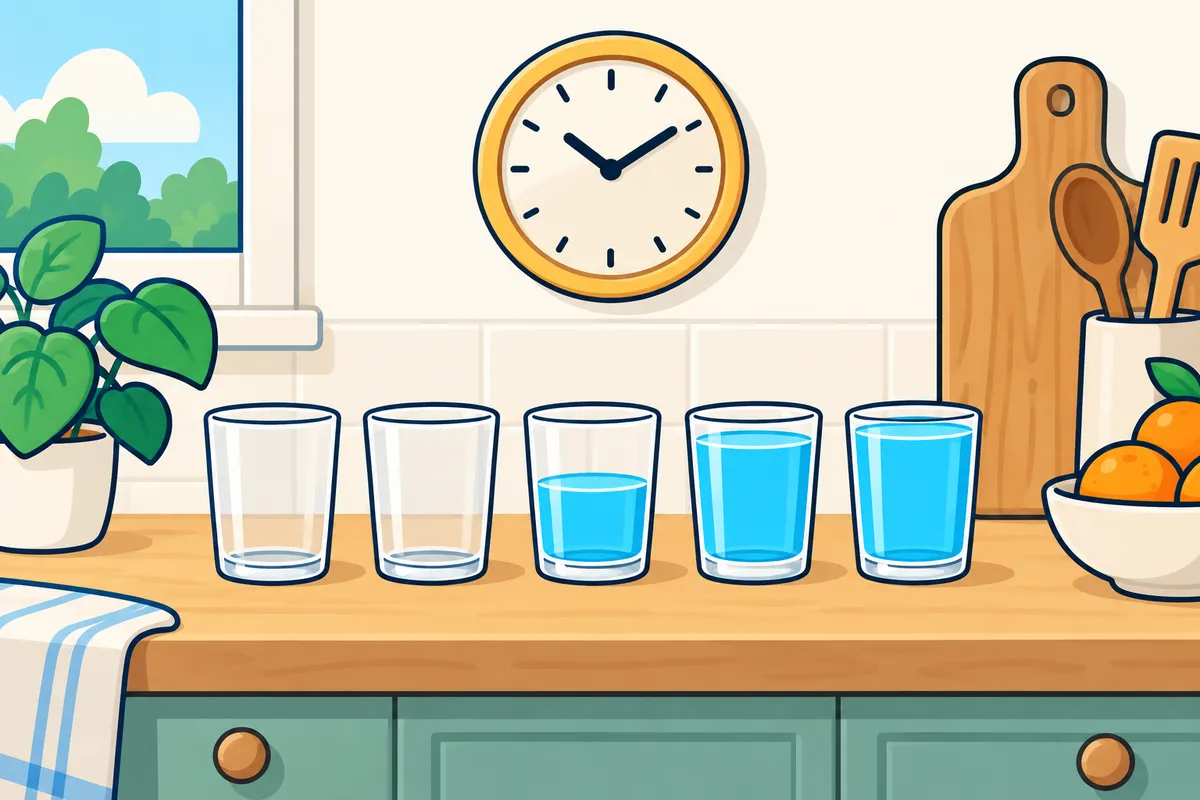
Most hydration advice gives you a number for the day and leaves the hours to you. That gap is where people slip: nothing until lunch, then a whole bottle at 5 PM.
This page gives you a pace instead. It belongs to our guide on how to drink more water, which covers the daily cues that make a pace easy to keep.
How Often Should You Drink Water?
No health body sets an interval. Healthy people do well drinking when they are thirsty and having a drink with meals, the US National Academies found. On busy or hot days, when thirst gets ignored, a drink every hour or two keeps you on track.
What Your Goal Looks Like per Hour
Divide your goal by your waking hours and it shrinks fast. Here are four goals from Glubbo's habit formula, spread over 16 waking hours.
| Person | Glubbo goal | Per hour | One 250 ml (8 oz) glass every |
|---|---|---|---|
| 54 kg (119 lb) woman, low activity, cool climate | 1,600 ml (54 oz) | 100 ml (3.4 oz) | 2 h 30 min |
| 70 kg (154 lb) woman, moderate activity, mild climate | 2,050 ml (69 oz) | about 130 ml (4.3 oz) | about 2 h |
| 80 kg (176 lb) man, moderate activity, mild climate | 2,650 ml (90 oz) | about 165 ml (5.6 oz) | about 1 h 30 min |
| 85 kg (187 lb) man, high activity, hot climate | 3,250 ml (110 oz) | about 205 ml (6.9 oz) | about 1 h 15 min |
The first row sits on the formula's floor, since Glubbo never sets a goal under 1,600 ml. Even the last row stays far below what healthy kidneys can clear in an hour, as the next sections show.
Why Meals Count as Drinking Times
Three meals already give you three drinking times. Add one drink mid-morning and one mid-afternoon, and a 2,050 ml goal needs only about 400 ml (14 oz) at each of five moments.
Should You Drink Water Every Hour?
You do not have to. If you like a schedule, a 2.4 L goal over 16 waking hours comes to about 150 ml (5 oz) an hour, a few sips. Drinking every hour suits people who forget; a bigger glass every two hours adds up to the same total.
The water drinking schedule turns your goal, wake time and bedtime into a list of times, so you can see which interval your day allows.
How Much Water Can You Drink at Once?
Healthy kidneys clear at most about 0.7 to 1.0 L (24 to 34 oz) an hour, the US National Academies report, so sipping beats chugging. Even for hot, hard work, NIOSH says that "fluid intake should not exceed 6 cups per hour", about 1.4 L (48 oz).
The risky moment is the catch-up. You notice at 6 PM that you are a litre behind and try to fix it in ten minutes.
If evening drinks wake you up, stopping two hours before bed matters more than the last few hundred ml.
How Often Should You Drink Water in Hot Weather?
For moderate work in the heat that lasts under 2 hours, drink 1 cup (8 oz, about 240 ml) every 15 to 20 minutes, as NIOSH advises. If you sweat for several hours, add sports drinks with balanced electrolytes. On hot days, drink more even when you sit still: water helps "regardless of how active you are," says the CDC.
| Work time in the heat | Cups of 8 oz | About |
|---|---|---|
| 30 minutes | 1.5 to 2 | 0.35 to 0.5 L (12 to 16 oz) |
| 1 hour | 3 to 4 | 0.7 to 1.0 L (24 to 32 oz) |
| 2 hours | 6 to 8 | 1.4 to 1.9 L (48 to 64 oz) |
Four cups an hour stays under the NIOSH ceiling of six. Which drinks to reach for after a few hours of sweat is covered in our guide to what counts toward your water; for a workout in the gym or on the road, see when to drink around exercise.
Should You Wait Until You’re Thirsty to Drink?
For most healthy adults, thirst is a good guide because it starts early. Physiologist Heinz Valtin noted that thirst begins when your blood concentration has risen by less than 2 %, while most experts put the start of dehydration at a rise of at least 5 %, as Dartmouth reported. Some people do better with a plan.
Drink on a plan instead of thirst if one of these fits you:
- You are over 65. In hot weather the CDC tells older adults to drink more than usual and not wait until they are thirsty.
- You work outdoors in the heat for hours, where the NIOSH cup-every-15-to-20-minutes pace applies.
- You train for long, competitive events. The NATA position statement warns that thirst may lag in competitive athletes.
- Your days leave no room to notice: long shifts, back-to-back meetings, hours of driving.
How Many Times a Day Should You Pee?
Most people pee about seven to eight times a day, according to Cleveland Clinic. Going more often can still be normal if you drink a lot, and alcohol and caffeine make you pee more too. A Cleveland Clinic urologist says more than 10 times in 24 hours "may be too much", so raise it with your doctor.
Colour tells you more than the count. The NHS says to drink enough that your pee is a pale colour; dark yellow, strong-smelling pee means you need more.
Reminders That Keep Your Pace
A fixed interval is easy to set and just as easy to ignore. The Glubbo app keeps a pace in one of three styles, shown here for a 2,050 ml goal with a two-hour interval:
- Strict reminds you every two hours until you reach 2,050 ml.
- Gentle waits four hours between reminders and never nudges.
- Smart moves the next reminder by your last drink and your pace, so a glass you drink on your own at 10:40 pushes the next reminder later.
All three stop once you reach your goal, so a day you finish by 6 PM stays quiet.
General information for healthy adults, not medical advice. If a doctor has set your fluid amount, follow that.
More in Drinking Habits
Sources
- National Academies of Sciences. Report sets dietary intake levels for water, salt, and potassium (press release), 2004.
- National Academies of Sciences. Dietary Reference Intakes for Water, Potassium, Sodium, Chloride, and Sulfate: Summary, 2005.
- CDC NIOSH. Heat Stress, Workplace Recommendations, 2024.
- CDC. About Heat and Your Health, 2026.
- CDC. Heat and Older Adults (Aged 65+), 2024.
- Dartmouth Medical School. "Drink at Least 8 Glasses of Water a Day" - Really?, 2002.
- National Athletic Trainers' Association. Position Statement: Fluid Replacement for the Physically Active, 2017.
- Cleveland Clinic. Frequent Urination, 2025.
- Cleveland Clinic. How To Stop Frequent Urination at Night, 2022.
- NHS. Dehydration, 2026.
Sources checked by the Glubbo team on Oct 16, 2026. General information, not medical advice.