Too Little, Too Much · Signs and Checks
How to Rehydrate Fast: How Much to Drink and How Long It Takes
 By the Glubbo team · Updated Oct 16, 2026 · 7 min read
On This Page
Steady sips, with some salt.
drink back 100–150 % of what you lost
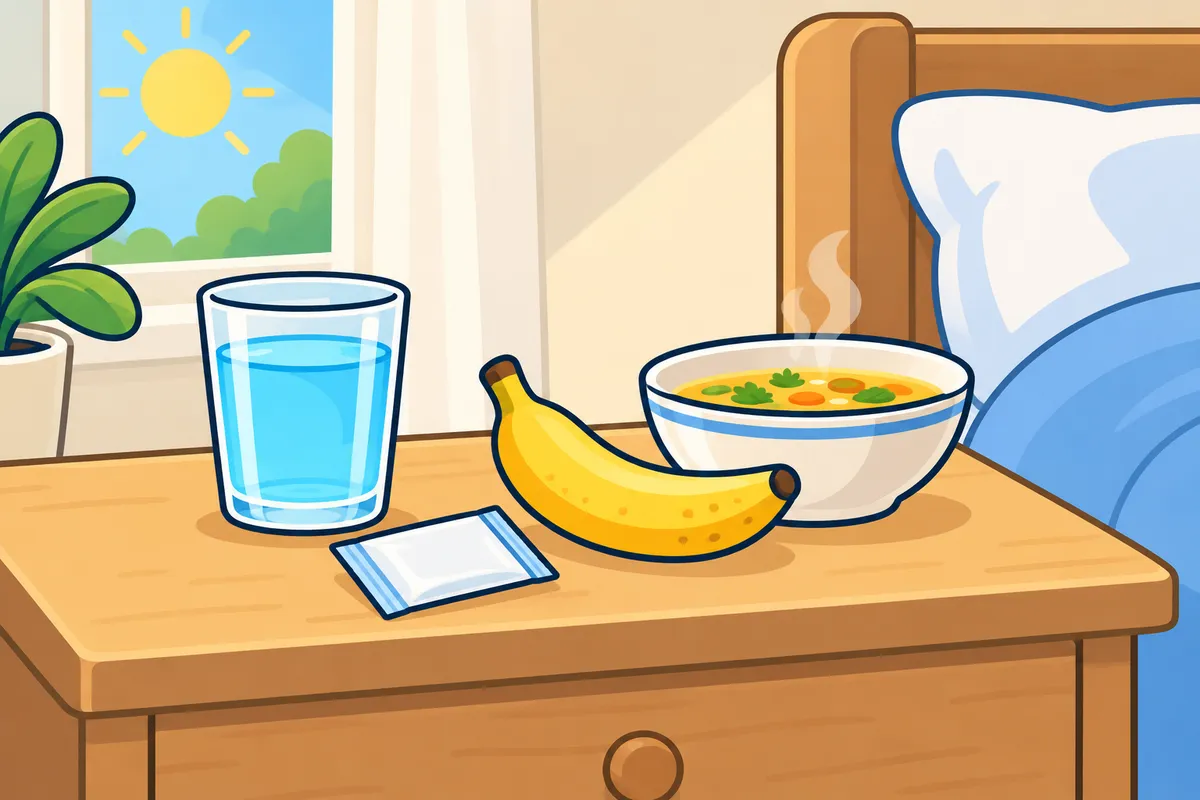
You notice it at 4 pm: a dry mouth, a dull head, dark yellow pee. Or you step on the scale after a July run and see 1.2 kg (2.6 lb) gone. Either way you want the water back quickly, without overshooting.
This page gives you the amounts and the timing. It belongs to our guide on how to tell if you are drinking enough water; if you are not sure you are short at all, check the signs of dehydration in adults first.
What Is the Fastest Way to Rehydrate?
Start with small sips and build up, as the NHS advises, then keep drinking steadily instead of gulping. Take some salt with the fluid, from a meal, a salty snack or an oral rehydration solution. Sodium helps your body hold on to what you drink, so less of it runs straight through to your bladder.
Here is the order that works, with who says so:
Rehydrate in Four Steps
- Sip first: "start with small sips and then gradually drink more" (NHS)
- Add salt from food; sodium "will help retain ingested fluids and help stimulate thirst" (Korey Stringer Institute)
- Use a pharmacy sachet when vomiting or diarrhoea drains fluid fast; a pharmacist can recommend one (NHS)
- After exercise, finish within 2 hours, the institute's target
Plain water with no food is the slow route. Without enough sodium, the institute warns, your body cannot get back to normal hydration and makes extra urine instead.
How Much Do You Need to Drink to Rehydrate?
After exercise, weigh yourself before and after, then drink back a little more than the scale says you lost, as the athletic trainers' NATA position statement advises.
- 1 kg
- (2.2 lb) lost is about 1 liter of fluid
- 100–150 %
- of that loss is what to drink back
- 150 %
- when you have under 4 hours to recover
Weigh Yourself Before and After
The Korey Stringer Institute's method is simple. Weigh yourself with no clothes before the session, again after, and take the difference.
The difference in kilograms is roughly the liters of fluid you lost. Anything you drank during the session is already in the result, because it kept the scale higher.
Why 150 % and Not 100 %?
You keep making pee while you rehydrate, so part of each drink leaves again. NATA's review says up to 150 % of the deficit needs to go in to replace losses over a short recovery of under 4 hours. The institute writes the same rule as a formula: weight before minus weight after, times 1.5.
| Weight lost | Fluid lost | Drink back at 100 % | Drink back at 150 % (under 4 h to recover) |
|---|---|---|---|
| 0.5 kg (1.1 lb) | 0.5 L (17 oz) | 0.5 L (17 oz) | 0.75 L (25 oz) |
| 1.0 kg (2.2 lb) | 1.0 L (34 oz) | 1.0 L (34 oz) | 1.5 L (51 oz) |
| 1.5 kg (3.3 lb) | 1.5 L (51 oz) | 1.5 L (51 oz) | 2.25 L (76 oz) |
| 2.0 kg (4.4 lb) | 2.0 L (68 oz) | 2.0 L (68 oz) | 3.0 L (101 oz) |
NATA also wants you to finish a session less than 2 % lighter than you started. For a 70 kg (154 lb) person, that line sits at 1.4 kg, so the bottom two rows of the table mean the session went past it.
How Long Does It Take to Rehydrate?
It depends on how much you lost and how soon you need to be ready. After exercise, the Korey Stringer Institute aims to finish within 2 hours, and NATA notes that with more than 12 hours to recover, normal meals and drinks restore balance on their own. For mild everyday dehydration, sip steadily until your pee turns pale yellow again.
| Your situation | Time frame | What to drink |
|---|---|---|
| Two sessions less than 4 hours apart | Within the first 2 hours | 150 % of the weight lost, with salt |
| One session a day, over 12 hours to recover | Over the evening | Normal meals and drinks, to thirst |
| A dry afternoon at home or work | Over the next few hours | Small sips, then more, until pee is pale |
| Vomiting or diarrhoea | As long as the fluid loss lasts | Small, frequent sips and a pharmacy sachet |
No source we read gives a clock time for the last two rows, and we will not invent one. The US panel's water chapter does note that people often replace less than they lost at first, and that thirst triggers the rest across the next day.
That is why one rough afternoon usually fixes itself by the next morning. A pattern of dark pee day after day is a different matter.
When Should You Use an Oral Rehydration Solution?
Use one when you lose fluid fast, through vomiting or diarrhoea, and buy a ready-made one from a pharmacy. The NHS says these are powders you mix with water, and a pharmacist can tell you which suits you or your child. Mix it with exactly the amount of water on the pack.
We give no home recipe on this page. A ready-made sachet has the salt and sugar measured for you, and getting those amounts wrong at home defeats the point.
A 2016 trial shows why the salt matters. Researchers gave 72 men, all already well hydrated and fasted, 1 liter of one drink over 30 minutes and measured how much they kept. After an oral rehydration solution the men passed less urine than after water: the study's hydration index scored it about 1.5 against water's 1.0 at two hours, and milk scored about the same.
For long, sweaty work rather than illness, NIOSH advises sports drinks with balanced electrolytes once sweating lasts several hours. On a normal day, water and your meals cover it. If your job means drinking close to a gallon on hot days, our guide on whether a gallon of water a day is too much shows who really needs that much.
Can You Rehydrate Too Fast?
Yes, if you drink far more than you lost. Healthy kidneys clear only about 0.7 to 1.0 liter of extra water an hour, and NATA tells athletes not to drink more than their exercise weight loss. Treat 150 % of a measured loss as your ceiling.
Over-drinking feels like dehydration at first: headache, dizziness, nausea. The symptoms, and a Boston Marathon study of who got low sodium, are on our page asking can you drink too much water.
When to See a Doctor
Rehydrating at home suits mild dehydration in healthy adults. Get help instead when the signs below show up, or when you cannot keep fluids down.
Babies and children follow the NHS advice above and their doctor's, never the adult amounts on this page.
Getting Back to Your Usual Day
Once you are level again, go back to your daily amount rather than drinking extra "to be safe." The water intake calculator gives you that number from your weight, activity, climate and sex.
On ordinary days, thirst does most of the work. Our guide on whether thirst is a good guide shows when to trust it and when to drink on a plan.
If you rehydrate and still feel parched an hour later, that is worth a look of its own: see why you might always be thirsty.
For where daily numbers come from, read how much water you should drink a day. Soup, fruit and vegetables add water too, as total water vs drinking water shows.
General information for healthy adults, not medical advice. If a doctor has set your fluid amount, follow that.

More in Too Little, Too Much
Sources
- NHS. Dehydration, 2026.
- Korey Stringer Institute, University of Connecticut. Hydration, checked 2026.
- National Athletic Trainers' Association. Position Statement: Fluid Replacement for the Physically Active, 2017.
- National Academies of Sciences. Dietary Reference Intakes for Water, Potassium, Sodium, Chloride, and Sulfate: Chapter 4, Water, 2005.
- American Journal of Clinical Nutrition (Maughan and colleagues). A randomized trial to assess the potential of different beverages to affect hydration status: development of a beverage hydration index, 2016.
- CDC NIOSH. Heat Stress, Workplace Recommendations, 2026.
Sources checked by the Glubbo team on Oct 16, 2026. General information, not medical advice.