Water Intake · Rules and Myths
What Percentage of the Body Is Water? Your Share by Age and Sex
The share of your weight that is water at every age, why muscle and fat change it, and what that means in liters.
 By the Glubbo Editorial Team · Updated Oct 19, 2026 · 8 min read
On This Page
- What Percentage of the Body Is Water?
- How Many Liters of Water Are in the Human Body?
- Does Muscle Hold More Water Than Fat?
- Why Do Women Have a Lower Percentage of Body Water?
- How Does Body Water Change With Age?
- Where Is the Water in Your Body?
- Can Drinking More Water Raise Your Body Water Percentage?
- What Is a Healthy Body Water Percentage on a Scale?
- How Much of Your Body Water Do You Replace Each Day?
- Is the Water Reading on a Body Fat Scale Accurate?
- What Your Body Water Means for Your Daily Goal
- Sources
Short answer
About 60 % for an adult, from 45 to 75 %.
- Men aged 19 to 50 average 59 % water and women 50 %, by the US review.
- Muscle and other lean tissue are 70 to 75 % water; fat tissue 10 to 40 %.
- A 70 kg (154 lb) man carries about 42 liters of water.

Weigh yourself, and a little over half of that number is water. It sits inside your cells, in your blood and between your tissues, and your body keeps the amount almost perfectly steady from one day to the next.
The share is not the same for everyone, though. Age, sex and above all how much of you is muscle and how much is fat move it by more than 25 points.
What Percentage of the Body Is Water?
About 60 % for an adult, with a range from about 45 to 75 %. That is the figure the US National Academies give in their review of water needs. Men aged 19 to 50 average 59 % water, women of the same age 50 %, and the share falls a few points after 50.
The averages hide wide ranges: two men of the same age can differ by 30 points.
How Far People Stray From the Average
The panel's table gives a range for every group, and the spread inside one group is wider than the gap between groups.
| Group | Lowest | Highest | Spread |
|---|---|---|---|
| 0 to 6 months | 64 % | 84 % | 20 points |
| 6 months to 1 year | 57 % | 64 % | 7 points |
| 1 to 12 years | 49 % | 75 % | 26 points |
| Boys, 12 to 18 | 52 % | 66 % | 14 points |
| Girls, 12 to 18 | 49 % | 63 % | 14 points |
| Men, 19 to 50 | 43 % | 73 % | 30 points |
| Women, 19 to 50 | 41 % | 60 % | 19 points |
| Men, 51 and over | 47 % | 67 % | 20 points |
| Women, 51 and over | 39 % | 57 % | 18 points |
These are the panel's Table 4-1 values, which draw on a 1961 compilation of body water measurements.
How Many Liters of Water Are in the Human Body?
About 42 liters in an average 70 kg (154 lb) man, the US National Academies estimate. To find your own rough figure, multiply your weight in kilograms by the share for your group.
Estimate Your Own Liters
- Take your weight in kg (pounds ÷ 2.2)
- Pick the mean for your age and sex from the table
- Multiply: 75 kg × 0.59 ≈ 44 liters
- Adjust: more muscle, higher; more body fat, lower
Since 1 liter of water weighs 1 kg, the liters and the kilograms are the same number.
Liters of Body Water by Weight
| Body weight | Women 19 to 50 (50 %) | Men 19 to 50 (59 %) | Women 51+ (47 %) | Men 51+ (56 %) |
|---|---|---|---|---|
| 50 kg (110 lb) | 25 L | 30 L | 24 L | 28 L |
| 60 kg (132 lb) | 30 L | 35 L | 28 L | 34 L |
| 70 kg (154 lb) | 35 L | 41 L | 33 L | 39 L |
| 80 kg (176 lb) | 40 L | 47 L | 38 L | 45 L |
| 90 kg (198 lb) | 45 L | 53 L | 42 L | 50 L |
| 100 kg (220 lb) | 50 L | 59 L | 47 L | 56 L |
We multiplied each weight by the group means in the US National Academies table and rounded to whole liters. At 70 kg, a woman over 50 carries about 33 liters and a man aged 19 to 50 about 41. The gap grows with weight, to about 12 liters at 100 kg.
Those are averages for groups. Your own share depends far more on how much of you is lean tissue than on your age or sex.
Does Muscle Hold More Water Than Fat?
Yes, much more. In adults, fat-free mass, which includes muscle and organs, is about 70 to 75 % water, while fat tissue is about 10 to 40 %, the US National Academies report. That single difference explains most of the gap between two people of the same weight.
Lean Tissue
- Muscle, organs and blood
- The more you carry, the higher your water share
- Strength training adds more of it
Fat Tissue
- Stored body fat
- The more you carry, the lower your water share
- Holds far less water per pound
A 2012 study that traced labelled water in 36 young men, average weight 77 kg, measured their body water at 60.7 % of body weight and 72.7 % of lean mass, right inside those ranges. It is in the European Journal of Applied Physiology.
Why Muscle Changes the Number
The scale shows the same 80 kg for both. Inside, the rugby player carries about 12 liters more water, close to the weight of a full 12-liter bucket.
Why Do Women Have a Lower Percentage of Body Water?
Because on average women carry more body fat and less fat-free mass than men of the same weight. The US National Academies give exactly that reason: women and older people have less body water "primarily because of having lower fat-free mass and increased body fat."
It is not a sign of drinking less. A woman athlete with low body fat can sit well above the 50 % average, and a man with high body fat can sit below it.
How Does Body Water Change With Age?
It falls from about 74 % in the first months of life to about 60 % by age one, holds near that through childhood, then drifts down in later adulthood. Women 51 and over average 47 % and men 56 %, as fat-free mass shrinks with age.

Babies have the highest share of anyone, but that tells you nothing about how much they should drink. Babies under 6 months get their fluid from breast milk or formula, and when a baby can start sipping water has its own answer.
At the other end of life, thirst fades and the body holds less water, so older adults need a few habits of their own to keep drinking enough.
Where Is the Water in Your Body?
About two thirds sits inside your cells and one third outside them, in blood plasma and the fluid between cells. The US National Academies put the split at 65 % and 35 %: in a 70 kg man, about 28 liters inside cells and 14 liters outside.
- 42 L
- total body water
- 28 L
- inside cells, about 65 %
- 14 L
- outside cells, blood plasma and tissue fluid, about 35 %
Water moves freely between these spaces. When you sweat or skip drinks, your body draws on both, which is why a day without enough fluid shows up in your blood tests and your urine at once.
Can Drinking More Water Raise Your Body Water Percentage?
No, not for more than a few hours. Your kidneys pass the extra, and the US National Academies note that healthy adults at rest keep their water balance within about 0.2 % of body weight over 24 hours. Gaining muscle is the lasting way to carry more water.
On a 70 kg body, 0.2 % is about 140 ml, less than a cup. Drink a liter more than usual and most of it leaves within hours, as the time your body takes to pass extra water shows.
Your daily intake still varies a lot from person to person. The same study found people took in 1.2 to 7.7 liters a day from food and drinks, and age, weight, height and body mass index explained under 12 % of that spread.
What Is a Healthy Body Water Percentage on a Scale?
Anything inside your group's range in the table above is within what the panel reports for healthy people:
- 41 to 60 % for women aged 19 to 50
- 43 to 73 % for men of the same age
A reading near 50 % for a woman or near 59 % for a man sits at the group average, and an average is not a target. Because fat holds less water than muscle, a lower number often just means more body fat.
How Much of Your Body Water Do You Replace Each Day?
About 7 to 8 %. A study of 458 American adults aged 40 to 79 found preformed water intake from drinks and food averaged 3.0 L a day for men and 2.5 L for women. Set against body water, that is:
- roughly one fourteenth turned over every day for an average man, who holds about 42 L
- about one twelfth for a 60 kg woman at 50 %, who holds 30 L
Is the Water Reading on a Body Fat Scale Accurate?
Only roughly. Home scales estimate body water from a small electric current, a method called bioelectrical impedance, which the US National Academies say "may not have sufficient accuracy" to detect moderate dehydration, a loss of about 7 % of body water. Labs measure body water by having people drink heavy water and tracking the tracer.
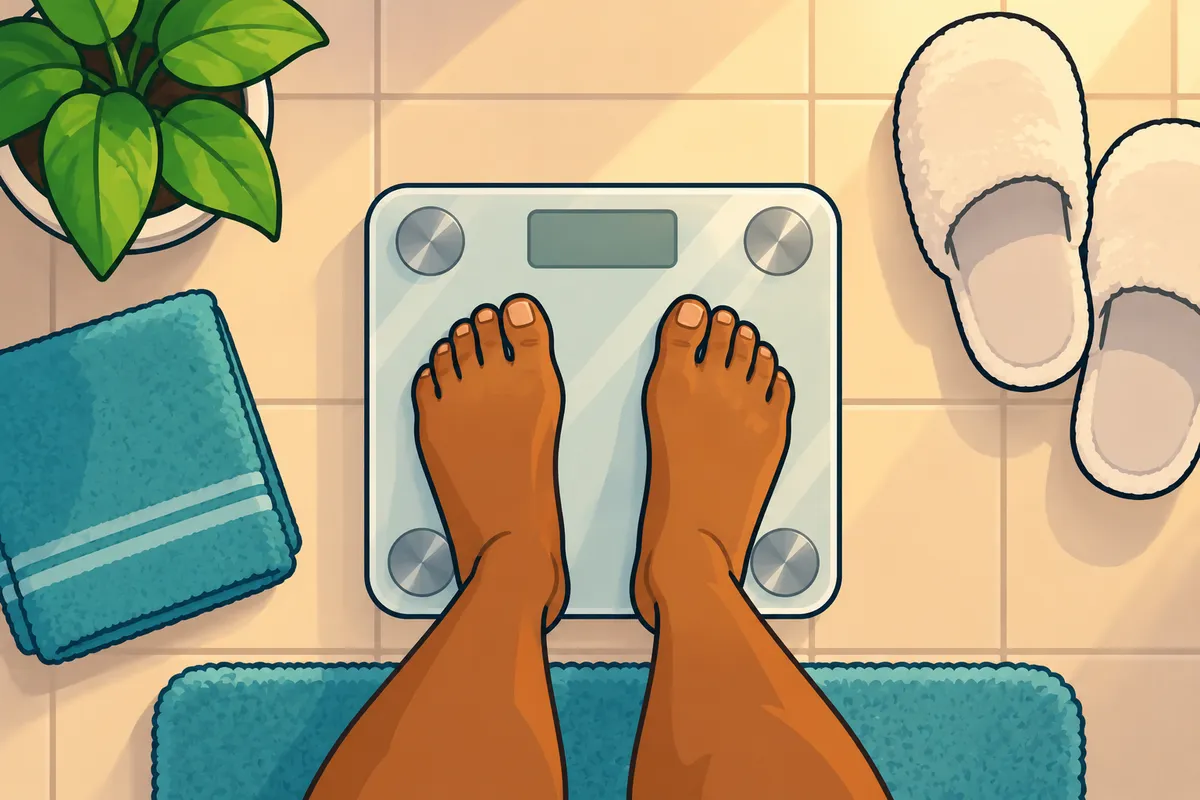
Treat the scale's water number as a trend at best. Weigh at the same time of day, before you eat or drink, and compare the average of a week with the next week, not one morning with another.
What Your Body Water Means for Your Daily Goal
Putting the Percentage to Use
4 items- Your body holds tens of liters; your daily goal tops up the few you lose
- More muscle means more body water, and often a higher drinks goal
- A low reading on a home scale is only a guess
- Your drinks goal comes from weight, activity and climate: try the calculator
The share of your body that is water barely moves from day to day; what moves is the 2.5 to 3 liters of water you take in and lose on a quiet day. Your goal by body weight starts from the same scale reading, and food supplies about a fifth of that refill, as total water versus drinking water explains.
General information for healthy adults, not medical advice. If a doctor has set your fluid amount, follow that.

More in Water Intake


Sources
- National Academies of Sciences. Dietary Reference Intakes for Water, Potassium, Sodium, Chloride, and Sulfate: Chapter 4, Water, 2005.
- European Journal of Applied Physiology (Péronnet and colleagues). Pharmacokinetic analysis of absorption, distribution and disappearance of ingested water labeled with D2O in humans, 2012.
- American Journal of Physiology, Renal Physiology (Raman and colleagues). Water turnover in 458 American adults 40-79 yr of age, 2004.
Sources checked by the Glubbo Editorial Team on Oct 19, 2026. General information, not medical advice. How we write and check our guides.

