Kids Water Intake Calculator: Daily Drinks by Age, 0 to 18
Pick your child's age and see their drinks for the day in ml, cups, ounces and kids' bottles.
1,200 ml of drinks a day
About 5 cups · 41 oz · 3.5 kids' bottles of 350 ml
From the American Academy of Pediatrics. On hot days and at sports practice, children need more.
See the Full Guide by AgeGeneral amounts for healthy children. Ask your pediatrician about yours.
Tap your child's age and the calculator shows one daily amount of drinks, in milliliters first, then in cups, US ounces and 350 ml (12 oz) kids' bottles. For ages 1 to 8 the number comes from the American Academy of Pediatrics (AAP); from 9 to 18 it comes from the US National Academies.
Spread the amount over a real day: a third with breakfast and the school run, a third by mid-afternoon, the rest with dinner. Milk has its own limits by age, which the full answer for ages 1 to 18 sets out with the warning signs.
What Each Age Tile Shows
Each tile gives a fixed amount, because children's figures go by age alone. The calculator never asks for weight and never uses Glubbo's adult habit formula, which starts from body weight and fits grown-ups only.
| Age tile | Main number | Second line on the card | From |
|---|---|---|---|
| Under 6 months | No water yet | Breast milk or formula covers it | AAP |
| 6–12 months | 120–240 ml of water | 4–8 oz, in small sips from a cup | AAP |
| 1–3 years | 950 ml of drinks | About 4 cups · 32 oz · 2.5 kids' bottles | AAP |
| 4–8 years | 1,200 ml of drinks | About 5 cups · 41 oz · 3.5 kids' bottles | AAP |
| 9–13 years | Girls 1,600 ml, boys 1,800 ml | 7 or 8 cups · 54 or 61 oz · 4.5 or 5 bottles | US National Academies |
| 14–18 years | Girls 1,800 ml, boys 2,600 ml | 8 or 11 cups · 61 or 88 oz · 5 or 7.5 bottles | US National Academies |
The AAP gives about 4 cups of fluids a day for ages 1 to 3 and around 5 cups for ages 4 to 8. Its figure for older children is a broad 7 to 8 cups, so from age 9 the calculator switches to the narrower drinks figures by sex from the US National Academies.
The row of little cups under the number is the same amount drawn as 8 oz cups. A toddler gets four, a 15-year-old boy gets eleven.
What Counts Toward the Number
Every drink counts: water, milk and anything else your child drinks. Food adds more water on top, which is why you never need to hit the number with water alone.
The US panel shows the gap. For ages 4 to 8 it sets total water at 1.7 L a day and the drinks part at 1.2 L, so meals and snacks bring the other half liter.
Why Does the Result Show No Water Under 6 Months?
A baby under 6 months gets all the water they need from breast milk or formula, so the calculator gives no amount at all. The AAP says extra water is not recommended at this age and suggests offering a little from around 6 months.
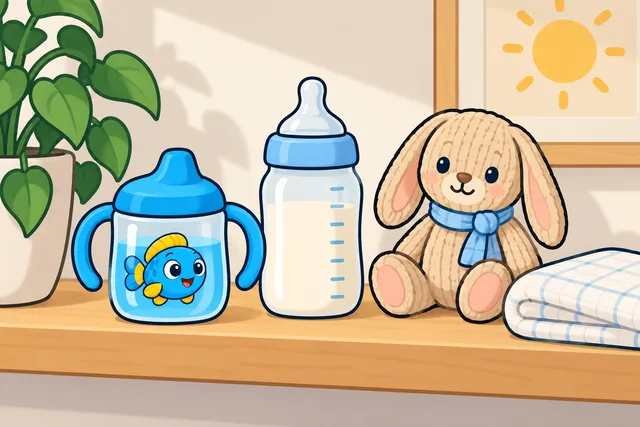
From 6 to 12 months, the card shows 120 to 240 ml (4 to 8 oz) of water a day, the range in the AAP's table of drinks for children age 5 and younger. That water comes on top of breast milk or formula, given in sips from an open or sippy cup at mealtimes.
The first cup, hot days and how to mix formula each come with a few rules, and your pediatrician answers anything about a younger baby.
Why Do Girls and Boys Get Different Amounts From Age 9?
From age 9 the calculator uses the US National Academies' figures, and those differ by sex: 1.6 L of drinks for girls and 1.8 L for boys at 9 to 13, then 1.8 L for girls and 2.6 L for boys at 14 to 18. The panel based them on what healthy children in each group drink.
The gap widens in the teen years, because healthy teen boys drink more on average than girls of the same age.
These are averages for healthy children. A small, quiet boy may need less than his tile says, and a tall girl who plays soccer four days a week may need more.
Turn the Result Into Your Child's Day
Split the number across meals, school and play, then count it in the cup or bottle your child really uses. Most children drink at meals without thinking, so the gaps between meals are where the day falls short.
A Toddler at Home
The AAP's table gives toddlers aged 12 to 24 months 1 to 4 cups of water and 2 cups of milk. Noah's day sits in the middle of both ranges.
A School Day
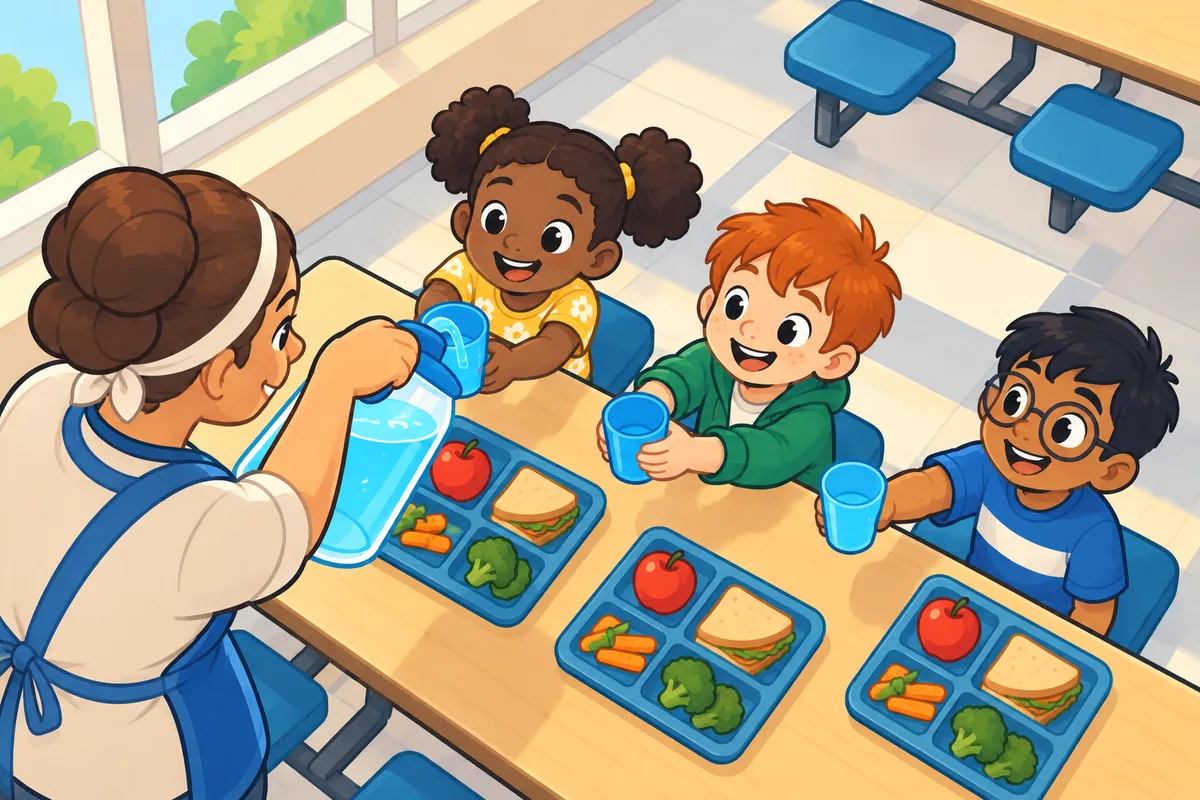
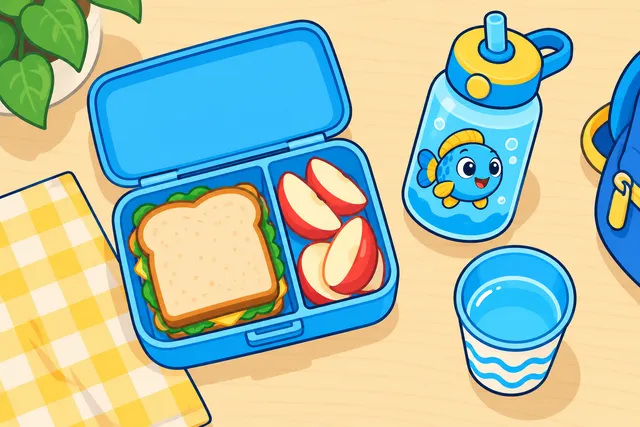
The trick is the refill at lunch. Ask the teacher whether children can refill bottles at school, and send a bottle your child can open alone.
A Teen With Practice
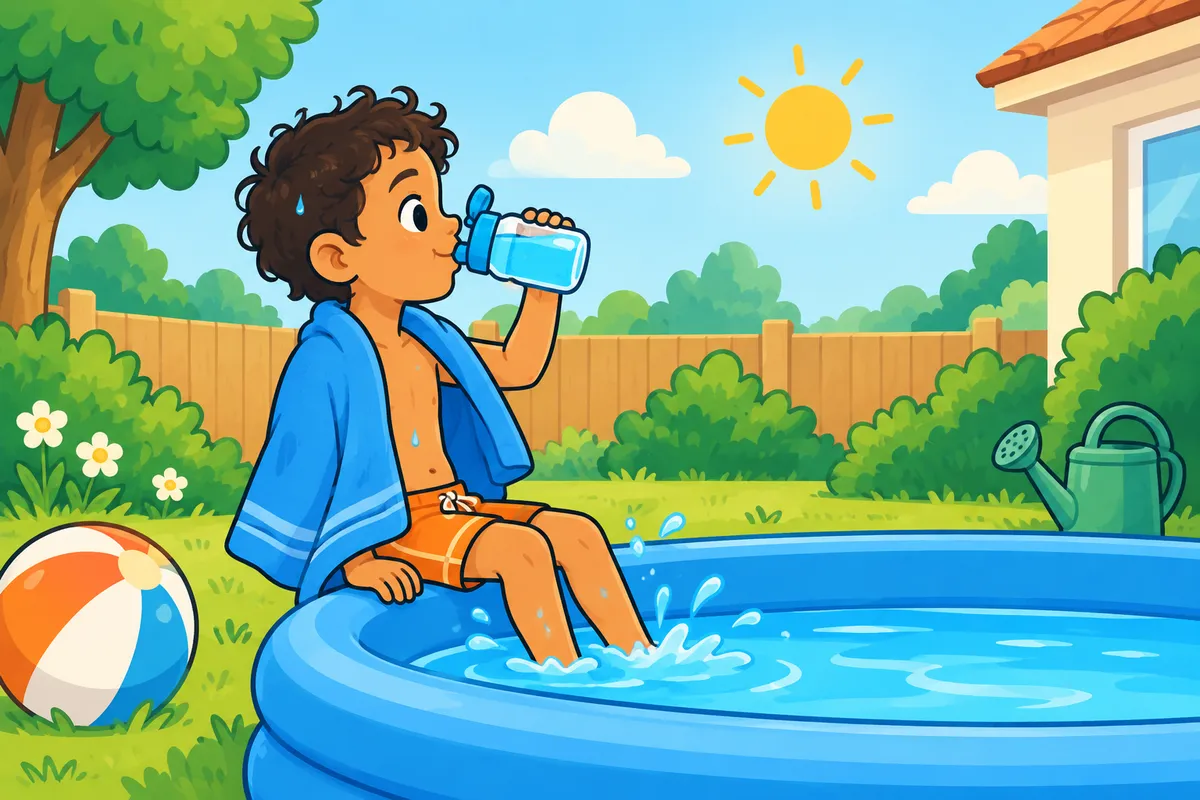
Sport sits on top of the tile's number. The AAP says teens who exercise hard need about 34 to 50 oz (1.0 to 1.5 L) of water an hour, and children aged 9 to 12 about 3 to 8 oz every 20 minutes. Game days need a plan of their own, including whether a young player needs a sports drink at all.
To count any result in your child's own bottle, enter it with the bottle size. If the bottle is marked only in ounces, switch the units to milliliters.
Reading the Number on Hot and Busy Days
Treat the result as an everyday target. The AAP notes that children may need more on hot, humid days and with activity. A child who skipped lunch also got less water from food.
Watch the child as well as the number. The AAP says pee should be very light yellow, almost clear, and that tells you more than an exact count of milliliters.
When your child resists water, try ideas that work at home and at school.
When Should You Ask a Pediatrician About How Much Your Child Drinks?
Call your pediatrician when you worry that a baby is not drinking enough, when a child shows signs of dehydration, or when symptoms last more than an hour after play. A child with a heart or kidney condition, or one whose doctor has set a fluid amount, should follow that plan and skip the calculator.
These situations call for a phone call, according to the AAP's page on healthy hydration:
- A baby with fewer wet diapers than usual; the AAP gives 6 to 8 a day as typical.
- A child with dry lips, a sticky mouth, dark pee or fewer trips to the toilet.
- A child who is sleepy and irritable after time in the heat.
- Symptoms that worry you or last more than an hour.
Older teens can go by the signs doctors use for adults, which are similar but not the same.
From Age Tile to School Bag
Set Up Your Child's Day
- Tap your child's age and note the ml and cups
- Take off the milk they already drink
- Measure their cup or bottle once with a jug
- Pack a bottle for school and ask about refills
- Add drinks at the gaps between meals
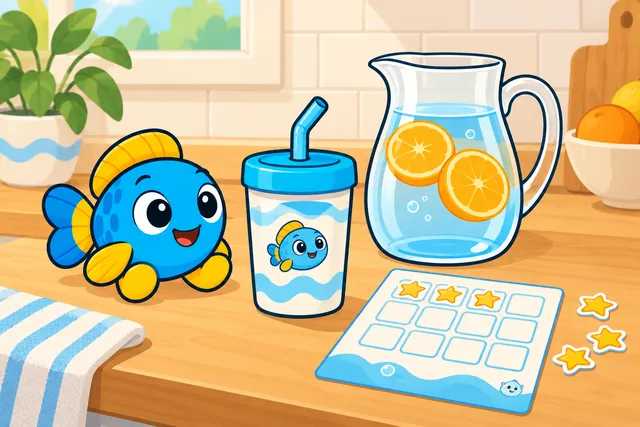
A paper sheet helps younger children see their progress: print one with a mark for each glass, or give each drink a set time if you prefer a clock.
Common Questions
Does the calculator use my child's weight?
No. Both the AAP and the US National Academies give children's amounts by age, so the calculator asks only for age, and for girl or boy from age 9.
Can I use the adult water intake calculator for my teenager?
No. Glubbo's habit formula is for adults. Use the kids calculator until 18; at 19 the adult figures take over.
Does juice count toward the amount?
Juice is a drink, so it counts, but the AAP says no juice before age 1 and no more than 4 oz (120 ml) a day at ages 1 to 3. Build the day on water and milk.
Why does a teen boy's result jump so much?
The US National Academies' figure for boys aged 14 to 18 is 2.6 L of drinks a day, against 1.8 L at 9 to 13. The panel set each figure from what healthy children in that group drink, and teen boys drink the most.
General information for healthy adults, not medical advice. If a doctor has set your fluid amount, follow that.
Guides Behind the Numbers
Sources
- American Academy of Pediatrics (HealthyChildren.org). Choose Water for Healthy Hydration, 2024.
- American Academy of Pediatrics (HealthyChildren.org). Recommended Drinks for Children Age 5 & Younger, 2023.
- National Academies of Sciences. Dietary Reference Intakes for Water, Potassium, Sodium, Chloride, and Sulfate: Summary, 2005.
Formula and sources checked by the Glubbo Editorial Team on Oct 16, 2026.

Glubbo
Log a drink in 1 tap. Every glass fills a fish tank
Free · No account needed
912 people installed Glubbo in the last 30 days912 installed in 30 days
Free · No account needed

