Every Age
How Much Water by Age, From Your Toddler to Adults Over 70
Your family's cups by age, US and European numbers side by side, and when a doctor sets the number instead.
 By the Glubbo Editorial Team · Updated Nov 9, 2026 · 9 min read
Short answer
About 4 to 13 cups of drinks a day, by age.
- Ages 1 to 3: about 4 cups (0.9 L) a day; ages 4 to 8: about 5 cups (1.2 L).
- Adults: about 9 cups (2.2 L) for women and 13 cups (3.0 L) for men, even past 70.
- Under 6 months: no plain water. Children go by age, never by an adult formula.
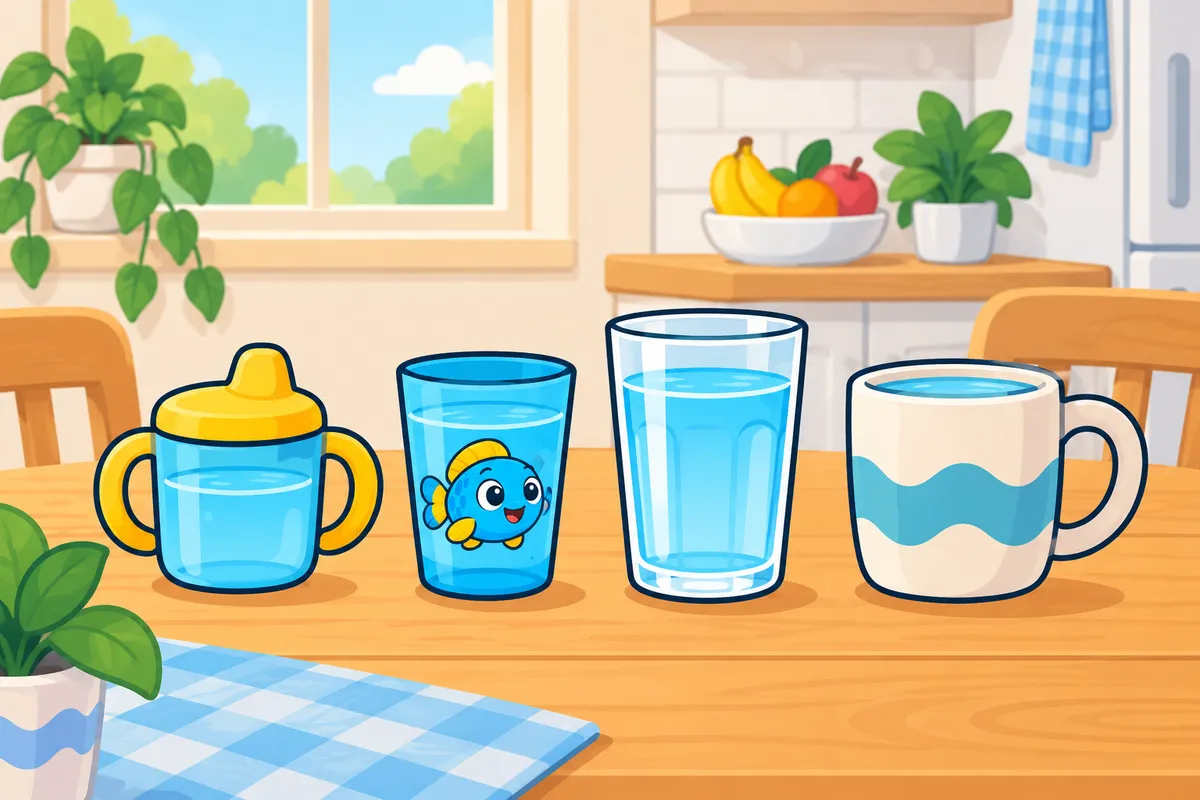
Your water need climbs through childhood and then holds still for the rest of your life. A 2-year-old needs about 4 cups of drinks a day, a teenage boy about 11, and an adult man about 13, at 30 or at 80.
Children follow their age, never their weight, and never an adult formula.
How Much Water Should You Drink by Age?
From about 4 cups (0.9 L) of drinks a day at ages 1 to 3 up to about 9 cups (2.2 L) for women and 13 cups (3.0 L) for men, according to the US National Academies. Boys and girls split apart at 9. After 19 the values stop changing, even past 70.
These are drinks only. The panel's total water figures add the water in food on top, and the water chapter gives both for every age. The bars show ounces: 8 oz is one cup, so a 30 oz bar is just under 4 cups.
Seven stages at a glance
Babies under 1
Breast milk or formula first
- No plain water under 6 months
- 4 to 8 oz a day from 6 months
Suits you if your baby is starting solids around 6 months.
Children 1 to 8
Milk counts
- About 4 cups at 1 to 3
- About 5 cups at 4 to 8
Suits you if you pack a toddler cup or a school bottle.
Ages 9 to 18
Boys and girls split
- About 7 to 8 cups (AAP)
- Boys 14 to 18: about 11 cups
Suits you if you have a teen, above all one who plays sport.
Adults 19 to 70
Size, activity, climate
- Women 2.2 L, men 3.0 L of drinks
- 2.7 L and 3.7 L with food
Suits you if you want your own number in that range.
Over 70
Same numbers, weaker thirst
- Same totals as at 30
- Thirst comes late: drink on a routine
Suits you if you look after an older parent.
Pregnancy
A little more
- About 2.3 L (10 cups) of drinks
- Sip little and often with nausea
Suits you if you are pregnant and want a starting number.
Breastfeeding
Replaces water in milk
- About 3.1 L (13 cups) of drinks
- Drinking extra makes no more milk
Suits you if you are feeding and often thirsty.
Babies Under 1 Year
Babies under 6 months get no plain water at all: the American Academy of Pediatrics says they "should only be drinking breast milk or formula". From about 6 months, a little water in a cup can start, about 4 to 8 oz (120 to 240 ml) a day until the first birthday.
On a hot day, a breastfed baby under 6 months gets the extra from more feeds, not from water.
Children 1 to 8
Toddlers aged 1 to 3 need about 4 cups of fluids a day, and children aged 4 to 8 about 5 cups, the AAP says. Both counts include milk.
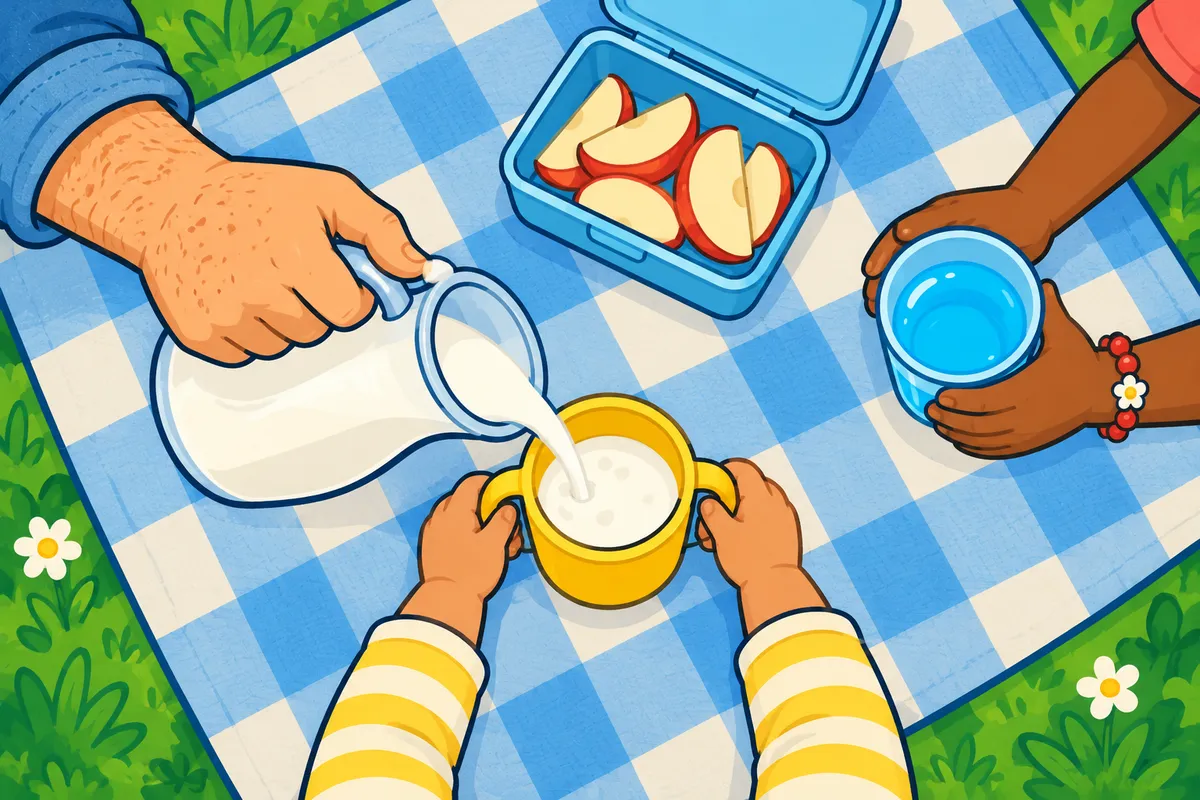
The AAP's table for young children splits that between the two drinks it recommends: up to 4 cups of water a day at 12 to 24 months beside 2 cups of milk, and up to 5 cups at 2 to 5 years beside 2 to 3 cups of milk, in its guide to recommended drinks for children age 5 and younger. Packing a school bag is easier with the same amounts in milliliters and bottles.
Ages 9 to 18
Here the AAP says about 7 to 8 cups a day for "older children", without naming an age. The US panel splits it by sex, and the gap widens fast in the teens.
| Age | Girls, drinks a day | Boys, drinks a day |
|---|---|---|
| 9 to 13 | 1.6 L, about 7 cups | 1.8 L, about 8 cups |
| 14 to 18 | 1.8 L, about 8 cups | 2.6 L, about 11 cups |
A 16-year-old boy who plays football needs more than his 12-year-old sister by a full four cups, before practice adds anything.
Adults 19 to 70
Per day, the US panel gives adults two numbers:
| Adults | Drinks | Total water with food |
|---|---|---|
| Women | about 2.2 L (74 oz) | 2.7 L |
| Men | about 3.0 L (101 oz) | 3.7 L |
Where your own number sits in that range depends on your size, how active you are and your climate.
Do Men and Women Need Different Amounts?
Yes, by about 0.8 L. The US panel gives women 2.2 L of drinks and men 3.0 L, and the European agency gives women 2.0 L and men 2.5 L counting food. The split begins at age 9 and widens in the teens, when boys' needs run ahead of girls'.
Over 70
The numbers do not drop. The panel's water chapter sets the same 2.7 L and 3.7 L of total water for adults over 70 as for adults of 30, and the thirst that should prompt those drinks gets weaker with age. Europe's geriatric nutrition society sets a floor for older adults of 1.6 L of drinks for women and 2.0 L for men, which sits below the US typical figures.
Pregnancy
The US panel sets two numbers for pregnancy:
| In pregnancy | Per day | More than before pregnancy |
|---|---|---|
| Total water | about 3.0 L | 300 ml (10 oz) |
| Drinks | about 2.3 L (10 cups) | only 100 ml (3.4 oz) |
Morning sickness can make even that hard to reach, and the NHS says sipping little and often may help keep it down. Pale pee is the simplest daily check, and in pregnancy a dark, cloudy or pink shade each means something different.
Breastfeeding
While breastfeeding, the panel's figure rises:
- Total water: 3.8 L a day.
- Drinks: about 3.1 L (13 cups) of it, roughly 4 cups more than before pregnancy.
The extra replaces the water that leaves in milk, and drinking past that does not make more milk.
Do You Need Less Water as You Get Older?
No, though the floor for older adults is lower than the typical figure.
- 2.2 L
- typical drinks for women of any age over 19 (US)
- 3.0 L
- typical drinks for men of any age over 19 (US)
- 1.6 L
- minimum drinks for older women (ESPEN)
- 2.0 L
- minimum drinks for older men (ESPEN)
No. The US reference stays at 2.2 L of drinks for women and 3.0 L for men from age 19 through 70 and beyond, and Europe keeps one adult value from 18 on. What changes is your thirst: the US panel calls it "impaired in the elderly", so the same amount takes more planning.
Older adults also have a harder time in the heat. The CDC tells people over 65 to "drink more water than usual and don't wait until you're thirsty to drink" on hot days.
The fix is a routine: a glass tied to meals, pills and an afternoon show instead of waiting for thirst.
Why Do US and European Numbers Differ?
They count different things. The US panel gives a total and a drinks figure for each age, while the European Food Safety Authority gives one total that already includes "water contained in food".
US National Academies
- Two numbers: total water and drinks
- Ages 4 to 8: 1.7 L total, 1.2 L drinks
- Boys 14 to 18: 3.3 L total, 2.6 L drinks
- Adults over 70: same as at 19
EFSA (Europe)
- One number: drinks and food together
- Ages 4 to 8: 1.6 L
- Boys 14 to 17: 2.5 L
- Adults 18 and over: 2.0 L women, 2.5 L men
Read side by side, the two bodies land close. For a child aged 4 to 8, the US total of 1.7 L and the European 1.6 L differ by less than half a cup.
The European values from EFSA's finder run:
- 1.3 L at ages 2 to 3.
- 1.9 L for girls and 2.1 L for boys at 9 to 13.
- 2.0 L for girls and 2.5 L for boys at 14 to 17.
In the US figures for women, food makes up the 0.5 L between 2.7 L total and 2.2 L of drinks.
Why Children Never Use the Adult Formula
Glubbo's habit formula starts from body weight, 30 ml per kilogram, and is built for adults. Children's guidance from the AAP and the US panel goes by age, so a heavy 8-year-old and a light 8-year-old get the same 5 cups.
Use the age numbers above for anyone under 19. For pregnancy and breastfeeding, the formula does not apply either, and your midwife or doctor sets the number.
How Do You Help Every Age Drink Enough?
Each age slips for its own reason, so the fix differs too.
| Age | Where it slips | What helps |
|---|---|---|
| Toddlers | Milk or juice fills them up | Water between meals, milk at meals |
| School age | No drink between breakfast and pickup | A bottle in the school bag, a cup at every snack |
| Teens | Sports drinks and soda replace water | Their own bottle, refilled before practice |
| Adults | The afternoon passes without a glass | Reminders spread over waking hours |
| Over 70 | Thirst comes late or not at all | A glass at set times: meals, pills, the news |
For children, the AAP's tips start with a cup they chose and fruit in the water, and you drinking where they can see it. For adults and older parents, turn the daily amount into times on a clock.
How Heat and Sweat Raise Every Amount
Heat and sweat raise every number on this page. The AAP says how much children and teens who exercise hard need:
- Children aged 9 to 12: about 3 to 8 oz (90 to 240 ml) every 20 minutes.
- Teens: about 34 to 50 oz (1.0 to 1.5 L) an hour.
For a child's practice or game, the amounts change before, during and after play. A stomach bug or a heat wave can leave any child short, so the signs to watch from toddler to teen are worth knowing before the next one.
For adults, training days add back the water you sweat out on top of the daily amount. The National Institute on Aging asks older adults to drink plenty of liquids in the heat and to avoid alcohol and caffeinated drinks.
One Number for Each Person in Your House
One evening, the whole house
- A baby under 6 monthsNo plain water; breast milk or formula
- A child in schoolTheir age's cups on the fridge, a filled bottle in the bag
- An older parentSet drink times instead of waiting for thirst
- You, aged 19 or overThe adult formula, which starts from your weight
General information for healthy adults, not medical advice. If a doctor has set your fluid amount, follow that.
All Guides in Every Age
Every guide, A to Z
Babies and Children 7 guides
Children's needs follow age, not adult formulas. These guides start with a baby's first sips and go up to teens at sports practice, with the amounts pediatricians give.
Babies and Children page When Can Babies Drink Water? From 6 Months, in Small Sips
 How Much Water Should a Child Drink? Cups for Ages 1 to 18
 How to Get Kids to Drink More Water, From Toddlers to Teens
 How Much Water Should Kids Drink During Sports? A Practice Plan
 Signs of Dehydration in Babies and Toddlers, and When to Call
 What Drinks Are Safe for Toddlers? Water, Milk and Little Else
 Signs of Dehydration in Children: What to Look For and What to Do
Pregnancy and Later Life 4 guides
Pregnancy, breastfeeding and later life each change how much you need and how well thirst works. These guides give the amounts the public bodies set and the signs worth watching.
Pregnancy and Later Life page

Sources
- National Academies of Sciences. Dietary Reference Intakes for Water, Potassium, Sodium, Chloride, and Sulfate: Summary, 2005.
- National Academies of Sciences. Dietary Reference Intakes for Water, Potassium, Sodium, Chloride, and Sulfate: Chapter 4, Water, 2005.
- American Academy of Pediatrics (HealthyChildren.org). Choose Water for Healthy Hydration, 2024.
- American Academy of Pediatrics (HealthyChildren.org). Recommended Drinks for Children Age 5 & Younger, 2023.
- European Food Safety Authority (EFSA). Dietary Reference Values finder, water, 2010.
- CDC. Heat and Older Adults (Aged 65+), 2024.
- National Institute on Aging. Hot Weather Safety for Older Adults, 2022.
Sources checked by the Glubbo Editorial Team on Nov 9, 2026. General information, not medical advice. How we write and check our guides.

