Water at Home · Wells, Storage and Emergencies
How Much Water to Store for an Emergency, by Household Size
Gallons for 3 days and 2 weeks at every household size, who needs extra, and the 6-month swap.
 By the Glubbo Editorial Team · Updated Oct 19, 2026 · 8 min read
On This Page
- How Much Water Should You Store per Person?
- How Many Gallons of Water Do You Need for 2 Weeks?
- Who Needs More Than a Gallon a Day?
- Which Containers Are Safe for Storing Water?
- Store-Bought or Tap Water?
- How Long Does Stored Water Last?
- Where Should You Store Emergency Water?
- When Your Stored Water Runs Low
- What Is the Safest Way to Treat Water if You Run Out?
- Fill the Shelf in Four Weekly Buys
- Sources
Short answer
Store 1 gallon per person per day, for 2 weeks.
- The CDC minimum is 3 days at 1 gallon (3.79 L) per person per day.
- A family of four needs 12 gallons for 3 days and 56 gallons for 2 weeks.
- Replace water you bottled yourself every 6 months; check dates on bought water.
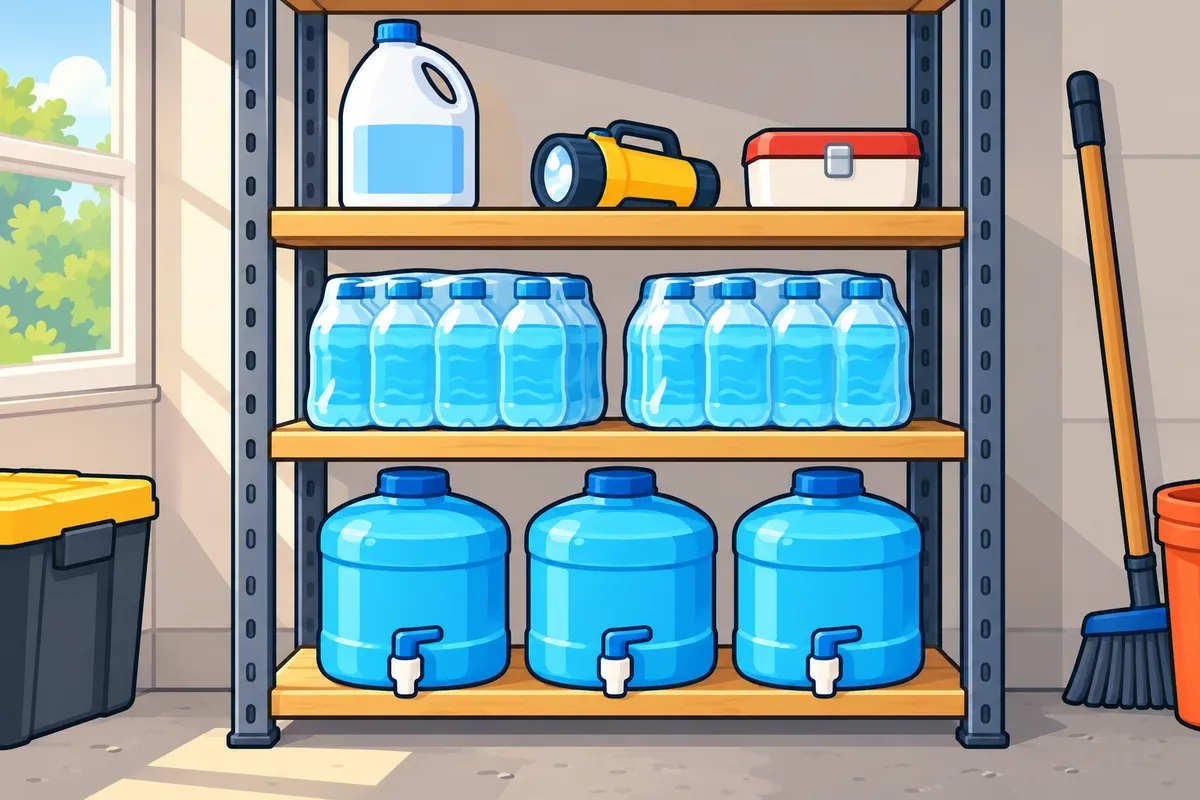
Store at least 1 gallon (3.79 liters) of water per person per day, enough for 3 days as the floor and 2 weeks if you can. That gallon covers drinking and sanitation, so you multiply it by the people in your home, then add extra for pets, illness and hot weather.
For a family of four, the floor is 12 gallons and the two-week goal is 56.
How Much Water Should You Store per Person?
At least 1 gallon per person per day. The CDC's emergency supply guide sets that amount for at least 3 days and asks for 2 weeks if possible. A US gallon is 3.79 liters, by NIST's conversion table, so one person's two weeks is about 53 liters.
| Household | 3 days | 2 weeks | 2 weeks in liters |
|---|---|---|---|
| 1 person | 3 gal | 14 gal | about 53 L |
| 2 people | 6 gal | 28 gal | about 106 L |
| 3 people | 9 gal | 42 gal | about 159 L |
| 4 people | 12 gal | 56 gal | about 212 L |
| 5 people | 15 gal | 70 gal | about 265 L |
| 6 people | 18 gal | 84 gal | about 318 L |
A Gallon Covers More Than Your Drinking Goal
You will not drink the whole gallon. Ready.gov says a normally active person needs about three quarters of a gallon of fluid a day from water and other drinks, which leaves the rest for cooking, teeth and washing up.
If your everyday drinking goal is 2,000 ml (68 oz), that is a little over half of the 3,790 ml you store per day. Store the gallon anyway: the gap is your cooking water, and it disappears fast once the tap stops.
How Many Gallons of Water Do You Need for 2 Weeks?
14 gallons for each person, before any extra for heat, illness or pets. Two adults need 28 gallons; a family of four needs 56. That is a lot of shelf space, so most households mix sealed store-bought water with containers they fill at the tap.
How Many Bottles Is Two Weeks of Water?
Oregon State Extension counts one person's 14 gallons as 14 one-gallon jugs, 27 two-liter bottles or 53 one-liter bottles. Divide 14 gallons by any other container the same way.
| Container | One person, 2 weeks | Four people, 2 weeks |
|---|---|---|
| 1-gallon jug | 14 | 56 |
| 5-gallon jug | 3 | 12 |
| 2-liter bottle | 27 | 106 |
| 1-liter bottle | 53 | 212 |
| Half-liter bottle | 106 | 424 (about 18 cases of 24) |
Count your current stock first. A standard case of 24 half-liter bottles holds 12 liters, about 3.2 gallons, so one case covers a single person for about three days.
Who Needs More Than a Gallon a Day?
Plan above 1 gallon a day for each person or animal that fits one of these:
Store Extra Water For
5 items- People who are pregnant (CDC) or nursing (Ready.gov)
- People who are sick
- Children (Ready.gov)
- Pets
- Everyone, in a hot climate: needs can double, says Ready.gov
The federal pages give no gallon figure for pets, but two extension services do:
| Source | Water per pet per day | For two weeks |
|---|---|---|
| Oregon State Extension | 1 gallon | 14 gallons |
| University of Florida IFAS Extension | A quart to a gallon, by the animal's size | 3.5 to 14 gallons |
Medical needs count too. Ready.gov notes that a medical emergency may call for more water, so a household with someone on home care plans on the high side.
Which Containers Are Safe for Storing Water?
Screw-top, food-grade plastic is the default; glass breaks, and some containers should never hold drinking water. Food-grade water storage containers come first and, failing those, a durable, unbreakable one with a tight lid and ideally a narrow opening.
| Container | Verdict | Why |
|---|---|---|
| Food-grade water jugs and buckets | Best | Made for it; drums should carry a PETE or HDPE recycling code (Oregon State) |
| 2-liter soda and juice bottles | Fine when sanitized | Screw tops, food-grade plastic (Oregon State, University of Florida) |
| Glass jars and bottles | Avoid | They break, and may crack in a freezer (University of Florida) |
| Milk jugs | Avoid | Hard to clean, can leak, and milk protein can spoil the water (Oregon State, University of Florida) |
| Bleach, pesticide or chemical containers | Never | Not food-grade, and they held toxic chemicals (University of Florida) |
When you pour from a big jug, use a clean scoop or the spout. Keep your hands out of the water and off the inside of the container, so the water you stored clean stays clean.
Store-Bought or Tap Water?
Both work. The CDC calls unopened, commercially bottled water the safest and most reliable emergency supply, while filling clean containers from your tap costs almost nothing and is fine when you rotate it.
Sealed Store-Bought Water
- Safest and most reliable choice
- Keep it sealed until you need it
- Check the date on the pack
Tap Water You Bottle
- Costs almost nothing
- Needs clean, food-grade containers
- Replace it every 6 months
Does Tap Water Need Treating Before You Store It?
City tap water does not. Oregon State Extension says municipal water is already treated, so fill and seal it as is. Water from your own well or a spring is untreated: boil it for one minute or treat it with unscented bleach before it goes into storage.
How Long Does Stored Water Last?
Six months for water you put in containers yourself, the CDC says; then empty the jugs and refill. For store-bought water, go by the date on the pack, though the extension services differ on how strict to be. Oregon State replaces even sealed bottled water every six months for quality, while the University of Florida says public-supply water has an indefinite shelf life and suggests a swap every 6 to 12 months for the best taste.
| Water | How often to replace it | Who says so |
|---|---|---|
| Tap water you bottled yourself | Every 6 months | CDC |
| Store-bought water in its sealed pack | Go by the printed date; or every 6 months for quality | The pack's date; Oregon State (6 months) |
| City tap water in clean, closed containers | 6 to 12 months for the best taste | University of Florida |
The safe choice is the shorter interval for your own jugs and the printed date for sealed packs. A dated label and a phone reminder do the rest.
Where Should You Store Emergency Water?
Somewhere cool, dark and away from chemicals. The CDC sets the range at 50 to 70 °F (10 to 21 °C), out of direct sunlight and away from toxic substances such as gasoline or pesticides. Vapors from fuel and pesticides can pass through plastic, the University of Florida adds, so a lid is not enough.
Your Home, Your Storage Spot
- A small apartment with no storage roomCases of bottles under the bed or in a closet
- A garage with gas cans and garden spraysJugs on the far side, away from fuel and pesticides
- Summers above 70 °FThe coolest indoor room, not the garage or attic
- Water you will forget aboutA dated label and a 6-month phone reminder
Filling Your Own Containers
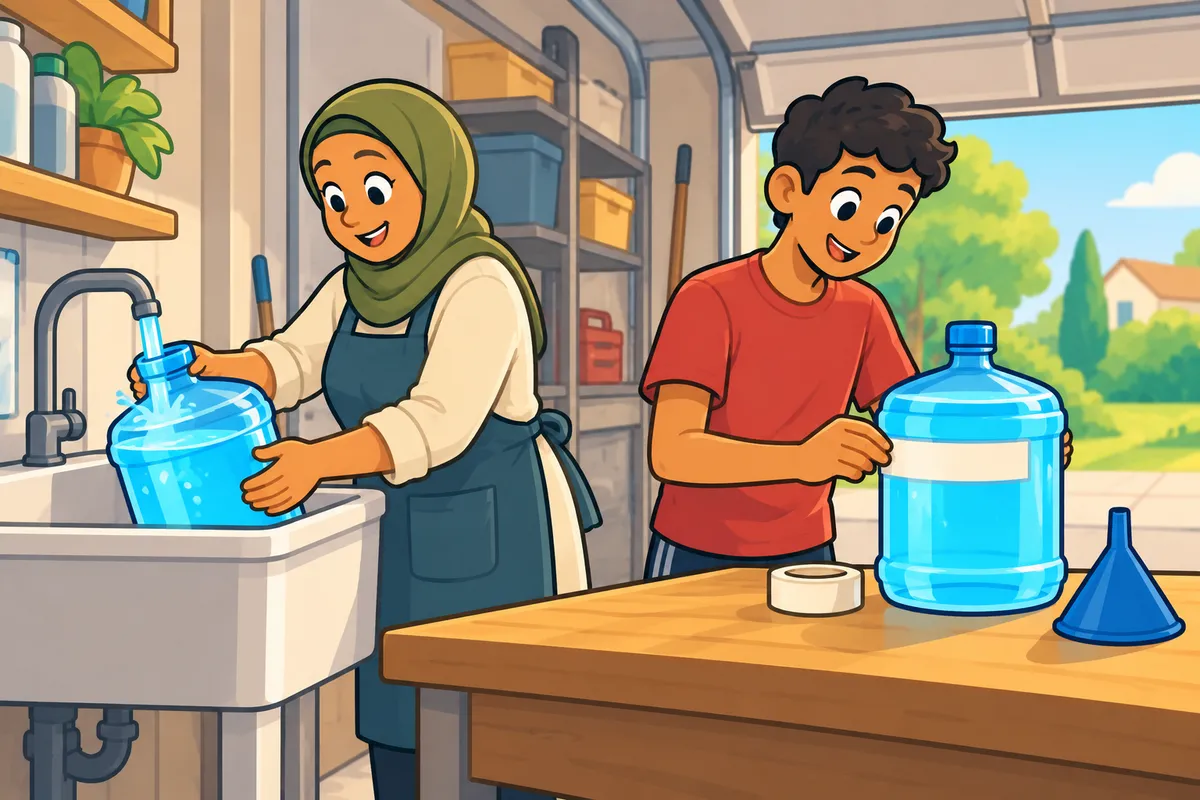
Wash and sanitize each container before the first fill. The method uses unscented liquid household bleach with 5 % to 9 % sodium hypochlorite:
Clean, Sanitize, Fill, Label
- Scrub the container with soap and rinse it well
- Mix 1 teaspoon of bleach into 1 quart (4 cups) of water and pour it in
- Close it, shake so it wets every surface, wait 30 seconds, pour it out
- Air-dry, fill with tap water, close tightly and label it with the date
Freeze Some of It
A freezer runs more efficiently when it is full, Oregon State Extension notes, so fill spare space with jugs of water. Frozen jugs keep food cold through a power cut and give you drinking water as they melt. Use plastic containers only, since glass may not survive expanding ice, and check the maker's guidance on how full to fill them.
When Your Stored Water Runs Low
Do not ration drinking water unless officials tell you to, Ready.gov says. Drink what you need today and look for more. The CDC lists safe water already inside your home:
- The tank of the water heater that feeds your taps, not a heating radiator tank
- Ice cubes made from water that was safe
- The toilet tank, never the bowl, if the water is clear and has no cleaner in it
- The liquid in canned fruit and vegetables
Pool and spa water is for washing, not drinking.
What Is the Safest Way to Treat Water if You Run Out?
Boil it if you have power or gas; use bleach if you do not. Both kill germs but leave chemicals in the water, while distillation also removes heavy metals, salts and most other chemicals. So none of them rescues water with fuel or chemicals in it: for that, you need stored or bottled water.
| Method | Kills germs | Removes heavy metals, etc. | What it takes |
|---|---|---|---|
| Boiling | Yes | No | A rolling boil for 1 full minute |
| Chlorination with bleach | Yes | No | Unscented bleach and a 30-minute wait |
| Distillation | Yes | Yes | Boiling for 20 minutes and collecting the steam |
If you have to treat doubtful water with bleach, count the drops for each gallon before you drink it.
Fill the Shelf in Four Weekly Buys
A family of four does not have to buy 56 gallons at once. Each week's goal below adds to the last, and the 12-gallon floor comes first so a three-day outage is covered from week one.
- Week 1: reach 12 gallons, the 3-day floor (4 people × 3 days × 1 gallon).
- Week 2: add 16 to reach 28 gallons, a full week.
- Week 3: add 14 to reach 42 gallons, about 10 days.
- Week 4: add 14 to reach 56 gallons, two weeks. Then date every jug and add the pet and summer extras.
To check your daily drinking share inside that gallon, turn your goal into bottles of the size you keep. Keep a bottle of unscented 5 to 9 % bleach next to the water for the days it runs out.
General information for healthy adults, not medical advice. If a doctor has set your fluid amount, follow that.
More in Water at Home
Sources
- CDC. How to Create an Emergency Water Supply, 2025.
- Ready.gov (US Department of Homeland Security). Water, 2021.
- CDC. How to Find Clean Water in an Emergency, 2025.
- NIST. Approximate Conversions from U.S. Customary Measures to Metric, 2026.
- Oregon State University Extension. Survival basics, Water (EM 9285), 2020.
- University of Florida IFAS Extension. Preparing and Storing an Emergency Safe Drinking Water Supply (SS439), 2020.
Sources checked by the Glubbo Editorial Team on Oct 19, 2026. General information, not medical advice. How we write and check our guides.

