Why Is My Tap Water Brown? Causes and What to Do Right Now
Which tap tells you where the color comes from, how long it lasts, and when brown water is a reason to call.
 By the Glubbo Editorial Team · Updated Oct 19, 2026 · 8 min read
On This Page
- Why Is My Tap Water Brown?
- Is Brown Tap Water Safe to Drink?
- Why Is My Tap Water Yellow or Orange?
- What Do Green, Blue, Black and Milky Tap Water Mean?
- Why Is Only My Hot Water Brown?
- How Long Does Brown Water Last After a Water Main Break?
- Will Brown Water Stain My Laundry?
- Why Is My Well Water Brown?
- Should I Call My Water Utility or a Plumber?
- Sources
Short answer
Usually rust or manganese stirred loose in the pipes.
- Run a cold tap 5 to 10 minutes; most brown water clears within a few hours.
- Skip hot water and light laundry until the cold tap runs clear.
- Do not drink it until you know the cause; call the utility if it stays.
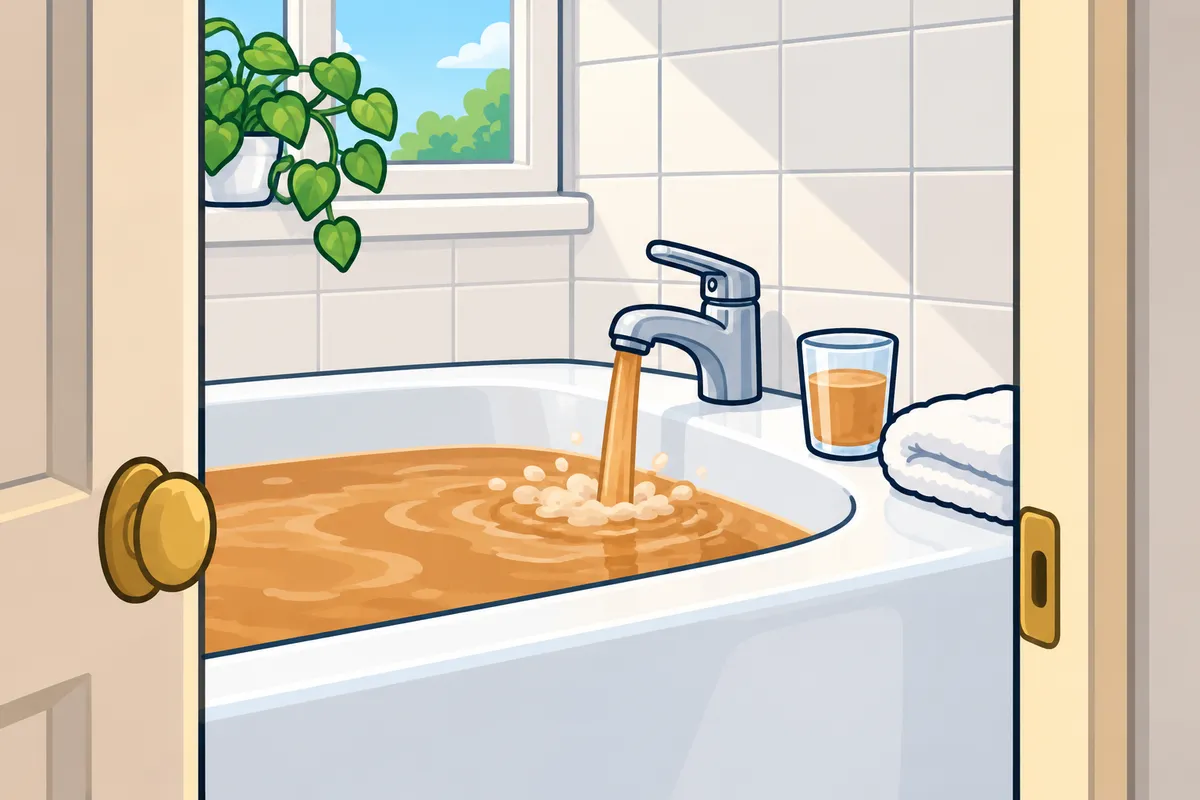
Brown tap water is usually iron, rust or manganese stirred loose in the pipes by a main break, hydrant flushing or a pressure change. Run one cold tap for 5 to 10 minutes: if the water clears, the cause is in your house; if it stays brown, it is out in the street.
The glass fills the color of weak tea, and the first ten minutes of running water tell you whose pipes are responsible. The test order matters, so start with the right tap.
The 10-Minute Cold Tap Test
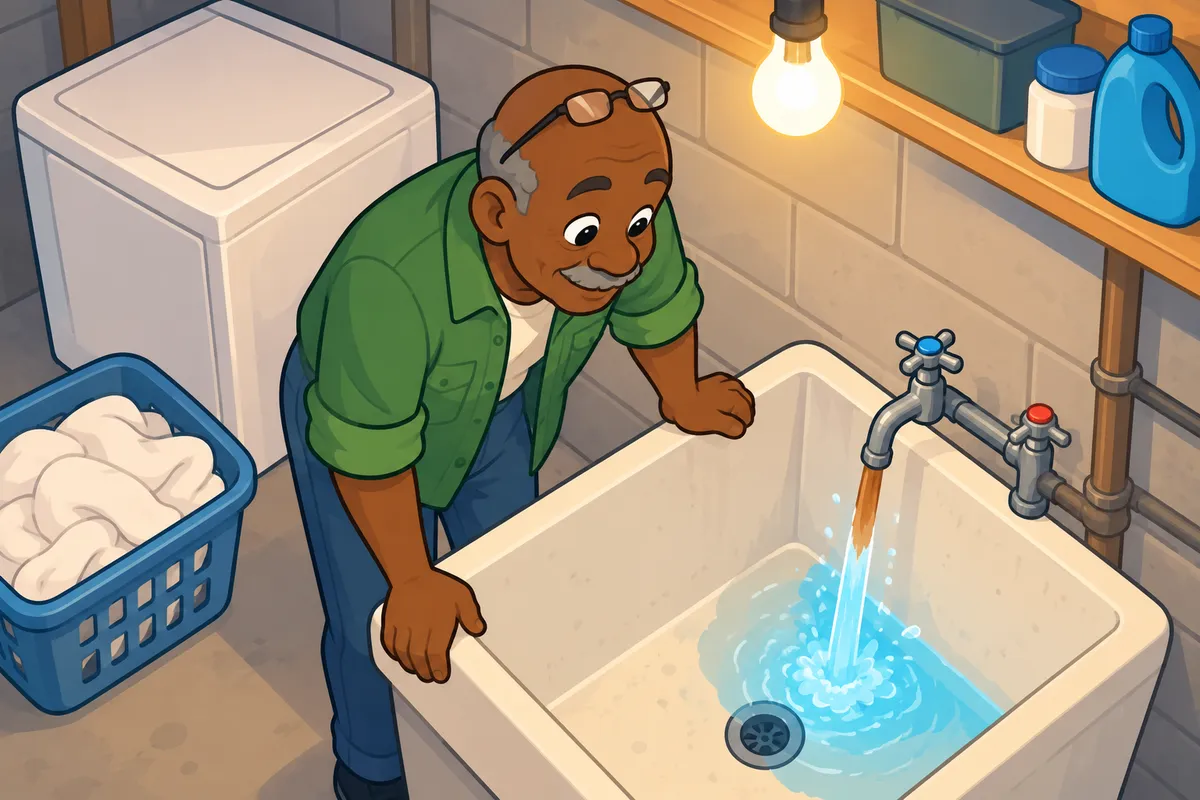
- Run one cold tap, ideally the lowest in the house, for 5 to 10 minutes
- Clears fast: the color came from your own pipes or fixtures
- Still brown: wait 30 minutes, then run it 1 to 2 minutes again
- Still brown after a few tries: call your utility to report it
Why Is My Tap Water Brown?
Because iron, rust or manganese got stirred into it. The City of Richmond's water utility says brown, red or yellow water "usually contains an excess of iron/rust or manganese," loosened by main breaks, system work, hydrant flushing or pressure changes. Those minerals settle quietly in pipes until a sudden change in flow lifts them.
The EPA's guidance on nuisance chemicals matches each color to its mineral, and the amount it takes to show.
| What you see | Likely cause | EPA secondary level | Other signs the EPA lists |
|---|---|---|---|
| Rusty brown, red or orange | Iron | 0.3 mg/L | Sediment, metallic taste, reddish or orange stains |
| Black to brown, black specks | Manganese | 0.05 mg/L | Black staining, bitter metallic taste |
| A visible tint of any color | Color units | 15 color units | Most people object above this level |
| Colored water with scale | Total dissolved solids | 500 mg/L | Hardness, deposits, salty taste |
Source: EPA, Secondary Drinking Water Standards.
Which Tap Tells You Where It Comes From
Where the color shows matters more than the color itself. Richmond's utility reads it this way: when every cold tap runs brown, a disturbance in the street mains is the likely cause; when only the hot water does, look at your water heater.
Fort Collins Utilities adds the timing test. Color that clears quickly after you run the water points to plumbing in your home; color that stays points to a temporary event in your area.
Is Brown Tap Water Safe to Drink?
Probably, but wait until you know the cause. The EPA says iron and manganese at their secondary levels are not a health risk, and Fort Collins says subtle discoloration "does not necessarily indicate your water is unsafe to drink"; it also asks you not to drink it until someone finds the source of the color and fixes it.
The color shows you what got stirred up. It cannot show you whether anything else came with it, so drink from another source until the tap runs clear or your utility says it is fine.
When Manganese Matters for Health
Manganese has health guidance well above the level where it starts to tint water. The Minnesota Department of Health sets guidance values of 100 micrograms per liter for babies whose formula or water comes from the tap, and 300 µg/L for everyone over one year old.
- 50 µg/L
- manganese where water can turn black to brown (EPA, 0.05 mg/L)
- 100 µg/L
- Minnesota guidance for babies on tap-water formula
- 300 µg/L
- Minnesota guidance for everyone over one year old
Put on one scale, the infant guidance is twice the level where color can start, and the adult guidance six times it. So water can look brown while sitting under the health values, and clear-looking water can still hold manganese; Minnesota says the only way to know the level is to ask your water system or test through an accredited lab.
Why Is My Tap Water Yellow or Orange?
The same minerals in smaller amounts, most often. Richmond groups brown, red and yellow water together under iron, rust and manganese, and the EPA lists reddish or orange staining as a sign of iron. A light yellow tint after nearby work usually clears with the cold tap test above.
A color that comes back every morning, then fades as the water runs, points to old fixtures or pipes in your home, Fort Collins says. It lists three fixes:
- Running the tap first
- A filter
- Replacing old fixtures and possibly pipes
Old pipes that shed rust deserve one more question, because galvanized iron pipes can also add lead.
What Do Green, Blue, Black and Milky Tap Water Mean?
Not every odd color is rust. The utility pages sort the others by cause, and the quick test for each is to see where it shows and whether it clears.
What Other Colors Usually Mean
- Green Algae in the source water (Richmond), or corroding copper plumbing if it looks blue-green (Fort Collins)
- Blue Copper plumbing, or blue toilet disinfectant siphoned back after the supply was shut off
- White or milky Air bubbles: harmless if the glass clears from bottom to top in about three minutes
Black or gray specks point to something else: deteriorating rubber gaskets, carbon from a water filter, or iron or manganese from old pipes, Fort Collins says. Replace the gaskets or the filter as needed. Pink or gray stains on a sink, toilet or shower are bacterial biofilms, not discolored water, so clean the fixtures and keep humidity down.
Why Is Only My Hot Water Brown?
The water heater, most likely. Richmond explains that sediment and minerals settle in the tank over time, and Fort Collins adds that iron or copper pipes between the heater and the faucet can add color too.
Let the sediment settle and run the hot tap briefly, Richmond suggests, or have the tank flushed. Fort Collins says the heater may need a flush or service. If the hot water stays brown after that, call a plumber rather than your utility.
How Long Does Brown Water Last After a Water Main Break?
Usually a few hours. Richmond says brown water usually clears within a few hours, though toilet water may take longer, and Fort Collins says the color from an area event may take a few hours to clear, so expect an afternoon, not a week.
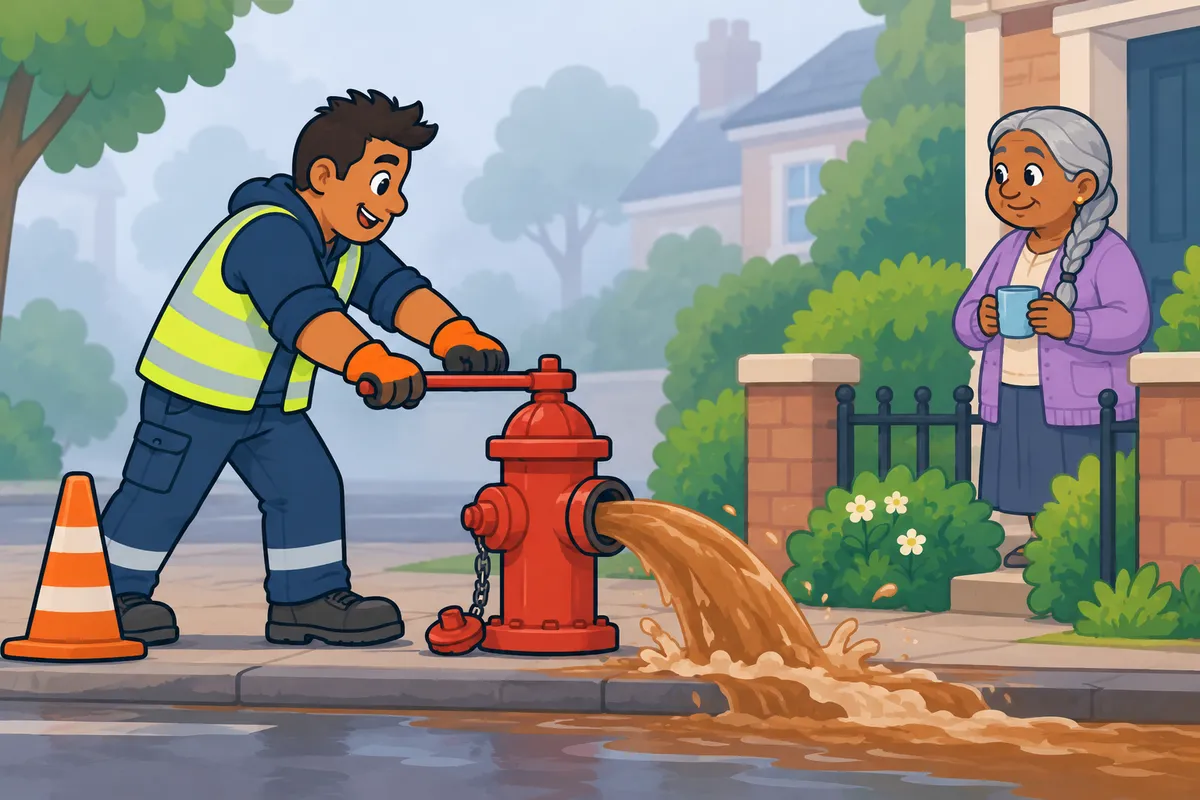
Running a tap nonstop does not make it clear faster, Richmond notes. Check one cold faucet every 30 minutes for 1 to 2 minutes instead, so you do not waste water or draw more sediment into your pipes.
After a Repair on Your Street
Richmond's utility gives a house-wide order for flushing once the work is done. Open the cold sink faucets from the lowest floor up, and close them in the same order once the water runs clear, which usually takes about 5 minutes; leave toilets, tubs and showers until you finish.
Then open the hot water slowly the first time, flush the refrigerator's water line, and clean any aerators that sediment has clogged.
What to Hold Off On Until It Clears
Everything that pulls the color deeper into your home.
While the Water Is Brown, Hold Off On
5 items- Hot water, so sediment stays out of the water heater
- Light-colored laundry, which the minerals can stain
- Your water filter, until the water runs clear
- Drinking it, until you know the cause
- Running the tap nonstop, which does not clear it faster
Will Brown Water Stain My Laundry?
It can. Richmond says most discolored water is safe for bathing and cleaning "but it may stain clothes or fixtures," and Fort Collins asks you to avoid washing light-colored laundry while the color lasts.
Each mineral leaves its own mark:
- Iron: reddish or orange stains, per the EPA
- Manganese: black stains, and a brownish-black ring on toilets, tubs and sinks, per the Minnesota Department of Health
Keep the white wash in the basket until a cold tap runs clear. If something already went in, wash it again only once the water runs clean, so the second wash does not add more color.
Why Is My Well Water Brown?
On a well, the brown usually comes from the ground. Penn State Extension explains that well water with dissolved iron or manganese can look clear at first, then turn orange-brown or black with specks once air reaches it.
That calls for a lab test and a treatment plan for the well, not a flush. Penn State lists softeners, oxidizing filters and other options, each fitting a different range of iron and manganese, and says treatment should cover all the water entering the home.
| Iron and manganese in well | Option Penn State lists |
|---|---|
| Small amounts of dissolved iron, under 5 mg/L, pH above 6.7 | Water softener |
| Dissolved iron under 2 mg/L | Polyphosphate, which holds the iron in the water instead of removing it |
| About 3 to 10 mg/L combined | Manganese greensand oxidizing filter |
| Above 10 mg/L combined | Oxidation (chlorine, permanganate or peroxide), then filtration |
Polyphosphate is generally not effective for manganese, and a lab report on the exact levels and the form of the metals decides which row fits.
Should I Call My Water Utility or a Plumber?
Your utility when every cold tap stays brown or crews are working on the street; a plumber when the color comes only from the hot water, clears within seconds or comes back every morning from old fixtures. The two tests above sort it out in under an hour.
Your report helps the utility find the affected streets and decide whether more hydrant flushing is needed, Richmond says, so give the address and say which taps are brown. If the color keeps returning, the yearly water report shows what your system tests for and the levels it found.
General information for healthy adults, not medical advice. If a doctor has set your fluid amount, follow that.

More in Water at Home
Sources
- US Environmental Protection Agency. Secondary Drinking Water Standards: Guidance for Nuisance Chemicals, 2026.
- City of Richmond Department of Public Utilities. Understand Discolored Water: Common Causes and Solutions, 2026.
- City of Fort Collins Utilities. Troubleshooting Water Concerns, 2026.
- Minnesota Department of Health. Manganese in Drinking Water, 2025.
- Penn State Extension. Iron and Manganese in Private Water Systems, 2024.
Sources checked by the Glubbo Editorial Team on Oct 19, 2026. General information, not medical advice. How we write and check our guides.

