What Counts · Tap and Bottled Water
Tap Water vs Bottled Water: Which Is Safer, and Is a Filter Worth It?
See who checks each one, where lead and microplastics come in, and what bottles cost you a year.
 By the Glubbo Editorial Team · Updated Nov 9, 2026 · 9 min read
On This Page
- Is Bottled Water Safer Than Tap Water?
- Is Some Bottled Water Just Tap Water?
- Does Bottled Water Have Microplastics?
- Does Bottled Water Have Fluoride?
- Is Filtered Water Better Than Tap Water?
- What Do Bottles Cost You Over a Year?
- Is Tap Water Safe in an Older Apartment Building?
- Does Bottled Water Expire?
- Tap or Bottled When You Travel Abroad?
- When Does Bottled Water Make Sense?
- Read the Water Report, Then Decide on Bottles
- Sources
Short answer
In the US, neither is safer as a rule.
- Read your utility's yearly water report and look at the violations column.
- Buy a filter only for a named reason, with the matching NSF standard.
- Meeting your goal from 500 ml bottles takes over 1,000 bottles a year.
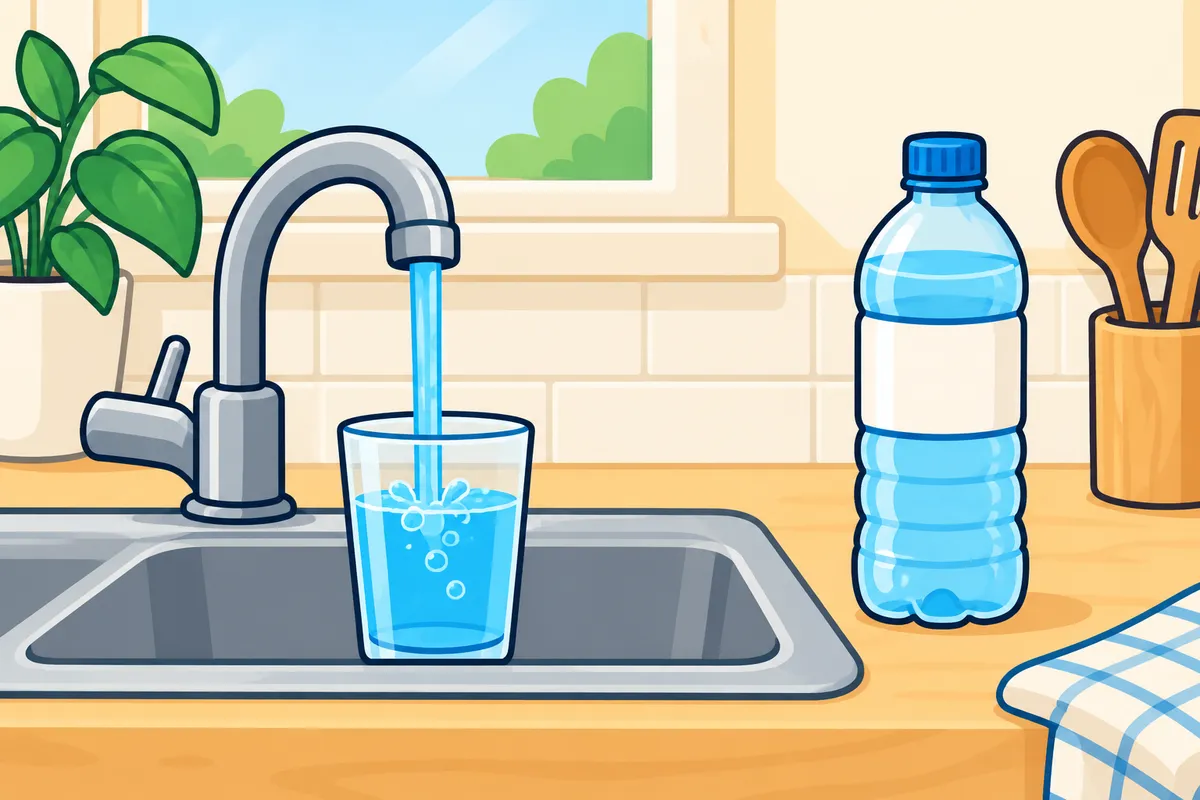
In the US, neither is safer as a rule. The EPA sets the standards for public tap water and the FDA keeps bottled water in line with them, so for hydration the two are the same thing: water, and every glass of either counts toward your daily water in full. Where they differ is who checks them, what can get in on the way to your glass, and what each one costs you over a year.
The weak points sit in different places: old pipes inside your building and private wells for tap water, and the plastic bottle itself for bottled water.
Is Bottled Water Safer Than Tap Water?
Not as a rule. In the US the EPA sets the standards for public tap water, and the FDA either adopts each EPA standard for bottled water or finds it unnecessary. Tap water's weak points sit near you: old pipes in your building, which can add lead, and private wells, which nobody checks but you.
The CDC puts it simply: the EPA is responsible for public water supplies, while the FDA, not the EPA, oversees bottled water. The EPA's drinking water rules limit more than 90 contaminants in tap water.
Who Checks Each One
| Public tap water | Bottled water | |
|---|---|---|
| Who sets the rules | EPA, under the Safe Drinking Water Act of 1974 | FDA, under the Federal Food, Drug, and Cosmetic Act |
| How the limits compare | EPA sets them | FDA adopts each EPA limit or finds it unnecessary |
| Lead limit | 15 parts per billion | 5 parts per billion, since bottling skips lead pipes |
| What you can read | A yearly water quality report from your utility | The label; ask the maker for details |
| Where it comes from | Reservoirs, rivers, lakes or wells | Springs, wells, or a city's tap water |
The lead line looks like a win for bottles, and the FDA explains why it differs: lead leaches from pipes between the utility and your faucet, and bottled water skips those pipes. So the question for tap water is less about the utility and more about your building's plumbing: ask your utility whether a lead service line feeds your home.
Tap Water
- Pipes in your building can add lead
- May carry fluoride for your teeth
- No bottle to buy
- carry or recycle
Bottled Water
- Skips your building's pipes
- Little or no fluoride if labeled purified
- A bottle to buy and throw away each time
Is Some Bottled Water Just Tap Water?
Yes. The FDA says some bottled water comes from municipal sources, which means public tap water, usually treated again before bottling. The common steps are:
- Distillation
- Reverse osmosis
- Fine filtration down to 1 micron
- Ozone
Water treated that way can carry the label "purified water".
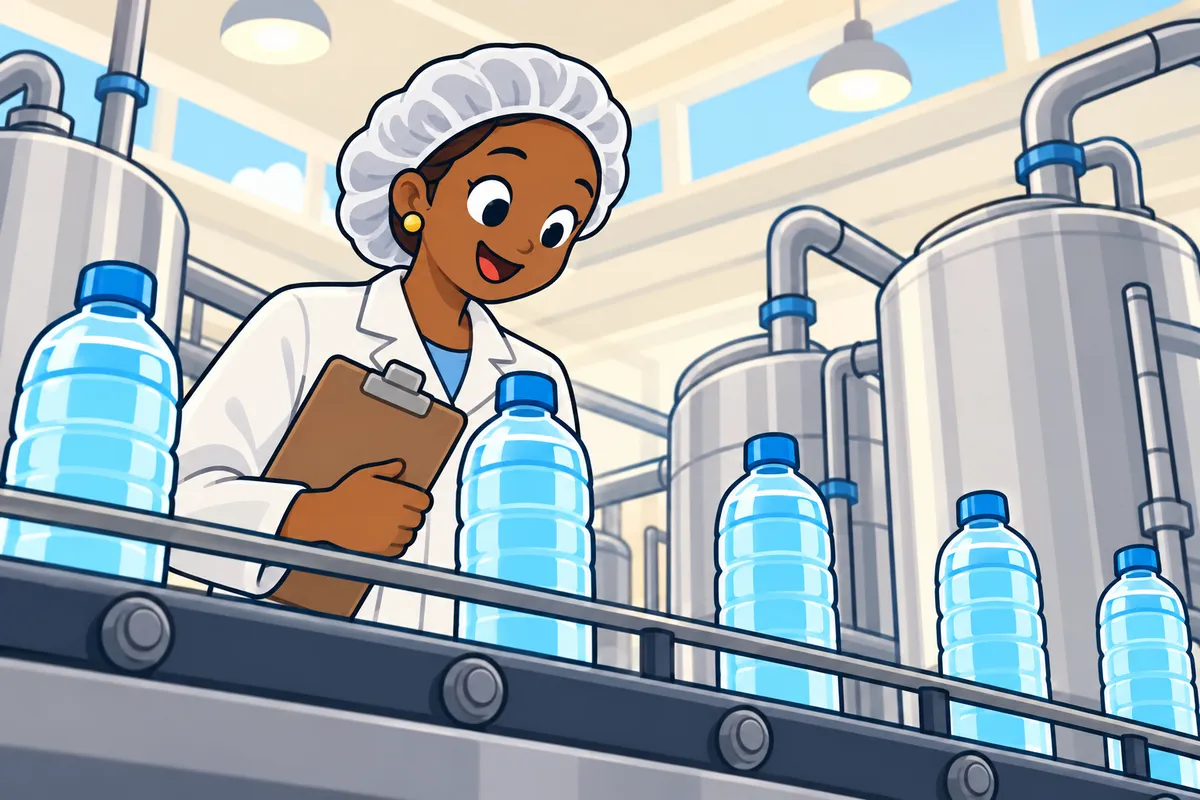
The other labels name the source. Seltzer, club soda and tonic water do not count as bottled water under the FDA's rules, which treat them as soft drinks, and alkaline is not one of its names either, so on a label that word is the seller's own.
| On the label | What the FDA says it is |
|---|---|
| Purified | Treated by distillation, reverse osmosis or a similar process |
| Spring | Flows naturally to the surface from an underground formation, collected at the spring or by a borehole |
| Artesian well | From a well tapping an aquifer under pressure |
| Well | From a bored or drilled hole that taps an aquifer |
| Mineral | From an underground source with at least 250 ppm of minerals, none added later |
Your body takes up the calcium in high-calcium mineral water about as well as the calcium in milk.
Does Bottled Water Have Microplastics?
Yes, and a detailed 2024 study counted a lot of them:
- 240,000
- tiny plastic particles per liter of bottled water on average, with a wide spread between samples
- 90 %
- of them nanoplastics, smaller than 1 micron
- 3
- brands tested
Whether that amount harms you is not yet known; the WHO has called for more research.
The 2024 study used a new imaging method, and the count came out far higher than older estimates. It did not test tap water, so it cannot say how the two compare. Columbia University, the Hudson River Foundation and two research centers of the US National Institutes of Health supported the work.
In 2019 the World Health Organization said that, "based on the limited information we have", microplastics in drinking water "don't appear to pose a health risk at current levels". Your body is unlikely to take in particles larger than 150 micrometres, while nanoplastics may pass in more readily, and the WHO calls the data on them "extremely limited". The 2024 count came five years later, with a method that finds far more particles than the older ones.
Does Bottled Water Have Fluoride?
Some does and some does not:
- Bottled water from a public system that adds fluoride, or from a naturally fluoridated spring, carries fluoride.
- Water labeled purified, distilled, de-ionized or demineralized has no or only trace amounts, according to the CDC.
That matters if bottles are most of what you drink: you "may not get an optimal amount of fluoride to prevent cavities". Tell your dental provider, or ask the maker about a brand's fluoride content.
Is Filtered Water Better Than Tap Water?
Only if your tap water has something you want out. If your tap water is free of harmful germs and chemicals, you may not need a filter at all. Most pitcher and fridge filters use activated carbon to improve taste and smell; they are not designed to remove germs.
A filter also removes good things. The CDC's filter guide notes that some filters take out the chlorine that kills germs and the fluoride that prevents cavities. Choose a filter for a reason, and match it to that reason.
How to Choose a Filter
| NSF/ANSI standard | What the label covers |
|---|---|
| 42 | Taste and odor |
| 53 | Cyst reduction |
| 58 | Reverse osmosis |
| 62 | Distillation |
Source: CDC, About Choosing Home Water Filters.
Work in this order:
- Start from your water report or a well test.
- Name what you want removed.
- Match it to the NSF standard on the label.
For lead, the lead page asks for a filter certified to NSF/ANSI 53 for lead removal and 42 for particles.
Why Does My Tap Water Taste of Chlorine?
Because your utility adds it on purpose. The guide to water reports says utilities "often add low levels of disinfectants like chlorine to tap water to kill germs", and that "chlorine is beneficial at the right levels." If the taste stops you drinking it, a filter certified to standard 42, the taste and odor standard in the list above, is the matching fix.
What Do Bottles Cost You Over a Year?
Count them before you count dollars. A daily goal met only from 500 ml (16.9 oz) bottles runs to more than a thousand bottles a year, even at the lowest goal Glubbo's formula gives an adult. Certified bottled water is one way to avoid lead in tap water, but it "may not be the most cost-effective option for long-term use", as the CDC's lead page puts it.
Take two adults with goals from Glubbo's habit formula. Food adds water on top of these, and coffee, tea or milk count toward them too, so a real day needs fewer bottles than this.
| Adult | Glubbo goal | 500 ml bottles a day | Bottles a year |
|---|---|---|---|
| 72 kg (159 lb), moderately active, mild climate, sex not given | 2,250 ml (76 oz) | 4.5 | about 1,640 |
| 58 kg (128 lb), little activity, cool climate, female | 1,600 ml (54 oz), the formula's minimum | 3.2 | about 1,170 |
Prices vary by store, so the next table uses three prices to try, not averages. Each cell is the bottles in the column heading times the price in the row.
| Price per 500 ml bottle | 1,170 bottles a year | 1,640 bottles a year |
|---|---|---|
| $0.25 | $293 | $410 |
| $0.50 | $585 | $820 |
| $1.00 | $1,170 | $1,640 |
Put your own bottle price in the same sum, or turn your own goal into bottles of the size you buy.
Is Tap Water Safe in an Older Apartment Building?
It depends on the pipes between the street and your faucet. Lead enters drinking water mainly through lead service lines, lead solder and brass fixtures, and buildings put up before 1986 are the most likely to have them. A clean utility report does not guarantee clean water at your tap, because it measures the water leaving the plant, not the water leaving your faucet.
Three steps close the gap:
- Ask your landlord or utility whether a lead service line feeds the building and whether the interior pipes contain lead solder.
- Run the cold tap for 30 seconds to 2 minutes before filling a glass, especially first thing in the morning, because water that sat overnight picks up the most lead.
- Use only the cold tap for drinking and cooking: hot water dissolves more lead than cold.
If the answers leave doubt, a water test for your faucet costs about $20 to $100 from a state-certified lab, the EPA says, and a filter certified to NSF/ANSI 53 for lead is the matching fix if the number comes back high.
Does Bottled Water Expire?
Follow the date printed on the bottle for taste, and replace water you stored yourself every 6 months. The guide on whether water expires explains what the date means and how to store it.
Tap or Bottled When You Travel Abroad?
Bottled, where you cannot be sure of the tap. The CDC's guide for travelers says to use "only commercially bottled water from an unopened, factory-sealed container", or water you have disinfected yourself, for drinking, ice, cooking and brushing your teeth. The full country-by-country rules have their own guide.
Source: CDC Yellow Book, Food and Water Precautions for Travelers.
When Does Bottled Water Make Sense?
When your tap water is unsafe or unknown. A refillable bottle filled at the tap is the cheaper way to reach your goal the rest of the time.
Tap, filtered or bottled, by situation
- A boil water or do-not-drink advisoryBottled or boiled water until it is lifted
- A private well you have not testedBottled water until the test is back
- A violation in your water quality reportBottled water or a filter matched to the violation
- Travel where you do not know the waterSealed bottled water
- Old plumbing with possible leadA certified filter, or bottled water until you have one
- A clean report and newer pipesTap water in a refillable bottle
Read the Water Report, Then Decide on Bottles
Before you buy another case of bottles
- Find your utility's water quality report and look for the violations column
- If your home was built with old plumbing, ask your utility about a lead service line
- Run only cold water for drinking and cooking
- Buy a filter only for a named reason, with the matching NSF standard on the label
- Fill one refillable bottle at the tap, and check your goal against your weight and your day
General information for healthy adults, not medical advice. If a doctor has set your fluid amount, follow that.
More in What Counts
Sources
- US Food and Drug Administration. Bottled Water Everywhere: Keeping it Safe, 2022.
- CDC. Drinking Water Standards and Regulations: An Overview, 2024.
- CDC. About Lead in Drinking Water, 2025.
- CDC. About Choosing Home Water Filters, 2024.
- CDC. Community Water Fluoridation Frequently Asked Questions, 2024.
- Proceedings of the National Academy of Sciences (Qian and colleagues). Rapid single-particle chemical imaging of nanoplastics by SRS microscopy, 2024.
- World Health Organization. WHO calls for more research into microplastics and a crackdown on plastic pollution, 2019.
- CDC Yellow Book. Food and Water Precautions for Travelers, 2026.
- CDC. How to Read Drinking Water Quality Reports, 2024.
- US Environmental Protection Agency. Basic Information about Lead in Drinking Water, 2026.
Sources checked by the Glubbo Editorial Team on Nov 9, 2026. General information, not medical advice. How we write and check our guides.

