Soda Water vs Sparkling Water: Seltzer, Club Soda and Tonic Compared
What seltzer, club soda, mineral water and tonic add to the water, and the sodium and sugar in a can.
 By the Glubbo Editorial Team · Updated Oct 22, 2026 · 11 min read
On This Page
- What Is the Difference Between Soda Water and Sparkling Water?
- Is Seltzer the Same as Sparkling Water?
- What Is Club Soda Made Of?
- How Is Sparkling Mineral Water Different From Club Soda?
- Is Tonic Water the Same as Soda Water?
- Do Seltzer, Club Soda and Tonic All Count as Water?
- Which Fizzy Water Should You Buy?
- Can You Make Soda Water at Home?
- Read These Lines on the Can Before You Buy a Case
- Common Questions
- Sources
Short answer
All are fizzy water; the add-ins set them apart.
- Seltzer is carbonated water alone; club soda adds sodium or potassium salts.
- Store club sodas with sodium salts hold about 71 mg of sodium per 12 oz can.
- Tonic water adds quinine and about 32 g of sugar per 12 oz can, per USDA.
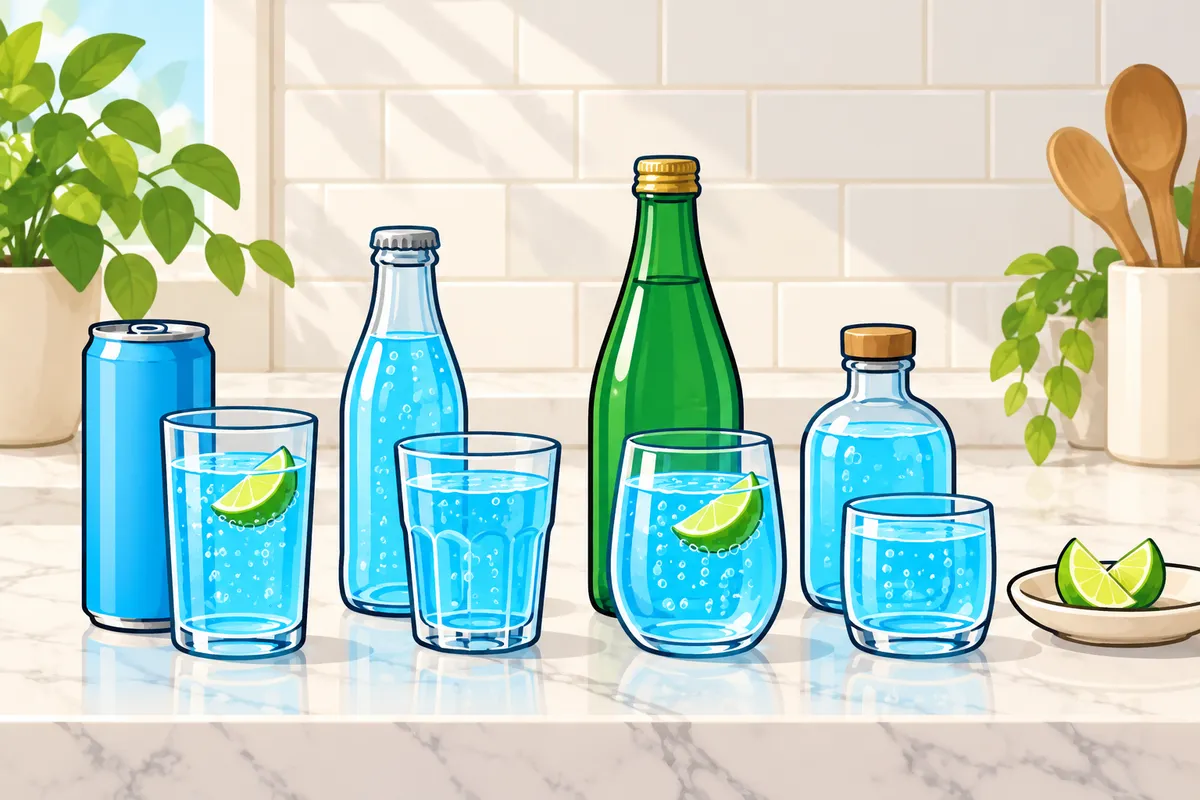
Soda water, also sold as club soda, is fizzy water with mineral salts the maker adds; seltzer and plain cans sold as sparkling water hold only water and carbon dioxide. Sparkling mineral water carries the minerals of its spring, and tonic water adds quinine and sugar.
So the bubbles are the same, and what the maker puts in the water decides how much sodium, potassium or sugar the can holds. On store labels in USDA's database, that runs from 0 mg of sodium in a can of seltzer to about 120 mg in the saltiest club soda.
What Is the Difference Between Soda Water and Sparkling Water?
Soda water has salts added by the maker, and sparkling water on a US can usually has nothing added. The FDA groups drinks labeled sparkling water, seltzer water, soda water, tonic water or club soda as soft drinks, not bottled water, so none of those names promises a spring or a mineral level.
Four Fizzy Waters on the Shelf
Seltzer or plain sparkling water
Nothing added
- Ingredient list: carbonated water
- 0 to 4 mg sodium in most 12 oz cans
- 0 g sugar
Suits you if you want fizz and nothing else in the glass.
Club soda (soda water)
Salts added
- Sodium or potassium salts added
- About 71 mg sodium a can if sodium-based
- 0 g sugar
Suits you if you want the classic mixer and do not count sodium closely.
Sparkling mineral water
Minerals from the source
- At least 250 ppm dissolved minerals
- No minerals may be added
- About 11 mg sodium in a typical can
Suits you if you want the taste of one spring and read its mineral line.
Tonic water
Quinine and sugar
- Quinine up to 83 ppm, named on the label
- About 32 g sugar per 12 oz can
- About 44 mg sodium a can
Suits you if you want the bitter mixer and count it as a sweet drink.
The sodium and sugar figures above come from USDA FoodData Central, the government's food composition database, and from the store labels it holds. The legal names come from the FDA's bottled water rule and its quinine rule, both quoted below.
Is Seltzer the Same as Sparkling Water?
Yes, in most US stores: seltzer is plain carbonated water, and a plain can sold as sparkling water lists the same single ingredient. Plain seltzer labels in USDA's branded-food database list carbonated water as the only ingredient, and almost all of them list 0 to 1 mg of sodium per 100 ml.
Carbonated water is the plain name for the same thing. All three words say the water had carbon dioxide pressed into it at the plant.
One label phrase is different. Under the FDA's rule, "sparkling bottled water" must hold the same amount of carbon dioxide from its source that it had when it came out of the ground, after any treatment and any replacement of the gas. A bottle that says "carbonation added" got its bubbles at the plant.
What Is Club Soda Made Of?
Club soda is carbonated water plus one or more mineral salts. On store labels the salts are:
- Sodium bicarbonate, sodium citrate, salt, sodium sulfate or potassium sulfate in the sodium-based kind.
- Potassium bicarbonate and potassium citrate in the sodium-free kind.
The FDA's bottled water rule leaves soda water out, so the ingredient list is the only place to learn which salts went into your can. That choice decides almost all of the sodium.
Sodium-Based or Potassium-Based Club Soda?
Of the plain club soda labels in USDA's branded-food database, about 6 in 10 list a sodium salt and about 4 in 10 list only potassium salts. The two kinds look the same on the shelf, so the ingredient line is the giveaway.
Sodium-Based Club Soda
- Sodium bicarbonate, sodium citrate or salt
- Middle label: about 20 mg sodium per 100 ml
- About 71 mg sodium in a 12 oz can
- USDA's generic entry: 75 mg a can
Potassium-Based Club Soda
- Potassium bicarbonate and potassium citrate
- Most labels: 0 to 2 mg sodium per 100 ml
- Up to about 99 mg potassium in a 12 oz can
- Can carry the FDA's sodium-free term
- One sodium-based store club soda lists sodium bicarbonate, salt and potassium sulfate and 27 mg of sodium per 100 ml.
- One potassium-based can lists potassium bicarbonate and potassium citrate, 0 mg of sodium and 28 mg of potassium per 100 ml.
How Much Sodium Is in Club Soda?
About 75 mg in a 12 oz (355 ml) can by USDA's generic entry, and 0 to about 120 mg on real store labels. USDA's club soda entry lists 21 mg per 100 g and weighs a 12 oz can at 355 g.
Every fizzy water can carry one of the FDA's sodium label terms, each set per serving:
- Sodium-free: under 5 mg
- Very low sodium: 35 mg or less
- Low sodium: 140 mg or less
| Drink, 12 oz (355 ml) can | Sodium per 100 ml | Sodium per can | FDA label term it can carry |
|---|---|---|---|
| Seltzer labels (most) | 0 to 1 mg | 0 to 4 mg | Sodium-free |
| Club soda with potassium salts (most labels) | 0 to 2 mg | 0 to 7 mg | Sodium-free |
| Sparkling mineral water labels (middle half) | 1 to 4.5 mg | 4 to 16 mg | Very low sodium |
| Tap water carbonated at home (USDA) | 4 mg | about 14 mg | Very low sodium |
| Tonic water, USDA generic entry | 12 mg | 44 mg | Low sodium |
| Club soda with sodium salts (middle label) | 20 mg | about 71 mg | Low sodium |
| Club soda, USDA generic entry | 21 mg | about 75 mg | Low sodium |
| Saltiest club soda label | 34 mg | about 121 mg | Low sodium |
Sources: USDA FoodData Central SR Legacy entries 174842, 171869 and 173647 and Branded Foods labels as listed on 22 October 2026, per 100 ml × 3.55 (tonic: USDA's 366 g can); label terms from the FDA.
Even the saltiest can stays a small part of the day. The FDA's Daily Value for sodium on Nutrition Facts labels is less than 2,300 mg, and the FDA calls 5 % of the Daily Value or less per serving low, about 115 mg a serving, which every can in the table except the saltiest one meets.
Why a Tracker May Show Sodium for Plain Seltzer
USDA's survey entry for plain carbonated water uses the club soda figure of 21 mg per 100 g. So a nutrition app that logs your seltzer under that generic entry adds about 75 mg a can that the label does not show.
A simple fix is to log the can by its own label, or as plain water if the label says 0 mg. Over four cans a day, that is about 300 mg of sodium the app was counting on paper only.
How Is Sparkling Mineral Water Different From Club Soda?
Sparkling mineral water carries minerals from its underground source, while club soda gets its salts from the maker. Under 21 CFR 165.110, mineral water must:
- Hold at least 250 parts per million of dissolved solids.
- Come from a protected underground source.
- Keep a steady mineral balance.
- Have "no minerals may be added to this water."

The rule also sets two label phrases, and they tell you how much mineral the water holds before you open it:
| Words on the label | What the FDA rule requires |
|---|---|
| Mineral water | At least 250 ppm of dissolved solids, all from the source |
| Low mineral content | Mineral water under 500 ppm |
| High mineral content | Mineral water over 1,500 ppm |
| Sparkling bottled water | The same carbon dioxide from the source it had at the spring |
| Seltzer, soda water, club soda, tonic water | Outside the bottled water rule; the FDA treats them as soft drinks |
Most sparkling mineral waters are low in sodium anyway. The middle half of plain sparkling mineral water labels in USDA's branded database list 1 to 4.5 mg per 100 ml, about 4 to 16 mg a can, though a few springs run much higher, so the label is the only sure number.
Calcium and magnesium are the minerals worth reading for, and only the bottle's own label or the spring's published analysis gives them. USDA's generic club soda entry, by comparison, lists 5 mg of calcium and 1 mg of magnesium per 100 g.
Is Tonic Water the Same as Soda Water?
No. Tonic water is carbonated water with sugar or another sweetener and quinine, so a 12 oz can of regular tonic carries about 32 g of sugar and 124 kcal by USDA's tonic entry, where club soda carries none.
Quinine gives tonic its bitter taste, and federal law caps it. Under 21 CFR 172.575, quinine in carbonated drinks may not exceed 83 parts per million, which is at most about 30 mg in a 12 oz can, and the label must name quinine, either in the drink's name or in a separate line.
Tonic labels in USDA's branded database name high fructose corn syrup, sugar, cane sugar, invert sugar, fructose or agave as the sweetener, and most regular tonics list 8 to 10.7 g of sugar per 100 ml. Tonics sold as "light" still list about 3 to 4 g, or 10 to 14 g in a can, so even a lighter tonic is a sweet drink.
A diet tonic swaps the sugar for a sweetener, and its label shows 0 g of sugar. If you drink tonic for the taste, that version keeps the bitterness without the 32 g.
Do Seltzer, Club Soda and Tonic All Count as Water?
Yes, each one counts at its full size. In a 2016 trial of 72 men, urine output in the 4 hours after a liter of sparkling water did not differ from that after a liter of still water, so the fizz does not flush water out faster.
Tonic counts too, with its sugar on top, the way a can of regular soda counts. Two side effects are left to weigh: plain fizz is gentle on enamel but can bloat some stomachs.
Which Fizzy Water Should You Buy?
Pick seltzer when you want plain fizz, and pick the others for their add-ins only if you want those add-ins. The right can depends on whether you watch sodium, potassium or sugar.
The Can That Fits Your Day
- You watch your sodiumSeltzer, or club soda listing only potassium salts
- A doctor told you to limit potassiumSeltzer; skip potassium-based club soda
- You want the taste of a springSparkling mineral water; read its mineral line
- You want a bitter mixer with less sugarDiet tonic, or tonic topped up with seltzer
- You just want more water in your daySeltzer, logged at its full size
A half-and-half glass is the easy middle road for tonic fans. Topping 6 oz of tonic with 6 oz of seltzer halves the sugar to about 16 g and still gives you a full 12 oz toward your water.
Can You Make Soda Water at Home?
Yes: a home carbonator turns tap water into seltzer by adding carbon dioxide and nothing else. The sodium in the glass is whatever your tap water carries, and USDA lists drinking tap water at 4 mg per 100 g, about 14 mg in 12 oz.
Your own tap may hold more or less than that average. A simple check is your utility's yearly water report, if it lists sodium, and whether the tap water itself is safe to drink comes before any of this.
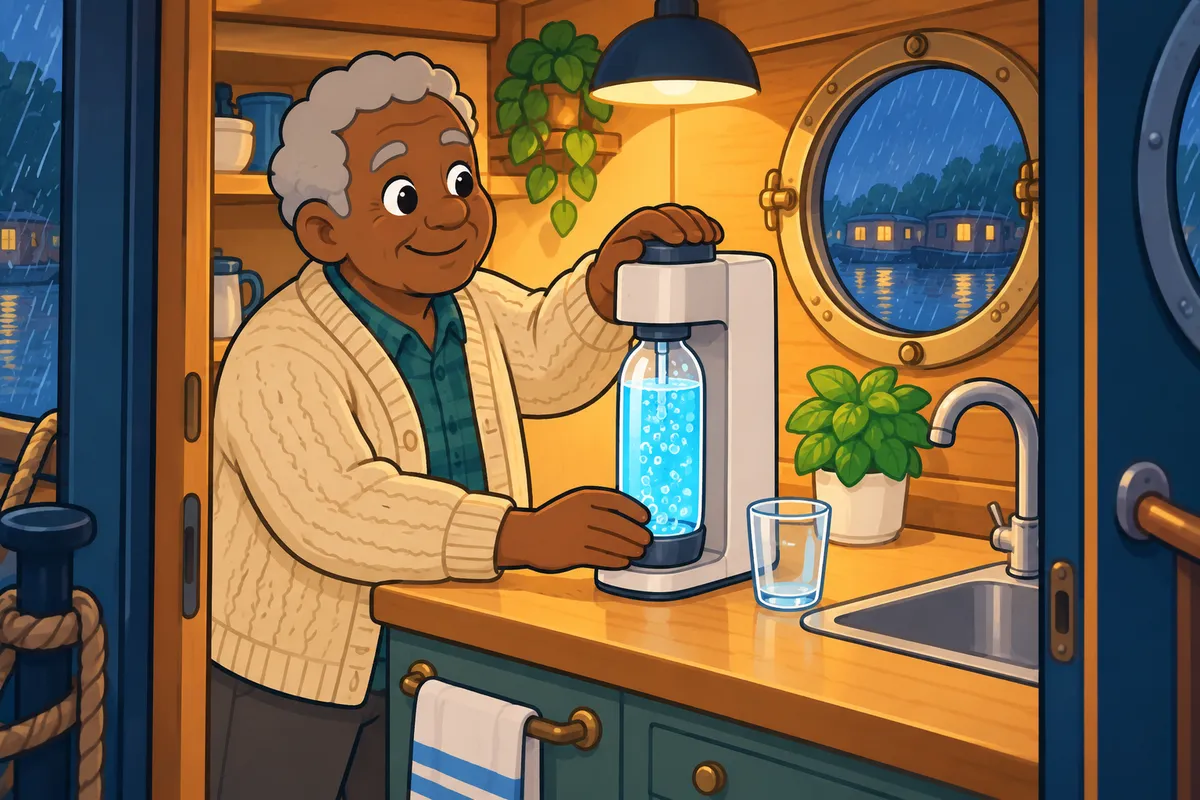
A home bottle counts the same as a store can: a 1 liter (34 oz) carbonator bottle is 1,000 ml toward your daily water, and counting it in bottles shows how many refills your goal takes.
Read These Lines on the Can Before You Buy a Case
The name on the front tells you the family, and the back tells you the rest. Four lines settle it before you carry a case home.
From the Shelf to Your Cart
- Read the name: seltzer, club soda, mineral water or tonic
- Scan the ingredients for sodium, salt, potassium or quinine
- Check sodium per serving: under 5 mg is sodium-free
- Check sugar: tonic and flavored cans carry it, seltzer does not
If two cans tie on all four lines, buy the one you will actually drink. Plain fizz you enjoy is still water, can after can.
Common Questions
Is seltzer still safe after its best-by date?
Usually yes, while the can is sealed. Except for infant formula, the USDA says date labels mark best quality, not safety, so an old seltzer comes down to taste and fizz.
Does tonic water have any electrolytes?
Almost none. USDA lists no potassium in tonic water and only a little sodium, so a can replaces little of what sweat takes out; a sports drink or a salty snack does more.
General information for healthy adults, not medical advice. If a doctor has set your fluid amount, follow that.

More in What Counts


Sources
- US Code of Federal Regulations (eCFR), Title 21. 21 CFR 165.110 Bottled water, 2026.
- US Code of Federal Regulations (eCFR), Title 21. 21 CFR 172.575 Quinine, 2026.
- US Food and Drug Administration. Bottled Water Everywhere: Keeping it Safe, 2022.
- US Food and Drug Administration. Sodium in Your Diet, 2024.
- USDA FoodData Central (SR Legacy). Beverages, carbonated, club soda (FDC 174842), 2019.
- USDA FoodData Central (SR Legacy). Beverages, carbonated, tonic water (FDC 171869), 2019.
- USDA FoodData Central (FNDDS 2021-2023). Water, carbonated, plain (FDC 2710539), 2024.
- USDA FoodData Central (Branded Foods). Club soda, carbonated water with sodium bicarbonate, salt and potassium sulfate (FDC 2103956), 2021.
- USDA FoodData Central (Branded Foods). Club soda, carbonated water with potassium bicarbonate and potassium citrate (FDC 2434420), 2022.
- USDA FoodData Central (Branded Foods). Seltzer water, carbonated water (FDC 2549814), 2023.
- USDA FoodData Central (SR Legacy). Beverages, water, tap, drinking (FDC 173647), 2019.
- American Journal of Clinical Nutrition (Maughan and colleagues). A randomized trial to assess the potential of different beverages to affect hydration status: development of a beverage hydration index, 2016.
- NIH Office of Dietary Supplements. Potassium: Fact Sheet for Health Professionals, 2022.
- USDA Food Safety and Inspection Service. Food Product Dating, 2026.
Sources checked by the Glubbo Editorial Team on Oct 22, 2026. General information, not medical advice. How we write and check our guides.

