Drinking Habits · When to Drink
Can You Drink Water While Intermittent Fasting? Yes, and How Much
What else you can drink in the fasting hours, how much more water you need, and a 16:8 day.
 By the Glubbo Editorial Team · Updated Oct 19, 2026 · 9 min read
On This Page
- Can You Drink Water While Intermittent Fasting?
- Does Water Break a Fast?
- What Can You Drink While Fasting?
- Do Diet Drinks or Electrolyte Packets Break a Fast?
- How Much Water Should You Drink While Intermittent Fasting?
- Why Fasting Can Make You Thirsty or Give You a Headache
- Is Dry Fasting the Same Thing?
- What About 24-Hour and Longer Fasts?
- Does Drinking Water Help With Hunger While Fasting?
- Who Should Not Try Intermittent Fasting?
- A Glass by the Bed for the Fasting Morning
- Sources
Short answer
Yes, water never breaks a fast.
- Black coffee, plain tea and plain sparkling water are fine while you fast.
- A skipped meal takes about 180 to 250 ml of water with it; add a small glass.
- On a 16:8 day, plan three drinks before your first meal.
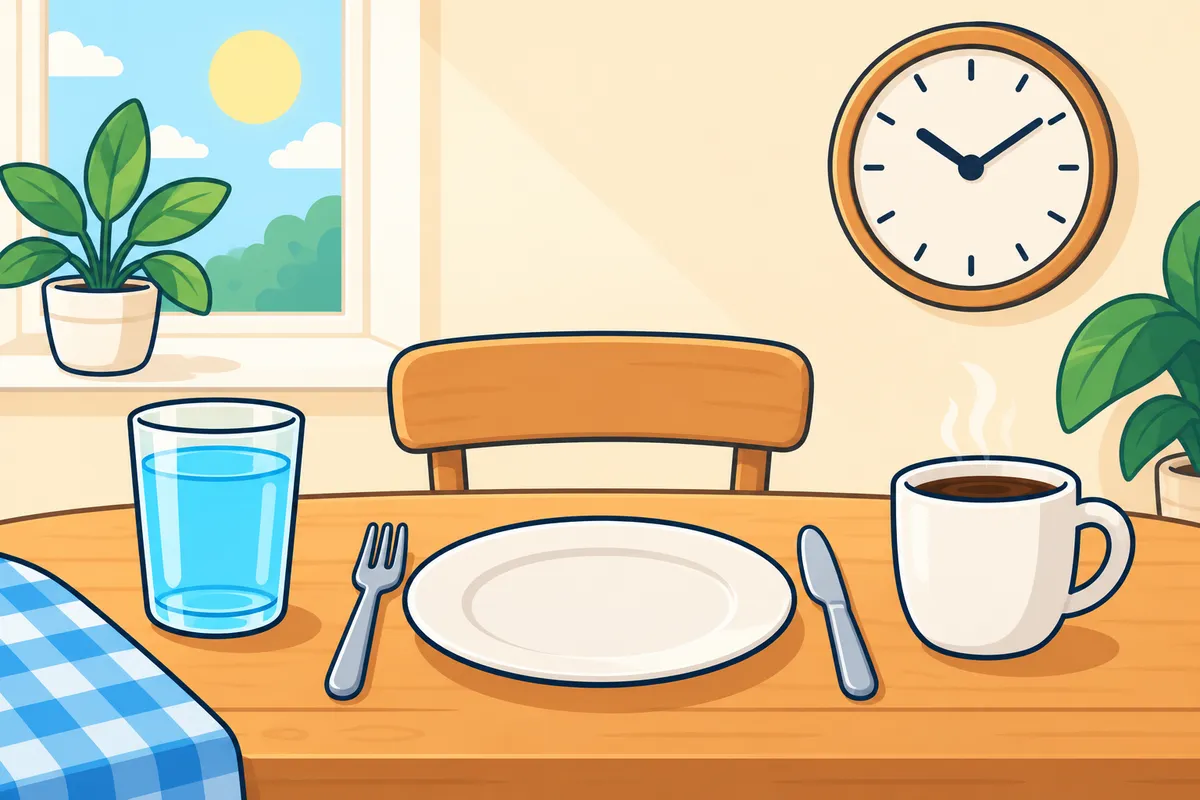
Intermittent fasting limits when you eat, never when you drink water. A glass at 7 am on a 16:8 plan is as fine as a glass with lunch.
The mistake people make runs the other way: they skip breakfast, and the morning coffee and water go with it.
Can You Drink Water While Intermittent Fasting?
Yes, as much as you need. Johns Hopkins Medicine lists two things you can have while fasting: water, and "zero-calorie beverages such as black coffee and tea". A fasting window is a break from calories, and plain water has none.
This is where intermittent fasting parts ways with Ramadan. During Ramadan, water is off limits from dawn to sunset, so the whole day's water moves into the night.
Does Water Break a Fast?
No. The CDC puts it simply: "Water has no calories." Your fast stays intact through every glass, hot or cold, still or sparkling.
What breaks a fast is anything with calories in it. By the zero-calorie rule Hopkins gives, milk in your coffee or sugar in your tea counts as eating, and the CDC names "sweetened coffee and tea" among the sugary drinks that "contain calories but little nutritional value". So the cup that keeps your fast is the plain one.
Keeps the Fast
- Water, hot or cold
- Still or sparkling, with nothing added
- Black coffee and plain tea
Breaks the Fast
- Milk in your coffee
- A spoon of sugar in your tea
- Juice, a smoothie or a sports drink
What Can You Drink While Fasting?
Water, plain sparkling water, black coffee and plain tea. Those are the drinks with no calories, the ones Hopkins allows in the fasting hours. Anything with milk, sugar, juice or alcohol waits for your eating window.
Fine in the Fasting Hours
4 items- Water, still, at any temperature
- Plain sparkling water and seltzer, with nothing added
- Black coffee, with no milk or sugar
- Plain tea, green, black or herbal, unsweetened
Can You Drink Sparkling or Lemon Water While Fasting?
Plain sparkling water, yes: it is water with carbon dioxide added, and the CDC lists it among the low-calorie choices next to plain coffee and tea. Check the label on flavored seltzers, since some have sweeteners or juice added; the CDC calls flavored waters "low-calorie choices", which is not the same as none.
A wedge of lemon is a grey area. It adds a squeeze of juice, so it is not strictly zero calories; if your plan follows Hopkins' zero-calorie rule to the letter, keep the lemon for your eating window, and if not, a wedge in a big glass is a small trade for drinking more.
Do Gum, Bone Broth and Supplements Break a Fast?
Apply the same zero-calorie test to the label. A product that says "calorie free" has fewer than 5 calories a serving and passes a strict fast by the label, while bone broth, a protein shake or a powder that lists calories does not.
Plain tablets and capsules with no calories on the label are a separate question for your doctor or pharmacist, who can tell you whether a medicine needs food.
Black Coffee and Tea in the Fasting Window
Black coffee is the drink most people lean on in a morning fast. It counts toward your fluids almost like water.
The catch is the second and third cup, which tend to replace water instead of joining it. Put a glass of water next to each coffee and drink the water first.
If cold water is hard to drink first thing, warm water or a plain herbal tea does the same job, since warm water hydrates you just as well.
Do Diet Drinks or Electrolyte Packets Break a Fast?
Read the label, not the front of the pack. Under US labeling rules, "calorie free" means fewer than 5 calories per serving, while "low calorie" allows up to 40, per 21 CFR 101.60. Only the first fits a strict zero-calorie fast, so a packet with sugar on its label breaks it.
| On the label | Calories per serving | Strict zero-calorie fast |
|---|---|---|
| Plain water, sparkling water, black coffee, plain tea | None to speak of | Keeps it |
| "Calorie free" on the label, such as a diet soda | Fewer than 5 | Keeps it by the label |
| "Low calorie" | Up to 40 | Breaks it |
| Sports drink, sweetened water, sweetened coffee or tea (the CDC's sugary drinks) | Sugar on the label | Breaks it |
Diet drinks pass the calorie test, but they carry a second question. The World Health Organization "recommends against the use of NSS to control body weight", and it found no lasting cut in body fat from long-term use. If you fast to lose weight, plain water does the job a diet soda only appears to do.
WHO's list of those sweeteners includes:
- aspartame
- sucralose
- saccharin
- acesulfame K
- stevia
Its advice does not apply to people who already have diabetes.
How Much Water Should You Drink While Intermittent Fasting?
At least your usual amount, and a little more if you skip a meal. No health body sets a separate amount for intermittent fasting. Your water need does not drop on a fasting day, but one source of it does: food.
Where the Missing Water Comes From
The US National Academies found that about 80 % of people's total water comes from drinks and "the other 20 percent is derived from food". Skip a meal, and part of that 20 % has to come from a glass instead.
The rough arithmetic runs on those reference totals. For adult women the total is 2.7 L a day, so about 540 ml comes from food; skip one of three meals and roughly 180 ml (6 oz) of it is gone, about one small glass.
For adult men the reference total is 3.7 L, so food brings about 740 ml, and a skipped meal takes away roughly 250 ml (8 oz). These are averages. A bowl of soup or a salad brings more water than a sandwich, and a few foods are almost all water.
- 20 %
- of total water comes from food
- ~180 ml
- lost with one skipped meal, women (6 oz)
- ~250 ml
- lost with one skipped meal, men (8 oz)
A 16:8 Day of Glasses
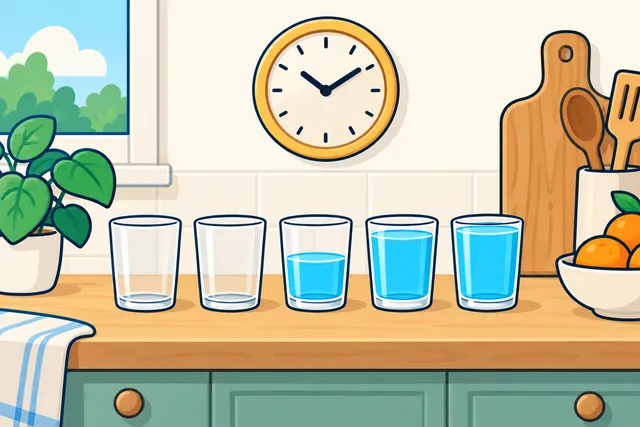
On a 16:8 plan you eat in an 8-hour window and fast for 16, as Hopkins describes. The same day looks like this with the eating window from noon to 8 pm:
A 16:8 Day, Eating From Noon to 8 PM
- 7 AM
- 9 AM
- 10:30 AM
- 12 PM
- 2 PM
- 4 PM
- 6 PM
- 7:30 PM
The morning is the part to plan. With no breakfast to remind you, the first three drinks need their own cues, such as the alarm, the commute and the first meeting.
Your Goal on a Fasting Day
Your daily goal does not change on a fasting day, so the same number is spread over a different shape of day. At 250 ml (8 oz) a drink, the eight drinks on the timeline make 2 liters, and 750 ml of it falls before your first bite.
If you train after work, more of your water falls in the eating window, and exercise adds its own drinking on top.
The 5:2 Days
On the 5:2 plan you eat normally five days a week and have one meal of 500 to 600 calories on the other two. Those two days bring much less water from food, so add a glass or two on top of your usual amount.
Why Fasting Can Make You Thirsty or Give You a Headache
Some of it is the change of routine, and some of it is missed water. Hopkins notes that it can take two to four weeks to get used to intermittent fasting, and that you may feel hungry or cranky in that time.
Missed water is the part you can fix today: if the headache comes mid-morning on fasting days and not on others, check whether the glasses you used to have with breakfast went missing too.
Hopkins advises you to talk to your doctor if you notice "unusual anxiety, headaches, nausea or other symptoms" after you start. A headache that a glass of water does not settle is one of those.
Is Dry Fasting the Same Thing?
No. Dry fasting means no water at all during the fast, and it is a different practice. The intermittent fasting plans Hopkins describes keep water in the fasting hours.
If you are thinking about dry fasting, ask your doctor first.
What About 24-Hour and Longer Fasts?
Water still never breaks them, but Hopkins cautions that longer periods without food, such as 24-, 36-, 48- and 72-hour fasts, "are not necessarily better for you, and may be dangerous". For a fast longer than a day:
- talk to your doctor first
- drink plain water through it
- treat the first meal back as a time to drink too
Does Drinking Water Help With Hunger While Fasting?
A little, at the start of a meal more than in the fasting hours. In an 84-adult trial in England, people who drank 500 ml of water 30 minutes before their main meals lost 1.3 kg more over 12 weeks than people told to imagine a full stomach, though the gap was borderline after adjustment and the trial did not test fasting windows.
If a glass does not tame the morning hunger, that is information about your fasting window, not about your water. Water with meals has its own page.
Who Should Not Try Intermittent Fasting?
Hopkins names four groups. It also advises everyone to check with a doctor before starting.
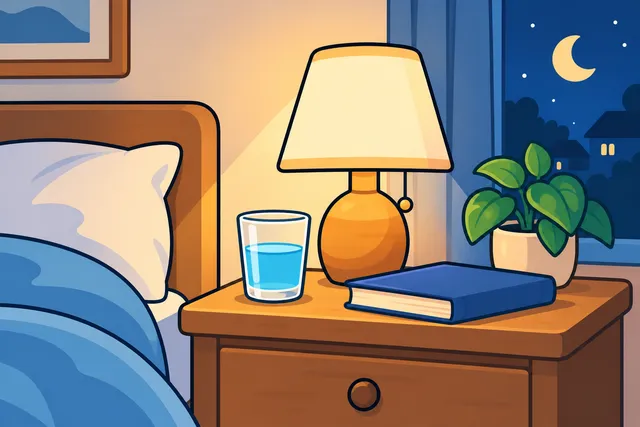
A Glass by the Bed for the Fasting Morning
Tomorrow's fasting morning
5 items- Put a full glass by your bed tonight and drink it when you wake
- Pair each black coffee with a glass of water, water first
- Set two phone reminders for the fasting morning, at the times breakfast used to remind you
- Have a glass with your first meal, and let the evening taper off before bed
- Turn your goal into drink times starting from the hour you wake, not the hour you eat
General information for healthy adults, not medical advice. If a doctor has set your fluid amount, follow that.
More in Drinking Habits
Sources
- US Code of Federal Regulations (via Cornell LII). 21 CFR 101.60, Nutrient content claims for the calorie content of foods, 2026.
- World Health Organization. WHO advises not to use non-sugar sweeteners for weight control in newly released guideline, 2023.
- Johns Hopkins Medicine. Intermittent Fasting: What is it, and how does it work?, 2026.
- CDC. About Water and Healthier Drinks, 2026.
- Obesity (Parretti HM et al.). Efficacy of water preloading before main meals as a strategy for weight loss in primary care patients with obesity: RCT, 2015.
- National Academies of Sciences. Report sets dietary intake levels for water, salt, and potassium (press release), 2004.
Sources checked by the Glubbo Editorial Team on Oct 19, 2026. General information, not medical advice. How we write and check our guides.

