Drinking Habits · When to Drink
Can You Drink Water Before a Blood Test? Yes, and Why It Helps
What plain water does to your results, how long each test needs you to fast, and the drinks that spoil a fast.
 By the Glubbo Editorial Team · Updated Oct 19, 2026 · 9 min read
On This Page
- Can You Drink Water Before a Blood Test?
- Does Drinking Water Affect Blood Test Results?
- Does Water Affect a Fasting Blood Glucose Test?
- How Long Do You Fast Before a Blood Test?
- Can You Drink Coffee or Tea Before a Fasting Blood Test?
- How Much Water Should You Drink Before a Blood Test?
- Can You Brush Your Teeth Before a Fasting Blood Test?
- What If You Ate or Drank Something Before Your Blood Test?
- Your Plan for the Night Before
- Common Questions
- Sources
Short answer
Yes, plain water is fine, even during a fast.
- MedlinePlus allows plain water during the usual 8 to 12 hour fast.
- Water keeps more fluid in your veins, which makes the draw easier.
- Skip coffee, tea, juice, flavored sparkling water and gum until after the test.
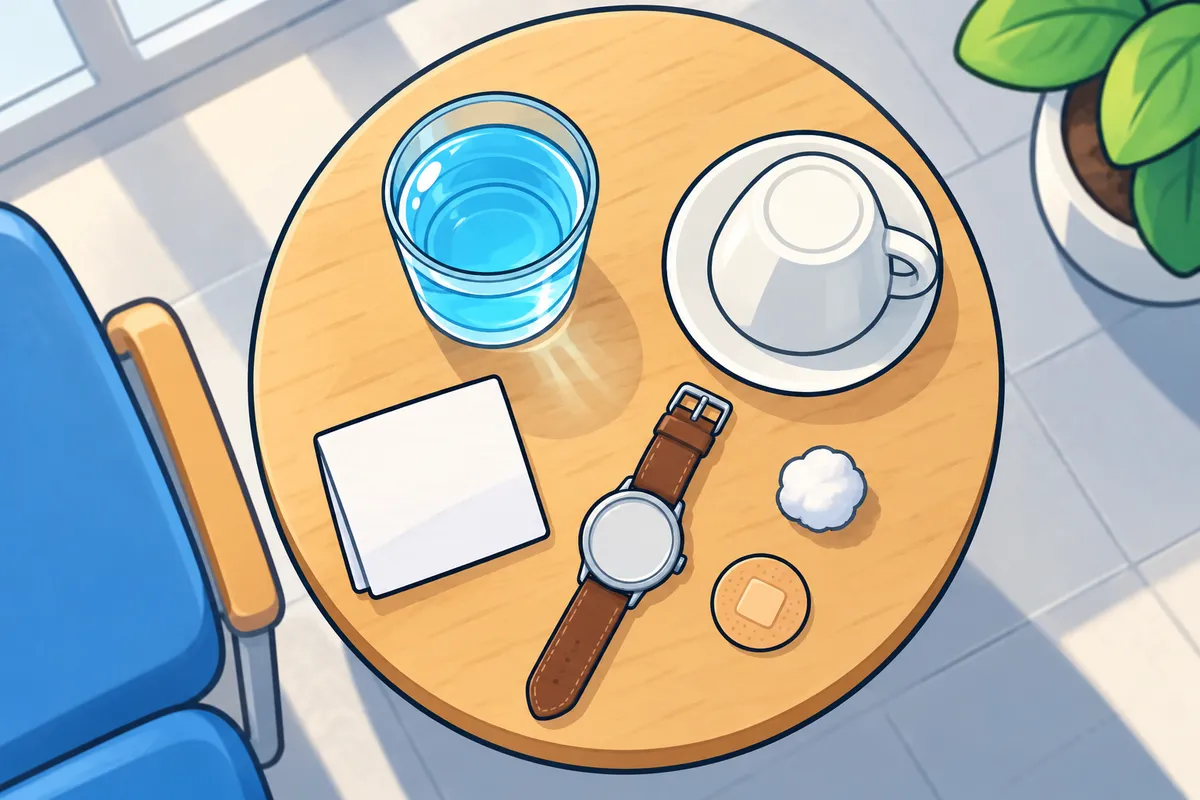
Yes. Plain water is the one thing a fasting blood test allows, and the person drawing your blood will thank you for it.
The letter says "fast from 8 pm" and your appointment is at 8:30 the next morning. By then you have gone more than 12 hours without a drink, your mouth is dry, and you are wondering whether a glass of water would spoil the test.
Can You Drink Water Before a Blood Test?
Yes. MedlinePlus, the health site of the US National Library of Medicine, defines the fast as nothing to eat or drink except plain water, usually for 8 to 12 hours. The NHS words it the same way: for a fasting test, you have nothing other than water.
That holds for tests you do not fast for, too. If your letter says nothing about fasting, eat and drink as usual.
Fine During the Fast
- Plain still water, tap or bottled
- Plain unflavored sparkling water, if your lab allows it
- Your usual medicines, unless your provider says otherwise
Wait Until After the Draw
- Coffee and tea, even black
- Juice, soda and flavored or lemon water
- Chewing gum, smoking and exercise
The items on the right come from the same MedlinePlus page, which says juice, coffee, soda and other drinks "can get in your bloodstream and affect your results." Plain sparkling water sits on the left only with a caveat: MedlinePlus warns against flavored carbonated water, so if your lab's letter says plain water only, keep to still.
Why Labs Want You to Drink Water
Because water keeps your veins full. MedlinePlus explains that water "helps to keep more fluid in your veins, which can make it easier to get a sample of your blood." A well-filled vein is easier to find and to draw from.
A dry, fasting arm is the hard arm, so drink before you go. The draw itself is short; the NHS says it usually takes about 10 minutes.
Does Drinking Water Affect Blood Test Results?
A glass or two does not change them in a way that matters. Two studies took blood before and one hour after people drank water. Many numbers shifted by a tiny amount, but the changes stayed inside the normal day-to-day wobble of each test, with one exception in white blood cells.
- 300 ml
- an hour before the draw: no change that mattered (20 women)
- 500 ml
- an hour before: only lymphocytes moved enough to matter (33 adults)
- 2 of 2
- studies with no change in fasting glucose after the water
The 300 ml Study
Benozzi and colleagues took blood from 20 women (median age 24) at rest, then again one hour after each drank 300 ml (10 oz) of water. They measured 16 common chemistry tests, from glucose and cholesterol to liver and kidney markers.
Nine of them moved by a statistically significant amount, such as triglycerides going from 1.05 to 1.06 mmol/L. None of the shifts was big enough to count as a real change in a patient, and the authors concluded that 300 ml an hour before the draw "does not interfere" with the tests they studied.
The 500 ml Study
Zhai and colleagues went further in 2026. Thirty-three healthy adult medical postgraduate students gave blood before and one hour after drinking 500 ml (17 oz), and the team checked both a full blood count and a set of chemistry tests against how much each test normally varies from day to day.
Nineteen numbers moved, including hemoglobin, cholesterol and creatinine. Only one, the lymphocyte count, moved by more than its normal variation, and the authors judged the overall effect "minimal."
| Measured an hour after water | 300 ml study (Benozzi 2018) | 500 ml study (Zhai 2026) |
|---|---|---|
| Glucose | No significant change | No significant change |
| Triglycerides | Tiny shift, not meaningful | No significant change |
| Cholesterol | Total: tiny shift, not meaningful; LDL: no change | Total and LDL: small shift, inside normal variation |
| Creatinine and urea | Urea: tiny shift; creatinine: no change | Small shift, inside normal variation |
| Blood count | Not tested | Lymphocytes: the one meaningful change |
| Who took part | 20 women | 33 healthy adults |
Both groups were small and healthy, so the studies say nothing about people with kidney or heart disease. They do show that a normal glass of water is far from the result-wrecker people fear.
Does Water Affect a Fasting Blood Glucose Test?
No. In both studies above, fasting glucose did not change after the water, at 300 ml or at 500 ml. Glucose is the number most people worry about, and it was among the steadiest.
What does raise a fasting glucose reading is anything with sugar or calories, which is why MedlinePlus rules out juice, soda and flavored water. Not every glucose test needs a fast, so check your letter and ask your provider if it is unclear.
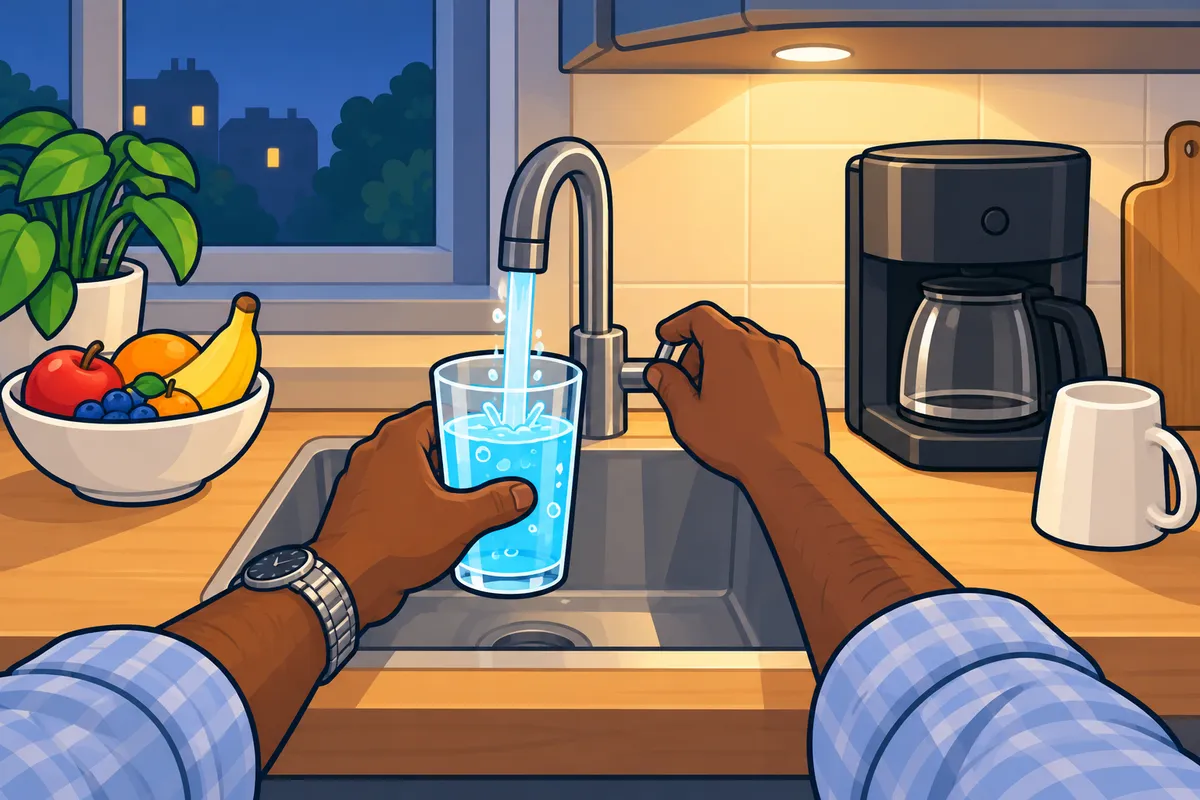
How Long Do You Fast Before a Blood Test?
Usually 8 to 12 hours, MedlinePlus says, but the time depends on the test and on your provider, so the letter from your clinic wins. Some tests need no fast at all.
| Test | Fast needed? | What the source says |
|---|---|---|
| Cholesterol (lipid panel) | Often | CDC: you may need to fast 8 to 12 hours |
| Triglycerides | Usually | MedlinePlus lists it among tests that commonly need a fast |
| Fasting glucose | For some glucose tests | MedlinePlus: not every glucose test needs one, so ask |
| Basic metabolic panel | Usually | MedlinePlus lists it among tests that usually need a fast |
| Liver function tests | Sometimes | Only when ordered as part of a comprehensive metabolic panel |
| Kidney (renal) panel | Sometimes | Your provider may ask you to fast |
| Calcitonin | Usually | MedlinePlus lists it among tests that commonly need a fast |
| Full blood count | Not on either MedlinePlus list | Follow your form; ask if it is unclear |
One draw often covers several tests. If your form lists a blood count beside a cholesterol test, fast for the cholesterol test, because one tube of blood serves both.
When Should Your Last Meal Be?
The fast starts with your last bite or sip of anything but water, so count back from the appointment. Here are three appointment times against the 8-, 10- and 12-hour ends of the MedlinePlus range.
| Appointment | 8-hour fast: last meal at | 10-hour fast | 12-hour fast |
|---|---|---|---|
| 7:00 AM | 11:00 PM | 9:00 PM | 7:00 PM |
| 8:30 AM | 12:30 AM | 10:30 PM | 8:30 PM |
| 10:00 AM | 2:00 AM | 12:00 AM | 10:00 PM |
If your letter names the hours, use the later time in your row. An early appointment shortens the night you spend hungry, because most of the fast is sleep.
Can You Drink Coffee or Tea Before a Fasting Blood Test?
No. MedlinePlus names coffee among the drinks that can get into your bloodstream and affect your results, and it gives no exception for black coffee or plain tea. Wait until the nurse has your sample; you can eat and drink as soon as the test is over.
This is where a blood test fast differs from a diet fast. During intermittent fasting, black coffee and plain tea are fine, but a lab fast is stricter because it protects the test, not your calories.
Gum, cigarettes and a morning run are out as well:
- MedlinePlus lists chewing gum, smoking and exercise among the things to avoid before a fasting test.
- Its prep page adds alcohol, overeating the day before and strenuous exercise.
How Much Water Should You Drink Before a Blood Test?
No lab sets a number; drink as you normally would, plus a glass in the hour before you go. MedlinePlus says some blood tests come with a request to drink extra water. The two studies used 300 to 500 ml (10 to 17 oz) an hour before the draw with no change that mattered.
For a test with no fast, such as a full blood count at 2 PM, eat lunch and drink as usual, and fill your bottle on the way out: a well-filled vein makes the draw quicker whether or not you fasted.
More is not better. The studies tested 300 to 500 ml, nothing in them suggests a liter helps, and gulping that much in the waiting room only sends you looking for the toilet. People who drink little day to day may want to read their own signs of running low before a morning draw.
Can You Brush Your Teeth Before a Fasting Blood Test?
Probably, but ask. MedlinePlus lists chewing gum, smoking and exercise among the things to avoid and does not mention brushing. If you brush:
- Spit out the toothpaste.
- Rinse with plain water.
- Skip a flavored mouthwash, which can carry sugar or flavoring that the lab asks you to keep out of your system.
If the fast is for a test where a strict lab protocol applies, such as a glucose tolerance test, phone the lab and ask; they know their own instructions better than any general page.
What If You Ate or Drank Something Before Your Blood Test?
Tell the person taking your blood before they start. MedlinePlus asks you to tell your provider if you ate or drank before the test, because you may need to reschedule for a day when you can fast, so your results are accurate.
A glass of plain water needs no confession. A latte, a cookie or a stick of gum does, even if it seems small. Saying "I had a coffee at 7" costs you a second trip; hiding it can cost you a wrong result.
Medicines, Urine Tests and Other Exceptions
Do not stop a medicine to fast. MedlinePlus says to ask your provider whether to take your usual medicines, and not to stop them unless your provider tells you to. Mention vitamins and supplements too.
A few tests turn the water rule around. MedlinePlus notes that some urine tests ask you to drink water 15 to 20 minutes beforehand, and some blood tests come with a request for extra water. A scan that needs a full bladder has its own instructions from the clinic.
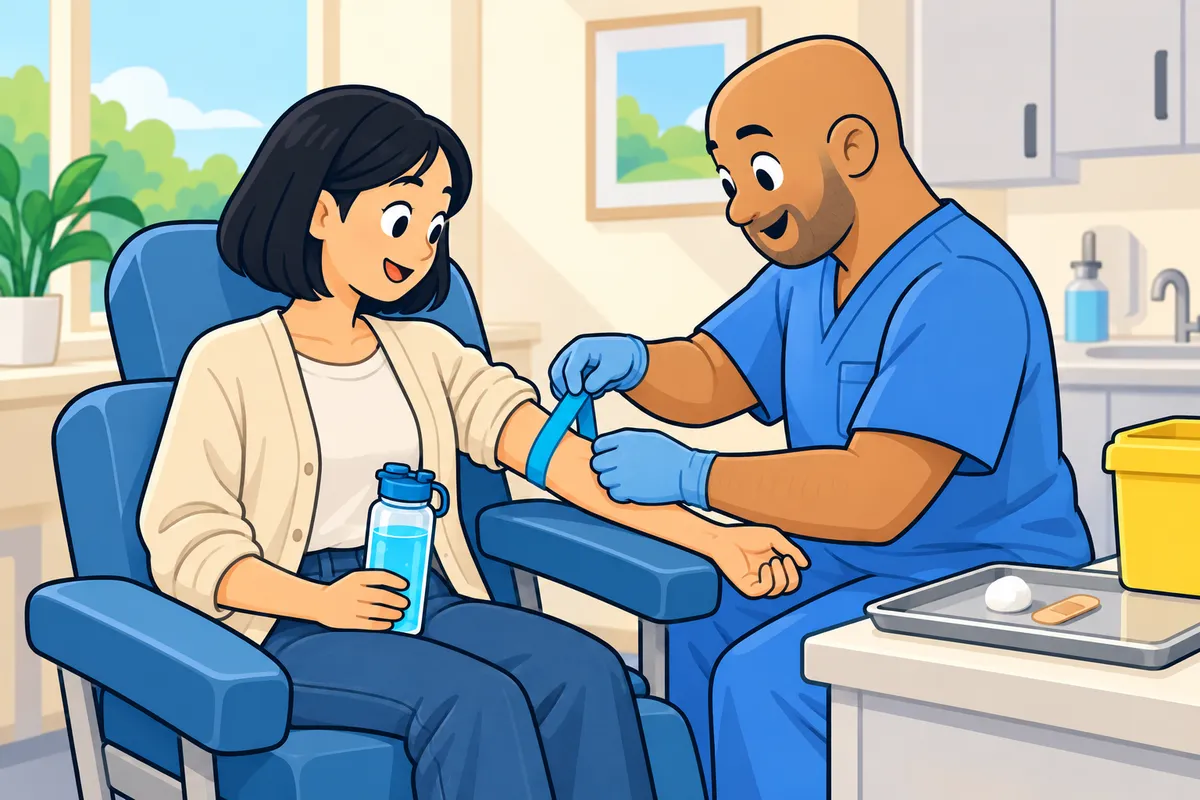
Your Plan for the Night Before
Tonight is when the test is won or lost, because the last meal and the first drink both happen before you leave the house.
Before the draw
5 items- Read the letter: fasting or not, and for how many hours
- Count back from the appointment and set the time of your last meal
- Drink plain water through the evening and again when you wake
- Have a glass or a small bottle in the hour before the draw
- Pack a snack and a drink for the moment the sample is taken
If you are also giving blood as a donor that week, the rules flip: blood services ask donors to eat and drink well beforehand, and donors get a 500 ml drink right before they give. For every other day, your normal rhythm of glasses through the day picks up again after breakfast.
Common Questions
Can being dehydrated change your blood test results?
Yes. MedlinePlus names dehydration as the most common cause of a high hematocrit, and it lists dehydration among the causes of a high BUN, a kidney test.
Can you drink water before a glucose tolerance test?
Yes, and only water. An East Kent NHS leaflet asks for an 8 to 14 hour fast with no black coffee or diet drinks, and allows water during the 2-hour wait between samples.
General information for healthy adults, not medical advice. If a doctor has set your fluid amount, follow that.
More in Drinking Habits

Sources
- MedlinePlus, US National Library of Medicine. Fasting for a Blood Test, 2024.
- MedlinePlus, US National Library of Medicine. How to Prepare for a Lab Test, 2024.
- NHS. Blood tests, 2025.
- US Centers for Disease Control and Prevention. Getting Your Cholesterol Checked, 2024.
- Biochemia Medica (Benozzi SF et al.). Fasting conditions: Influence of water intake on clinical chemistry analytes, 2018.
- Frontiers in Medicine (Zhai ZZ et al.). Effect of water intake on routine laboratory test parameters in healthy adults: a cross-sectional study, 2026.
- MedlinePlus, US National Library of Medicine. Hematocrit Test, 2026.
- MedlinePlus, US National Library of Medicine. BUN (Blood Urea Nitrogen), 2026.
- East Kent Hospitals University NHS Foundation Trust. Oral glucose tolerance test (adults), 2025.
Sources checked by the Glubbo Editorial Team on Oct 19, 2026. General information, not medical advice. How we write and check our guides.

