Drinking Habits · Building the Habit
Is It Better to Drink Cold or Warm Water? What Studies Show
Both hydrate you the same; cool water gets drunk more. When each one fits.
 By the Glubbo Editorial Team · Updated Oct 19, 2026 · 8 min read
On This Page
- Is It Better to Drink Cold or Warm Water?
- Do You Drink More When Water Is Cold?
- Is Cold Water Better After a Workout?
- Is Cold Water Bad for You?
- Does Cold Water Burn More Calories?
- Does Warm Water Help Digestion?
- Is Warm Water Better When You Have a Cold?
- Is It Bad to Drink Very Hot Water?
- Cold or Warm in Different Situations
- Run a Three-Day Temperature Test
- Sources
Short answer
Drink whichever temperature you will drink more of.
- Cool drinks under 22 °C got people exercising to drink about 50 % more.
- Warm water hydrates you just as well, and it suits cold mornings.
- Let drinks above 65 °C (149 °F) cool for a few minutes before you sip.
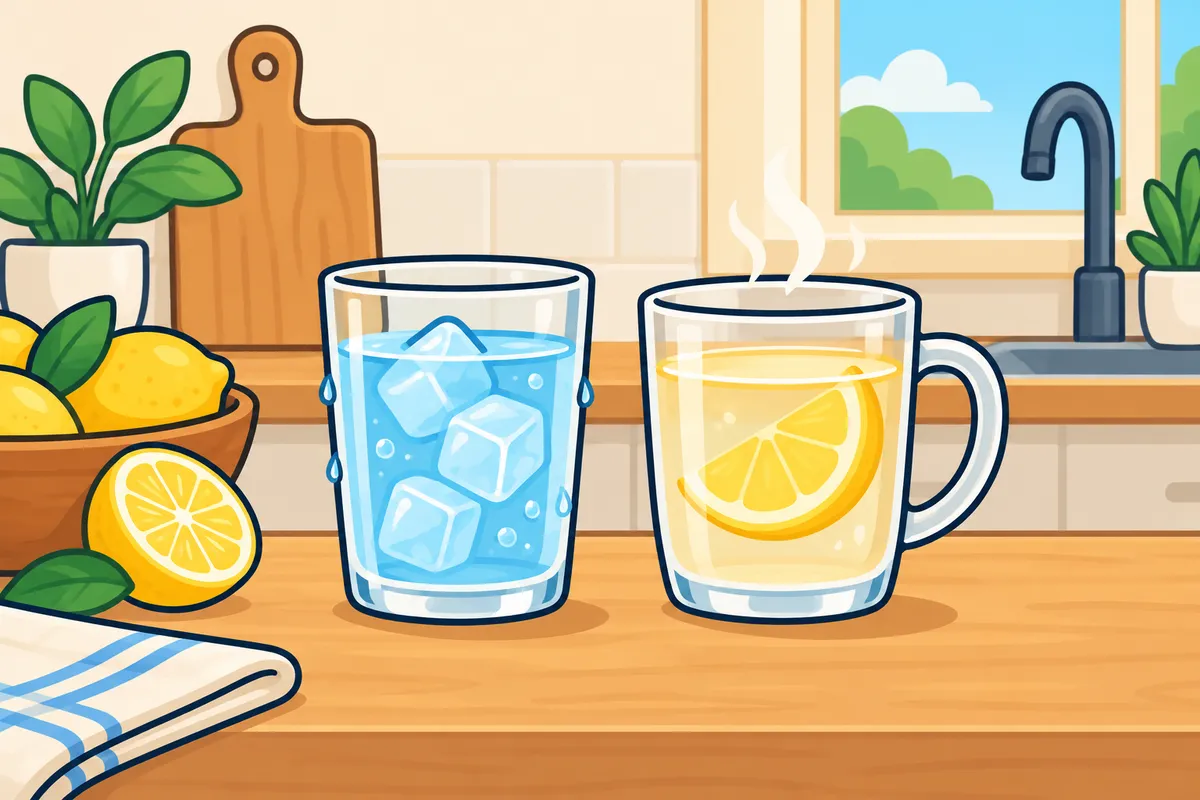
Cold or warm, a glass of water ends up at body temperature within half an hour, and it hydrates you the same either way. The real difference is how much of it you drink.
That makes temperature a habit question. If one temperature gets you to finish the glass, that is the better one for you.
Is It Better to Drink Cold or Warm Water?
For most people, cool water is the better habit because people drink more of it, especially in heat and during exercise. Warm water hydrates you just as well, and it suits cold mornings and people who find cold water hard to drink. Very hot drinks, above 65 °C (149 °F), are the one choice to avoid.
Your stomach evens the two out quickly. In a 1988 study in the journal Gut, six volunteers drank orange juice at 4 °C, 37 °C and 50 °C; the temperature inside the stomach returned to body temperature within 20 to 30 minutes for both the cold and the warm drink.
Cool or Cold Water
- You drink more of it in heat and exercise
- Feels good after a workout
- Easy to keep cold all day in a frozen bottle
Warm Water
- Hydrates you the same
- Easier on cold mornings and in winter
- Kinder to teeth or heads that hate ice
Do You Drink More When Water Is Cold?
Yes, at least while you exercise. A 2012 review of 14 studies pooled the five that measured intake and found that people exercising drank about 50 % more when their drinks were cold (0 to 10 °C) or cool (10 to 22 °C) than when the drinks were 22 °C or warmer. Cool and cold drinks also cut the dehydration that came with exercise by 1.3 % of body weight.
The other studies in the review asked people which drink tasted better; ten of them did. All of it came from small lab trials of adults exercising, and the drinks never went above 50 °C.
- ~50 %
- more fluid drunk when it was cool during exercise
- 1.3 %
- less body weight lost to dehydration
- 7.6 %
- of women got a headache from ice-cold water
The National Athletic Trainers' Association says the same in plain words: "Individuals exercising in the heat will voluntarily ingest more fluid if it is chilled." It lists temperature next to flavor, sweetness and fizz among the things that affect how much an athlete drinks.

What Counts as Cold, Cool, Warm and Too Hot
The studies use exact temperatures, and they line up into one scale:
Water that has sat in a 25 °C (77 °F) kitchen counts as warm on this scale, and a bottle straight from a 4 °C (39 °F) fridge counts as cold. The 22 °C line is a warm room, so "room temperature" can land on either side of it.
On a Hot Workday
NIOSH, the US institute for workplace safety, asks employers to keep drinking water below 15 °C (59 °F), close to where people work. Cool water near the job means more cups get drunk, at about one every 15 to 20 minutes on a hot shift.
Is Cold Water Better After a Workout?
Yes, if it gets you to drink back what you sweated out. The NATA position statement adds that athletes often prefer cool, flavored drinks, and that these "should be available, when possible, to promote rehydration"; it also notes that a little sodium in the drink helps.
Cold water does not rehydrate you faster once you have drunk it. What it changes is the amount you are willing to drink, and after a long, sweaty session that amount matters most. How much to drink back, and how fast, depends on what the session took out of you.
Is Cold Water Bad for You?
Not for most people. The two effects studies have found are small and short:
- ice-cold water can set off a headache in some people
- very cold drinks slow the first minutes of stomach emptying a little
| Study | Who took part | What they drank | What changed |
|---|---|---|---|
| Sun et al., 1988 | 6 volunteers | Orange juice at 4 °C, 37 °C and 50 °C | The 4 °C drink left the stomach more slowly at first; the stomach was back at body temperature in 20 to 30 minutes |
| Sun et al., 1995 | 12 volunteers | Drinks at 4 °C, 37 °C and 50 °C | Both the cold and the hot drink changed the stomach's muscle activity in a way that slows emptying, the cold one more, mostly in the first 30 minutes |
| Mattsson, 2001 | 669 women at breast screening | 150 ml (5 oz) of ice-cold water through a straw | 51 of them (7.6 %) got a headache; women with a migraine in the past year twice as often |
None of the three reported any harm beyond those short effects.
Cold Water and Headaches
About 1 woman in 13 in the Swedish study got a headache from 150 ml of ice-cold water, and a migraine in the past year doubled the odds. Women whose last migraine was more than a year ago were no more likely to get one.
The study covered women only. If ice water gives you that sharp pain, drink it cool instead of ice-cold, or sip it slowly.
Does Cold Water Burn More Calories?
Barely. Drinking 3 °C water raised energy burned by 4.5 % over the next hour in a 2006 study of healthy young adults, and water at room temperature raised it by nothing the researchers could separate from chance. If you burn about 65 calories an hour at rest, 4.5 % is roughly 3 calories.
That is a small effect from a single study design. The authors concluded that drinking water is unlikely to be an effective way to manage weight through burning energy. The benefit that is real is filling: water before a meal can change how much you eat, whatever its temperature.
Does Warm Water Help Digestion?
Healthy people digest food fine at any water temperature, and the stomach studies above show only brief changes. In the 1988 study, the 50 °C drink did not empty from the stomach significantly differently from a drink at body temperature. In the 1995 study it changed the stomach's muscle activity in the same slowing way as cold water, though less.
If a warm glass in the morning is what gets you drinking, keep it; it counts the same as any other glass. Its real benefit is that you drink it.
The claim that cold water with a meal hurts digestion has no better support: a glass of water changes your stomach acid for only about 3 minutes.
Is Warm Water Better When You Have a Cold?
Hot drinks loosen things up for a short while. In a 1978 study of 15 healthy adults, hot water and hot chicken soup sped up the flow of nasal mucus at five minutes, and the effect was gone by 30 minutes.
- 15
- healthy adults took part
- 5 min
- when hot water sped up nasal mucus
- 30 min
- when cold water slowed it and the hot effect was gone
Airflow resistance in the nose did not change. The authors credited the steam you breathe in as part of the effect.
The adults had no cold, and the study did not measure a sore throat, so the result suggests a reason to choose a hot drink while you are congested and shows nothing more. Sip it warm enough to be comfortable, and below 65 °C (149 °F).
Is It Bad to Drink Very Hot Water?
Yes, above about 65 °C (149 °F). The International Agency for Research on Cancer, part of the WHO, classed drinking very hot beverages as "probably carcinogenic to humans", because of a link with cancer of the esophagus.

The evidence came from places where people drink tea or maté at about 70 °C, and the risk rose with temperature. IARC's director said "it is the temperature, rather than the drinks themselves, that appears to be responsible." The evidence in people is limited, and smoking and alcohol remain the major causes of esophageal cancer in high-income countries.
So let a just-boiled kettle cool for a few minutes before you drink. Coffee is a separate question. The same review moved coffee itself to "not classifiable".
Cold or Warm in Different Situations
The answer changes with the day you are having. Use whichever temperature you drink most of at that moment.
Pick the temperature for the moment
- A hot day or a workoutCold, from a bottle frozen overnight
- A winter morning, when thirst is weakA warm mug
- Ice water gives you a sharp headacheCool, not ice-cold, sipped slowly
- Traveling where the tap water is unsafeNo ice unless made from safe water
- A fasting dayWarm water or plain tea
- Tea or water straight from the kettleLet it cool below 65 °C (149 °F)
Winter is the easy row to miss: cold weather already blunts thirst, so a warm mug gets finished when an iced glass would not. To keep a hot-day bottle cold without a freezer, an insulated bottle does the job.
Abroad, ice is only as safe as the water it was made from. On a fasting day, warm water or plain tea keeps a fast intact.
Run a Three-Day Temperature Test
Counting beats guessing. Use one bottle of the same size for all three days and note how much is left at 6 PM.
Find your own temperature in three days
- Day 1: fill the bottle with cold water from the fridge and write down how many ml (oz) you finish by 6 PM
- Day 2: fill it with warm tap water and write down the same number
- Day 3: use whichever finished faster, then spread your glasses across the day, from waking to bedtime
General information for healthy adults, not medical advice. If a doctor has set your fluid amount, follow that.
More in Drinking Habits


Sources
- International Journal of Sport Nutrition and Exercise Metabolism (Burdon et al.). Influence of beverage temperature on palatability and fluid ingestion during endurance exercise: a systematic review, 2012.
- Journal of Athletic Training (National Athletic Trainers' Association). National Athletic Trainers' Association Position Statement: Fluid Replacement for the Physically Active, 2017.
- CDC, National Institute for Occupational Safety and Health. Workplace Recommendations, 2026.
- Gut (Sun et al.). Effect of meal temperature on gastric emptying of liquids in man, 1988.
- Gut (Sun et al.). Effect of drink temperature on antropyloroduodenal motility and gastric electrical activity in humans, 1995.
- Cephalalgia (Mattsson). Headache caused by drinking cold water is common and related to active migraine, 2001.
- International Agency for Research on Cancer (WHO). IARC Monographs evaluate drinking coffee, maté, and very hot beverages (press release 244), 2016.
- Journal of Clinical Endocrinology and Metabolism (Brown, Dulloo and Montani). Water-induced thermogenesis reconsidered: the effects of osmolality and water temperature on energy expenditure after drinking, 2006.
- Chest (Saketkhoo, Januszkiewicz and Sackner). Effects of drinking hot water, cold water, and chicken soup on nasal mucus velocity and nasal airflow resistance, 1978.
Sources checked by the Glubbo Editorial Team on Oct 19, 2026. General information, not medical advice. How we write and check our guides.

