Sleep and Recovery · Sleeping Better
How to Sleep When It's Hot: Beat the Heat and Its Sticky Nights
The night-time room temperature the WHO aims for, why heat steals deep sleep, and what works with no air conditioning.
 By the Glubbo Editorial Team · Updated Oct 19, 2026 · 10 min read
On This Page
- How Do You Sleep in Hot Weather?
- How Hot Is Too Hot to Sleep?
- Why Is It Hard to Sleep in the Heat?
- How Do You Sleep Without Air Conditioning?
- Should You Sleep With the Air Conditioner On?
- What If You Wake Up Soaked in Sweat?
- Do Fans Help You Sleep in a Heatwave?
- How Do You Sleep in a Heatwave With No Relief at Night?
- What to Eat and Drink on a Hot Night
- Checking Your Own Bedroom Tonight
- Sources
Short answer
Cool the room by day, then cool your body at bedtime.
- The WHO aims for a room below 24 °C (75 °F) at night in a heatwave.
- Shut blinds on sunny windows by day; open windows at night when it is cooler outside.
- A fan helps below 35 °C (95 °F); above that, a cool shower works better.
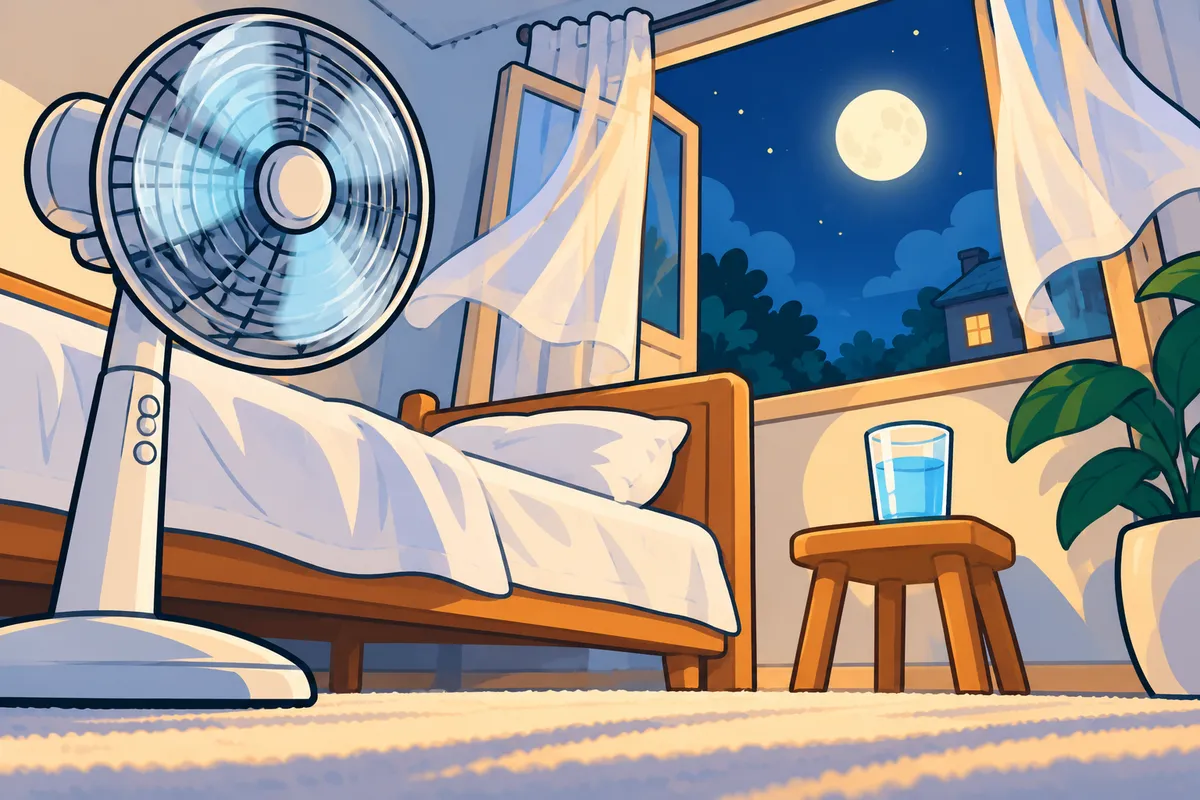
Cool the bedroom by day, let cool air in at night, then cool your body just before bed. The WHO's heatwave advice aims for a room below 75 °F (24 °C) at night, and every step below works toward that number.
Most of the fix happens hours before bed. A room that soaked up sun all afternoon will not cool down by the time you lie down, so the plan starts in the morning. Say the forecast is 88 °F (31 °C) and the bedroom is still warm at midnight: that room needs the morning steps, not a better pillow.
How Do You Sleep in Hot Weather?
Keep heat out of the bedroom during the day, let cool air in at night, then cool your body just before bed.
A hot night, planned from the morning
- Morning: close blinds and windows on the sunny side
- Evening: check the bedroom; the WHO's last check is after 10 PM
- When it is cooler outside, open the windows wide, if safe
- Before bed: a cool shower, then a thin cotton sheet
- Run a fan while the room stays below 95 °F (35 °C)
The CDC's sleep tips ask for a bedroom that is quiet, relaxing and "at a cool temperature". In a heatwave that one line becomes most of the job.
How Hot Is Too Hot to Sleep?
Above about 75 °F (24 °C) at night, by the WHO's heatwave advice, which says keeping below it matters most for infants, people over 60 and anyone with a chronic health condition. The WHO also aims for a daytime room below 90 °F (32 °C). Sleep research finds heat breaking up sleep well before it matters to health.
The reason is the air under your covers. A 2012 review of sleep and temperature by Okamoto-Mizuno and Mizuno says the air between you and your bedding normally sits around 90 to 93 °F (32 to 34 °C), with 40 to 60 % humidity. When the room is already near that, your bed cannot shed heat.
| Room at night | What the sources say | What to do |
|---|---|---|
| 55 to 73 °F (13 to 23 °C) | With normal bedding, sleep stages did not differ across this range (review) | Sleep as usual |
| Up to 75 °F (24 °C) | The WHO's ceiling for a room at night in a heatwave | Keep the blinds and night-air routine going |
| Above 75 °F (24 °C) | Over the WHO's aim; matters most for infants, people over 60 and the chronically ill | Move to the coolest room; a fan |
| Humid heat, such as 90 °F (32 °C) with 80 % humidity | Less deep sleep in lab tests (review) | Cool shower, fan, thin cotton |
| Above 95 °F (35 °C) | Fans may not prevent heat illness (NHS, WHO) | Cool water on the skin; find a cool place |
Sources: Okamoto-Mizuno and Mizuno, 2012; WHO Europe; NHS.
Why Is It Hard to Sleep in the Heat?
Because your core temperature normally falls through the night, and a hot room holds it up. With normal bedding and clothes, the review found that heat "increases wakefulness and decreases slow wave sleep and rapid eye movement sleep", the deep and dreaming stages you most need.
Humidity Makes It Worse
Sticky nights are harder than dry ones. The review says humid heat "further increases wakefulness, decreases REM and SWS", because sweat cannot evaporate to cool you; in one set of tests, a room at 90 °F (32 °C) and 80 % humidity cut deep sleep.
That is why a muggy night feels worse than a dry one at the same temperature. Hanging wet towels to cool a room, which the WHO suggests, raises humidity at the same time, so use them in a dry heat, not a muggy one.
Older Sleepers Feel It More
Age changes how heat lands. The review describes studies of older men:
- Even mild heat made them wake more and lose dreaming sleep.
- It roughly doubled how much they sweated overnight.
The WHO names people over 60 among those who most need a cool room.

How Do You Sleep Without Air Conditioning?
Work with the outdoor temperature: shut the house during the hot hours and flush it with night air. Then add the body-cooling steps, which work in any room.
Cooling a bedroom with no air conditioning
Blinds by day, windows by night
Cools the room itself
- Shut sun-facing windows in the day
- Open everything once it is cooler outside
Suits you if Every hot spell; it costs nothing
A fan
Moves air, not heat
- Helps while the room is below 95 °F
- The CDC: do not rely on fans alone
Suits you if A humid night that is warm but not extreme
Cool shower or sponging
Cools you, not the room
- WHO, NHS and CDC all suggest it
- A cool foot bath works too (WHO)
Suits you if The last thing before bed, and again at 3 AM
The coolest room
When the bedroom will not cool
- Often downstairs, on the shady side
- The WHO's advice for nights in a heatwave
Suits you if A top-floor or sun-facing bedroom that stays hot
Use the Night Air
Open up when the outside air is cooler than inside, often late in the evening and before dawn. The WHO says to open all windows and shutters during the night and the early morning if it is safe, and to close windows and shutters facing the sun during the day.
Cut the heat you make indoors too. The WHO asks you to switch off lights and as many electrical devices as you can; a television, a laptop on standby and a hall light all add warmth to a closed room.
Cool Your Body, Not Only the Room
A cool shower or bath is the quickest step. The WHO and NHS list these options for when a shower is not handy:
- A cool shower or bath
- Cold packs and wraps
- Damp towels and sponging
- A cool foot bath
- Cool water on your skin or clothes

Bedding and Nightclothes
Go light and loose. The WHO suggests light, loose-fitting clothes of natural materials and "light bed linen and sheets, and no cushions, to avoid heat accumulation". A single cotton sheet can replace the duvet for the whole hot spell.
Should You Sleep With the Air Conditioner On?
Yes, if you have one, and early in the night. The CDC says that even a few hours in air conditioning can help, and that is the point of a cooling stretch at the start of the night. Three details make it work:
- If you can only run it for part of the night, the sleep review recommends using it in the first part of the night.
- If you run it later, dry off any sweat and change into dry clothes first, the review adds, so the cold air does not chill you.
- Without a unit at home, the CDC suggests a mall or public library by day, and your local health department can point you to an air-conditioned shelter.
What If You Wake Up Soaked in Sweat?
Dry off, change into dry nightclothes and bedding, and sip water. The review notes that wet underwear reduces insulation, so damp clothes hold the heat against your skin instead of letting it go.
Keep a spare set of light cotton nightclothes and a dry towel by the bed, so changing takes a minute.
Do Fans Help You Sleep in a Heatwave?
Yes, up to a point. Three health bodies set the limit:
- The NHS says "Electric fans can help if the temperature is below 35 degrees" Celsius.
- The WHO says that above 95 °F (35 °C) a fan may give relief but may not prevent heat-related illness.
- The CDC adds a US caution: do not rely solely on fans to keep you cool, and above that heat they will not prevent heat-related illness.
A fan matters most on humid nights, when sweat sits on your skin and needs moving air to evaporate. In a dry heat, the wet towels the WHO suggests add cooling to the room, with the humidity trade-off the review describes.
A fan, mild heat
- Moving air helps sweat dry on your skin
- Pair it with a cool shower before bed
- Best on a muggy night in a warm room
A fan, severe heat
- It gives relief, but illness is still possible
- Add cool water on skin and a cool place by day
- The CDC: never rely on fans alone
How Do You Sleep in a Heatwave With No Relief at Night?
Change rooms and keep checking the temperature. When night air stays warm, the WHO says to move to the coolest room in the home, to check the room temperature three times a day, and to spend 2 to 3 hours of the day in a cool place if you cannot cool your home.
Who is most at risk in hot weather
5 items- older people, especially those aged 65 and over
- babies and young children aged 5 years and under
- people who are pregnant or have serious long-term conditions
- people who live alone and may be unable to care for themselves
- people on multiple medicines or medicines that may make them more likely to be badly affected by hot weather
The list goes on to people already ill and dehydrated, and to people who work or spend a lot of time outside. If you take regular medicine, the WHO suggests asking your doctor how it affects your body's heat and fluid balance, and it says to keep medicines below 77 °F (25 °C) or in the refrigerator.
Cooling the Room You Actually Sleep In
What to Eat and Drink on a Hot Night
Water, and enough of it during the day. The WHO says to:
- Drink regularly, but avoid alcohol and too much caffeine and sugar.
- Eat small meals more often and avoid foods high in protein.
Hot drinks are best skipped too.
Keep a glass by the bed for sips if you wake hot and thirsty. If night-time trips to the bathroom wake you as well, front-load your drinks earlier in the day so the last big glass falls a couple of hours before bed.
If a hot week has cut you to 6 hours a night for days, add a short early nap rather than sleeping late into the hot morning, when the bedroom warms up again.
Checking Your Own Bedroom Tonight
Put a thermometer where you sleep, not in the hallway. The WHO names three daily readings, and the last one decides the night.
The WHO's room checks on a hot day
- 8 AM
- 10 AM
- 1 PM
- 10 PM
General information for healthy adults, not medical advice. If a doctor has set your fluid amount, follow that.

More in Sleep and Recovery


Sources
- World Health Organization, Regional Office for Europe. Information for the general public during heat-waves, 2015.
- Journal of Physiological Anthropology (Okamoto-Mizuno and Mizuno). Effects of thermal environment on sleep and circadian rhythm, 2012.
- NHS. Heatwave: how to cope in hot weather, 2026.
- NHS. Heat exhaustion and heatstroke, 2026.
- Centers for Disease Control and Prevention. Heat and People without Air Conditioning, 2025.
- Centers for Disease Control and Prevention. About Sleep, 2024.
Sources checked by the Glubbo Editorial Team on Oct 19, 2026. General information, not medical advice. How we write and check our guides.

