Sleep and Recovery · Sleep Basics
Why Do We Dream? What Sleep Science Knows and Still Does Not
The main theories and the evidence for each, what your brain does while you dream, and why dreams vanish by breakfast.
 By the Glubbo Editorial Team · Updated Oct 19, 2026 · 10 min read
On This Page
Short answer
No one knows for sure; emotion and memory lead.
- The NIH says dreaming's exact purpose is not known but may help process emotions.
- You spend about 2 hours a night dreaming, most vividly in REM sleep.
- In one study, people who dreamed about a maze task improved most when retested.

Nobody knows for sure why we dream. The leading ideas are that dreams help you process emotions and sort new memories, and the evidence for each is partial. What science does know well is how dreams happen: everyone dreams, for about two hours a night, and the most vivid dreams come in REM sleep.
You were back at school, late for an exam in a classroom with no door, and your old neighbor was the teacher. By the time you poured your coffee, most of it had gone.
Why Do We Dream?
No one knows for certain. The NINDS sleep page says dreaming's "exact purpose isn't known, but dreaming may help you process your emotions," and a neuroscience review quotes a leading researcher: "the biological function of dreaming remains unknown."
Several ideas compete, and they are not mutually exclusive. The table sets out what each says and how much evidence stands behind it.
| Theory | What it says | Evidence so far |
|---|---|---|
| Emotion processing | Dreams help you work through the feelings of the day | NINDS names it; the brain's emotion center is very active in REM sleep |
| Memory sorting | Dreams reflect the brain replaying and filing new memories | One lab study: the 4 of 50 nappers who dreamed of a maze improved most at it |
| A side effect of brain activity | The sleeping brain fires and the mind makes a story from it | Brain imaging and lesion studies describe how; it explains form more than purpose |
| Guarding sleep (Freud) | Dreams disguise unconscious wishes so they do not wake you | Freud's idea, which the 2010 review sets beside a researcher's verdict that the function "remains unknown" |
Sources: NINDS, Nir and Tononi, 2010, Wamsley and colleagues, 2010.
Dreams probably do more than one job, and science has measured only parts of each.
Emotion
The case for emotion rests on what lights up. During REM sleep the amygdala, an almond-shaped structure that processes emotions, "becomes increasingly active," NINDS says, and the 2010 review by Nir and Tononi describes strong activation of limbic areas such as the amygdala, anterior cingulate and insula.
Yet emotion is not always there. The same review reports that emotions are absent altogether in 25 to 30 % of REM dream reports.
Memory
This idea has a direct test behind it. Memory consolidation "most likely requires both non-REM and REM sleep," NINDS says, and the clearest test of dreams themselves comes from a maze study described further down.
A Side Effect of a Busy Brain
Some researchers see dreams as the mind making sense of activity that starts lower in the brain. In one model the review describes, dreams arise "from activation of sensory cortex by the brainstem," while areas tied to self-monitoring go quiet, which would explain why a classroom with no door feels normal at the time.
Why Do We Dream When We Sleep?
Because parts of the brain stay highly active while others switch off. During REM sleep the thalamus keeps "sending the cortex images, sounds, and other sensations that fill our dreams," NINDS explains, while your arm and leg muscles go temporarily limp, a paralysis "which prevents you from acting out your dreams."
How Often People Report a Dream, by Stage
The answer depends on which stage you wake from and how the question is put. These are the figures the 2010 review gathers from sleep-lab studies.
| Woken from | Asked | Reported dream or content |
|---|---|---|
| REM sleep, adults | Did you dream? | 74 to 80 % vivid recall in early studies; 80 to 90 % in later ones |
| Non-REM sleep, adults | Did you dream? | 7 to 9 % in early studies |
| Non-REM sleep, adults | Anything going through your mind? | 23 to 74 % |
| Stage N1, the lightest | Anything going through your mind? | 80 to 90 %, but very short |
| Stages N2 and N3 | Anything going through your mind? | 50 to 70 % |
| REM sleep, children under 7 | Did you dream? | about 20 % |
Source: Nir and Tononi, 2010.
You dream in non-REM sleep too, just less vividly. When researchers changed the question from "did you dream?" to "tell me anything that was going through your mind," reports from non-REM sleep rose to between 23 and 74 %, the review notes, and 10 to 30 % of them could not be told apart from REM dreams.
Why the Best Dreams Come Toward Morning
REM periods get longer and deeper as the night goes on, NINDS says. So the long, story-like dreams cluster in the last hours before your alarm, which is also when you are most likely to wake in the middle of one.
That pattern explains a common experience. Cut your night short with an early alarm and you lose mostly REM time, and with it many of the night's most vivid dreams; the deep sleep that fills the first half of the night is the part your brain protects first.
Why Do We Forget Our Dreams?
Because the dreaming brain is in a poor state for making memories. In one model the 2010 review describes, some chemical messenger systems go silent in REM sleep and part of the frontal cortex switches down, leaving "a brain state which is not favorable for subsequent memory."
So "I never dream" usually means "I never remember." NINDS is clear that everyone dreams, about two hours a night, "but may not remember most of your dreams."
Alcohol shifts this too: it delays the first REM period and, at moderate and high doses, cuts total REM sleep over the night, a review of alcohol and sleep studies found, which changes when and how much you dream.
Why Do We Dream About People We Know?
Because dreams borrow from waking life. About 50 % of dreams include "residues" from waking experience, the 2010 review reports, but placed in new and unrelated settings; only about 1.5 % replay a real recent episode as it happened.
About Half of Dreams
- Borrow people, places or worries from waking life
- Drop them into new, unrelated settings
- Your colleague flies the plane
About 1.5 % of Dreams
- Replay a real recent day as it happened
- Same place, same people, same order
- The rarest kind, per the 2010 review
That is why your colleague turns up as a pilot, or a school friend you have not seen in twenty years appears in your current kitchen. "Events from the day often invade your thoughts during sleep," NINDS notes.
Do Dreams Help Memory?
They seem to reflect memory at work, though the clearest test rests on four dreamers. In a 2010 study, 99 students learned a 3D virtual maze at lunchtime; 50 then napped in a sleep lab and 49 stayed awake, and everyone ran the maze again 5 hours later.
Only 4 of the 50 nappers reported a dream about the maze, and those four improved about ten times as much as the other 46. The four had also started out among the slowest, which left them the most room to get better; the authors report that the link held after allowing for that.
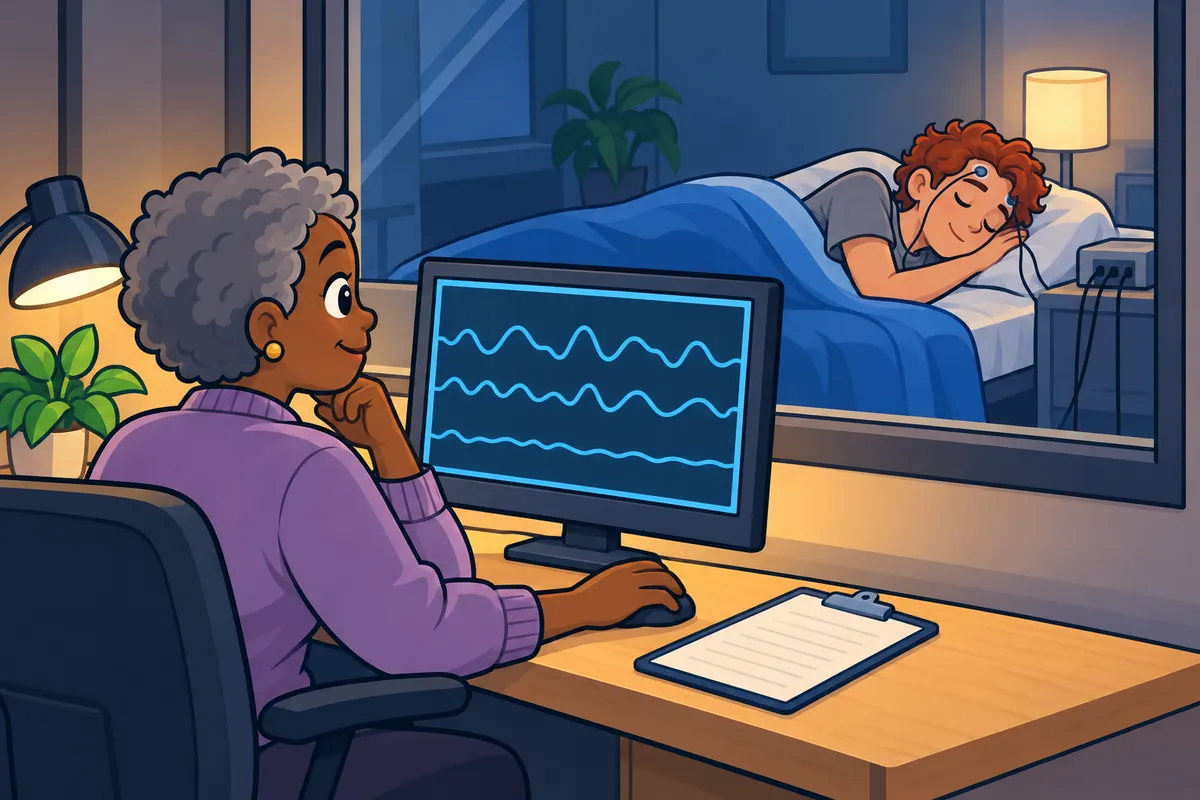
Thinking about the maze while awake did not help. The authors concluded that dreaming "may be a reflection of the brain processes supporting sleep-dependent memory processing," and say they do not claim the dreams cause the gain: closer to "dreams show the filing" than "dreams do the filing."
Does Everyone Dream?
Adults do, though children dream less often. NINDS says "everyone dreams," and the review reports that children under 7 woken from REM sleep reported dreaming only about 20 % of the time, compared with 80 to 90 % in adults.
- 2 hours
- of dreaming a night for a typical adult
- 80–90 %
- of adults report a dream when woken from REM
- ~20 %
- of children under 7 report a dream from REM
- 25–30 %
- of REM dream reports contain no emotion at all
Young children's dreams, when they report them, are often static and plain, such as seeing an animal or thinking about eating, the same review says. Some people dream in color and others recall dreams only in black and white, NINDS adds. And "as you age, you spend less of your time in REM sleep," the stage of the most vivid dreams.
Why Are My Dreams So Vivid Lately?
Usually because you are waking from, or close to, REM sleep, which is when dreams are most vivid and most emotional. Vivid periods often follow a change:
- Stress.
- A new medicine.
- Drinking alcohol, or stopping it.
- A night that ends mid-REM at the alarm.
A new medicine and abrupt alcohol withdrawal are both listed triggers of frightening dreams, and the alcohol review above shows alcohol delaying and cutting REM sleep. NINDS adds that people under stress or anxiety "are more likely to have frightening dreams." If the change started with a new prescription, tell the prescriber before stopping it.
Can You Control Your Dreams?
Rarely. The 2010 review says dreams normally lack voluntary control: you cannot pursue goals and have no say over the content, partly because REM sleep switches off an area linked to waking choices. The review calls lucid dreaming, being aware that you are dreaming, "possibly a way to control some dreams," and notes that people find it surprising for exactly that reason.
The table earlier in the page gives the full ranges. What stands out is that N1, the lightest stage, produces dream reports nearly as often as REM, though those dreams are very short. The vivid, story-like experiences cluster in the long REM periods toward morning.
Can What You Eat or Drink Affect Your Dreams?
Some foods and drinks change the sleep stages that produce dreams. Alcohol, as the 2013 review shows, delays and reduces REM sleep in the first half of the night, then often produces a rebound of vivid, sometimes disturbing dreams in the second half as blood alcohol drops.
A heavy meal close to bed can lead to more awakenings, which raises the chance you remember a dream, but no study has shown that spicy food itself causes nightmares.
Caffeine deserves a mention too. A late coffee does not change dream content, but it can shorten total sleep and cut into the long REM periods of the early morning, the periods most likely to produce vivid dreams.
Do Blind People Dream?
Yes. People born blind dream with sound, touch, taste and smell instead of images, and those who lost sight after about age 5 to 7 often retain some visual dreaming, the 2010 review notes. The brain builds dreams from the senses it has used, so a person who has never seen does not miss the images.
Why Do We Have Bad Dreams?
Mostly stress, plus a list of common triggers. People under stress or anxiety "are more likely to have frightening dreams," NINDS says, and nightmares "can be one way our brain deals with the stresses and fears of everyday life," according to MedlinePlus.
A major life event or more stress at home or work can start a run of bad dreams, and MedlinePlus names these other triggers:
Things that can trigger nightmares
5 items- A new medicine from your provider
- Abrupt alcohol withdrawal, or drinking too much alcohol
- Eating just before going to bed
- Illness with a fever
- Over-the-counter sleep aids and medicines
In children, nightmares usually begin at 3 to 5 years and are "most often considered a normal part of childhood," MedlinePlus says. Night terrors are different: a child who wakes early in the night from deep sleep in fear is probably "terrorized by disorientation due to incomplete awakening rather than by a dream," the 2010 review notes.

A large meal late at night is on the trigger list too, so finish a full dinner about 3 hours before bed.
General information for healthy adults, not medical advice. If a doctor has set your fluid amount, follow that.

More in Sleep and Recovery



Sources
- National Institute of Neurological Disorders and Stroke (NIH). Brain Basics: Understanding Sleep, 2025.
- Trends in Cognitive Sciences (Nir and Tononi). Dreaming and the brain: from phenomenology to neurophysiology, 2010.
- Current Biology (Wamsley and colleagues). Dreaming of a learning task is associated with enhanced sleep-dependent memory consolidation, 2010.
- MedlinePlus (US National Library of Medicine). Nightmares, 2024.
- Alcoholism, Clinical and Experimental Research (Ebrahim and colleagues). Alcohol and sleep I: effects on normal sleep, 2013.
Sources checked by the Glubbo Editorial Team on Oct 19, 2026. General information, not medical advice. How we write and check our guides.

