Food and Electrolytes · Sugar and Calories in Drinks
Coconut Water Sugar Content and Potassium by Cup, Carton and Label
Grams of sugar and milligrams of potassium in each carton size, how far labels differ and who should go easy.
 By the Glubbo Editorial Team · Updated Oct 22, 2026 · 9 min read
On This Page
- How Much Sugar Is in Coconut Water?
- Does Coconut Water Contain Potassium?
- How Does Coconut Water Compare With a Sports Drink and Water?
- How Much Do Coconut Water Brands Differ?
- Is Coconut Water High in Sugar?
- Who Should Limit Coconut Water Because of Potassium?
- A 500 ml Bottle on a Hot Afternoon
- Check These Lines Before a Carton Goes in Your Cart
- Common Questions
- Sources
Short answer
About 9.6 g of sugar in a cup of plain coconut water.
- Sweetened coconut water holds about 21 g a cup, more than double.
- The same cup brings 404 mg of potassium, 9 % of the 4,700 mg Daily Value.
- Kidney disease or an ACE inhibitor? Ask a doctor before a daily carton.
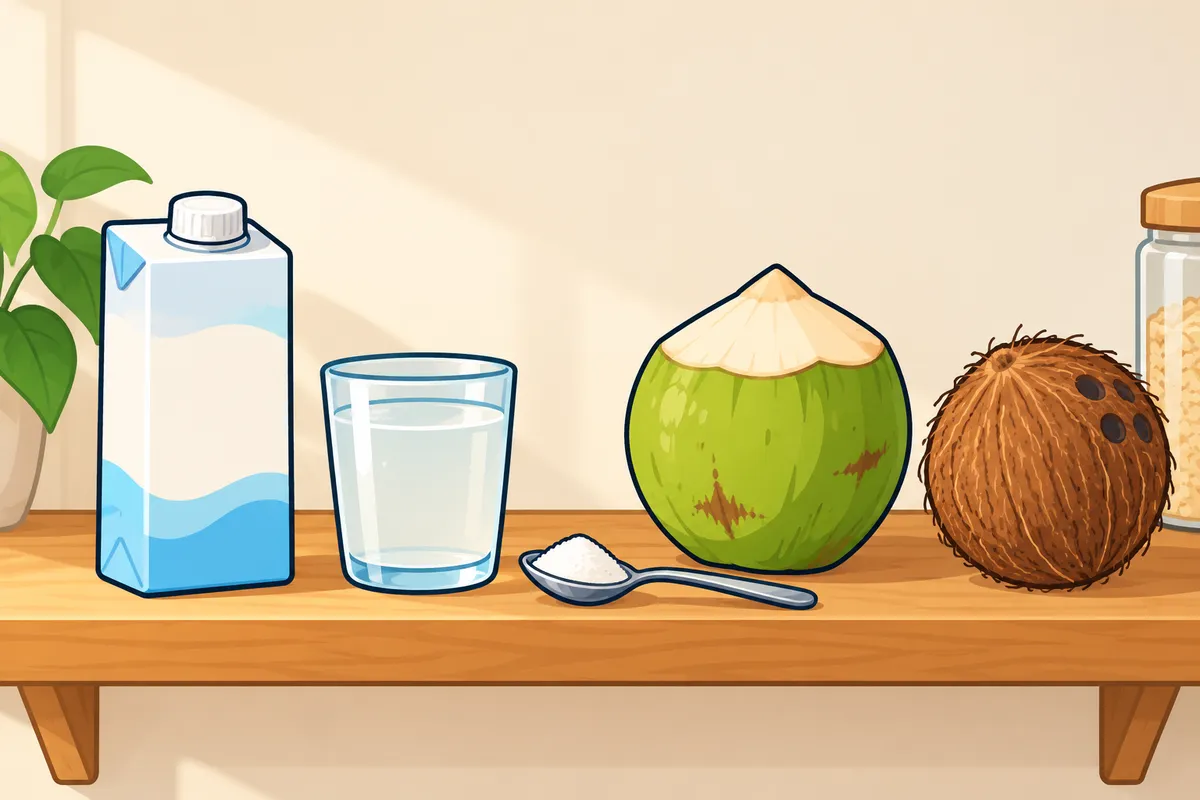
A cup (8 fl oz) of unsweetened packaged coconut water holds about 9.6 g of sugar, all of it from the coconut, and 404 mg of potassium, by USDA FoodData Central. Sweetened coconut water more than doubles the sugar, to about 21 g a cup.
So coconut water is a lightly sweet drink. The carton size decides most of what you get, and the label on your brand can sit well above or below USDA's average.
How Much Sugar Is in Coconut Water?
From about 6.3 g in a cup straight from a fresh coconut to about 44 g in a 500 ml bottle of the sweetened kind, by USDA's figures. The carton size moves the total far more than the brand does, because people rarely stop at one cup.
USDA lists packaged coconut water at 3.92 g of sugar per 100 g and weighs a cup at 245 g. The fresh coconut entry lists 2.61 g per 100 g, and the sweetened entry 8.78 g.
| Serving | Sugar, unsweetened | Sugar, sweetened | Potassium, unsweetened | Calories, unsweetened |
|---|---|---|---|---|
| 1 cup, 8 fl oz (245 g) | 9.6 g | 21.1 g | 404 mg | 44 kcal |
| Small carton, 330 ml (11.2 oz) | 12.9 g | 29.0 g | 545 mg | 59 kcal |
| Bottle, 500 ml (16.9 oz) | 19.6 g | 43.9 g | 825 mg | 90 kcal |
| Carton, 1 liter (33.8 oz) | 39.2 g | 87.8 g | 1,650 mg | 180 kcal |
Source: USDA FoodData Central 174831 (unsweetened, ready-to-drink) and 2707573 (sweetened), per 100 g; the carton rows treat 1 ml as about 1 g.
Is the Sugar in Coconut Water Natural or Added?
Natural, in a carton whose only ingredient is coconut water. The FDA counts sugars added during processing and sugars from concentrated juices as added sugars, and leaves out sugars that occur naturally in fruit, so a plain carton lists 0 g on its Added Sugars line.
A sweetened carton is the other story. Its 330 ml size carries about 16 g more sugar than the plain one; read as added sugar, that is about a third of the 50 g a day the FDA sets as the Daily Value for added sugars on a 2,000-calorie diet.
Which Sugars Are in It?
Mostly fructose. USDA's packaged entry splits the 3.92 g per 100 g into 2.14 g of fructose, 0.96 g of sucrose and 0.82 g of glucose.
- 5.2 g
- fructose in a cup
- 2.4 g
- sucrose in a cup
- 2.0 g
- glucose in a cup
Fresh coconut water from the nut holds less sugar than the packaged average and adds 1.1 g of fiber per 100 g by USDA's figures. Its total of 6.3 g a cup is the lowest of the three kinds.
Does Coconut Water Contain Potassium?
Yes, a lot for a drink: about 404 mg in a cup of unsweetened packaged coconut water and 600 mg in a cup from a fresh coconut, by USDA's figures. Plain water has none, and a sports drink has about 37 mg a cup.
On a food label, that cup reads as 9 % of the Daily Value, which the FDA sets at 4,700 mg for adults and children 4 and older. The NIH Office of Dietary Supplements counts a food as a high source at 20 % or more of the Daily Value, so:
- One cup is a modest source.
- A 1 liter carton, at 35 %, is a high one.
Measured against what healthy adults need, the numbers look bigger. NIH lists the adequate intake for adults 19 and older at:
- 2,600 mg a day for women, so a cup of packaged coconut water covers about 16 %.
- 3,400 mg a day for men, so a cup covers about 12 %.
How Does Its Potassium Compare With Orange Juice and a Banana?
A cup of packaged coconut water sits just below a cup of orange juice and a medium banana. Fresh coconut water tops all three.
The banana comes with fiber and no liquid to speak of, while the coconut water also counts toward your water for the day. Among solid foods, dried apricots, lentils and baked potatoes carry even more per serving.
How Does Coconut Water Compare With a Sports Drink and Water?
Coconut water carries more potassium and less sodium than a sports drink, and less sugar than juice or cola. Plain water carries almost nothing at all, which is the point of it.
| Per cup (8 fl oz) | Calories | Sugar | Potassium | Sodium | Magnesium | Calcium |
|---|---|---|---|---|---|---|
| Tap water | 0 kcal | 0 g | 0 mg | 10 mg | 2 mg | 7 mg |
| Coconut water, packaged, unsweetened | 44 kcal | 9.6 g | 404 mg | 64 mg | 15 mg | 17 mg |
| Coconut water, fresh from the nut | 46 kcal | 6.3 g | 600 mg | 252 mg | 60 mg | 58 mg |
| Coconut water, sweetened | 89 kcal | 21.1 g | 377 mg | 60 mg | 14 mg | 17 mg |
| Sports drink | 64 kcal | 13.0 g | 37 mg | 97 mg | 0 mg | 2 mg |
| Orange juice, 100 % | 117 kcal | 20.3 g | 449 mg | 5 mg | 25 mg | 139 mg |
| Cola, regular | 104 kcal | 24.7 g | 12 mg | 7 mg | 0 mg | 2 mg |
Source: USDA FoodData Central 2710707, 174831, 170174, 2707573, 2710769, 2709186 and 2710541, per 100 g × USDA's weight for 8 fl oz of each (240 to 248 g).
Sodium is the line that matters after hard sweating, since the NIH notes that only a very small amount of potassium leaves in sweat. A cup of packaged coconut water has about two-thirds of a sports drink's sodium, so a long, salty sweat calls for salt as well, from a sports drink or a salty snack.
Fresh coconut water is the odd one out. Its 252 mg of sodium a cup is more than twice the sports drink's 97 mg.

How Much Do Coconut Water Brands Differ?
A lot. Among the plain coconut water labels in USDA's branded-food database, the ones whose only ingredient is coconut water (sometimes with added vitamin C), the sweetest lists more than five times the sugar of the least sweet, and the richest about four times the potassium of the poorest.
| Per 240 ml (8 fl oz) | Lowest label | Middle half of labels | Highest label | USDA packaged average |
|---|---|---|---|---|
| Sugar | 3.0 g | 9.0 to 12.2 g | 17.0 g | 9.4 g |
| Potassium | 154 mg | 336 to 487 mg | 614 mg | 396 mg |
| Sodium | 5 mg | 41 to 70 mg | 130 mg | 62 mg |
Source: USDA FoodData Central Branded Foods, plain coconut water labels as listed on 22 October 2026 (for example FDC 2449556), per 100 ml × 2.4.
The middle label lists about 4.55 g of sugar and 178 mg of potassium per 100 ml, a little above USDA's average on both. So a generic figure gets you within a few grams, and only your carton's label gets you the real number.
Is Coconut Water High in Sugar?
Not compared with juice or soda. By USDA's figures, a cup holds:
- Unsweetened coconut water: about 9.6 g of sugar, under half the juice and cola figures below.
- Orange juice: 20.3 g.
- Regular cola: 24.7 g.
- Sweetened coconut water: about 21 g, in the juice range.
Where the sugar adds up is volume. A 1 liter carton of plain coconut water holds 39 g of sugar, about what a 12 oz can of regular soda carries, so treat a big carton as several drinks, not one.
If you track carbohydrate for a health reason, count coconut water as a sweet drink. Its carbohydrate is 4.24 g per 100 g in USDA's packaged entry, about 10.4 g a cup, nearly all of it sugar.
Who Should Limit Coconut Water Because of Potassium?
People whose bodies hold on to potassium. The NIH Office of Dietary Supplements says healthy kidneys pass extra potassium out in the urine, but in people with chronic kidney disease, or who take ACE inhibitors or potassium-sparing diuretics, even intakes below the adequate intake can cause high blood potassium. It also names these as raising the risk of high blood potassium, which in severe cases can cause muscle weakness and an irregular heartbeat:
- Angiotensin receptor blockers
- Type 1 diabetes
- Congestive heart failure
- Adrenal insufficiency
- Liver disease
For healthy people the picture is simpler. The NIH notes that the national committee set no upper limit for potassium, and that high intakes from food pose no risk when the kidneys work normally, because they pass the extra out in urine.

A 500 ml Bottle on a Hot Afternoon
The bottle size, more than the brand, sets how much sugar and potassium you get. This plan shows the arithmetic for one common size.
Every milliliter of that bottle also counts toward her water for the day. If she drinks it in place of a soda, she trades about 52 g of sugar in a 16.9 oz cola for 19.6 g, by USDA's cola entry at 9.94 g per 100 g and 524 g a bottle.
Check These Lines Before a Carton Goes in Your Cart
Four lines on the carton tell you what you are buying. They take a few seconds on the shelf.
Reading a Coconut Water Carton
- Ingredients: coconut water alone, or with vitamin C
- Added Sugars: 0 g on a plain carton
- Potassium: mg and % Daily Value per serving
- Serving size: compare it with the whole carton
If your carton lists more sugar than the 9 to 12 g a cup that half of all plain labels show, check the ingredient list for juice or concentrate before you blame the coconut.
Common Questions
Does coconut water have cholesterol?
No. USDA lists no cholesterol and no fat in unsweetened packaged coconut water, as you would expect from the liquid inside a fruit.
Why does coconut water sometimes turn pink?
An enzyme reaction turns it pink. Polyphenol oxidase acts on the water's own phenolic compounds, sped up by heat and traces of copper, and younger nuts pinked in a 2007 CORD study while mature ones did not.
General information for healthy adults, not medical advice. If a doctor has set your fluid amount, follow that.

More in Food and Electrolytes



Sources
- USDA FoodData Central (SR Legacy). Beverages, Coconut water, ready-to-drink, unsweetened (FDC 174831), 2019.
- USDA FoodData Central (SR Legacy). Nuts, coconut water (liquid from coconuts) (FDC 170174), 2019.
- USDA FoodData Central (FNDDS 2021-2023). Coconut water, sweetened (FDC 2707573), 2024.
- USDA FoodData Central (FNDDS 2021-2023). Sports drink (Gatorade G) (FDC 2710769), 2024.
- USDA FoodData Central (FNDDS 2021-2023). Water, tap (FDC 2710707), 2024.
- USDA FoodData Central (FNDDS 2021-2023). Orange juice, 100%, NFS (FDC 2709186), 2024.
- USDA FoodData Central (FNDDS 2021-2023). Soft drink, cola (FDC 2710541), 2024.
- USDA FoodData Central (SR Legacy). Bananas, raw (FDC 173944), 2019.
- USDA FoodData Central (Branded Foods). Coconut water, single-ingredient labels (example: 100% coconut water, FDC 2449556), 2022.
- NIH Office of Dietary Supplements. Potassium: Fact Sheet for Health Professionals, 2022.
- US Food and Drug Administration. Added Sugars on the Nutrition Facts Label, 2026.
- CORD (Garcia, Masa, Rodriguez and Rolle). Control of pink discoloration in coconut water, 2007.
Sources checked by the Glubbo Editorial Team on Oct 22, 2026. General information, not medical advice. How we write and check our guides.

