Food and Electrolytes · Sugar and Calories in Drinks
Does Sugar Dehydrate You? What Sugary Drinks Do to Your Water
What sweet drinks did to urine in two trials, what they left out, and when sugar does cost water.
 By the Glubbo Editorial Team · Updated Nov 2, 2026 · 9 min read
On This Page
- Does Sugar Dehydrate You?
- Does More Sugar in a Drink Change How Much Water You Keep?
- Does Sugar Slow Down Hydration?
- Does Sugar Make You Pee More?
- When Can Sugar Make You Lose Water?
- Is Sugar Good for Dehydration?
- Does Sugar Make You Thirsty?
- Do Sweets and Desserts Dry You Out?
- How to Fit a Sweet Drink Into a Day of Water
- Sources
Short answer
Not in trials on healthy men; two cases differ.
- 72 fasted healthy men: cola and juice left no more urine than water.
- 12 men: 10–20 % sucrose drinks left less urine than 0–5 % drinks.
- Peeing a lot and feeling very thirsty can mean high blood sugar: see a doctor.

In two fluid trials on healthy men, sugary drinks left no more urine than water, and the sweetest ones left less over 4 hours. Those trials did not test every kind of sugar intake, so this page says what each one measured.
Sugar does take water with it when blood sugar is high enough that glucose spills into your urine. A very sugary drink is also a poor choice on a day of diarrhea, according to the Merck Manual.
Does Sugar Dehydrate You?
Not in the trials that tested it. In a 2016 trial, cola and orange juice left no more urine over 4 hours than still water did, with no statistically significant difference. A later paper from the same group found that 10 % and 20 % sucrose drinks left less urine than 0 % and 5 % drinks.
2016 trial
- 72 fasted, healthy men
- 1 L of still water or 1 of 3 other drinks, over 30 minutes
- Cola and orange juice: urine not different from water
2019 paper
- 12 young, healthy, active men per group
- 1 L of drink with 0, 5, 10 or 20 % sucrose
- 10 % and 20 %: less urine than 0 % and 5 %
Both measured urine for 4 hours, one way your body sheds extra water.
A sweet drink that left more urine than water would point to drying out, and none did. "No significant difference" is not proof of exact equality, and the men were already hydrated. A can of soda counts toward your day at its full size in the same short-term sense.
Does More Sugar in a Drink Change How Much Water You Keep?
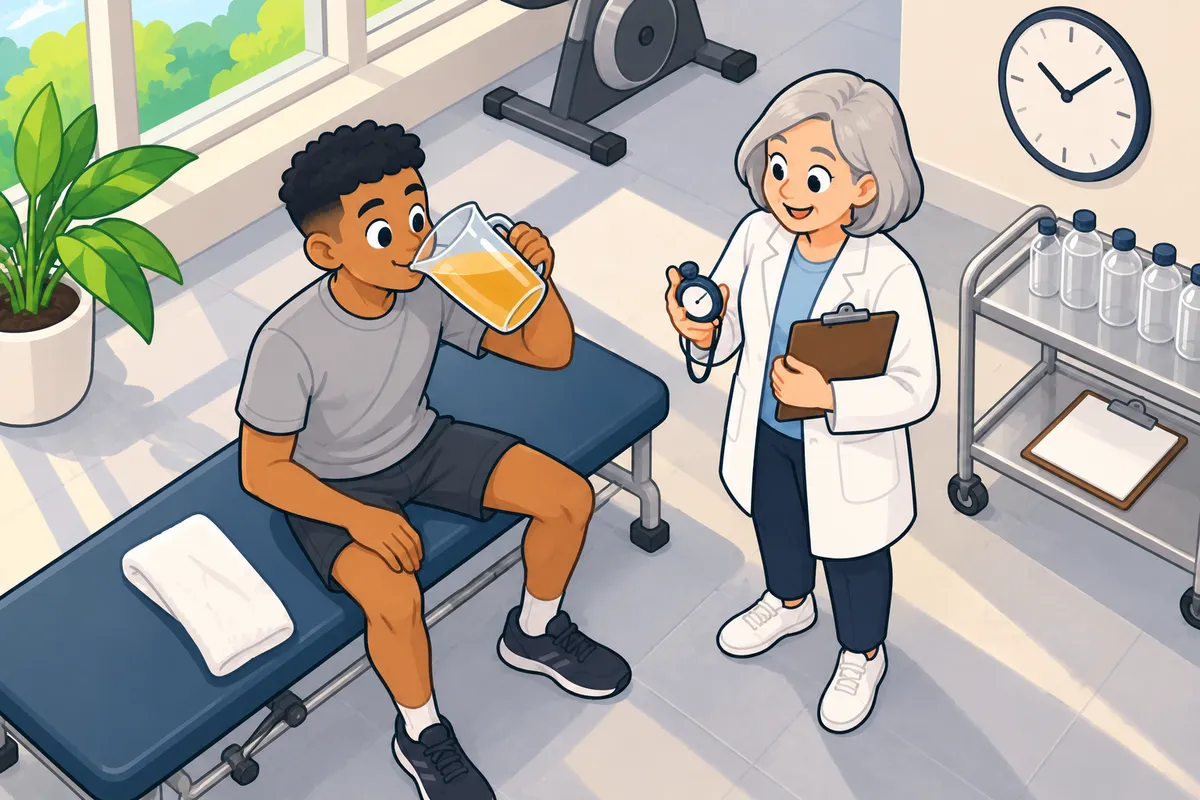
In one group of men, yes. In the 2019 paper, 12 young, healthy, active men drank 1 L of a 0 %, 5 %, 10 % or 20 % sucrose drink, double-blind and crossover, and urine was collected for 4 hours. After the 10 % and 20 % drinks, urine output was lower and net fluid balance higher than after the 0 % and 5 % drinks (p < .05).
The same paper tested salt and caffeine in two more groups of 12 men:
- Sodium: drinks with 27 and 52 mmol of sodium per liter also left less urine than drinks with 7 and 15 mmol.
- Caffeine: from 0 to 400 mg per liter it made no difference (p = .83).
Sugar Level by Sugar Level
Regular cola is about 9.9 % sugar by weight in USDA FoodData Central, so it sits near the 10 % level. A 12 oz (355 ml) can weighs 370 g in USDA's portion list and holds about 37 g of sugar; the table turns each trial drink into cans of cola, as a rough comparison.
| Sucrose in the 1 L drink | Sugar in that liter | Same sugar as | Urine over 4 hours |
|---|---|---|---|
| 0 % (the trial's sugar-free control drink) | Close to 0 g | No cola comparison | More than the 10 % and 20 % drinks |
| 5 % | About 50 g | 1.4 cans of cola | More than the 10 % and 20 % drinks |
| 10 % | About 100 g | 2.7 cans of cola | Less: more fluid kept |
| 20 % | About 200 g | 5.4 cans of cola | Less: more fluid kept |
Sugar in the liter assumes the percent is grams per 100 ml. The cola figure is a percent by weight and the paper's methods give sucrose in grams per liter, so the cans are approximate. The 20 % drink holds about twice the sugar of regular cola, so the paper tested sugar well past normal drinking.
In that paper, the liter with about five cans' worth of sugar left less urine than the sugar-free drink. Fluid retention over 4 hours is what it scored, and the 37 g of sugar in each can is a separate cost.
Who Took Part, and What That Leaves Out
Every drinker in both trials was a healthy man who started well hydrated, and each drank 1 L over a short time. The 2016 men had not eaten beforehand. These trials do not cover:
- women
- people with diabetes
- sugar eaten in food
- anything past the first 4 hours of urine, so they do not show what happens to hydration over a whole day, or after a smaller drink
Does Sugar Slow Down Hydration?
In the 2019 paper, sweeter drinks were retained more, and the authors say the key driver is energy density, "likely through slowed fluid delivery to the circulation." They did not measure stomach emptying, so that is a likely explanation, not a result.
A separate 1995 study of six healthy men measured stomach emptying of 600 ml glucose and glucose polymer solutions, not the trial drinks. A concentrated glucose solution (188 g per liter) took 130 minutes to half empty, and a dilute one (40 g per liter) took 17. Its authors concluded that carbohydrate content matters more than osmolality, and it counted no urine.
Does Sugar Make You Pee More?
Not when your blood sugar is normal. Your kidneys filter glucose out of your blood and then, in MedlinePlus's words, "hold on to glucose and send it back to your bloodstream," so normal urine holds very little or none. With no sugar in the urine, sugar has nothing to pull water out with.
High blood sugar changes that, in the order the Merck Manual describes:
How High Blood Sugar Turns Into More Urine
- Your kidneys filter glucose out of the blood with the water
- The kidney tubules take the glucose back, up to a limit
- Above that limit, glucose stays in the urine
- Water follows the glucose, so you pass more urine
MedlinePlus says normal urine holds very little or no glucose, so at normal blood sugar there is no glucose in the urine to hold water there.
When Can Sugar Make You Lose Water?
Sugar in a cake, sugar in a drink, high blood sugar and diarrhea are four different situations. The drink trials above cover only the second. The two cases with a sourced water cost are high blood sugar and diarrhea.
Is sugar costing you water?
1Are you peeing a lot, very thirsty or waking at night to pee?
YesAsk about your blood sugar. MedlinePlus and the NIDDK list these among the signs of high blood sugar and diabetes, and advise talking to a health care professional.
No2Do you have diarrhea or vomiting?
YesSkip soda, juice and sports drinks. The Merck Manual says not to use them to rehydrate. Ask a pharmacist for the glucose and sodium solution it describes.
NoOtherwiseThese trials found no water cost. In the trials on healthy men, sweet drinks left no more urine than water. Desserts were not tested.
High Blood Sugar
High blood sugar is the case where sugar really does take water with it. MedlinePlus lists these among its signs:
- being very thirsty, a dry mouth and needing to urinate a lot
- getting up at night to pee
The cause there is the glucose level in your blood, which your body controls in health.
The NIDDK names "increased urination" and "feeling very thirsty" as common symptoms of diabetes, and advises talking with your health care professional about any symptoms you have. Diabetes and water loss work in both directions, and how much to drink with diabetes is a question of its own.
Diarrhea and Vomiting
The Merck Manual says this about sports drinks, sodas, juices and similar drinks:
- they "generally have too little sodium and too much carbohydrate" for the gut's sodium-glucose transport
- the osmotic effect of the excess carbohydrate "may result in additional fluid loss"
- you should not use them for rehydration
Is Sugar Good for Dehydration?
For dehydration from diarrhea, a small amount of glucose paired with sodium is part of the standard solution. The WHO describes oral rehydration solution as a mixture of clean water, salt and sugar that your small intestine absorbs. Glucose and sodium cross the gut wall together, so the sugar helps the salt and water in.
The dose decides whether sugar helps or hurts. Merck lists the WHO formula as 75 mmol of glucose and 75 mmol of sodium in each liter, and glucose weighs about 180 g per mole, so that is about 13.5 g of sugar per liter.
Plain sugar water lacks the sodium. Merck says a rehydration solution needs glucose and sodium together, at about a 1:1 ratio, so sugar water alone is not a rehydration solution for diarrhea. For children and for severe diarrhea, follow the WHO or your doctor's guidance.
Does Sugar Make You Thirsty?
In one breakfast study, a sweet drink quenched thirst as well as sparkling water. In a 2003 study, 32 volunteers aged 18 to 35 (14 men and 18 women) each had a slice of toast with 590 ml (20 oz) of regular cola, orange juice, 1 % milk or sparkling water, on four different days. They rated thirst every 20 minutes for 2 hours, and the study reports that all four drinks satisfied thirst equally well.
That study used thirst ratings only, with no urine or blood tests, and only those four drinks with toast.
Thirst that keeps coming back with frequent peeing is a different matter. That pair is a common diabetes symptom in the NIDDK's list, so ask your doctor about a blood sugar test instead of drinking more soda to chase it.
Do Sweets and Desserts Dry You Out?
The drink trials did not test food, so they cannot say what a candy bar or a slice of cake does to your water, and there is no answer for desserts. If you are peeing a lot and very thirsty after sweets, that pattern is on the blood sugar list above, so ask a doctor.
Fruit is the sweet food that does add water. Juicy fruit and other watery foods count toward your daily water on top of your drinks.
How to Fit a Sweet Drink Into a Day of Water
Log the sweet drink as fluid and judge it by its sugar. The trials did not find that a sweet drink cost water in healthy men over 4 hours, and they did not test a whole day. A 12 oz can is 12 oz (355 ml) of fluid and about 37 g of sugar, which counts toward your added sugar.
Two cases change that:
- If you are always thirsty and peeing a lot, ask your doctor about blood sugar.
- On a stomach bug, use a pharmacy rehydration solution instead of soda.
If you want fewer sweet drinks, the daily added sugar limits show how far one can goes. Swapping it for water keeps your fluid the same and drops the sugar to zero.
General information for healthy adults, not medical advice. If a doctor has set your fluid amount, follow that.

More in Food and Electrolytes
Sources
- American Journal of Clinical Nutrition (Maughan and colleagues). A randomized trial to assess the potential of different beverages to affect hydration status: development of a beverage hydration index, 2016.
- International Journal of Sport Nutrition and Exercise Metabolism (Maughan and colleagues). Sucrose and Sodium but not Caffeine Content Influence the Retention of Beverages in Humans Under Euhydrated Conditions, 2019.
- Journal of Physiology (Vist and Maughan). The effect of osmolality and carbohydrate content on the rate of gastric emptying of liquids in man, 1995.
- Physiology and Behavior (Almiron-Roig and Drewnowski). Hunger, thirst, and energy intakes following consumption of caloric beverages, 2003.
- USDA FoodData Central (SR Legacy). Beverages, carbonated, cola, regular (FDC 174852), 2018.
- MedlinePlus (US National Library of Medicine). Glucose in Urine Test, 2024.
- MedlinePlus (US National Library of Medicine). High blood sugar - self-care, 2026.
- Merck Manual Professional Version. Polyuria, 2024.
- Merck Manual Professional Version. Oral Rehydration Therapy, 2025.
- National Institute of Diabetes and Digestive and Kidney Diseases. Symptoms and Causes of Diabetes, 2024.
- World Health Organization. Diarrhoeal disease (fact sheet), 2024.
Sources checked by the Glubbo Editorial Team on Nov 2, 2026. General information, not medical advice. How we write and check our guides.

