Food and Electrolytes · Water in Food
Do Pickles Help With Dehydration? The Water and Salt in One Pickle
How much water and salt a pickle really holds, when the salt helps you keep fluid, and when it works against you.
 By the Glubbo Editorial Team · Updated Oct 19, 2026 · 9 min read
On This Page
- Do Pickles Help With Dehydration?
- Are Pickles Hydrating?
- How Much Sodium Is in One Pickle?
- When Can the Salt in a Pickle Help?
- Is Pickle Juice Hydrating?
- Do Pickles Dehydrate You?
- Can Pickles Replace a Rehydration Drink When You Are Sick?
- Who Should Not Eat Pickles to Rehydrate?
- Water All Day, Salt With Lunch
- Sources
Short answer
Only as salt alongside water, after heavy sweating.
- A large dill pickle holds 127 g of water and 1,092 mg of sodium (USDA).
- That sodium is 47 % of the 2,300 mg daily limit in one snack.
- Sick with vomiting or diarrhea? A pharmacy rehydration solution does the job, not pickles.

Only a little, and only as salt alongside water. A large dill pickle holds about 127 g of water next to 1,092 mg of sodium, so it is useful after hours of heavy sweating and unhelpful in most other situations.
The idea sounds right on paper: pickles are mostly water, the brine is salty, and you lose salt when you sweat. The numbers show one pickle carrying a lot of salt and very little water.
Do Pickles Help With Dehydration?
A little, and only alongside water. A large dill pickle holds about 127 g of water and 1,092 mg of sodium in USDA data, so it adds salt far faster than fluid.
After heavy sweating, that salt helps your body hold the water you drink. On its own, a pickle does not rehydrate you.
- 94 %
- of a dill pickle's weight is water
- 127 g
- of water in one large 4-inch pickle, about 4.3 fl oz
- 1,092 mg
- of sodium in that pickle, 47 % of the 2,300 mg daily limit
The salt can help in one case, after you have sweated hard for hours. The water barely counts, about half a glass in a whole large pickle.
Are Pickles Hydrating?
Not much. A pickle is 94.3 % water in the USDA entry, nearly as watery as fresh cucumber, but a normal serving is small: a small spear weighs 35 g and gives you 33 g of water, about two tablespoons. You would need seven large pickles to match one 30 oz bottle.
Dill, Sour, Sweet or Reduced-Sodium
The table compares the pickle family with the cucumber it starts from. Water barely changes; the sodium changes by a factor of several hundred.
| Food, USDA serving | Water | Sodium | Sugar |
|---|---|---|---|
| Fresh cucumber with peel, 135 g | 128.5 g | 2.7 mg | 2.3 g |
| Dill pickle, small spear (35 g) | 33.0 g | 283 mg | 0.4 g |
| Dill pickle, large 4-inch (135 g) | 127.3 g | 1,092 mg | 1.4 g |
| Dill pickle slices, 1 cup (155 g) | 146.2 g | 1,254 mg | 1.7 g |
| Sour pickle, large (135 g) | 127.0 g | 1,634 mg | 1.4 g |
| Reduced-sodium dill, large (135 g) | 127.3 g | 24 mg | 1.4 g |
| Sweet pickle slices, 1 cup (153 g) | 116.6 g | 699 mg | 28.0 g |
| Sauerkraut with liquid, 1 cup (236 g) | 218.3 g | 1,560 mg | 4.2 g |
Sources: USDA FoodData Central entries for dill, sour and reduced-sodium dill pickles, sweet pickles, sauerkraut and raw cucumber.
Four kinds of pickle, four different jobs
Dill pickle
Salt top-up
- 809 mg sodium per 100 g
- 94.3 % water
Suits you if you sweated for hours and want salt with your water.
Sour pickle
Saltiest
- 1,210 mg sodium per 100 g
- 94.1 % water
Suits you if you want the strongest brine and have room for the salt.
Reduced-sodium dill
Crunch without salt
- 18 mg sodium per 100 g
- 94.3 % water
Suits you if you limit salt but like pickles with lunch.
Sweet pickle
Sugar, not salt
- 457 mg sodium per 100 g
- 18.3 g sugar per 100 g
Suits you if you treat it as a sweet relish, not a rehydration snack.
The reduced-sodium row is the one to notice. It holds the same water as a regular dill pickle with about 2 % of the sodium, so it behaves like a crunchy cucumber, not a salt dose.
For water alone, eat the cucumber; a pickle only earns its place when you need the salt. A whole fresh cucumber holds about 287 g of water and about 6 mg of sodium.
How Much Sodium Is in One Pickle?
Between about 280 mg and 1,630 mg, depending on size and brine. A small dill spear holds 283 mg, a large dill pickle 1,092 mg and a large sour pickle 1,634 mg in USDA data. The FDA calls 20 % of the Daily Value (460 mg) or more per serving a high-sodium food.
One large dill pickle carries about three times the sodium of an ounce of salted pretzels, and seven times that of an ounce of salted potato chips. Against the FDA's limit of less than 2,300 mg a day, and the 3,400 mg that Americans eat on an average day, most people already have more than enough salt before the pickle.
How Many Pickles a Day Is Too Many?
Two large dill pickles hold 2,184 mg of sodium, 95 % of the 2,300 mg daily limit, so for most people one a day is already a lot of salt and two is the whole day's allowance.
A small spear costs 283 mg, 12 % of the limit, and a reduced-sodium pickle 24 mg. The kind you pick changes the answer more than the count does.
When Can the Salt in a Pickle Help?
After long, heavy sweating, when you lose sodium as well as water. The FDA notes that sodium "attracts water" and draws it into the bloodstream, so salt eaten with your drink helps you keep the fluid you are trying to replace.
For a short workout or a normal day, the salt you already eat covers it.
How much salt you sweat out varies widely. A 2019 review in the journal Temperature puts sweat sodium at 10 to 90 mmol per liter, which is about 230 to 2,070 mg of sodium in every liter of sweat.
Is Pickle Juice Hydrating?
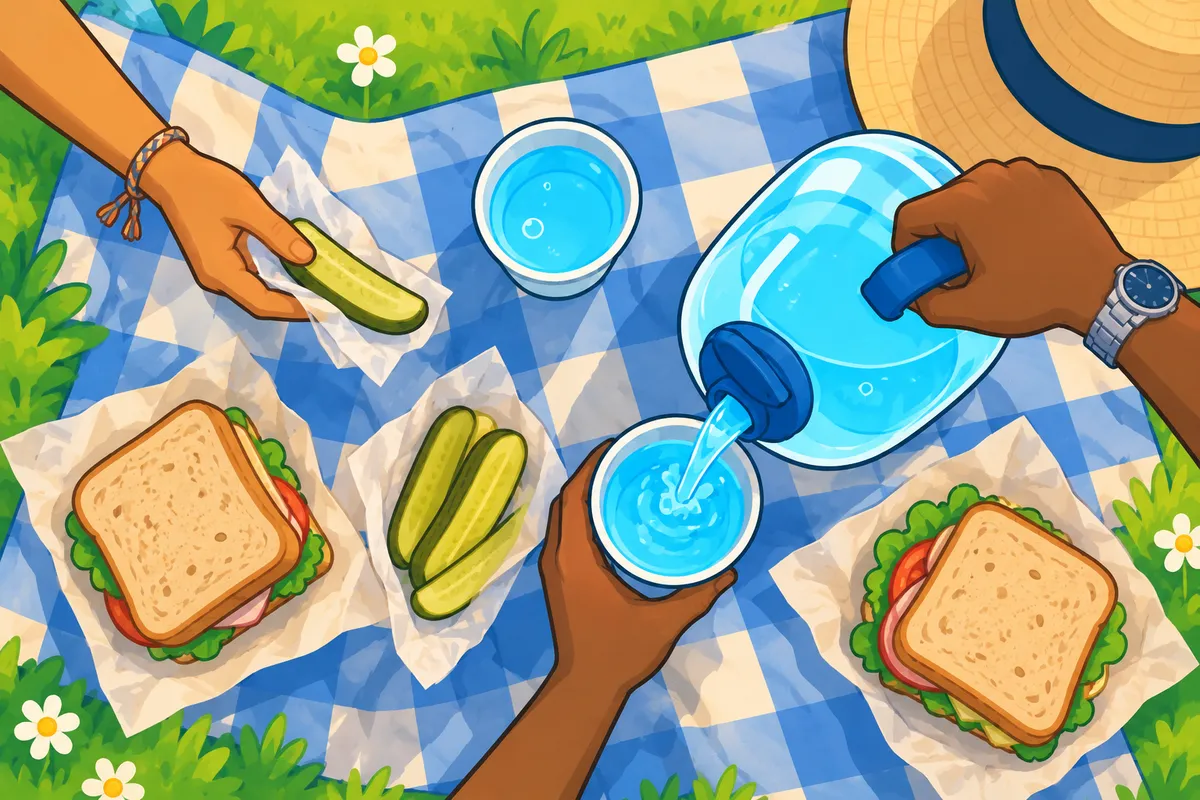
Not as a drink. The brine is mostly water, but it is so salty that a cup would hold 2,300 to 5,400 mg of sodium, one to two and a half days' limit, going by the 415 to 979 mmol per liter that lab studies measured in commercial brines. Sips are the only sensible serving.
Two trials show what the juice does and does not do:
- In a 2009 lab study, men who drank about 86 ml of pickle juice, with roughly 820 mg of sodium in it, showed no change in blood volume over the next hour, so such sips do not make up a fluid deficit.
- Where pickle juice did show an effect was on cramps: in a later trial, a cramp ended 49 seconds sooner after pickle juice than after water.
Do Pickles Dehydrate You?
No good evidence says they do. A salty snack makes you thirsty, which pushes you to drink, but the US National Academies' water report found that raising sodium intake 40-fold changed urine volume very little in one study, from 2.1 to 2.3 liters a day. Your kidneys handle the salt and you drink more.
The Academies' water chapter is careful here. Across the studies it reviewed, it says, "it is not possible to determine the extent to which sodium intake influences water intake," so neither side of the claim is proven for an extra pickle.
What does happen is thirst. If a jar of pickles leaves you reaching for water, drink it; that is your body correcting the salt, and the glass counts toward your day.
Can Pickles Replace a Rehydration Drink When You Are Sick?
No. For vomiting or diarrhea, the NHS advises fluids and, when you are losing a lot, an oral rehydration solution from a pharmacy that puts back sugar, salts and minerals.
The WHO describes that solution as clean water, salt and sugar. A pickle supplies only the salt.
Oral rehydration solution
- Water, salt and sugar in set amounts
- Mostly fluid, sipped often
- Sold by pharmacies for vomiting and diarrhea
Pickles or pickle juice
- Salt, with very little water per bite
- No sugar to help the gut absorb the salt
- Acidic brine on an upset stomach
The acid matters on a sick day too. The 2009 study notes that acidic, salty drinks like pickle juice should slow stomach emptying, which delays water and salt reaching your gut, the opposite of what an upset stomach needs. The NHS also suggests small sips if you feel sick, then more as you manage it.

Who Should Not Eat Pickles to Rehydrate?
Anyone told to limit salt or fluid. The FDA links high-sodium diets to high blood pressure, a major cause of stroke and heart disease, and one large pickle uses up almost half a day's 2,300 mg. People with heart failure or kidney disease often have both salt and fluid limits from their doctor.
Sweet and bread-and-butter pickles bring a different trade. They carry less sodium, about 700 mg a cup, but 28 g of sugar in that cup, which counts toward the foods that pile up sugar without tasting like dessert.
Water All Day, Salt With Lunch
Plan the water first and let the salt ride along with food. A pickle is worth its 1,092 mg of sodium only on a day you sweated some of it out.
A hot day, from first glass to dinner
4 items- Drink water through the day; a pickle adds only half a glass
- Sweat for hours? Add a salty snack, such as one pickle, at lunch
- Count it: a large dill pickle is about 1,092 mg of sodium
- Let dinner bring back the rest of the salt and minerals
On a salt or fluid limit, ask your doctor before using pickles this way, and for vomiting or diarrhea use a pharmacy rehydration solution instead. Reduced-sodium dill pickles, at 24 mg each, give you the crunch without the salt.
For the days you do sweat for hours, a sports drink and a pickle answer different needs, and the sodium a long session calls for depends on how long and how hard you work.
General information for healthy adults, not medical advice. If a doctor has set your fluid amount, follow that.

More in Food and Electrolytes

Sources
- USDA Agricultural Research Service, FoodData Central. Pickles, cucumber, dill or kosher dill (SR Legacy 168558), 2019.
- USDA Agricultural Research Service, FoodData Central. Pickles, cucumber, sour (SR Legacy 169379), 2019.
- USDA Agricultural Research Service, FoodData Central. Pickles, cucumber, dill, reduced sodium (SR Legacy 168563), 2019.
- US Food and Drug Administration. Sodium in Your Diet, 2024.
- Journal of Athletic Training (Miller, Mack and Knight). Electrolyte and Plasma Changes After Ingestion of Pickle Juice, Water, and a Common Carbohydrate-Electrolyte Solution, 2009.
- Temperature (Baker). Physiology of sweat gland function: The roles of sweating and sweat composition in human health, 2019.
- Institute of Medicine (National Academies). Dietary Reference Intakes for Water, Potassium, Sodium, Chloride, and Sulfate, Chapter 4: Water, 2005.
- NHS. Dehydration, 2026.
- World Health Organization. Diarrhoeal disease (fact sheet), 2024.
Sources checked by the Glubbo Editorial Team on Oct 19, 2026. General information, not medical advice. How we write and check our guides.

