Food and Electrolytes · Electrolytes and Minerals
Does Pickle Juice Help Muscle Cramps? What the Lab Trials Found
The trials behind the sideline remedy, how fast it worked, how much salt you swallow, and when a cramp needs a doctor.
 By the Glubbo Editorial Team · Updated Oct 19, 2026 · 9 min read
On This Page
- Does Pickle Juice Help Muscle Cramps?
- How Fast Does Pickle Juice Work on a Cramp?
- Why Would Pickle Juice Stop a Cramp?
- How Much Sodium Is in Pickle Juice?
- How Much Pickle Juice Should You Drink for a Cramp?
- Does Pickle Juice Rehydrate You?
- Does Pickle Juice Work for Night Leg Cramps?
- Cramp Remedies Side by Side
- Who Should Not Drink Pickle Juice for Cramps?
- When the Next Cramp Hits
- Sources
Short answer
It shortened lab cramps, but salt is not why.
- Lab cramps lasted 85 seconds after pickle juice and 134 after water (Miller 2010).
- About 80 ml of juice raised no blood salt within an hour, so a reflex is the likely cause.
- That sip can hold over 1,500 mg of sodium; skip it if you were told to limit salt.
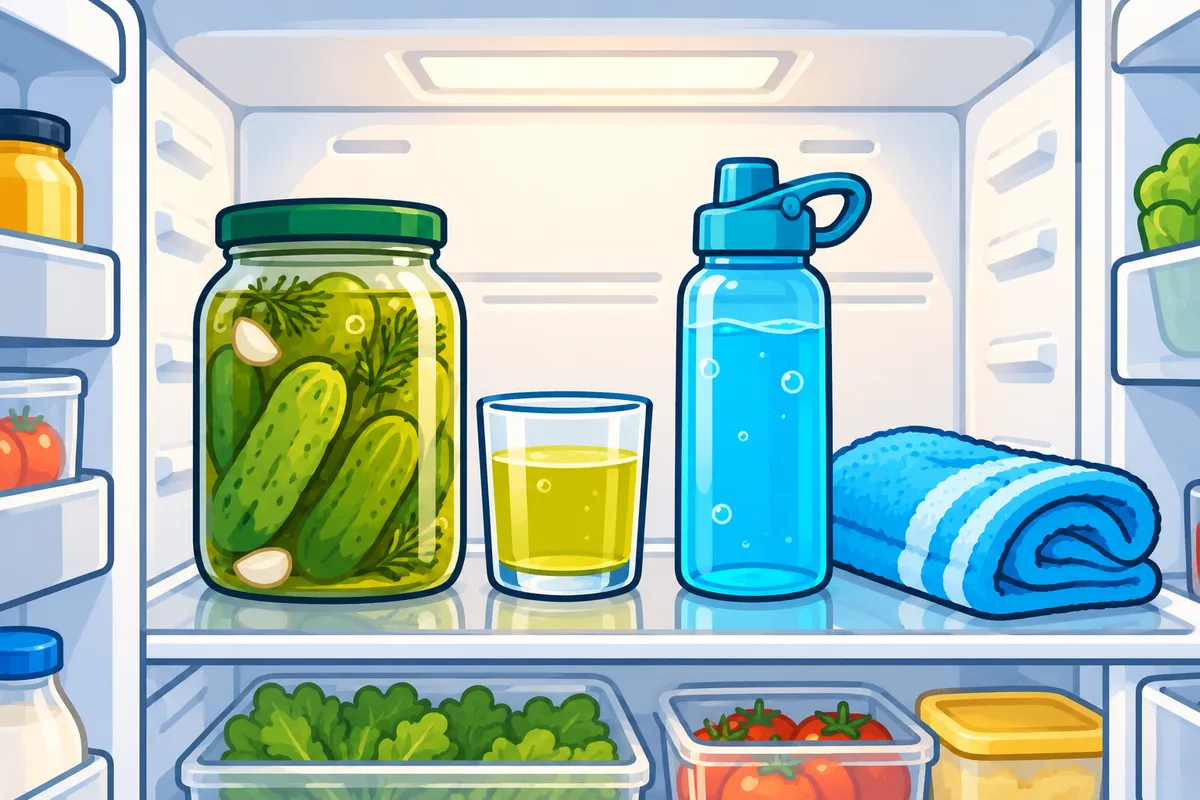
In the one lab trial of it, pickle juice ended an electrically induced foot cramp 49 seconds sooner than water, and the likely reason is a reflex from the mouth and throat, not the salt. A small sip carries up to 1.5 g of sodium, so skip it if you were told to limit salt.
Every season a player goes down with a calf cramp and a trainer jogs over with a small cup of green brine: 25 % of athletic trainers (92 of 370) in one survey had used it. The trials behind the remedy come mostly from one lab in the United States.
Does Pickle Juice Help Muscle Cramps?
In a lab trial, yes: it ended cramps faster than water. Researchers cramped a small foot muscle in dehydrated men with an electric current, and after a sip of pickle juice the cramp lasted 49 seconds less than after water. That is one small trial on cramps made by a machine, not a cure for every cramp.
How the 2010 cramp trial worked
- Men exercised until they lost about 3 % of their body weight in sweat
- A current to a nerve in the leg set off a cramp in a small muscle of the big toe
- At a second cramp they drank 1 ml per kg of body weight of pickle juice or water, about 74 ml
- The team timed each cramp and measured the muscle's electrical activity and blood salts
The trial, published in Medicine and Science in Sports and Exercise, used the same people on two days a week apart, once with water and once with pickle juice. Without a drink, their first cramps lasted about the same on both days, 152 and 153 seconds.
After pickle juice
- Cramp lasted 84.6 seconds
- 49.1 seconds shorter than with water
- No change in blood sodium or fluid
After water
- Cramp lasted 133.7 seconds
- About the same as with no drink
- No change in blood sodium or fluid
Forty-nine seconds out of 134 is a cut of about 37 %. The muscle's electrical activity during the cramp did not differ between the two drinks, only how long the cramp lasted.
How Fast Does Pickle Juice Work on a Cramp?
Within about a minute and a half. In the 2010 trial the cramp lasted 84.6 seconds on average when the sip came right at its start, and the same lab later wrote that small volumes relieve cramps within 85 seconds. That is far too fast for anything in the juice to reach the muscle through the blood.
The speed is the clue. If salt were doing the work, it would first have to leave your stomach, pass into your blood and travel to the leg, which takes much longer than a minute.
Why Would Pickle Juice Stop a Cramp?
Probably through a reflex that starts in your mouth and throat, not through salt. The 2010 authors suspect the sour, salty taste fires nerves that tell the spinal cord to stop the cramping muscle's signals. The juice works, if it works, before you have absorbed any of it.
A second study from the same lab gave rested men a large drink, 7 ml per kg, of pickle juice or water and tracked their stomachs. Both drinks began to empty in the first 5 minutes. After that the water kept leaving, down to about 112 ml by 30 minutes, while the pickle juice stopped, held back, the authors think, by its acidity and saltiness.
They worked out that only about 8 to 10 ml of pickle juice would leave the stomach in the under-a-minute window when cramps ease. That is too little to change the salt in your body, which supports the reflex idea.
What Each Study Measured
| Study | Who | What they drank | What happened |
|---|---|---|---|
| Miller 2010, MSSE | Dehydrated men, lab cramps | 1 ml/kg pickle juice or water | Cramp 49.1 s shorter with pickle juice |
| Miller 2010, J Athl Train | 10 rested men | 7 ml/kg pickle juice or water | Pickle juice stayed in the stomach; little absorbed |
| Allen 2013 | 15 men after 60 min of hard exercise | About 83 ml pickle juice, salt water or water | Blood salt unchanged; drank about as much water afterwards (700 ml vs 533 ml) |
| Miller 2014 | 9 people after 2 h in the heat | About 79 ml pickle juice, or mustard | No change in blood sodium or potassium in 60 min |
| McKenney 2015 | 9 men exercising in the heat | 1 or 2 sips of 1 ml/kg | No rise in blood sodium, no high potassium |
| Tapper 2022 | 74 people with cirrhosis | Sips of brine or tap water at cramp onset | Cramp severity fell more with brine over 28 days |
Sources: Miller 2010, Miller 2010 gastric study, Allen 2013, Miller 2014, McKenney 2015, Tapper 2022.
None of these trials tested a real cramp in the middle of a match. They tested a cramp made by a machine, or blood salts after a sip, so a calf cramp at mile 20 of a marathon is still an open question.
How Much Sodium Is in Pickle Juice?
A lot for a small cup. When the 2014 study tested its jar, the brine held 832.5 mmol of sodium per liter, and its 79 ml sip delivered about 1.5 g of sodium. Other brines studied ranged from 415 to 979 mmol per liter, so the jar you buy matters.
- 1.5 g
- sodium in a 79 ml sip of the 2014 study's brine
- pH 3.68
- acidity of that brine, close to vinegar
- 415–979
- mmol of sodium per liter across the brines studied
Turned into everyday units, that 832.5 mmol per liter works out to about 19 mg of sodium in every milliliter. Trainers who give 2 ounces (60 ml) are handing over about 1,150 mg, half of the 2,300 mg a day that US guidelines set as the limit.
How Much Pickle Juice Should You Drink for a Cramp?
About 1 ml per kg of body weight, which is 2 to 3 ounces for most adults. The 2010 cramp trial used that dose, about 74 ml, taken in one go once the cramp had started; a 2015 study found up to two such doses during exercise caused negligible changes in blood sodium and potassium.
| Body weight | Dose at 1 ml per kg | 2014 brine, 19 mg/ml sodium | Mild brine, 9.5 mg/ml sodium |
|---|---|---|---|
| 110 lb (50 kg) | 50 ml, 1.7 oz | 955 mg | 475 mg |
| 132 lb (60 kg) | 60 ml, 2.0 oz | 1,145 mg | 570 mg |
| 154 lb (70 kg) | 70 ml, 2.4 oz | 1,335 mg | 665 mg |
| 176 lb (80 kg) | 80 ml, 2.7 oz | 1,530 mg | 760 mg |
| 198 lb (90 kg) | 90 ml, 3.0 oz | 1,720 mg | 855 mg |
| 220 lb (100 kg) | 100 ml, 3.4 oz | 1,910 mg | 950 mg |
The sodium in your own jar decides which column you are in, and the label gives it per small serving, so scale it up to the dose. Both cramp trials, the 2010 lab study and the 2022 cirrhosis trial, gave the juice after a cramp began; none of them tested drinking it beforehand to prevent one.

Does Pickle Juice Rehydrate You?
Not by itself. After 2 hours of hard exercise in the heat, people in the 2014 study had lost about 2 liters of sweat and roughly 2,200 mg of sodium, and a 79 ml sip of pickle juice "did not fully replenish" either. You still need to drink and eat afterwards.
Sipping it did not stop people drinking, though. Researchers had worried that the salt would quench thirst too early, but in the 2013 study people drank about 700 ml of water in the hour after pickle juice and 533 ml after plain water, a gap too small to rule out chance. They rated the taste poorly, 26 out of 100 against 73 for water.
Eating the pickles instead changes little, since one large dill pickle holds about 127 g of water next to its salt.
What the 2013 and 2014 sips mostly do is replace a little salt. The real refill comes from fluid over the next hours and a salty meal, and the trials linking dehydration to cramps in the first place are mixed, as the studies on sweat losses and cramping show.
Does Pickle Juice Work for Night Leg Cramps?
There is no trial in healthy people with night cramps. The one trial outside sport, the 2022 PICCLES study, enrolled 82 people with liver cirrhosis who had more than 4 cramps a month and asked them to sip pickle brine or tap water when a cramp began.
After 28 days, cramp severity on a 0 to 10 scale fell by 2.25 points with brine and 0.36 with water. The authors reported no side effects from the brine, though everyone in it was under a liver doctor's care.
For night cramps in older adults, magnesium is the other popular remedy, and a Cochrane review found that magnesium supplements are unlikely to help them, so a pill is not the answer for most.

Cramp Remedies Side by Side
Stretching is the one remedy MedlinePlus names first, and the others work alongside it. The trials above support each of them to a different degree.
What to reach for when a cramp hits
Stretch and massage
First step
- MedlinePlus's home care for cramps
- No salt, no cost
Suits you if any cramp, anywhere, before anything else.
A sip of pickle juice
Shortened lab cramps
- Cramp 49 s shorter than water
- About 19 mg of sodium per ml
Suits you if you cramp in sport, tolerate sour tastes and have no salt limit.
Yellow mustard
Same salt, more to swallow
- No blood salt change in 60 min
- 135 g to match a sip's sodium
Suits you if you would rather eat than drink something salty.
Water and a salty meal
The real refill
- Replaces the liters you sweated
- Food brings the sodium back
Suits you if you have finished a long, sweaty session.
The mustard figure comes from the 2014 study, where people ate about 135 g of mustard to get roughly the same sodium as the pickle juice. Neither changed blood sodium or potassium within an hour.
Who Should Not Drink Pickle Juice for Cramps?
Anyone told to limit salt, such as people with high blood pressure, heart failure or kidney disease. One sip can carry 750 to over 1,500 mg of sodium, a large share of a day's 2,300 mg limit. People with reflux or a sensitive stomach may also find the acid hard to take.
When the Next Cramp Hits
The trials support pickle juice as a quick, salty sip that may shorten a cramp, not as a drink that fixes what caused it. Pick the line that fits you.
If a cramp catches you
- Calf or foot cramp during sport, no salt limitStretch, then a small sip of pickle juice if you like the taste
- You have high blood pressure or were told to cut saltStretch and massage; skip the brine
- Two hours of hard work in the heatWater over the next hours and a salty meal; the sip alone refills nothing
- Night leg cramps that keep waking youStretch, and see your doctor if they keep coming back
- Cirrhosis and frequent crampsAsk your liver doctor about the PICCLES trial
A cramp is over in seconds or minutes. The ache that peaks two days after a hard session is a different problem with different causes.
General information for healthy adults, not medical advice. If a doctor has set your fluid amount, follow that.

More in Food and Electrolytes


Sources
- Medicine and Science in Sports and Exercise (Miller and others). Reflex inhibition of electrically induced muscle cramps in hypohydrated humans, 2010.
- Journal of Athletic Training (Miller, Mack and Knight). Gastric emptying after pickle-juice ingestion in rested, euhydrated humans, 2010.
- Journal of Athletic Training (Miller). Electrolyte and plasma responses after pickle juice, mustard, and deionized water ingestion in dehydrated humans, 2014.
- Journal of Athletic Training (Allen and others). Ad libitum fluid intake and plasma responses after pickle juice, hypertonic saline, or deionized water ingestion, 2013.
- Journal of Athletic Training (McKenney and others). Plasma and electrolyte changes in exercising humans after ingestion of multiple boluses of pickle juice, 2015.
- American Journal of Gastroenterology (Tapper and others). Pickle Juice Intervention for Cirrhotic Cramps Reduction: The PICCLES Randomized Controlled Trial, 2022.
- MedlinePlus, US National Library of Medicine. Muscle cramps, 2024.
Sources checked by the Glubbo Editorial Team on Oct 19, 2026. General information, not medical advice. How we write and check our guides.

