Sleep and Recovery · Rest and Recovery
Why Am I Sore Two Days After a Workout? DOMS and What Helps
Why soreness peaks on day two or three, how long it lasts, what the Cochrane reviews found, and when it is not DOMS.
 By the Glubbo Editorial Team · Updated Oct 19, 2026 · 10 min read
On This Page
- Why Am I Sore Two Days After a Workout?
- What Is Delayed Onset Muscle Soreness?
- Is Lactic Acid the Cause of Muscle Soreness?
- How Long Does Muscle Soreness Last?
- Does Sore Mean You Had a Good Workout?
- What Actually Helps Sore Muscles?
- Should You Work Out When You Are Still Sore?
- Why Am I Less Sore the Second Time I Do a Workout?
- Where Sleep and Water Fit In
- Easy Days, Lighter Sets, Then Back to Normal
- Common Questions
- Sources
Short answer
It is DOMS, and it peaks 48 to 72 hours later.
- Lowering moves and unfamiliar exercise cause it, through tiny damage in the muscle.
- Lactic acid is not the cause: downhill runners got sore with no rise in it.
- Light exercise eases it for a while; stretching barely changes it, Cochrane found.
It is delayed onset muscle soreness, DOMS, and it peaks 48 to 72 hours after exercise. A 2018 review by Hotfiel and colleagues describes it as tiny damage to muscle cells after unfamiliar or lengthening work, followed by repair and inflammation that take a day or two to build up.
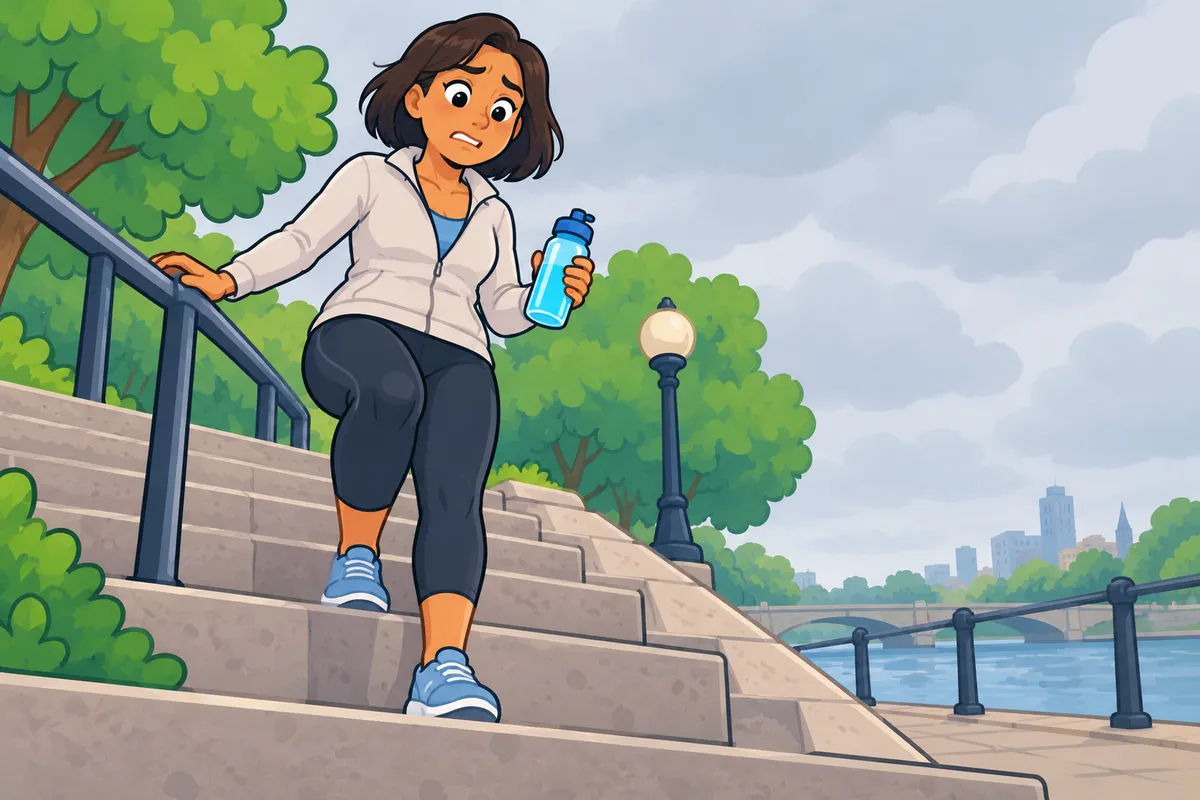
The workout felt fine. The next morning your legs were a little stiff, and today, two days later, the stairs are a project. That delay has a cause, and it is not the lactic acid most people blame.
Why Am I Sore Two Days After a Workout?
Because your muscles are repairing tiny damage, and the repair takes a day or two to build up. The same review puts the peak at 48 to 72 hours, which is why the day after can feel fine and day two does not.
You do not need to have trained hard. Any of these gives the muscle a load it is not used to:
- A new move
- A longer distance
- Simply a first session after a holiday
A 2003 review by Cheung, Hume and Maxwell adds that DOMS is most common when athletes return to training after a period of reduced activity, and when they first try certain activities, whatever the time of year.
What Is Delayed Onset Muscle Soreness?
It is a mild muscle injury at the level of single cells. The Hotfiel review describes it as "ultrastructural muscle damage" caused by eccentric or unfamiliar exercise, which then sets off protein breakdown, cell turnover and a local inflammatory response.
Signs of DOMS
5 items- reduced force capacities
- increased painful restriction of movement
- stiffness
- swelling
- dysfunction of adjacent joints
Eccentric means the muscle lengthens while it works. Three everyday cases:
- Your thighs braking you on a downhill run.
- Your arms lowering a dumbbell.
- Your calves landing from a jump.
Cheung's review says eccentric work causes micro-injury more often and more severely than other kinds of muscle action.
Why Is Muscle Soreness Worse on the Second Day?
Because the pain comes from the repair, and the repair builds after the workout ends. The Hotfiel review puts the delay down to "complex sequences of local and systemic physiological responses": the damage happens during the session, the inflammation that makes it hurt peaks later.
| Time after the workout | What you usually feel | What the research says |
|---|---|---|
| During and just after | Tired muscles, little pain | The micro-damage happens now (Hotfiel) |
| About 24 hours | Stiff and tender | Soreness was already measurable in the Cochrane trials |
| 48 to 72 hours | The worst of it | Peak soreness (Hotfiel) |
| 96 hours | Easing, often still tender | Still measurable in some trials (Bleakley, Cochrane) |
Sources: Hotfiel 2018; Bleakley and colleagues, Cochrane, 2012, whose trials measured soreness at 24, 48, 72 and 96 hours.
Is Lactic Acid the Cause of Muscle Soreness?
No. A classic experiment separated the two, and found soreness with no rise in lactic acid at all. Cheung's review still lists lactic acid among six old theories, but the evidence points to muscle damage and inflammation instead.
- 45 min
- of treadmill running, once level and once downhill
- −10 %
- slope of the downhill run
- 72 h
- of soreness checks after each run
In that 1983 study, Schwane and colleagues had people run 45 minutes on the level and 45 minutes downhill. Lactic acid rose on the level run, yet people were not sore afterwards; it never rose on the downhill run, yet people were clearly sore.
Downhill running produced soreness with no rise in lactic acid, so the soreness has to come from somewhere else: the lengthening, braking work of the muscles.
How Long Does Muscle Soreness Last?
Usually a few days. It builds over the first day, peaks at 48 to 72 hours, and then eases; in the trials pooled by the Cochrane review on cold water, soreness was still measurable at 96 hours, four days out.
The bigger and newer the load, the worse it gets: Cheung's review names the intensity and duration of exercise as important factors. A repeat of the same session a week later usually hurts far less, for reasons explained further down.
Does Sore Mean You Had a Good Workout?
No. Hotfiel and colleagues call DOMS "a mild type of injury", and one of the most common reasons for compromised sporting performance. Soreness tells you the muscle met a load it was not used to; it does not score how effective the session was.
Cheung's review makes the performance cost concrete: DOMS reduces joint range of motion, shock absorption and peak torque. A day-two squat is weaker and stiffer than a day-zero squat, which is the reason to plan around it instead of testing it.
What Actually Helps Sore Muscles?
Moving gently helps for a while, and time does the rest. Researchers have tested many popular remedies in randomized trials, and the results are smaller than their reputations.
Remedies for DOMS, by what the reviews found
Light exercise
Most effective, briefly
- Eases the pain while you move (Cheung)
- The relief is temporary
Suits you if You want to feel looser today
Stretching
Barely changes it
- 12 studies, one with 2,377 people
- About 1 point less pain out of 100
Suits you if You enjoy it for its own sake
Cold-water immersion
Some low-quality evidence
- 17 small trials, 366 people
- Water below 59 °F (15 °C) in those trials
Suits you if You are healthy and want to try it after a hard session
Massage
Helps early, then fades
- Benefit at 0 to 24 hours in a 2026 pooled analysis
- Effects mostly gone by 48 to 72 hours
Suits you if You have access to it and like it
Light Exercise
It is the best short-term pain relief. Cheung's review calls exercise "the most effective means of alleviating pain during DOMS", while warning that the effect is temporary; a 20-minute easy bike ride or walk loosens you up, and the ache returns later.
Does Stretching Help Sore Muscles?
Hardly at all. The Cochrane review by Herbert and colleagues pooled 12 studies and converted soreness to a 100-point scale; the reductions were tiny.
The first two results are not even statistically significant: their confidence intervals run from about 11 points less soreness to 10 points more. Only the large field trial, with 2,377 people, found a significant effect, and the authors call it very small.
The authors concluded that stretching "does not produce clinically important reductions" in soreness in healthy adults. Stretch if you like how it feels, but do not count on it to prevent day-two pain.
Cold Water and Ice Baths
The evidence is better than for stretching, but weak. The Cochrane review by Bleakley and colleagues found "some evidence" that cold-water immersion reduces DOMS compared with rest, from 17 small trials of low quality, most of which did not watch for side effects. People with heart or circulation problems should ask a doctor before trying it.
Massage
Massage helps early and then fades. A 2026 network meta-analysis of post-exercise recovery found:
- Massage and cold-water immersion both eased soreness straight after exercise and at 24 hours.
- Active recovery was better for restoring jumping power.
- By 48 to 72 hours most effects had diminished, though cold-water immersion was still linked to lower soreness at 48 hours.
Pain Relievers
Cheung's review reports that anti-inflammatory drugs showed dose-dependent effects that may also depend on when they are taken. That is a reason to ask a pharmacist before reaching for a pill after every hard session, especially if you take other medicines or have a stomach, kidney or heart condition.
Should You Work Out When You Are Still Sore?
Yes, lighter, or train a different body part. For athletes who train daily, Cheung's review advises two options for 1 to 2 days after a session that caused DOMS:
- Cut the intensity and length of sessions.
- Work less affected muscles meanwhile.
The reason is mechanics as well as pain. DOMS reduces your range of motion, shock absorption and peak force, and the review warns that the body compensates by changing how muscles fire, which can put unaccustomed stress on ligaments and tendons if you go back to full effort too soon.
Why Am I Less Sore the Second Time I Do a Workout?
Because one bout of eccentric exercise protects your muscles from the next. Scientists call it the repeated bout effect: McHugh's 2003 review describes how a single bout makes the muscle less prone to damage in later bouts, through changes in three places.
- Nerves: some evidence that the body recruits more slow-twitch muscle fibers.
- Muscle stiffness: both dynamic and passive stiffness increase with eccentric training.
- Muscle cells: the muscle adds sarcomeres lengthwise, and the inflammatory response changes so that damage spreads less.
McHugh adds that no single theory explains the protection yet. That is still the strongest tool you have: Cheung's review advises bringing in eccentric exercise or new activities progressively over 1 or 2 weeks, so the first light session does the protecting and the hard sessions that follow cause far less soreness.

Where Sleep and Water Fit In
Recovery happens around the clock, and sleep is part of it. The CDC's adult minimum of 7 hours a night applies on training days too, and a string of 6-hour nights leaves you slower even when you feel fine.
Muscle cramps during or straight after a session are a different problem from soreness two days later, and have different causes. For soreness, drinking enough simply keeps the rest of your recovery on track.
Easy Days, Lighter Sets, Then Back to Normal
Sore today? Plan the next three days
- Day 1 to 2: easy movement such as a walk or an easy ride
- Train other muscles, or go lighter and shorter (Cheung)
- Day 3 to 4: back to normal once the stiffness has gone
- Dark urine or pain that keeps getting worse: get checked
Common Questions
Is foam rolling worth it after a workout?
A little. A 2019 meta-analysis of 7 small studies in healthy, active people found rolling after exercise cut perceived muscle pain by about 6 %, and judged foam rolling more useful as a warm-up.
Is heat or ice better for sore muscles?
Heat, early on, though few trials tested it. A 2022 network meta-analysis of 59 small trials ranked a hot pack used within an hour of exercise first for pain in the first two days, and cold packs far lower.
General information for healthy adults, not medical advice. If a doctor has set your fluid amount, follow that.

More in Sleep and Recovery



Sources
- Sportverletzung Sportschaden (Hotfiel and colleagues). Advances in Delayed-Onset Muscle Soreness (DOMS): Part I: Pathogenesis and Diagnostics, 2018.
- Sports Medicine (Cheung, Hume and Maxwell). Delayed onset muscle soreness: treatment strategies and performance factors, 2003.
- The Physician and Sportsmedicine (Schwane and colleagues). Is Lactic Acid Related to Delayed-Onset Muscle Soreness?, 1983.
- Cochrane Database of Systematic Reviews (Herbert, de Noronha and Kamper). Stretching to prevent or reduce muscle soreness after exercise, 2011.
- Cochrane Database of Systematic Reviews (Bleakley and colleagues). Cold-water immersion (cryotherapy) for preventing and treating muscle soreness after exercise, 2012.
- Scandinavian Journal of Medicine and Science in Sports (McHugh). Recent advances in the understanding of the repeated bout effect: the protective effect against muscle damage from a single bout of eccentric exercise, 2003.
- Healthcare (network meta-analysis of post-exercise recovery strategies). Acute and Delayed Effects of Post-Exercise Recovery Strategies on Explosive Performance and Markers of Muscle Damage: A Systematic Review and Network Meta-Analysis, 2026.
- CDC, National Institute for Occupational Safety and Health. Heat-related Illnesses, 2024.
- Frontiers in Physiology (Wiewelhove and colleagues). A Meta-Analysis of the Effects of Foam Rolling on Performance and Recovery, 2019.
- Journal of Rehabilitation Medicine (Wang and colleagues). Effect of cold and heat therapies on pain relief in patients with delayed onset muscle soreness: A network meta-analysis, 2022.
Sources checked by the Glubbo Editorial Team on Oct 19, 2026. General information, not medical advice. How we write and check our guides.

