Food and Electrolytes · Electrolytes and Minerals
How Much Sodium Per Day: Limits, Teaspoons of Salt and Label Numbers
The daily sodium limit for adults and children, what it means in salt, and how to check it on a label.
 By the Glubbo Editorial Team · Updated Oct 19, 2026 · 9 min read
On This Page
- How Much Sodium Should You Have a Day?
- How Much Salt Is 2,300 mg of Sodium?
- Is 1,500 mg of Sodium a Day Enough?
- Does Cutting Sodium Lower Blood Pressure?
- How Much Sodium Should a Child Have a Day?
- How Do You Read Sodium on a Food Label?
- Where Does Most of Your Sodium Come From?
- Cut Your Sodium Starting With Tomorrow's Lunch
- Common Questions
- Sources
Short answer
Stay under 2,300 mg of sodium a day.
- 2,300 mg is about 1 teaspoon of table salt; the WHO sets its line lower, at 2,000 mg.
- Your body needs far less: the adequate intake for adults is 1,500 mg.
- On a label, 5 % DV or less per serving is low and 20 % or more is high.
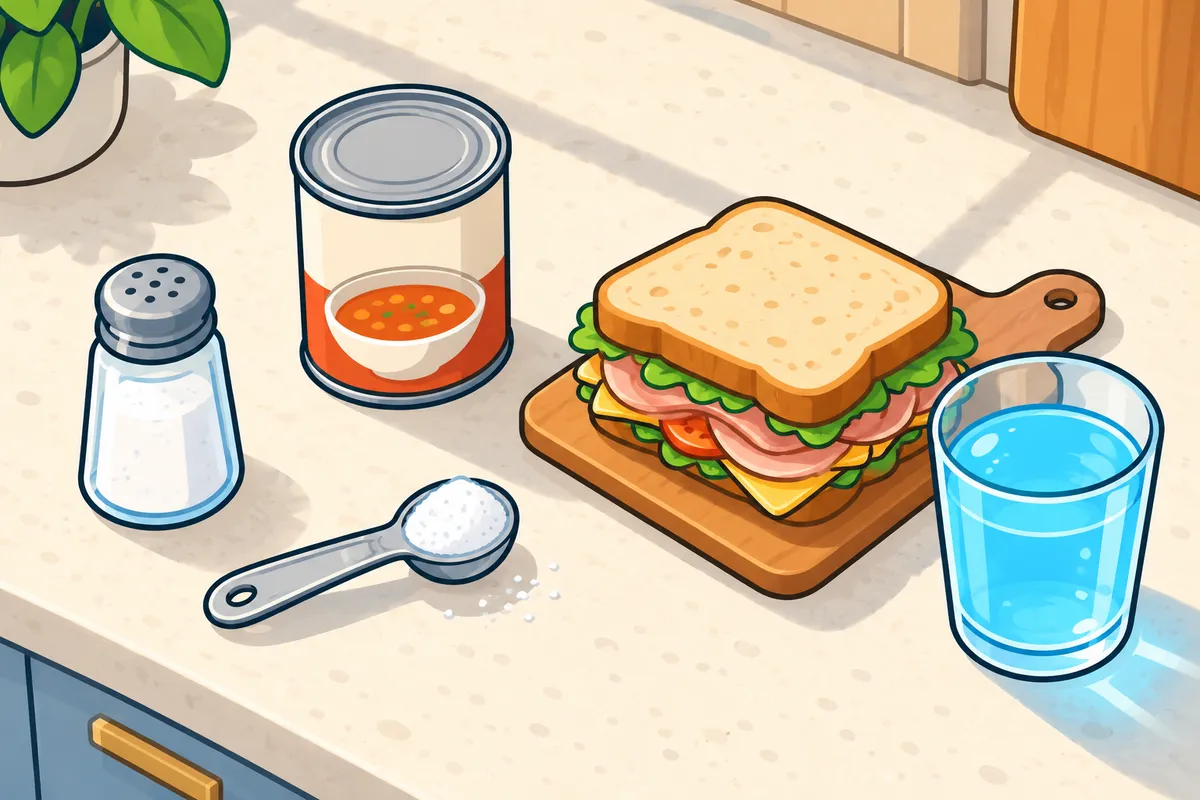
Keep sodium under 2,300 mg a day, which is about one teaspoon of table salt. Most of it never comes out of your salt shaker: it is already in the bread, the soup and the sandwich.
One teaspoon of salt holds about as much sodium as US guidance allows you in a whole day, so the numbers add up faster than the shaker suggests.
How Much Sodium Should You Have a Day?
Less than 2,300 mg if you are 14 or older. The Dietary Guidelines for Americans, 2025–2030 set that limit, and the FDA uses the same number as the Daily Value on food labels. The World Health Organization draws its line a little lower, at under 2,000 mg.
- 2,300 mg
- US limit for ages 14 and older
- 2,000 mg
- WHO limit for adults
- 1,500 mg
- adequate intake for adults
- 3,400 mg
- what Americans eat on an average day
The FDA puts the average American day at about 3,400 mg, and the CDC gives "more than 3,300 mg". Either way, that is about 1,000 mg over the limit, close to half a teaspoon of salt too much every day.
Why Two Different Limits?
The two numbers come from two expert bodies weighing the same evidence. The US limit is the National Academies' chronic disease risk reduction intake: cutting sodium that runs above 2,300 mg is expected to lower the risk of heart disease and high blood pressure.
The WHO sets its line at 2,000 mg and adds that almost every population eats too much. Its fact sheet gives a global average of 4,278 mg a day in 2021, more than double that line.
Too much sodium raises blood pressure, and the CDC links that to a higher risk of heart disease and stroke. Most of the extra arrives in packaged food, not from the shaker. If you aim under 2,300 mg, you are inside every limit above except the WHO's 2,000 mg.
How Much Salt Is 2,300 mg of Sodium?
About one teaspoon of table salt, per the FDA. Salt is not all sodium: the WHO's converter says 1 g of salt holds 400 mg of sodium, so salt weighs two and a half times its sodium. The WHO's own 2,000 mg line works out to 5 g of salt, "just under a teaspoon".
| Salt | Sodium in it |
|---|---|
| 1 g | 400 mg |
| 2.5 g | 1,000 mg |
| 3.75 g | 1,500 mg |
| 5 g | 2,000 mg |
| 5.75 g | 2,300 mg |
| 8.5 g | 3,400 mg |
Labels in the US list sodium, but many recipes and some foreign labels list salt. To switch, use the WHO's factor.
Turn Salt Into Sodium and Back
- Grams of salt × 400 = mg of sodium
- Example: 1.5 g of salt per serving is 600 mg of sodium
- mg of sodium × 2.5 = mg of salt
- Keep the day's sodium under 2,300 mg, about 5.75 g of salt
A half teaspoon of salt sprinkled over a pan of pasta adds about 1,150 mg of sodium, half the FDA teaspoon. Split four ways, each plate gets close to 290 mg from that pinch alone.
Is 1,500 mg of Sodium a Day Enough?
Yes for healthy adults. The National Academies set the adequate intake at 1,500 mg a day for everyone 14 and older, based on the lowest intakes tested in trials that showed no sign of deficiency. The WHO adds that sodium deficiency is "extremely unlikely in healthy individuals".
The National Academies also say "there is no concern of sodium inadequacy in the population", because most people in the US and Canada eat more than both the adequate intake and the limit. Their 2019 report highlights add that cutting below 2,300 mg can lower blood pressure further, though the effect on disease risk below that line has not been measured. The same report sets the day's potassium at 2,600 mg for women and 3,400 mg for men, and most adults fall a few hundred milligrams short of it.
When You Sweat for Hours
Long, sweaty days are the exception the guidelines name. They say "highly active individuals may benefit from increased sodium intake to offset sweat losses".
The American Heart Association adds that its 1,500 mg goal may not apply to people who lose big amounts of sodium in sweat, such as competitive athletes and workers in major heat stress.
How much depends on how long and how salty you sweat, and whether a long session calls for an electrolyte drink is the place to work that out. For a workout under an hour, a normal meal afterwards covers it. A daily electrolyte mix works the other way, adding up to 1,000 mg of sodium a serving to a day already over the line.
Pickles show how fast sodium adds up: a large dill pickle holds 1,092 mg, and a small sip of pickle juice can hold over 1,500 mg, yet in the lab its effect on a cramp came too fast for that salt to matter.

Does Cutting Sodium Lower Blood Pressure?
For most people, yes. The American Heart Association says cutting back by 1,000 mg a day can improve blood pressure, with 2,300 mg as the ceiling and an optimal goal of 1,500 mg for most adults. The National Academies add that the effect on disease risk below 2,300 mg has not been measured.
A 1,000 mg cut is easier to find than it sounds. Skipping one cup of canned chicken noodle soup (831 mg) and a half cup of jarred pasta sauce (577 mg) removes 1,408 mg. If you have high blood pressure, heart failure or kidney disease, follow the number your doctor sets, which may be lower than any of these.
How Much Sodium Should a Child Have a Day?
Less than an adult, by age. The Dietary Guidelines give under 1,200 mg for ages 1 to 3, under 1,500 mg for ages 4 to 8 and under 1,800 mg for ages 9 to 13. From 14, the adult limit of 2,300 mg applies.
The CDC's list for children ages 1 to 17 names savory snacks such as chips, crackers and popcorn, deli meat sandwiches, pizza, soups, pasta dishes, breads, cheese and poultry. A lunchbox with a deli sandwich and a bag of chips holds two of them.
How Do You Read Sodium on a Food Label?
Look at the % Daily Value next to sodium. The FDA's rule of thumb is that 5 % DV or less per serving is low and 20 % or more is high. Check the serving size too: if you eat the whole can and the label covers half, double the number.
What the front-of-pack words mean
4 items- Salt or sodium-free: less than 5 mg per serving
- Very low sodium: 35 mg or less per serving
- Low sodium: 140 mg or less per serving
- Reduced sodium: at least 25 % less than the regular product, which can still be a lot
"Reduced" needs the most care. A soup that started very salty is still salty with a quarter taken out, so read the milligrams, not the claim.

The label is the only way to compare two loaves of bread or two cans of beans. The same food can vary a lot by brand, and the sodium line takes a few seconds to read.
Pick the lower one when two products look the same, and over a week the difference adds up. Start with deli meat, bread and soup, all on the CDC's list of top sodium sources.
Where Does Most of Your Sodium Come From?
From food you did not salt yourself. The FDA says over 70 % of the sodium Americans eat comes from packaged and prepared foods, and the CDC says "most sodium comes from processed and restaurant foods". Its list for adults reads like an ordinary week of meals.
- Deli meat sandwiches
- Pizza
- Chicken nuggets and tenders, and other poultry
- Soups
- Savoury snacks such as chips, crackers and popcorn
- Pasta dishes, breads, rolls and buns, and cheese
None of these taste very salty, which is the problem. Bread and cheese reach you several times a day, so a little sodium in each serving adds up.
How Much Sodium Is in Everyday Foods?
A teaspoon of table salt tops the chart at 2,325 mg, and a few foods sit surprisingly close to it. A tablespoon of soy sauce holds 879 mg and a cup of canned chicken noodle soup 831 mg, while a slice of bread holds 142 mg, so several small servings add up like one salty meal.
Cut Your Sodium Starting With Tomorrow's Lunch
The WHO's own list of ways to cut back starts in your kitchen. Pick the line that fits your week.
Your situation, your first change
- You buy lunch most daysSwap the deli sandwich for one you make, and read the bread's label
- You snack on chips or crackersFruit, plain nuts or yogurt for half your snacks
- You salt food before tasting itTake the salt shaker off the table
- Food tastes flat with less saltHerbs, spices, lemon or vinegar
- You have high blood pressure or kidney diseaseFollow the limit your doctor sets
- Read the sodium line on the three packaged foods you eat most.
- Choose "low sodium" (140 mg or less per serving) where a version exists.
- Cook one more meal a week at home and season it with herbs or lemon.
- Keep the day under 2,300 mg, about one teaspoon of salt in all.
Common Questions
Does kosher salt have less sodium than table salt?
Yes, per teaspoon: Diamond Crystal kosher salt lists 280 mg of sodium per ¼ teaspoon and Morton kosher salt 480 mg. A spoonful weighs less than table salt, but gram for gram it is still about 40 % sodium.
Does kosher salt contain iodine?
No, not usually. The NIH Office of Dietary Supplements says specialty salts such as kosher salt and sea salt are not usually iodized, and the package label says when a salt is iodized.
General information for healthy adults, not medical advice. If a doctor has set your fluid amount, follow that.

More in Food and Electrolytes


Sources
- US Food and Drug Administration. Sodium in Your Diet, 2024.
- US Department of Health and Human Services and US Department of Agriculture. Dietary Guidelines for Americans, 2025–2030, 2026.
- National Academies of Sciences, Engineering, and Medicine. Dietary Reference Intakes for Sodium and Potassium, Report Highlights, 2019.
- World Health Organization. Sodium reduction (fact sheet), 2025.
- American Heart Association. How much sodium should I eat per day?, 2025.
- USDA Agricultural Research Service, FoodData Central. SR Legacy entries for the foods in the sodium chart, 2019.
- Centers for Disease Control and Prevention. About Sodium and Health, 2026.
- USDA Agricultural Research Service, FoodData Central. Kosher salt, Diamond Crystal, label data (Branded 2571981), 2023.
- USDA Agricultural Research Service, FoodData Central. Kosher coarse salt, Morton, label data (Branded 2617978), 2023.
- NIH Office of Dietary Supplements. Iodine, Fact Sheet for Consumers, 2024.
Sources checked by the Glubbo Editorial Team on Oct 19, 2026. General information, not medical advice. How we write and check our guides.

