Food and Electrolytes · Water in Food
Is Watermelon Hydrating? Water, Potassium and Sugar per Slice
The water, potassium and sugar in each watermelon serving, the rind and the juice, and how it compares with water.
 By the Glubbo Editorial Team · Updated Nov 2, 2026 · 8 min read
On This Page
Short answer
Yes: watermelon is 91 % water and counts as fluid.
- A cup of diced watermelon gives you 139 g of water, a wedge 262 g (USDA).
- A wedge has 320 mg of potassium but only 3 mg of sodium, so it won't replace sweat salt.
- One juice study, 12 teenage boys: urine showed no difference from water.
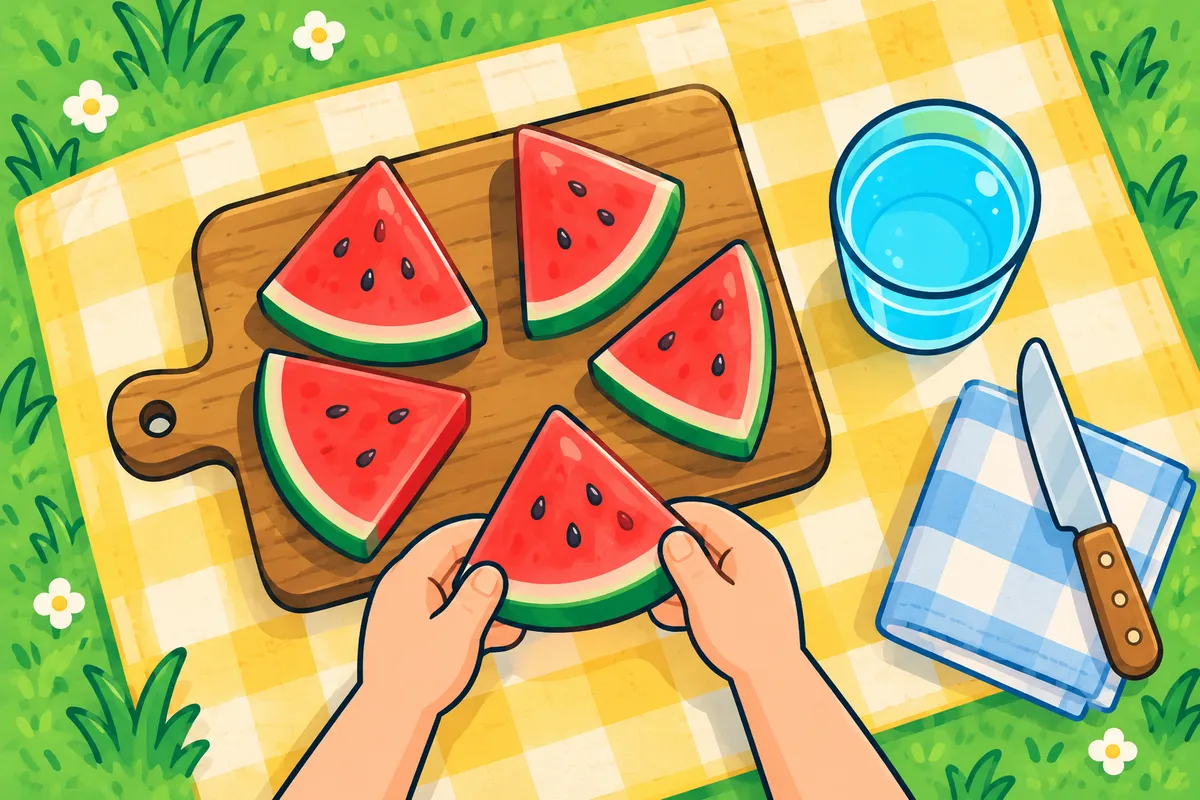
Yes. Watermelon is 91.45 g of water per 100 g in USDA FoodData Central, the figure most sites round to 92 %, and your body uses that water the same way it uses water from a glass. A cup of diced watermelon gives you about 139 g of water; a wedge gives you about 262 g, a little more than an 8 oz glass.
Watermelon supplies little sodium, and a wedge carries 18 g of sugar. The claim that it hydrates "better than water" rests on one small study of juice, which did not test eating the fruit.
Is Watermelon Hydrating?
Yes, gram for gram it is nine tenths water. The US National Academies treat water from food and from drinks as one supply: in their 2005 water report, water "regardless of form, is absorbed by the gastrointestinal tract and acts the same physiologically." So the 262 g of water in a wedge of watermelon counts toward your day exactly like 262 ml poured from a tap.
Food already supplies part of everyone's water. The Academies' water chapter puts it at about 19 % of total water in one US survey, about 20 % in another, and 28 % in a 1977–78 survey, so the share moves with what people ate that year.
Put the share into amounts. The Academies set total water at 2.7 L a day for women and 3.7 L for men aged 19 to 30, so 19 % from food is about 0.5 L and 0.7 L. One wedge of watermelon covers about half of a woman's usual water from food on its own.
A few foods hold even more water. Cucumber, celery and iceberg lettuce top the list of watery foods at about 95 %; watermelon leads the fruit.
How Much Water Is in a Cup of Watermelon?
About 139 g, close to 4.7 fl oz, in one cup of diced watermelon (152 g). That is a bit more than half of an 8 oz glass. A wedge, which USDA defines as one sixteenth of a melon, weighs 286 g and holds about 262 g of water, or 8.8 fl oz.
The serving you eat decides how much water you get, so here is each portion USDA weighs for watermelon, worked out from the record's values per 100 g:
| Serving (USDA portion) | Weight | Water | Sugar | Potassium | Calories |
|---|---|---|---|---|---|
| 10 melon balls | 122 g | 112 g (3.8 oz) | 7.6 g | 137 mg | 37 |
| 1 cup, diced | 152 g | 139 g (4.7 oz) | 9.4 g | 170 mg | 46 |
| 1 cup, balls | 154 g | 141 g (4.8 oz) | 9.5 g | 172 mg | 46 |
| Label serving | 280 g | 256 g (8.7 oz) | 17.4 g | 314 mg | 84 |
| 1 wedge, 1/16 of a melon | 286 g | 262 g (8.8 oz) | 17.7 g | 320 mg | 86 |
| Whole melon, 15 × 7½ in | 4,518 g | 4,132 g (140 oz) | 280 g | 5,060 mg | 1,355 |
Source: USDA FoodData Central, watermelon, raw, SR Legacy 167765, portions and nutrients per 100 g; a gram of water is about a milliliter.
A whole 15-inch melon holds about 4.1 liters of water, more than a man's full daily total, which is why one melon can feed a crowd's water as well as its dessert.

How Much Is One Serving of Watermelon?
On a US food label, one serving of watermelon is 280 g, a little under two cups of diced fruit. That serving holds about 256 g of water, 17.4 g of sugar and 84 calories in USDA's figures. At home most people eat a cup of cubes or one wedge, and the wedge is almost the same size as the label serving.
Is Watermelon Rind Hydrating?
Yes, the white rind is even wetter than the red flesh. USDA's newest samples measured the rind at 94.66 g of water per 100 g against 90.91 g for the flesh, and the rind carries about a third of the sugar and more than twice the potassium.
Red flesh, per 100 g
- 90.91 g of water
- 7.2 g of sugar
- 117 mg of potassium
White rind, per 100 g
- 94.66 g of water
- 2.2 g of sugar
- 273 mg of potassium
Few people eat the rind raw; it turns up pickled, in stir-fries or blended into drinks. If you pickle it, the brine adds salt, so treat pickled rind as a salty snack, not a watery one.
Is Watermelon More Hydrating Than Water?
The one study this page found that compared watermelon with water tested juice, not the fruit, in 12 teenage boys, and it was not randomized. It cannot say whether eating watermelon hydrates better than drinking water.
Gram for gram, plain water brings more, since a tenth of watermelon's weight is sugar, fiber and other solids: matching the water in a 16.9 oz (500 ml) bottle takes about 547 g of watermelon, or 3.6 cups.
The study appeared in 2024 in the Journal of Kerman University of Medical Sciences. Each boy ran two 30-minute treadmill sets until he lost about 2 % of his body weight, then drank water, a carbohydrate drink or watermelon juice equal to 125 % of that loss, on three visits a week apart. The group was only boys who train, and the paper gives no direct juice-versus-water result.
The paper reports two results:
- Body weight regained after the drink was greater after the juice and the carbohydrate drink than after plain water (P = 0.001).
- Urine specific gravity, a measure of urine concentration, showed no significant difference between the three drinks (P = 0.41).
Neither result settles whether eating watermelon hydrates better than drinking water.
What Other Drink Tests Show
In lab tests, drinks that carry some sugar, salt or protein stay in the body a little longer than plain water, and the 13 drinks in that 2016 test did not include watermelon. For everyday thirst, the difference is too small to matter.
Is Watermelon a Diuretic?
No study shows that watermelon makes you lose more fluid than it brings. It does add water, and like any water you take in beyond what you need, the extra leaves as urine. Peeing after a big bowl of watermelon means your kidneys are balancing the water, not that the fruit is drying you out.
Does Watermelon Have Electrolytes?
Some, mostly potassium. One wedge brings about 320 mg of potassium, 29 mg of magnesium and 20 mg of calcium, but only about 3 mg of sodium, per USDA's values for raw watermelon. Sodium is the mineral you sweat out most, so watermelon is no electrolyte drink.
Watermelon supplies little sodium. If you sweat heavily for hours, read about the salt you lose in sweat.
If your doctor has told you to limit potassium, for example because of kidney disease, count a wedge as 320 mg and follow that limit. The foods that carry the most potassium bring far more per serving, so watermelon is a modest source.
Is Watermelon High in Sugar?
Moderately. USDA lists 6.2 g of sugar per 100 g, so a cup of cubes has 9.4 g and a wedge 17.7 g. More than half of it is fructose (3.36 g per 100 g), the rest glucose and sucrose.
All of it is natural sugar from whole fruit, which food labels do not count as added sugar.
The amount builds up because watermelon is easy to eat in bulk. Three wedges on a hot afternoon add about 53 g of sugar along with 785 g of water.
Whole fruit still sits in a different place than sweet drinks. Its sugar comes with water, potassium and a little fiber, and the sugar in whole fruit does not count toward the added-sugar limit that health bodies set.

Is Watermelon Juice Hydrating?
Yes. USDA's survey database lists 100 % watermelon juice at the same 91.45 g of water per 100 g as the raw fruit, and a glass of it is easy to finish. You lose the chewing, though, so a few gulps can carry the sugar of a whole wedge.
Bottled "watermelon water" is pressed juice under another name. Read the label for added sugar and for the percentage of juice, since some bottles are a juice drink diluted with water and sweeteners.
Count the juice the way you would log any glass of 100 % juice, at its full volume. The fruit itself you can leave out of your log, or add its water from the serving table, whichever keeps your tracking simple.
Serve Watermelon Safely on a Hot Day
Wash and cut it at home, keep the cut fruit cold, and put leftovers away fast. Pre-cut melons were linked to a 2019 Salmonella outbreak with 137 illnesses in 10 states, the CDC reported.
The FDA says to scrub firm produce such as melons with a clean produce brush before cutting, even though you will not eat the skin. The knife otherwise carries dirt from the rind into the flesh. The CDC's advice for cut fruit is to refrigerate it within 2 hours, or within 1 hour above 90°F.
From whole melon to a safe summer snack
- Scrub the rind under running water with a clean brush
- Cut on a clean board, then wedge or cube it
- Chill the cut fruit in a covered container
- Keep it cold until you serve it
- Back in the fridge within 2 hours, 1 hour above 90°F
For a cooler at the beach or a game, pack the cubes in a sealed tub on ice and bring the water bottles in the same cooler. Eat the watermelon early, while it is still cold, and drink the water through the afternoon.
Common Questions
Is watermelon good for dehydration?
Yes for ordinary thirst on a hot day, since most of it is water, but it brings almost no salt. After hours of heavy sweating, pair it with a drink or snack that puts sodium back.
Is watermelon high in calories?
No. Going by USDA figures for raw watermelon, a whole pound of cubes comes to only about 136 calories.
General information for healthy adults, not medical advice. If a doctor has set your fluid amount, follow that.

More in Food and Electrolytes


Sources
- USDA Agricultural Research Service, FoodData Central. Watermelon, raw (SR Legacy 167765), 2019.
- USDA Agricultural Research Service, FoodData Central. Watermelon, seedless, flesh only, raw (Foundation 2747675), 2025.
- USDA Agricultural Research Service, FoodData Central. Watermelon, seedless, rind only, raw (Foundation 2747676), 2025.
- USDA Agricultural Research Service, FoodData Central. Watermelon juice, 100% (Survey FNDDS 2709333), 2024.
- Institute of Medicine (National Academies). Dietary Reference Intakes for Water, Potassium, Sodium, Chloride, and Sulfate, Chapter 4: Water, 2005.
- Journal of Kerman University of Medical Sciences (Mohammadnia Ahmadi and others). Effect of Watermelon Juice Compared to Carbohydrate Drinks on Rehydration and Anaerobic Performance in Active Male Adolescents, 2024.
- US Food and Drug Administration. Selecting and Serving Produce Safely, 2024.
- Centers for Disease Control and Prevention. Outbreak of Salmonella Infections Linked to Pre-Cut Melons (final update), 2019.
Sources checked by the Glubbo Editorial Team on Nov 2, 2026. General information, not medical advice. How we write and check our guides.

